| Jazz |
Summary: Kevin Sun’s two new albums, Kevin Sun I and II, offer an ambitious journey between complex jazz, reflection and improvisation, ahead of his Brooklyn launch concert.
Kevin Sun I & II: A Saxophonist Turns Jazz Into an Inner Journey
Kevin Sun does not make music designed to bring everyone to the same conclusion, and that may be the first thing worth understanding before approaching Kevin Sun I and Kevin Sun II. These two albums are much more interesting when considered not as a conventional double album, but as two sides of the same artistic personality. There is something in Sun’s approach to the saxophone that recalls the uncompromising spirit of musicians such as Satoko Fujii on piano or Wadada Leo Smith on trumpet, artists who have never seemed particularly interested in beginning with the question of what an audience expects to hear. Their music starts somewhere else, with an idea, a sensation or a musical possibility, and then follows that impulse wherever it happens to lead.
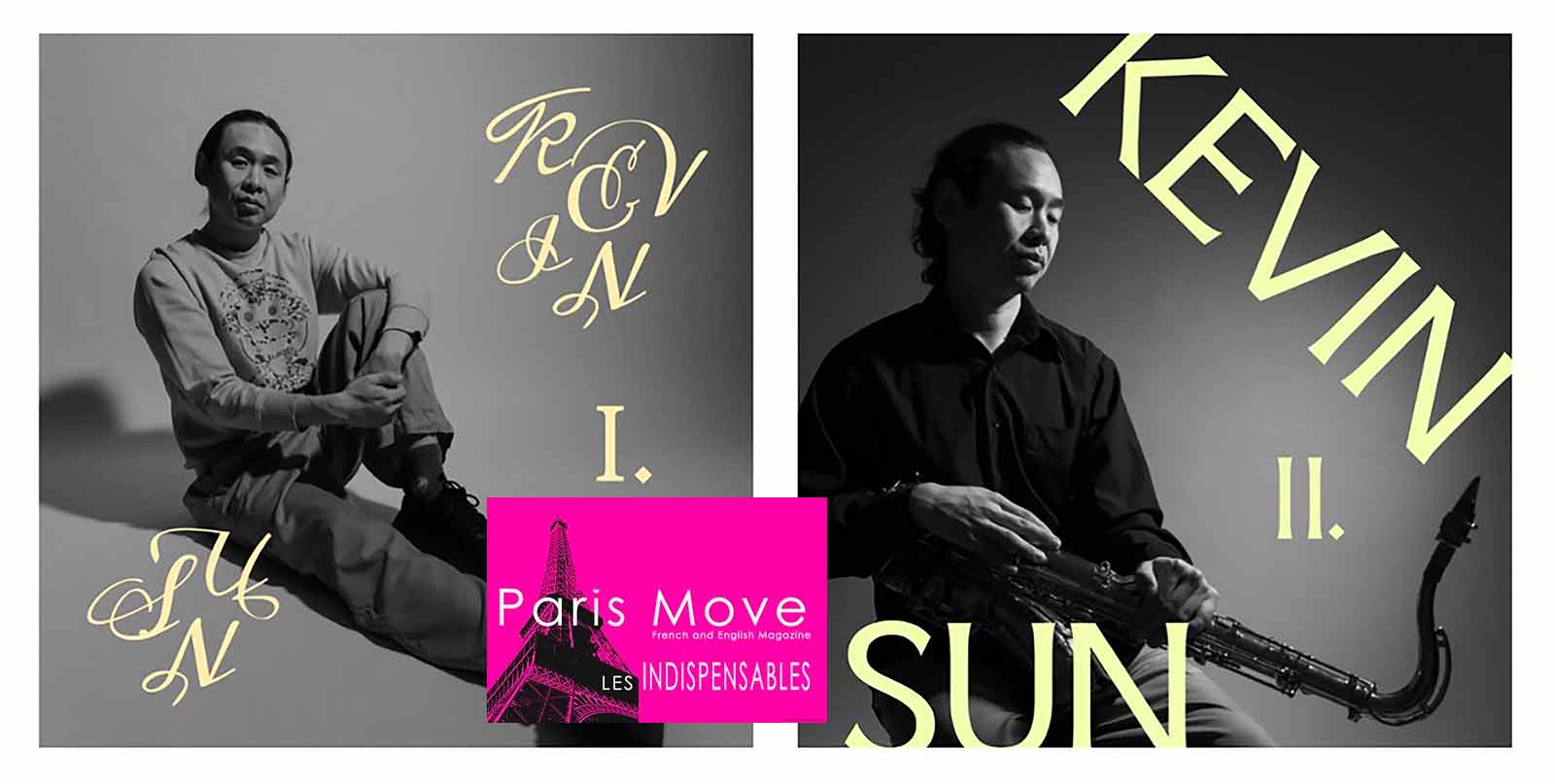
With Kevin Sun, that journey has produced two records that look at the same person from different directions. Kevin Sun I is more active, restless and exploratory, while Kevin Sun II leaves more room for reflection, atmosphere and poetry. Yet the distinction is never absolute, because neither record really exists in isolation from the other. Together, they form a much larger portrait, one in which the listener gradually discovers that the two albums are not simply different collections of songs, but two perspectives on the same creative mind. Sun himself has resisted the idea of describing the project as a conventional double album, comparing the records instead to two video games taking place in the same universe, each with its own style and its own cast of characters. It is an unusual comparison, but a surprisingly accurate one, because either album can be heard first and each can stand on its own, while listening to both inevitably changes the way the other is perceived.
There is also something deeply human about that structure. None of us moves through an entire day in a single emotional state, even though we often like to imagine that we do. We can be energetic in the morning, distracted by noon, impatient in the afternoon and unexpectedly contemplative at night, with a conversation, a memory, a piece of news or something as simple as a walk through the city capable of changing our mood completely. We are constantly moving between action and reflection, confidence and doubt, concentration and distraction, and the person who leaves home in the morning is not necessarily the same person who returns in the evening. Sun has transformed that familiar human instability into an artistic proposition, giving each album a different relationship to the same inner world.
For that reason, I found it particularly rewarding not to treat the records as two separate journeys, but to move between them. Listening to a track from Kevin Sun I and then following it with a piece from Kevin Sun II, before reversing the process and allowing the sequence to change according to instinct, produces an experience that is surprisingly intimate. The music gradually stops feeling like a collection of compositions and begins to resemble an interior conversation, a passage through different states of mind in which the listener is free to establish connections that may not have been obvious at first. The albums become a kind of mirror, and what they reflect depends to some extent on the person standing in front of it.
The musicians are essential to that experience. Kevin Sun I is a carefully constructed studio recording featuring guitarist Max Light, bassist Walter Stinson and drummer Jon Starks, and the material benefits from the extended period during which the quartet developed it through regular performances. That history can be heard in the way the musicians navigate Sun’s compositions, which can be demanding in terms of harmony, rhythm and structure without ever giving the impression that the players are fighting their way through the score. The complexity has been absorbed into the language of the group, transformed into something physical and conversational rather than merely intellectual.
Kevin Sun II comes from a somewhat different place. Sun is joined again by Walter Stinson, this time with pianist Christian Li and drummer Kayvon Gordon, and the recording followed a week of touring. That context matters because there is a particular quality that develops when musicians have spent time performing together, learning not only the written material but also the small signals and reactions that allow a group to move instinctively when the music changes direction. The two albums consequently share the same creative DNA while allowing their respective quartets to give the material different personalities, which is one of the reasons the project feels larger than a simple collection of studio sessions.
Sun is also refreshingly clear about what he is not trying to accomplish. Eclecticism, he has explained, is not the goal simply for the sake of appearing eclectic; he genuinely likes many different kinds of music, and each composition carries a personal meaning for him. That distinction is important because contemporary jazz can sometimes become so concerned with demonstrating intellectual sophistication that the human reason for making the music disappears behind the technique. Sun’s compositions can certainly be technically demanding, but the technique does not appear to be the subject. It is a means of reaching somewhere else.
That becomes immediately apparent in “Go In,” the opening track and first single from Kevin Sun I. The saxophonist moves through cascading harmonies and constantly changing meters with a confidence that makes the piece sound considerably easier than it probably is. Sun has explained that the composition began with John Coltrane’s “Countdown,” itself a famously dense piece of harmonic writing, before being pushed further through additional metric changes. By his own account, it is probably the most complicated piece he has written in terms of its notation, yet that complexity is almost beside the point once the quartet begins to play. What matters is that the musicians make the music feel natural, allowing the listener to hear the movement rather than the machinery underneath it.
Of course, natural is a relative word. For anyone already familiar with the language of contemporary jazz, “Go In” can be exhilarating, but for a listener approaching this vocabulary for the first time, it is unlikely to function as an easy introduction. The piece does not stop to explain itself, nor does it simplify its ideas in order to make the listener feel immediately at home. Instead, Sun seems to trust that a listener can remain curious even when everything is not immediately understood. The first encounter may be disorienting, but another listening can reveal a rhythmic detail that went unnoticed before, while a later encounter may make a harmonic turn suddenly seem inevitable. The pleasure comes partly from that gradual process of discovery.
The same openness can be heard throughout the repertoire of the two records. Sun moves between his own compositions and music that has clearly mattered to him, including his treatment of Ryuichi Sakamoto’s “Chanson” and Angelo Badalamenti’s “Laura Palmer’s Theme,” the haunting composition associated with Twin Peaks. These choices reveal something about the musician without requiring him to explain himself, because he does not appear particularly interested in maintaining a strict boundary between so-called serious jazz and the other music that has entered his life. Everything can become material for investigation, transformation and reinterpretation, provided that the connection is genuine.
There is an important difference between collecting influences and having a conversation with them, and Sun appears much more interested in the latter. He takes music that has meant something to him and asks what it might become when filtered through his own musical language and through the personalities of the musicians around him. That is why the albums never feel like a catalogue of references, even when the references are obvious. The music is continually being reshaped, and the result belongs to Sun without pretending that it emerged from nowhere.
That quality is also what makes the two quartets so important. They are not simply interchangeable groups brought together to perform predetermined material; each ensemble changes the character of the music. Max Light’s guitar gives Kevin Sun I a particular harmonic color and texture, while Christian Li’s piano creates a different kind of space on Kevin Sun II. Walter Stinson provides a thread connecting the two recordings, while Jon Starks and Kayvon Gordon give the respective rhythm sections distinctly different personalities. Listening carefully, it becomes clear that Sun is interested not only in writing compositions but in creating circumstances in which musicians can respond to one another, with the written material establishing a framework while still leaving enough space for individual voices to emerge.
This is where it becomes tempting to talk too much about difficulty, technique and influences, because all three are undeniably present in the music. Yet they are not really the heart of the story. What makes Kevin Sun I and Kevin Sun II compelling is that they reward attention because they treat the listener as an active participant rather than as a passive consumer. These are not records that disappear comfortably into the background while something else is happening in the room. They require a degree of concentration, and at times they may even require patience, but that demand is precisely what allows the music to reveal more of itself with repeated listening.
In an era when so much music is expected to reveal its identity within the first few seconds, there is something refreshing about a project that refuses to hurry. Sun gives the listener room to become familiar with the music instead of trying to win an immediate reaction. Some passages may seem difficult at first, some may feel elusive, and others may only reveal their emotional weight after several listens. That is not a barrier to the music; it is part of the relationship the music establishes with the listener.
Kevin Sun I and Kevin Sun II are therefore not really trying to settle the question of what contemporary jazz should sound like, nor are they designed to prove that Sun can write complicated music. They are more personal than that. They present two different perspectives on the same artistic identity and allow the listener to decide how those perspectives should fit together. One side is more concerned with movement and action, the other with reflection and atmosphere, but neither can fully exist without the other because both belong to the same person.
That makes the launch concert in Brooklyn particularly interesting. On Saturday, September 19, at Bar Bayeux, the music will leave the controlled environment of the recordings and return to the physical space where jazz ultimately makes the most sense: a room filled with people, musicians listening to one another in real time, and compositions that can change simply because the moment demands it. There is always a difference between hearing a carefully produced recording through headphones and standing in a room while musicians take the same material somewhere unexpected, and for Sun that difference may be especially important because these albums are built around movement, contrast and the relationship between structure and spontaneity.
The concert may therefore reveal another side of the project, one that cannot be completely captured on either recording. The carefully constructed architecture of the compositions will still be there, but so will the possibility of surprise, the small changes that occur when four musicians are responding to one another in the same room and the music is no longer fixed. For an artist who has divided this project into two complementary perspectives, the stage offers the possibility of bringing those perspectives back together in a single, living moment.
Perhaps that is ultimately the most useful way to approach Kevin Sun. Rather than asking which album is better, or which one represents the “real” musician, it makes more sense to accept that both are necessary. One looks outward toward movement, energy and action, while the other looks inward toward memory, reflection and the quieter spaces of the imagination. The tension between them is not a problem that needs to be resolved; it is the reason the project works.
Together, Kevin Sun I and Kevin Sun II create something much closer to a portrait of a human being than a simple pair of jazz albums. They suggest that identity is never as fixed as we like to believe, that several versions of ourselves can coexist without one making the others less authentic, and that music can sometimes reveal those contradictions more honestly than words can. Sun does not ask the listener to choose between the two sides of the mirror. He gives us both and leaves us to decide what we recognize when we look into them.
That may be the greatest strength of these recordings. They do not offer an easy answer, and they do not need to. They offer something more valuable: a reason to listen again, to change the order, to hear something differently the next time, and perhaps to recognize, somewhere inside the music, a version of our own constantly changing inner lives.
Thierry De Clemensat
Member at Jazz Journalists Association
USA correspondent for Paris-Move and ABS magazine
Editor in chief – Bayou Blue Radio, Bayou Blue News

PARIS-MOVE, September 1st, 2026
Follow PARIS-MOVE on X
::::::::::::::::::::::::
Album Release Concert on Saturday, September 19 at Bar Bayeux, Brookyn
Kevin Sun I :
Kevin Sun – tenor saxophone
Max Light – guitar
Walter Stinson – bass
Jon Starks – drums
Track Listing :
Go In
Scrollwork
Souls of Fire (A Moment’s Peace from DARK SOULS)
Forenoon
Between Night and Day
Hold Music
Bedrooms
Riot in Lagos
All songs composed by Kevin Sun (The Kevin Sun Music / ASCAP) except:
“Souls of Fire (A Moment’s Peace),” by Yuji Takenouchi
“Riot in Lagos,” by Ryuichi Sakamoto
Recorded and mixed by Andres Abenante at Jaybird Studio in Brooklyn, NY on November 11, 2024
Mastered by Brent Lambert at The Kitchen
Edited by Kevin Sun
Produced by Kevin Sun ⋅ Cover photo by Xavier Kim ⋅ Design by Diane Zhou
Kevin Sun II :
Kevin Sun – tenor saxophone
Christian Li – piano
Walter Stinson – bass
Kayvon Gordon – drums
Track Listing :
Unformed, Shrouded By Fog (Souls Prologue)
Souls Of Mist
Song No. 2
Laura Palmer’s Theme
Belong, Sonny
Forest Corridors III
Chanson
All songs composed by Kevin Sun (The Kevin Sun Music / ASCAP) except:
“Souls of Mist” by Shunsuke Kida
“Laura Palmer’s Theme” by Angelo Badalamenti
“Chanson” by Ryuichi Sakamoto
Recorded by Jason Obergfoll at the Terrarium in Minneapolis, MN on April 26, 2025
Mixed by Andres Abenante at Jaybird Studio
Mastered by Brent Lambert at The Kitchen
Produced by Kevin Sun ⋅ Cover photo by Xavier Kim ⋅ Design by Diane Zhou