| Jazz |
In a moment when many American jazz musicians are turning inward, seeking refuge in memory, autobiography, and the intimate stories that shaped them, Keith Oxman offers a quietly compelling example of what such introspection can sound like when it is filtered through decades of craft. His new album, Home, arriving after twelve releases on Capri Records, feels less like a continuation than a return: a return to formative landscapes, to the people who left traces on his life, to the kind of emotional territory that musicians often approach only when time has sharpened their perspective.
Home is an evocative title, but also an invitation. The album unfolds like a long conversation with an old friend, unhurried, warm, shaped by memories that have mellowed rather than aged. Each track points toward someone or something: a childhood companion, a family episode, a meaningful passage of adolescence. What emerges is an atmosphere of calm from the very outset, as if Oxman were opening a door into a room he has not visited in years, illuminated by familiar light.
Oxman’s presence in the jazz world dates back to the 1970s, placing him in the lineage of musicians who straddled the fading glow of the post-bop era and the restless, electrified experimentation that followed. His résumé reads like a secret history of late-century American jazz: a stint with Buddy Rich’s big band in 1986; stage time with Art Blakey, Sonny Stitt, Red Holloway, Pete Christlieb, Jack McDuff, Phil Woods, Dave Brubeck, Jon Hendricks, Louis Bellson, Pearl Bailey, The Temptations, and The Fifth Dimension. Two of his earlier records feature Curtis Fuller, John Coltrane’s trombonist, whose presence speaks volumes about the respect Oxman commands among musicians across generations.
For a fuller sense of his intellectual and musical world, one can turn to the May 2020 issue of DownBeat, in which the magazine commissioned an article from Oxman on the art of improvisation. The piece remains available here: https://downbeat.com/magazine/2020-05. Its clarity and generosity reveal as much about his artistic priorities as any performance could.
Oxman’s influence extends far beyond the bandstand. After eight consecutive years teaching instrumental music in the public schools of Colorado Springs, he has now spent roughly two decades at Denver’s East High School, shaping young musicians in a public-school system where resources are often scarce but passion is abundant. His career is, in many ways, a testament to the quiet but vital presence of educators who sustain jazz culture at its roots, long before students ever set foot in a conservatory or club. In a country where arts programs are often the first to be trimmed, Oxman’s dedication resonates like a political act, subtle yet steadfast.
Curiously, he has no personal website, an absence that feels almost metaphorical. Oxman has always been less concerned with self-promotion than with the work itself: teaching, composing, performing, contributing to the slow, steady ecosystem of American jazz. His biography exists scattered across liner notes, magazine pages, and the memories of colleagues and students, rather than in the centralized digital footprint so common today.
All the compositions on Home are his, and none of them feel didactic or overly constructed. Instead, Oxman writes with a kind of disciplined candor, as though shedding the last remains of self-consciousness. The complexity lies not in harmonic labyrinths but in the ensemble’s precision, the way each rhythmic gesture and melodic contour clicks into place. The structures follow a logic that borders on the mathematical, but the result is anything but cold. This is music that breathes, that imagines, that paints scenes with a clarity that listeners of all backgrounds can access.
There is nostalgia, to be sure, but it is not nostalgia that clouds. It clarifies. It becomes a lens through which Oxman reclaims the language of his predecessors, the generations of jazz musicians whose accumulated knowledge he distills into something unshowy and deeply humane. Listening to Home, one senses the ease of a musician who has nothing to prove except the enduring relevance of sincerity.
Jazz lovers will recognize the familiar architecture: solid forms, elegant progressions, melodic lines that define identity as much as aesthetics. The guitar lines frame the space; the saxophone moves through it like a central character, narrating a story that is at once personal and archetypal. At certain moments, the experience becomes almost cinematic, as if the album were an unmade film. One could imagine François Truffaut inhabiting this world, sensitive to gesture, memory, and small human truths, capturing the subtle magic of Oxman’s compositions.
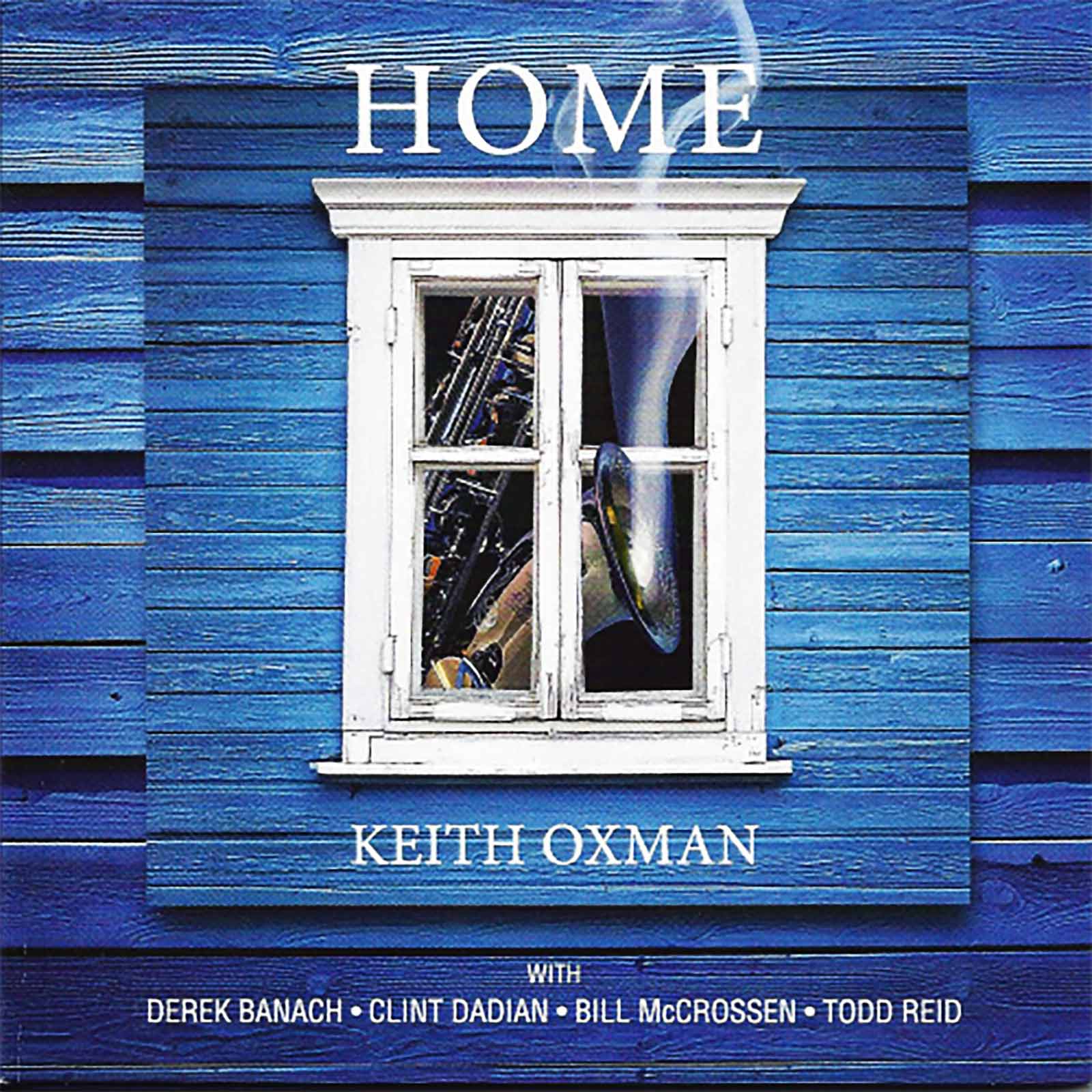
Even the album’s cover reinforces the emotional contour: a blue house, a white-framed window. Whether in the windswept corners of Brittany or along the Atlantic coast of the United States, many of us hold memories of summers spent in or near such blue-and-white houses. Home becomes, in that sense, a universal postcard, sent from a place both precise and indistinct, a place we have all known in some form.
And perhaps that is Oxman’s greatest achievement here: reminding us that “home” is not merely a location but a constellation of people, sounds, and fleeting moments that continue to resonate long after they have passed. Jazz, at its most enduring, serves exactly this purpose. It preserves what might otherwise be lost. It remembers for us.
Thierry De Clemensat
Member at Jazz Journalists Association
USA correspondent for Paris-Move and ABS magazine
Editor in chief – Bayou Blue Radio, Bayou Blue News
PARIS-MOVE, December 3rd 2025
Follow PARIS-MOVE on X

::::::::::::::::::::::::
Musicians :
Keith Oxman, saxophone
Derek Banach, Trumpet
Clint Dadian, guitar
Bill McGrossen, bass
Todd Reid, drums
Track Listing :
True Lou
Serenata
Home
Pam
Cousin Steve
Stray Killer
The Jazz Brothers visit Curtis Street
Detective Acosta and the Case of the Misplaced Square
Owen’s Defense
Opus For Wherda
An Extraordinary Rose