| Comédie musicale |
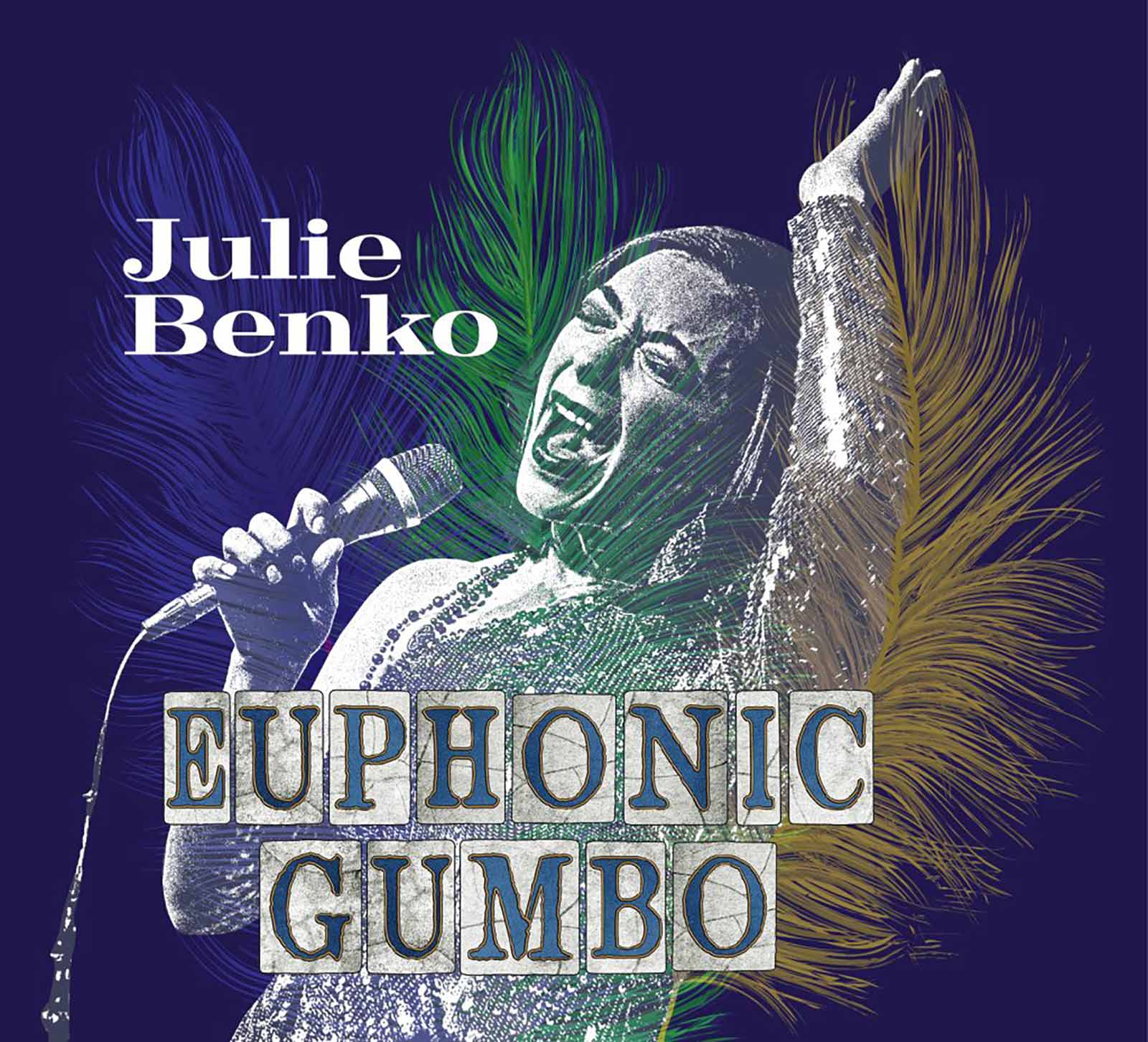
This is not an album to approach with the expectations one usually brings to a jazz record, nor even to a traditional vocal showcase. Euphonic Gumbo asks to be heard with a different ear, one attuned less to virtuosity than to atmosphere, narrative, and theatrical intent.
Singer and actress Julie Benko is best known for her work on Broadway, most prominently in Funny Girl, and this project follows that lineage far more than it does the conventions of the jazz or vocal albums typically reviewed in these pages. Rather than representing a stylistic departure, Euphonic Gumbo feels like a logical continuation of her career as a stage performer, rooted in storytelling and immersion. Its origin story is revealing. “The first time Jason and I visited New Orleans, we fell hopelessly in love with the city,” Benko recalls. “The history, the architecture, the food, oh, the food! The parades, the languages, and the way music is celebrated on every corner… it was unlike anything I had ever experienced.”
That infatuation evolved into a prolonged cultural absorption. After several years of Mardi Gras–themed performances, Euphonic Gumbo emerged from Benko and Yeager’s encounters with second-line parades, street brass bands, the layered history of Storyville, and the city’s ever-present musical pulse. What began in 2022 as an intimate duo quickly expanded into a full-fledged theatrical event at Birdland: beads thrown into the crowd, a second-line parade winding through the club, and a homemade king cake carried from table to table. “We want listeners of the album to feel as though they’re with us at our annual Mardi Gras celebration at Birdland,” Benko explains. Each year, the performance grew more elaborate, its repertoire expanding and gradually solidifying into the foundation of the album.
In this sense, Euphonic Gumbo is less a singer’s album than an actor’s project. Benko’s primary aim is not to seduce the listener through vocal prowess but to sustain the illusion of Mardi Gras as a living, communal experience. The album’s title comes from Benko’s original stage play, Down the Line, set in Storyville, New Orleans’ former red-light district. In the play, the legendary pianist Tony Jackson describes his own “jasmine” music as a “euphonic gumbo”, a slow-simmered musical stew that grows rich and complex while remaining immediately accessible.
That metaphor neatly captures the album’s ambition, though also its limitations. Seeking to present a broad sonic palette of New Orleans, Benko offers a deliberately softened, curated version of the city’s musical identity, one that feels designed for accessibility and narrative clarity rather than historical grit or stylistic risk. The result is closer in spirit to a cast album or a Broadway concept piece than to the raw hybridity of New Orleans jazz traditions. Comparisons might be drawn to theatrical crossover projects that favor mood and cohesion over individual instrumental or vocal bravura.
As a standalone listening experience, the album succeeds on its own terms. The arrangements are crafted to support storytelling, the pacing mirrors that of a live performance, and the production reinforces the sense of being carried through a festive evening rather than a sequence of discrete tracks. Those searching for daring reinterpretations or virtuosic departures may find the approach restrained, but restraint here is a conscious aesthetic choice, not a shortcoming.
Ultimately, Euphonic Gumbo represents the culmination of years of artistic exploration: of New Orleans’ cultural history, of Benko’s strengths as a storyteller, and of a musical identity still shaped by the traditions of musical theater. “I hope that everyone who listens feels like they’re with us at our Mardi Gras concert,” Benko says, “and that they can take a little bit of the spirit of New Orleans with them wherever they go.”
The album makes no greater claim than that. It offers itself as a postcard from an annual celebration, festive, generous, and unpretentious. In a genre where such theatrical hybrids remain rare, Euphonic Gumbo stands as an inviting, carefully crafted work that a wide audience can enjoy, even if it ultimately prioritizes experience over exploration.
Thierry De Clemensat
Member at Jazz Journalists Association
USA correspondent for Paris-Move and ABS magazine
Editor in chief – Bayou Blue Radio, Bayou Blue News
PARIS-MOVE, February 2nd 2026
Follow PARIS-MOVE on X

::::::::::::::::::::::::
The ensemble on Euphonic Gumbo brings depth and vitality to the project. Yeager (piano, organ, celeste) leads a rhythm section of Michael O’Brien (bass) and Jay Sawyer (drums). The horn section, Ron Wilkins (trombone), Andy Warren (trumpet), and Linus Wyrsch (clarinet), moves seamlessly between hot-jazz polyphony and R&B horn lines. Sasha Papernik (accordion), Justin Poindexter (strings/banjo), and Gabe Terracciano (violin) contribute essential textures rooted in Cajun and Creole traditions. Tap artist John Manzari adds a rare and dynamic percussive dimension.
Track Listing
- Down in New Orleans Medley
- Ticklin’ Time (Let the Good Times Roll/ Tipitina)
- The Lakes of Pontchartrain
- Funky Fête (Iko Iko/Tootie Ma Is a Big Fine Thing) (feat. John Manzari)
- Ma Belle Evangeline
- Pretty Baby
- Don’t You Come Home, Bill Bailey!
- St. James Infirmary (feat. John Manzari)
- J’ai Passé Devant Ta Porte
- Do You Know What It Means to Miss New Orleans? (Live at Birdland)