| Jazz |
Josh Warren’s The Path: Finding Extraordinary Beauty in Quiet Places
A Summer Morning, A Hummingbird, and the Beginning of a Journey
Some albums announce themselves with spectacular ambition. They arrive wrapped in bold promises, eager to convince listeners of their importance before the first note has even been heard. Others choose a quieter approach. They ask for nothing more than a willing ear and enough patience to let their story unfold. Those records rarely dominate headlines, but they often linger in memory long after louder releases have faded.
It was one of those mornings.
The day had barely begun, yet the sun already carried the unmistakable weight of summer. Its warmth settled gently across the garden, illuminating flowers that seemed to awaken one by one beneath the growing light. Butterflies drifted lazily from blossom to blossom, their effortless movements reminding me that nature never hurries, even when the world around it does.
Coffee in hand, I stood for a moment simply watching. Then, almost without warning, a hummingbird appeared.
It hovered only a few feet away, suspended in midair with impossible precision. Its wings moved so quickly that they dissolved into little more than a blur, producing that familiar vibration which always seems to challenge the laws of nature. For several seconds we shared the same space, neither of us in a hurry to leave. I smiled, quietly acknowledged my unexpected visitor, and watched as it disappeared into the morning light just as suddenly as it had arrived.
Moments like these have a way of preparing us for art. Perhaps not intentionally. Perhaps they simply remind us to slow down, to observe instead of consume, to listen before judging. The best music often asks the very same thing of us. With that thought still lingering in my mind, I walked into the studio.
For anyone who spends countless hours listening to music, the studio becomes something more than a workspace. It is a place where distractions fall away. Every familiar object has its place. The mixing console waits silently. Speakers stand like trusted companions. Shelves filled with recordings become an archive of countless conversations between artists and listeners across generations.
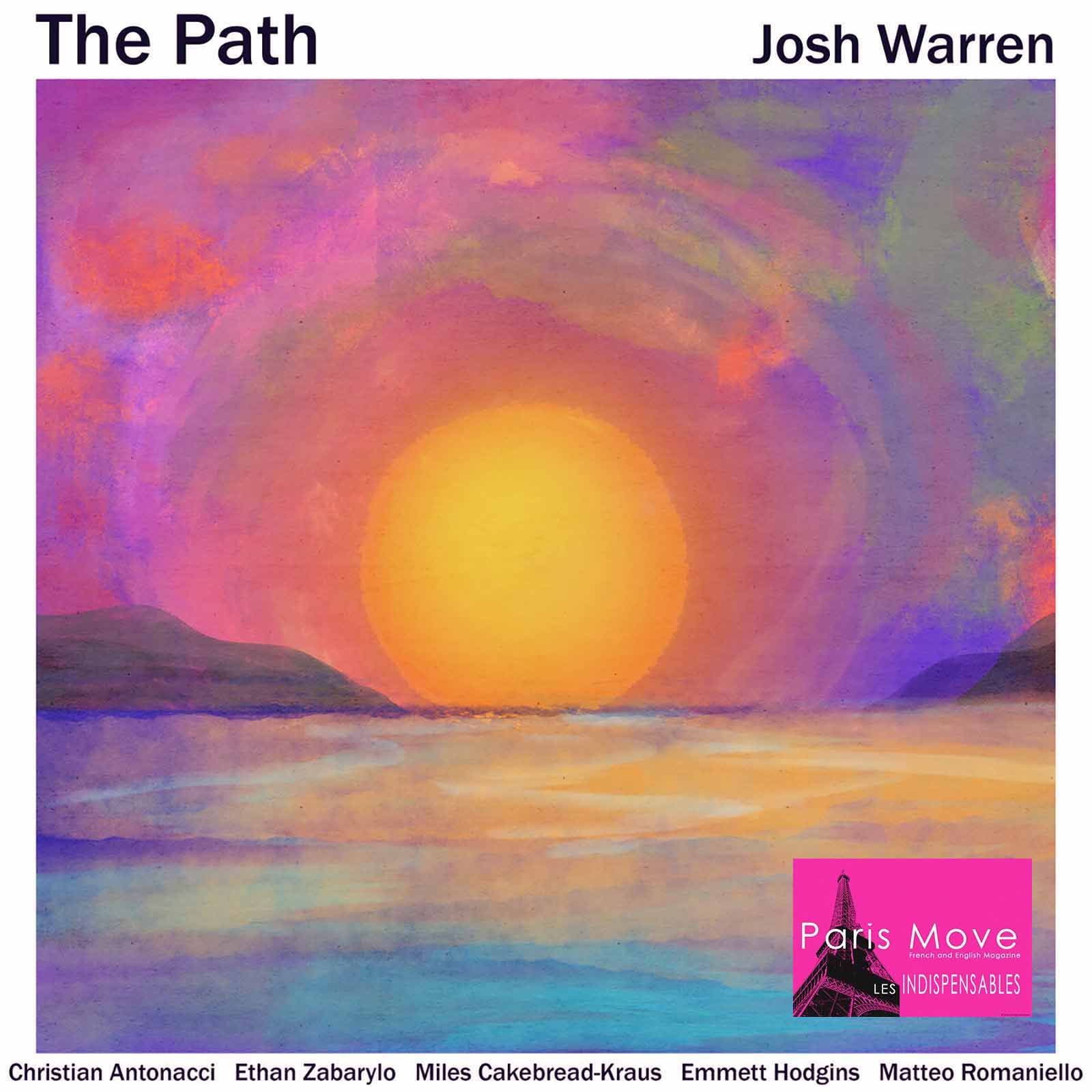
Resting beside the console was an album whose cover immediately invited curiosity. The artwork appeared to capture a sunset stretching across calm water. Whether it was a lake or the sea hardly mattered. The image conveyed tranquility rather than geography, offering the promise of reflection before a single note had been heard.
The record had traveled from Ontario. Its creator was bassist and composer Josh Warren. Its title was The Path. I pressed play.
The opening moments revealed no desire to impress through sheer force. There was no dramatic flourish, no calculated attempt to overwhelm the listener. Instead, Warren introduced his musical world with remarkable confidence and restraint. Every instrument seemed to enter naturally, as though the music had already existed long before the recording began and I had simply arrived in the middle of an ongoing conversation.
The first composition, “Gratitude,” immediately established the character of the album. The groove emerged gently, never insisting upon itself. Warren’s bass formed the foundation with quiet authority, not as an instrument demanding attention but as a storyteller guiding every voice around him. It is a role that many great bassists understand instinctively. They know that true leadership often comes from creating space rather than occupying it.
Above that foundation, the brass section brought warmth without unnecessary grandeur. Their phrasing felt conversational, never theatrical. Meanwhile, the drummer approached each rhythmic figure with unmistakable joy. There was energy in every measure, yet nothing sounded rehearsed into submission. Instead, the performance carried the excitement of musicians discovering possibilities together in real time. That sense of freedom would soon become one of the album’s defining qualities.
When the second track, “Spirit (for Jinx),” arrived, another voice stepped naturally into focus.
The trumpet. Rather than competing with the ensemble, it expanded the emotional landscape. Every phrase seemed carefully considered without ever sounding calculated. There is an important distinction between technical mastery and emotional intelligence. Many musicians possess the first. Far fewer consistently demonstrate the second.
Josh Warren appears to understand that difference exceptionally well.
In today’s jazz landscape, technical brilliance has become almost expected. Conservatories continue producing extraordinary instrumentalists capable of astonishing feats of precision and speed. Social media offers endless opportunities to showcase dazzling performances measured in seconds rather than complete artistic statements. The result is a musical culture that sometimes rewards complexity before communication.
The Path quietly resists that temptation. Its greatest strength lies not in what Warren chooses to play, but in what he deliberately leaves unsaid. Silence matters. Space matters. Breath matters.
Those elements have always been among jazz’s most expressive tools, yet they are often overlooked in an era that celebrates constant movement. Warren reminds us that confidence does not require volume. A composition can speak softly while remaining impossible to ignore.Perhaps that explains why the album immediately feels so welcoming. Listening to The Path never resembles attending a lecture delivered by accomplished musicians eager to display everything they know. Instead, it feels like being invited into someone’s home, where conversation flows naturally and every guest contributes without interrupting another voice.
That generosity defines the listening experience.
Although the recording is closer in length to an EP than to a traditional full length album, it never feels incomplete. Rather, it reflects an artist disciplined enough to explore one central idea with honesty instead of overwhelming the listener with endless demonstrations of versatility. Ironically, that restraint reveals far more about Josh Warren than any exhibition of virtuosity ever could. Great composers understand that every note carries responsibility. Every silence does as well. If there is one criticism to be made after these opening performances, it has little to do with the music itself. The journey ends too soon. Not because Warren has failed to say enough, but because he has created an environment so inviting that leaving it feels almost premature. Before long, I found myself glancing toward the remaining track list, quietly hoping there would be just one more composition waiting around the next corner. That feeling is remarkably rare. Many records overstay their welcome. Very few leave listeners wishing they had just begun. As the morning sunlight continued to pour through the studio windows, I realized I was no longer evaluating an album. I was following a path. And like any meaningful journey, it was becoming less about the destination than about the discoveries waiting along the way.
When a Composer Learns to Listen
The more I listened to The Path, the more one idea continued to surface. Josh Warren is not simply writing music. He is creating conversations. That distinction may appear subtle, but it changes everything.
There is an old saying among jazz musicians that playing is only half of the job. The other half is listening. The finest improvisers are rarely those who fill every available space. They are the ones who recognize when another musician has said something worth answering. They understand that every solo is part of a larger dialogue, one that stretches across the entire ensemble and, in many ways, across generations of jazz itself. That philosophy seems to guide every moment of The Path. Nothing on this record feels isolated. Every phrase appears connected to another, each instrument responding to ideas that have just emerged before gently introducing new ones of its own. The result is music that breathes with remarkable naturalness, allowing listeners to feel less like observers and more like participants in an unfolding story. Perhaps this should come as no surprise. Before releasing The Path, Warren made the decision to relocate to Toronto, a city that has quietly become one of North America’s most vibrant homes for creative jazz. While cities such as New York, Chicago, and New Orleans often dominate conversations about the genre, Toronto has steadily built a community where tradition and innovation coexist without conflict. It is a place where young musicians are encouraged to master the language of jazz before attempting to reinvent it. That education matters. Technique can be taught. Taste requires experience. Judgment takes years. Listening takes a lifetime.
Studying alongside some of Canada’s finest musicians offered Warren far more than technical instruction. It immersed him in an artistic culture built on curiosity, discipline, and mutual respect. Those values echo throughout The Path, sometimes more clearly than the notes themselves. Over the years, Warren has shared stages and recording studios with an impressive list of Grammy nominated and JUNO Award winning artists, including Ingrid Jensen, Jeremy Ledbetter, Rich Brown, Allison Au, and Joaquin Nunez. On paper, those collaborations demonstrate credibility. In practice, they represent something much deeper. Every accomplished musician leaves traces behind. Not copies. Not imitation. Perspective. One learns how a master shapes a melody, how another approaches rhythm, how another chooses silence over speed. These lessons cannot be measured by diplomas or awards. They become part of an artist’s instincts, quietly influencing decisions that audiences may never consciously notice. Listening to The Path, I found myself thinking less about individual performances and more about collective trust.
That may be the album’s greatest achievement. Many contemporary recordings are assembled with flawless precision. Every note lands exactly where expected. Every performance is technically beyond reproach. Yet perfection alone has never guaranteed emotion. Great jazz has always embraced the possibility of surprise. It thrives on risk. It welcomes vulnerability. That spirit runs throughout Warren’s compositions. Rather than surrounding himself with musicians whose only responsibility is to execute predetermined ideas, he appears to have invited collaborators capable of shaping the music alongside him. Every performance carries the unmistakable feeling that individual personalities were not merely accepted but encouraged.
The arrangements reflect that openness. The brass section never functions as decorative color.
It becomes another voice within the conversation. The rhythm section does far more than maintain tempo. It shapes emotional direction. Even moments that seem understated on first listen reveal remarkable sophistication with repeated attention. A subtle harmonic shift. A rhythmic hesitation. A phrase answered from another corner of the ensemble. These details reward patience, revealing themselves gradually rather than demanding immediate admiration.
That approach feels increasingly rare. Modern audiences often experience music through playlists, algorithms, and shortened attention spans. Songs compete for seconds rather than minutes. Albums are frequently consumed as collections of individual tracks instead of complete artistic statements. Jazz has always resisted that culture. Its greatest recordings ask listeners to slow down. To stay. To notice.
The Path belongs to that tradition. It is not an album interested in instant gratification. Instead, it rewards repeated listening, offering new discoveries each time the music returns. The melodies become more familiar, yet the arrangements continue revealing unexpected textures hidden beneath the surface.
This is where Warren distinguishes himself most clearly as a composer. Many talented instrumentalists eventually write music. Far fewer composers understand how to leave room for others. That generosity defines The Path.
As bassist, Warren could easily have placed himself at the center of every composition. Instead, his instrument often acts as the quiet foundation upon which everyone else builds. It is an artistic decision that says much about his priorities. Leadership in jazz has never meant speaking the loudest. It means creating conditions in which everyone can speak honestly. History offers countless examples. Miles Davis built legendary ensembles because he recognized individual voices rather than trying to control them. Duke Ellington wrote specifically for the personalities within his orchestra rather than treating musicians as interchangeable parts. Charles Mingus demanded individuality while insisting that every contribution serve the larger vision. Josh Warren is not attempting to imitate any of those giants. Nor should he. What connects them is not style. It is philosophy.
They understood that jazz reaches its greatest heights when composers trust musicians enough to let them become coauthors of the moment. That same trust is present throughout The Path. Perhaps that explains why the record feels so welcoming. Nothing here sounds manufactured.
Nothing feels calculated to satisfy current trends. The music simply exists with quiet confidence, comfortable in its own identity. In an era where many emerging artists understandably feel pressure to establish recognizable brands as quickly as possible, Warren appears content to let the music introduce him instead. That may prove to be his wisest decision. Because identities built around fashion eventually fade. Identities built around honest artistic voices tend to endure. As I reached the closing moments of another uninterrupted listen, I found myself reflecting on how rarely albums invite this kind of patience anymore.
Not because audiences have lost the ability to listen. But because so few recordings trust them enough to do so. The Path does. It never rushes. It never pleads for attention. It simply opens a door, invites the listener inside, and quietly waits for the conversation to begin. The best jazz has always done exactly that.
Stories Without Words
There is a moment, sooner or later, when every meaningful album stops being a collection of songs and begins to resemble something else entirely. A novel. A conversation. A memory.
A journey. By the time I reached the closing moments of The Path, I was no longer listening for individual solos or memorable themes. I had stopped thinking about arrangements, recording techniques, or even the remarkable chemistry between the musicians. Instead, I found myself asking a much simpler question. What story had Josh Warren just told me? That question led me somewhere unexpected. Jack Kerouac. At first glance, the connection might seem unlikely. One belonged to literature, the other to music. Yet Kerouac understood something that many writers still struggle to grasp. He believed rhythm could carry meaning just as powerfully as words. His lifelong fascination with bebop was never about entertainment alone. It was about freedom, movement, surprise, and the possibility that genuine emotion could emerge only when artists trusted instinct as much as intellect. He famously dreamed of writing prose that moved like a saxophone solo. Not polished into perfection. Alive.
Reading Kerouac today, one can almost hear Charlie Parker, Dizzy Gillespie, and Lester Young moving between the sentences. The words accelerate, hesitate, change direction, then suddenly discover unexpected beauty where no carefully designed outline could ever have predicted it. The greatest jazz musicians work in much the same way. Improvisation is often misunderstood by those who view it as spontaneous invention detached from discipline. In reality, the opposite is true. Freedom only becomes meaningful after years of study. The confidence to depart from structure exists because structure has already become second nature. That balance between preparation and instinct defines The Path. Nothing feels accidental. Yet nothing sounds forced. The music unfolds with the quiet assurance of artists who know precisely where they are going, even when they allow themselves the freedom to wander along the way. Perhaps that is why the album never feels like a demonstration. Modern music, particularly in the digital age, often rewards visibility above substance. Musicians are encouraged to prove themselves immediately. Every release must compete for attention against thousands of others arriving the very same week. Technical brilliance becomes a marketing strategy. Complexity becomes evidence of seriousness. Jazz has not escaped those pressures. Neither has classical music. Nor literature. Nor cinema. The temptation to impress has become nearly impossible to ignore. Josh Warren chooses another direction. Rather than asking listeners to admire his abilities, he invites them to share an experience.
That difference may sound insignificant. It is anything but. The albums that remain with us for years are rarely those that display the greatest number of ideas. They are the ones that develop a single idea honestly enough that it begins to feel universal. That is precisely what The Path accomplishes. Its emotional strength comes from coherence rather than excess. Its beauty comes from patience rather than spectacle. Its confidence comes from generosity rather than control. Listening again, I became increasingly aware of another quality that distinguishes this recording. Kindness. Not sentimentality. Not nostalgia. Kindness.
There is an unmistakable generosity running through these performances. Every musician appears genuinely interested in helping another voice shine. Solos emerge naturally before gracefully returning the conversation to the ensemble. Nobody seems interested in winning the performance. Everyone seems committed to serving the music. That philosophy has become surprisingly uncommon. The modern world celebrates individual achievement with understandable enthusiasm. Awards, streaming numbers, followers, and headlines often encourage artists to build careers around personal visibility. Collaboration sometimes becomes secondary. Jazz has always offered another possibility. Its greatest moments remind us that excellence does not diminish when shared. It grows. That lesson extends far beyond music.
It speaks to every creative discipline. Perhaps even to life itself. There is another reason authentic artists often struggle to explain their own work once it has entered the world.
The moment a painting hangs in a gallery, a novel reaches readers, or an album begins playing through someone’s headphones, ownership quietly changes. The work no longer belongs entirely to its creator. It begins collecting new meanings inside every person who encounters it. Listeners hear memories the composer never lived. Readers discover emotions the novelist never consciously intended. Art becomes collaboration. Not between musicians alone. Between artist and audience. That is why interviews can never fully explain great music. Nor should they.
The most meaningful works remain slightly mysterious. They leave enough unanswered questions for listeners to complete the experience themselves. The Path understands this instinctively. Its title now seems almost prophetic. A path is never simply a destination. It represents movement. Growth. Curiosity. Possibility. Every meaningful journey changes us, even if only in small ways. Looking back at that morning, I remember the hummingbird almost as clearly as the music itself. At first, the connection seemed accidental. Now it feels inevitable. The hummingbird’s astonishing speed disguised extraordinary precision. Its apparent stillness concealed constant motion. Josh Warren’s music works in much the same way.
Beneath its calm surface lies remarkable craftsmanship, countless artistic decisions, and years of experience distilled into compositions that never ask to be admired for their complexity. They simply invite us to listen. There is, perhaps, only one genuine criticism left to make. The album ends too soon. Not because it feels unfinished. Because it feels welcoming.
One more composition would not have weakened the experience. If anything, it would have allowed listeners to remain inside Warren’s carefully constructed world a little longer. That may be something worth exploring on future recordings. Not additional complexity, not greater ambition, simply more time. The musical language he has developed deserves room to breathe, evolve, and surprise us over the course of a full-length statement.
Yet perhaps even that lingering sense of absence serves a purpose. Great books leave us wishing for one more chapter. Great films make us reluctant to leave the theater. Great conversations always seem shorter than they really were. Great albums inspire us to begin again. That is exactly what happened here. When the final notes faded into silence, I did not begin searching for another recording. I returned to the beginning. Not to analyze. Not to evaluate. Simply to listen once more. That instinct tells us more than any rating system ever could. Some records entertain us. Some impress us. A very small number quietly become companions, returning at unexpected moments throughout our lives because they continue revealing something new about themselves, and perhaps something new about us.
It is still too early to know where The Path will ultimately find its place within contemporary Canadian jazz. History has a habit of making those decisions slowly. What already seems clear, however, is that Josh Warren possesses something far more valuable than technical brilliance alone. He possesses a voice. In jazz, as in literature, voices cannot be manufactured. They are discovered through patience, curiosity, humility, and an unwavering commitment to honesty.
Those qualities cannot be rushed. They can only be lived. If The Path represents the beginning of Josh Warren’s artistic journey, then the destination matters far less than the road that lies ahead. And after spending time with this remarkable recording, I suspect many listeners, myself included, will be more than willing to follow wherever that path leads next.
Thierry De Clemensat
Member at Jazz Journalists Association
USA correspondent for Paris-Move and ABS magazine
Editor in chief – Bayou Blue Radio, Bayou Blue News
PARIS-MOVE, August 7th, 2026
Follow PARIS-MOVE on X
::::::::::::::::::::::::
Track Listing :
Gratitude
Spirits (For Jinx)
Everything in Time
The Path
What Remains
Musicians:
Josh Warren – Bass
Christian Antonacci – Trumpet
Ethan Zabarylo – Tenor Saxophone
Miles Cakebread-Kraus – Guitar
Emmett Hodgins – Piano
Matteo Romaniello – Drums
Production team:
Thomas Mordaunt – Producer
Patric McGroarty – Recording/Mixing Engineer
Reuben Ghose – Mastering Engineer
Heather Kirby – Project Advisor
Noah Carson – Artwork/Design
Yeonggi Baik, Aiden Chisholm – Assistant Engineers
Recorded on October 2nd at Gordon Wragg Recording Studios in Toronto
On the road, again…
- August 22nd @ The Rex (Toronto, ON)
- August 28th @ Upstairs Jazz Bar (Montréal, QC)
- August 29th @ The Night Oat (Ottawa, ON)
- September 22nd @ The Palms (Victoria, BC)
- September 25th @ Moby’s Pub (Saltspring Island, BC)
- September 26th @ St Paul’s United Church (Sidney, BC)
- September 27th @ Hermann’s Jazz Club (Victoria, BC)
- October 1st @ Apollo’s Restaurant (Vancouver, BC)
- October 2nd @ Tyrant Studios (Vancouver, BC)
- October 3rd @ The Vault (Nanaimo, BC)
- October 4th @ 40 Knots Winery (Comox, BC)