| Jazz |

Summary: Josh Cohen’s We Are Home blends jazz, fusion, rock and funk in a deeply collaborative statement built on trust and musical freedom.
Josh Cohen – We Are Home: A Jazz-Fusion Journey
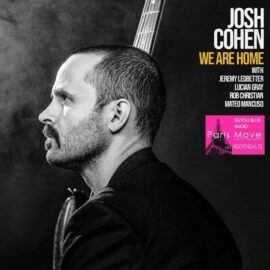
It is not often that I begin a jazz album review by giving the artist the floor. This time, however, I’m making an exception, because Josh Cohen’s own words immediately reveal what is happening beneath the surface of We Are Home, his new album. “For years, solo bass allowed me to shape an entire musical universe in my hands. With We Are Home, I had to entrust that universe to others: let go, trust the band, and allow the music to develop beyond what I could have imagined on my own.” That statement could almost stand as the album’s manifesto. It describes a fundamental shift for a musician who had learned to make the bass carry an entire musical architecture by itself. Here, Cohen is no longer trying to control every inch of the sonic landscape. He is sharing it. And that change is more significant than simply putting a new band together. It alters the way the music itself is conceived. The bass remains the anchor, but it is now part of a much larger conversation. Cohen allows his compositions to be reshaped by the personalities of the musicians who play them, and that decision is at the heart of what makes We Are Home more than a showcase for an accomplished bassist. It becomes a genuinely collective statement, one in which jazz, fusion, rock, funk and other influences can coexist without having to announce themselves as separate stylistic territories.
Cohen has never seemed particularly interested in putting his music inside a single box, and We Are Home continues that instinct. What is striking today is how unusual that kind of freedom can feel. So much contemporary music is presented with a clearly defined aesthetic identity, often established before the listener has even heard the first note. Cohen takes another route. The album moves from one texture and atmosphere to another, but the writing provides a strong enough thread to hold everything together. The opening compositions gradually establish the vocabulary of the record, and then Next Steps becomes a real point of departure. What had been developing in the background suddenly comes into sharper focus. The various influences begin to interact more openly, and the jazz-fusion character of the project becomes impossible to miss. Yet the music never feels as though it is checking off stylistic boxes. Cohen is interested in movement rather than labels, and that gives the album a sense of discovery even when the musical language feels familiar.
This is where his strengths as a composer and arranger become particularly evident. Cohen understands the bass from the ground up, but he does not treat it simply as the foundation on which everyone else builds. His bass lines move through the arrangements, comment on what is happening around them, create momentum and, when the moment calls for it, step forward as a lead voice. The interaction with Jeremy Ledbetter’s keyboards, Lucian Gray’s guitars, Rob Christian’s woodwinds and Mateo Mancuso’s drums gives the music its real character. There is a constant exchange taking place, and that exchange keeps the compositions alive. Each musician has room to make a statement, but the music never loses sight of the larger picture. That balance between individual expression and collective purpose is one of the album’s most convincing qualities.
There are moments when Cohen’s approach may bring to mind some of the work of Spyro Gyra or the Canadian group Uzeb. I would not take the comparison too far, nor would I suggest that We Are Home is attempting to recreate either of those sounds. The connection is more about attitude: the ability to combine strong melodic writing, serious instrumental command and an openness to letting jazz move into other musical spaces. Cohen is not recycling the formulas of earlier fusion. He is taking something more fundamental from that tradition — the idea that jazz can remain sophisticated and exploratory without becoming imprisoned by its own boundaries. He has enough of a musical identity of his own that he does not need to imitate anyone else.
The title We Are Home takes on a deeper meaning once the music is heard in that light. Home is not simply an address or a physical place. For Cohen, it seems to describe something more elusive: the feeling of belonging to a human and musical community, of building something with other people and discovering that the act of creating can itself become a kind of refuge. That sense of belonging runs through the album without ever becoming sentimental. You hear it in the way the musicians respond to one another, in the trust that has clearly developed within the group and in the feeling that the record itself has become a shared space.
That idea also connects with where Cohen finds himself in his own life — as a musician, husband, father and independent artist. We Are Home arrives at a moment of transition, and there is something here that feels like a return to one’s roots, but certainly not a retreat into the past. Coming home can mean looking back at everything you have traveled through and deciding what is worth carrying forward. The album carries traces of family life, change and transition, as well as Cohen’s deep connection to Toronto’s musical community and, more broadly, to the Canadian jazz scene. As I often say, the best musicians eventually learn to use their own lives as raw material. They may not tell their stories literally, but sooner or later, those experiences find their way into the sound. There is always a relationship between a musician and the environment in which that musician lives and works. In Cohen’s case, that relationship produces music that feels unmistakably urban — sometimes rough around the edges, sometimes deeply melodic — as if it has absorbed the contradictions and energy of a city like Toronto. There is movement here, contrast and density, but also moments when the music pulls back, breathes and allows a certain vulnerability to come through.
None of that would work without the musicians Cohen has assembled around him. Jeremy Ledbetter’s piano and keyboards bring a harmonic depth that substantially expands the group’s sonic range. Lucian Gray adds a different kind of tension on guitar, sometimes leaning toward rock, sometimes moving into more atmospheric territory. Mateo Mancuso gives the compositions their rhythmic foundation while keeping the music in motion. And Rob Christian occupies an especially important position, not only through his playing on tenor and alto saxophones, flute and EWI, but through his work behind the console as producer and sound engineer.
Christian’s contribution deserves particular attention because his role extends well beyond that of another instrumentalist on the record. His involvement in the recording, mixing and mastering directly affects the way the music reaches the listener. He helps shape the textures, balances and depth of the recording, as well as the relationships between the instruments. That production perspective is a significant part of why We Are Home has such a distinct sonic identity. Cohen’s music rewards that kind of attention because there is more going on than the immediate groove or the obvious melody. A first listen gives you the pulse, the themes and the instrumental virtuosity. Spend more time with the record and the arrangements begin to open up. You hear the conversations between the instruments, the way the bass organizes the ensemble and the small details that might pass unnoticed at first. Those details give the music its density and keep the compositions from becoming little more than vehicles for their main themes.
That distinction matters. There is a difference between an album that gathers a group of excellent musicians and an album in which those musicians actually sound like a band. We Are Home belongs to the second category. Everyone has enough freedom to establish a distinct voice, but nobody seems determined to dominate the music. Individuality strengthens the collective rather than threatening it. Cohen’s role as composer and bandleader is therefore less about controlling every outcome than about creating the conditions in which the musicians can contribute something of their own. The paradox is that by giving up some control, he gains something larger: a sound that could not have existed if he had remained alone.
That brings us back to the larger question of what jazz can be. Jazz has never really been a matter of categories. At its best, it is a way of allowing ideas to circulate between musicians. When that exchange works, the borders between jazz, rock, fusion and funk become secondary. What matters is whether a composition can sustain different interpretations and whether the players can give it a new life each time they enter it. We Are Home belongs to that increasingly valuable group of records that refuse to choose between composition and freedom. Cohen knows his instrument and his language well enough to create music with a clear architecture, but he is also willing to let that architecture breathe, bend and occasionally escape the intentions of its creator.
That may be the most interesting contradiction at the center of the album. The musician who spent years learning how to construct an entire sonic world by himself now chooses to place that world in the hands of a group. It is a risk, but it is also the source of the record’s personality. We Are Home is not simply an album about bass, jazz-fusion or instrumental virtuosity. It is an album about trust, about the collective, and about the deceptively simple idea that music can become a place where several individuals find room to exist. Cohen does not abandon his identity as a solo musician. Instead, he puts that identity into conversation with the personalities of his collaborators, and the music becomes richer for it.
Records built on that kind of chemistry require time. They require a clear artistic direction, but they also require something that cannot be arranged on paper: mutual trust. Cohen and his collaborators appear to have found that balance. Everyone contributes a voice, but nobody needs to occupy the entire room. The bass remains the heart of the project without becoming its exclusive center. Keyboards, guitars, woodwinds and drums all play an essential role in the architecture, and the result feels less like a collection of individual performances than a musical organism with its own identity.
In the end, We Are Home leaves us with the sense of a musician who has found a different way to tell his story. After learning how to build alone, Josh Cohen has chosen to build with others. And perhaps that is the album’s real meaning. Home is no longer simply the place we return to. It becomes the space we build together, with the people who accompany us, challenge us, inspire us and, ultimately, allow us to go farther than we could have imagined on our own.
Thierry De Clemensat
Member at Jazz Journalists Association
USA correspondent for Paris-Move and ABS magazine
Editor in chief – Bayou Blue Radio, Bayou Blue News

PARIS-MOVE, September 17th, 2026
Follow PARIS-MOVE on X
::::::::::::::::::::::::
Musicians:
Josh Cohen – bass, wordless vocals on tracks 3, 7 & 8
Jeremy Ledbetter – piano, keyboards
Lucian Gray – guitars
Rob Christian – woodwinds, EWI and sound design
Mateo Mancuso – drums
Elmer Ferrer – nylon-string and steel-string acoustic guitars on tracks 7 & 8
Production Credits:
Produced by Rob Christian
Recorded by Rob Christian at RC Sound, Toronto, 2024
Mixed and mastered by Rob Christian
Additional engineering by Rich Greenspoon
DDP master prepared by Dave Vanderploeg
Executive Producers: Howard Cohen, Anita Cohen, and Jeff Macklis
Photography: Alice Xue
Graphic design: Daniel Joseph Cohen
Copyright & Publishing:
All compositions by Josh Cohen – Published by Josh Cohen Music
Registered with SOCAN
℗ 2026 Josh Cohen Music
© 2026 Josh Cohen Music
Toronto, Canada