| Jazz |
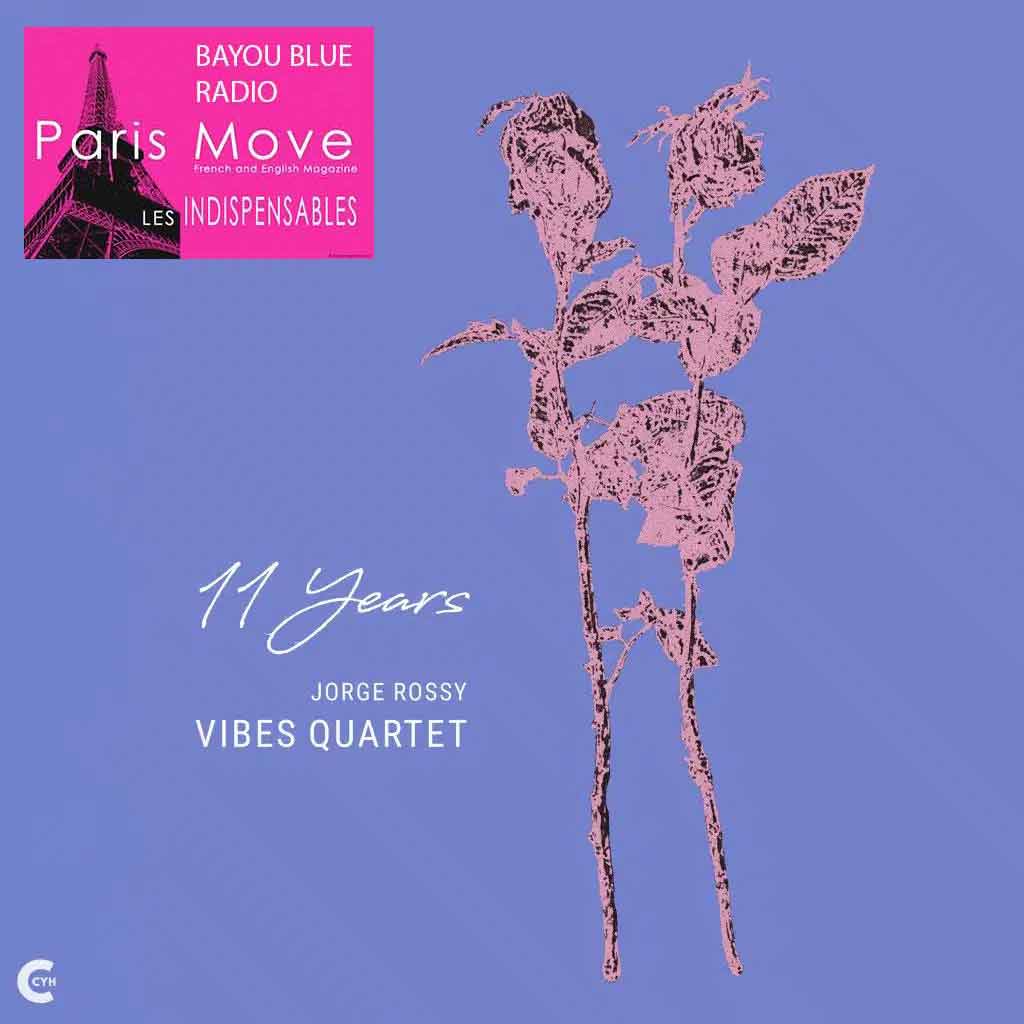
Some albums reveal their qualities immediately; others invite us into a musical world whose richness becomes apparent only as we spend time within it. 11 Years, the new recording by the Jorge Rossy Vibes Quartet, belongs to the latter category, although its appeal is anything but elusive. From the opening notes of “Song for D.G.,” the music establishes a distinctive atmosphere, balancing melodic clarity with harmonic depth, lyricism with a freedom that never becomes an end in itself. There is no need for grand gestures or conspicuous virtuosity to make an impression. The music draws its strength from the precision of its writing, the sensitivity of its phrasing and, above all, the remarkable understanding among four musicians who know how to make individual voices serve a shared musical purpose. What emerges is an album of uncommon coherence and expressive breadth, one that rewards attentive listening without ever turning that attention into a test of endurance. Its beauty lies not in an attempt to simplify complexity, but in the way complexity becomes an essential part of its emotional language.
Jorge Rossy has long demonstrated an unusual ability to understand jazz from several complementary perspectives. His experience as a drummer has given him an instinctive feel for rhythmic architecture, for the subtle relationship between pulse and movement, and for the possibilities that open up when time is allowed to breathe rather than being rigidly imposed. At the vibraphone and marimba, those instincts find another form of expression. The attack is different, the resonance more exposed, and every note carries a particular weight within the surrounding silence. Rossy makes full use of these qualities. His playing is attentive to the decay of a sound, to the space between phrases and to the way a chord can alter the emotional color of a melody. Rather than treating the vibraphone as an instrument whose crystalline timbre must constantly be brought to the foreground, he integrates it into the quartet’s collective language. The result is a sound that can be luminous without becoming decorative, harmonically sophisticated without losing its warmth, and rhythmically alert without sacrificing a sense of ease. Rossy’s achievement is not simply to display the instrument’s possibilities, but to make those possibilities indispensable to the music itself.
The quartet’s distinctive character also owes much to trumpeter Milena Casado, whose presence introduces a different kind of luminosity. Her sound and phrasing provide a compelling counterpoint to Rossy’s percussive resonance, creating a dialogue in which the two instruments can complement, challenge and illuminate one another. The trumpet’s capacity to sustain a line gives the music a different sense of direction from the vibraphone’s more fleeting tones, while Casado’s sensitivity to dynamics allows her to move naturally between lyrical expression and more exploratory territory. She does not rely on sheer volume or emphatic declarations to establish her presence. Instead, she shapes her phrases with an awareness of the ensemble’s balance, allowing a melodic idea to develop in relation to what the other musicians are doing. Her contribution is particularly valuable because it prevents the quartet’s music from settling into a single, easily recognizable texture. The interplay between trumpet and vibraphone becomes a source of continuous discovery, opening up spaces in which melody can be reconsidered, harmonies can shift their meaning and the music can move forward without needing to announce every change.
What makes 11 Years so satisfying is the way its compositions provide both direction and freedom. The pieces are carefully conceived, yet they never feel imprisoned by their structures. Their melodic contours remain sufficiently clear to give the listener something to hold on to, while the harmonic writing creates possibilities that extend well beyond the immediate theme. A melody may suggest one emotional destination, only for the harmony beneath it to introduce a subtle ambiguity; a phrase may appear to be approaching a natural conclusion, then acquire a new meaning through the response of another instrument. These are not tricks designed to keep the listener guessing. They are signs of a compositional intelligence that understands how music can remain accessible without becoming predictable. The quartet’s freedom emerges from the strength of its underlying construction, not from a desire to escape it. Each musician can respond spontaneously because the material offers a common ground on which those responses can become meaningful.
The rhythmic dimension deserves particular attention. Rossy’s background as a drummer is audible not merely in the ensemble’s sense of timing, but in its understanding of rhythmic space. The music is animated by movement, yet that movement is rarely reduced to a fixed pulse against which the soloists simply unfold their ideas. Rhythmic emphasis can shift, a phrase can lean forward or hold back, and silence can become as significant as a note. The bass does more than provide harmonic support: its movement helps establish direction, reinforces the music’s underlying tension and, at times, opens a path toward unexpected harmonic possibilities. The drums, in turn, contribute through nuance rather than insistence, shaping the music’s energy with changes of touch, carefully judged accents and an acute sense of proportion. This approach gives the quartet a flexibility that is central to its identity. The rhythm section does not merely accompany the melodic instruments; it participates in the composition as it unfolds, helping determine how an idea develops and where its emotional emphasis ultimately falls.
“Hope” exemplifies the quartet’s ability to bring together melodic appeal and harmonic richness without allowing either to dominate. The title might invite expectations of uncomplicated optimism, but the music is more interesting than that. Its expressive character rests on the relationship between a clear melodic impulse and the subtleties that surround it. The harmony gives the theme depth, while the ensemble’s restraint allows its emotional implications to emerge gradually. There is no need to underline the sentiment or turn the piece into a declaration. The musicians trust the material, and that trust is justified. What gives the performance its particular resonance is the sense that hope, here, is not a ready-made feeling but something discovered through movement, uncertainty and the possibility of change. The quartet’s control of dynamics and phrasing helps preserve that openness, giving the music room to breathe and allowing its lyricism to remain persuasive rather than sentimental.
“Ninety-one” reveals another aspect of Rossy’s compositional personality, particularly his ability to create interest through the relationship between rhythmic character and melodic development. The music does not depend on a single striking gesture; its appeal grows from the way its elements interact. The rhythmic foundation gives the piece momentum, while the melodic lines introduce a more reflective dimension. Neither element remains fixed in its role. The bass can redirect the listener’s attention, the drums can alter the weight of a phrase, and the exchanges between the foreground instruments can make familiar material sound newly considered. This is one of the quartet’s great strengths: even when a composition has a recognizable center, the musicians resist the temptation to treat it as a destination already reached. They continue to explore the possibilities contained within it, giving the performance a sense of movement that is both organic and intellectually engaging.
“Some Things They Aren’t” further demonstrates the album’s refusal to settle for easy distinctions between the lyrical and the abstract. The music can suggest a clear melodic path while leaving the harmony open enough to complicate the listener’s expectations. This tension is productive rather than disorienting. The musicians do not abandon the theme in pursuit of abstraction; they use the freedom of improvisation to examine its implications from different angles. The effect is one of controlled openness, a balance in which the composition retains its identity even as the performance moves beyond the obvious. Such an approach requires more than technical ability. It depends on listening, on the capacity to recognize when a phrase needs to be extended and when it is better left unresolved, and on a shared understanding of how much space each musician can occupy without diminishing the others. The quartet handles these demands with admirable assurance.
“Anarres” is especially revealing of the album’s broader aesthetic. Its interest lies in the space it creates around musical ideas, allowing them to emerge, change direction and acquire new shades of meaning. Rather than pushing relentlessly toward a climax, the performance finds its intensity in the gradual development of its relationships. The instruments seem to test the possibilities of the material without losing sight of its underlying character. This is where the quartet’s balance between composition and improvisation becomes particularly convincing. The written music provides a framework, but the musicians do not simply fill that framework with solos. They respond to its harmonic and rhythmic implications, allowing the performance to become a conversation in which the next development feels neither predetermined nor arbitrary. The music remains open, but never vague; exploratory, but never without purpose.
The more overtly blues-inflected language of “Blues 400” brings another color to the album without disrupting its coherence. The blues is not treated as a stylistic costume or as a convenient way to introduce familiar gestures. Instead, it becomes a source of phrasing, rhythmic inflection and expressive directness that the quartet can absorb into its own musical vocabulary. Its presence reminds us that harmonic sophistication and emotional immediacy are not opposing qualities. A simple musical idea can acquire considerable depth when the performers understand how to shape it, how to give a phrase the right degree of tension and how to let the ensemble’s response transform its meaning. The quartet’s command of this balance is one of the reasons the album remains so inviting. Its sophistication never becomes a barrier between the musicians and the listener.
“Bitty Ditty” offers a different kind of pleasure, drawing attention to the quartet’s alertness, its sense of proportion and its ability to make interaction itself a source of musical interest. Here, the details matter: the way one line prompts another, the subtle change in emphasis that alters the direction of a phrase, the rhythmic response that gives a melodic idea a fresh impulse. The music’s energy comes from the precision of these exchanges rather than from an accumulation of effects. The musicians are clearly attentive to one another, but their communication never feels mechanical. It has the spontaneity of a conversation among people who share a language well enough to play with it, interrupt it, redirect it and discover something new in the process. That ease is not the absence of discipline. It is what discipline makes possible.
“Drawing Room Blues” brings the album’s reflective and blues-oriented dimensions into particularly satisfying proximity. The title suggests intimacy, and the music’s appeal lies in its ability to preserve that sense of closeness without becoming confined by it. The quartet understands that intimacy in jazz is not necessarily a matter of playing softly or minimizing musical ambition. It is a question of proportion, of allowing each sound to register clearly and of giving the other musicians enough room to shape the collective result. The performance draws strength from the balance between the melodic voices and the rhythmic foundation, between the directness of the blues and the more complex harmonic language that surrounds it. Nothing needs to be overstated. The music trusts its own character, and the musicians’ restraint allows that character to emerge with clarity.
Across the album, bassist Robert Landfermann and drummer Cornelia Nilsson are essential to this sense of balance. Their contributions cannot be reduced to the conventional division between accompaniment and soloist, because the music depends on their ability to influence its direction from within. Landfermann’s bass lines help define the harmonic landscape while giving the ensemble a sense of forward motion. Their role is not merely to confirm the changes but to make the movement between them felt, sometimes grounding the music, sometimes opening up possibilities that the other instruments can pursue. Nilsson’s drumming brings an equally important combination of alertness and restraint. Her playing gives the quartet rhythmic definition without narrowing its freedom, and the subtlety of her touch allows the ensemble to change its energy without resorting to obvious signals. Together, they make possible the kind of collective flexibility that distinguishes the album: music in which the pulse remains alive, the harmony continues to move and every instrumental voice has a meaningful part in the whole.
The relationship among these four musicians is all the more compelling because 11 Years marks a shared quartet project built on individual experience and prior musical encounters. Such a meeting could easily have become a showcase for four accomplished players, each contributing a recognizable personal signature. Instead, the album is shaped by a genuinely collective sensibility. No single voice needs to dominate for the music to maintain its identity, and no musician is reduced to a supporting role. The ensemble’s cohesion comes from the quality of its listening, from an understanding that musical authority can be exercised through restraint as much as through assertion. The result is not a compromise between four distinct personalities, but a musical language that becomes richer because those personalities remain distinct. Their interaction gives the compositions depth, while the compositions provide a structure in which that interaction can flourish.
This is also what makes the album so rewarding over repeated listens. Its appeal is immediate enough to invite a first encounter, but its deeper qualities reveal themselves gradually. The listener begins to notice the role of a bass line in changing the direction of a passage, the way a trumpet phrase alters the emotional color of a vibraphone figure, or the importance of a rhythmic detail that might initially seem incidental. Harmonic choices that first register as atmosphere begin to reveal their structural purpose. The music’s apparent ease turns out to rest on a remarkable degree of attention and control. There is no contradiction between the album’s accessibility and its sophistication; each reinforces the other. The more closely one listens, the more one hears, and the more one hears, the more natural the music seems.
In a jazz landscape where recordings can sometimes confuse intensity with volume, virtuosity with accumulation, or freedom with the absence of form, 11 Years offers a particularly persuasive alternative. Its ambition is not to overwhelm the listener, but to create a musical space in which precision and spontaneity, intellectual curiosity and emotional warmth can coexist. The quartet’s language is open to lyrical expression and exploratory passages alike, yet it never loses its sense of proportion. Its compositions are substantial without becoming cumbersome, its improvisations adventurous without becoming self-indulgent, and its melodic writing memorable without relying on easy formulas. Most importantly, the music possesses a coherent personality. One can hear the thought behind it, but never at the expense of the pleasure it provides.
11 Years is, quite simply, a magnificent album. Its achievement lies in the rare balance it sustains between compositional intelligence and the freedom of collective improvisation, between harmonic sophistication and melodic immediacy, between the individuality of its musicians and the strength of their shared vision. Jorge Rossy has brought together a quartet capable of making complexity feel natural and making restraint speak with extraordinary eloquence. The contributions of Milena Casado, Robert Landfermann and Cornelia Nilsson are integral to that success, each bringing a distinctive musical sensibility to an ensemble whose cohesion never diminishes its members’ individuality. Nothing here feels like a concession, and nothing needs to be qualified by a reservation simply for the sake of appearing critical. The album succeeds on its own terms, with consistency, imagination and uncommon grace. Among the most beautiful European jazz recordings to have come my way in recent years, 11 Years is the work of musicians who understand that the deepest form of freedom is not the absence of structure, but the ability to make structure come alive. It is an album to return to, not because it withholds its pleasures, but because those pleasures continue to deepen.
Thierry De Clemensat
Member at Jazz Journalists Association
USA correspondent for Paris-Move and ABS magazine
Editor in chief – Bayou Blue Radio, Bayou Blue News
PARIS-MOVE, October 26th, 2026
Follow PARIS-MOVE on X
::::::::::::::::::::::::
Musicians:
Jorge Rossy | Vibraphone & Marimba
Milena Casado | Trumpet
Robert Landfermann | Double Bass
Cornelia Nilsson | Drums
Track Listing:
Song for D.G.
Blues 400
Hope
Ninety-one
Some Things They Aren’t
Anarres
Bitty Ditty
11 Years
Drawing Room Blues