
| Chanson Jazz |
Carrying the Songbook Forward: John Pizzarelli’s Intimate Salute to Tony Bennett
With “Dear Mr. Bennett,” the guitarist-singer honors a towering legacy not by imitation, but by quiet reinvention.
Onstage, guitar resting lightly against his shoulder, John Pizzarelli does not so much summon the spirit of Tony Bennett as converse with it. There is no grand gesture, no theatrical invocation. Instead, there is something more affecting: a sense of inheritance. You can almost picture the younger musician, once a wide-eyed observer at rehearsals and radio broadcasts, absorbing the craft of a master whose career spanned generations. That sense of lineage animates Dear Mr. Bennett, an album that feels less like a monument than a living room, warm, intimate and alive with dialogue.
For Pizzarelli, Bennett was never a distant icon. His father, the late guitar virtuoso Bucky Pizzarelli, worked frequently with Bennett, contributing to albums such as To My Wonderful One (1960) and I’ve Gotta Be Me (1969). As a young musician, John himself accompanied Bennett on a radio broadcast alongside pianist Ralph Sharon and bassist Jay Leonhart. The connection was personal, professional and, ultimately, formative.
What distinguishes this tribute is its refusal to mimic. Pizzarelli does not attempt to replicate Bennett’s burnished tone or expansive phrasing. Instead, he filters the repertoire through his own aesthetic, lighter, wryly conversational, harmonically supple. In spirit, his approach often feels closer to Michael Franks than to Bennett’s declarative style. That choice proves wise: reverence here never curdles into impersonation.
The trio setting, featuring the exceptional pianist Isaiah J. Thompson, creates a chamber-like atmosphere. Rather than overwhelm the material, the arrangements breathe. Tempos are frequently eased back, allowing melodies to unfurl naturally. On several tracks, Pizzarelli favors subtly reharmonized bridges, introducing passing diminished chords and gently altered dominants, that lend familiar standards a fresh shimmer without distorting their architecture. His guitar solos, often built on clean, unhurried eighth-note lines, recall the understated swing of classic small-group jazz while avoiding overt nostalgia.
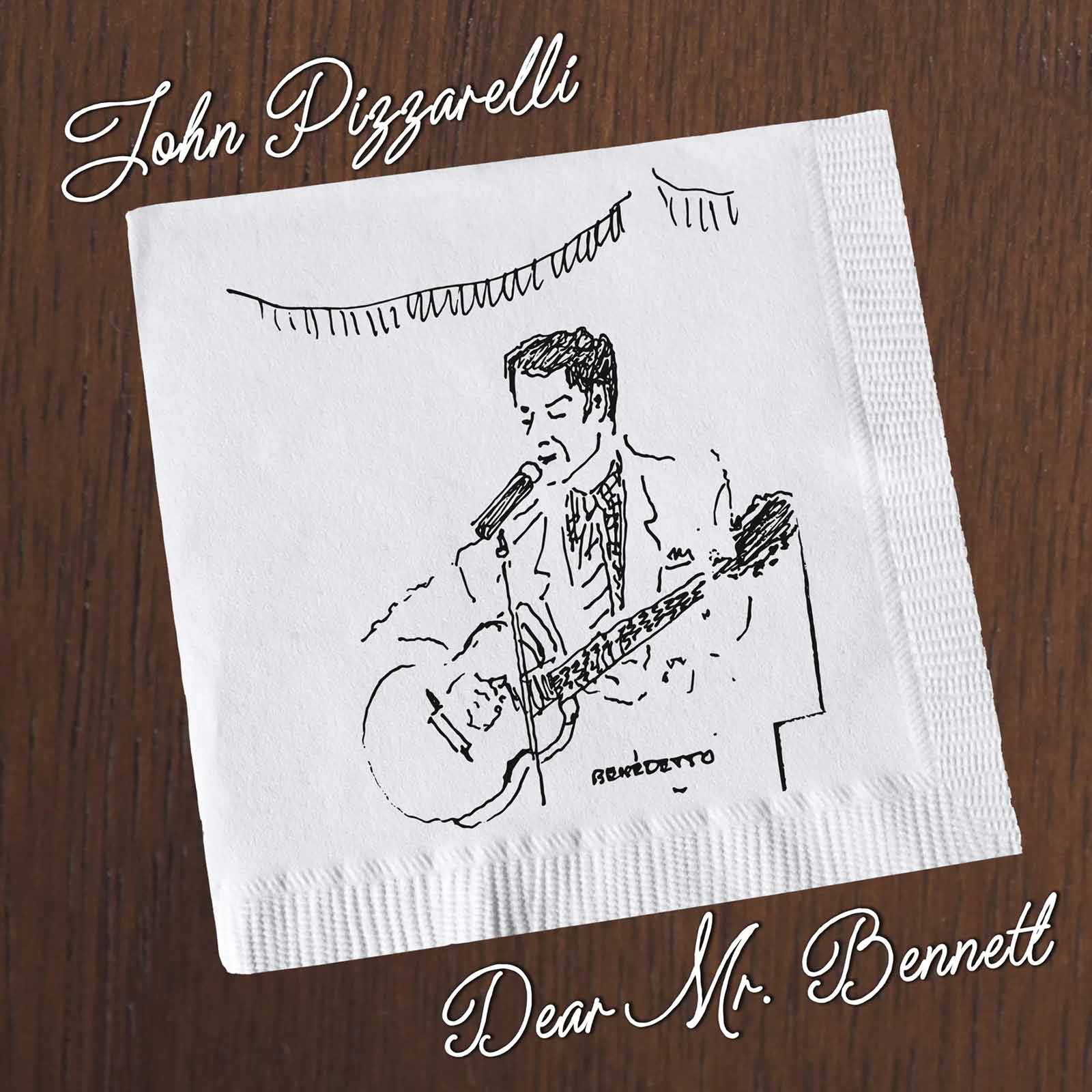
The album’s cover offers its own quiet testament to the bond between the two artists. Bennett, an accomplished painter, created Pizzarelli’s portrait during a performance at Feinstein’s at the Regency, inside the Loews Regency New York Hotel. The image, simple, affectionate, captures something essential about their relationship: mutual admiration rooted in craft.
For Pizzarelli, Bennett represents not merely a singer but a chapter in 20th-century cultural history. Few artists, across genres, have sustained such longevity or commanded such broad respect. From his early pop successes to the artistic reinvention that brought him into collaboration with figures like Bill Evans, George Barnes, and Ruby Braff, Bennett’s trajectory was one of continual refinement. Though often measured against Frank Sinatra, he carved out a legacy distinct in tone and temperament, less swagger, perhaps, but no less authority.
One of the album’s quiet triumphs is its balance between vocal and instrumental storytelling. Pizzarelli’s phrasing tends toward understatement; he resists melisma and instead lets the lyric sit comfortably within the groove. Meanwhile, the rhythm section maintains a buoyant but restrained swing, suggesting the intimacy of a late-night club set rather than a concert hall showcase. The cumulative effect is immersive. By the time the trio arrives at It Don’t Mean a Thing (If It Ain’t Got That Swing), the performance feels earned, playful, elastic and propelled by crisp guitar comping that nods to tradition while remaining unmistakably contemporary.
Yet the album’s significance extends beyond homage. At a moment when the Great American Songbook risks being treated as museum repertoire, Pizzarelli’s project argues for continuity over preservation. These songs endure not because they are encased in reverence, but because artists continue to reinterpret them, adjusting tempos, reframing harmonies, shifting emotional emphasis. In doing so, they remind listeners that standards are not relics; they are living texts.
If Bennett’s life embodied the possibility of reinvention, Dear Mr. Bennett suggests that reinvention is also the highest form of tribute. Pizzarelli honors the master not by echoing his sound, but by carrying forward his commitment to elegance, craft and curiosity. In an era hungry for novelty, there is something quietly radical about that choice.
It may well be among the most graceful tributes to Tony Bennett committed to record, a testament not only to a singular voice, but to the enduring conversation that is American jazz.
Thierry De Clemensat
Member at Jazz Journalists Association
USA correspondent for Paris-Move and ABS magazine
Editor in chief – Bayou Blue Radio, Bayou Blue News
PARIS-MOVE, March 4th 2026
Follow PARIS-MOVE on X

::::::::::::::::::::::::
Musicians :
John Pizarelly: guitar & vocals
Isahia J Thompson: piano
Mike Karn: Bass
Track Listing :
- Watch What Happens— 5:08
- The Best Is Yet To Come—2:34
- It Amazes Me—3:29
- Firefly—-1:24
- Boulevard of Broken Dreams—-4:41
- Because of You—3:56
- It Don’t Mean A Thing (If It Ain’t Got That Swing)—3:52
- Waltz For Debby—-2:50
- Young and Foolish—-4:42
- When In Rome—-2:39
- San Francisco—-2:25
- Shakin’ The Blues Away—-2:51
Upcoming Tour Dates
Mar 3-7 – Birdland – New York, NY
Mar 14 – Stewart Theatre – Raleigh, NC
Mar 29 – William Paterson University – Wayne, NJ
Apr 18 – Manchester Craftsmen’s Guild – Pittsburgh, PA
Apr 19 – Mountain Stage – Charleston, WV