
| Blues, Jazz |
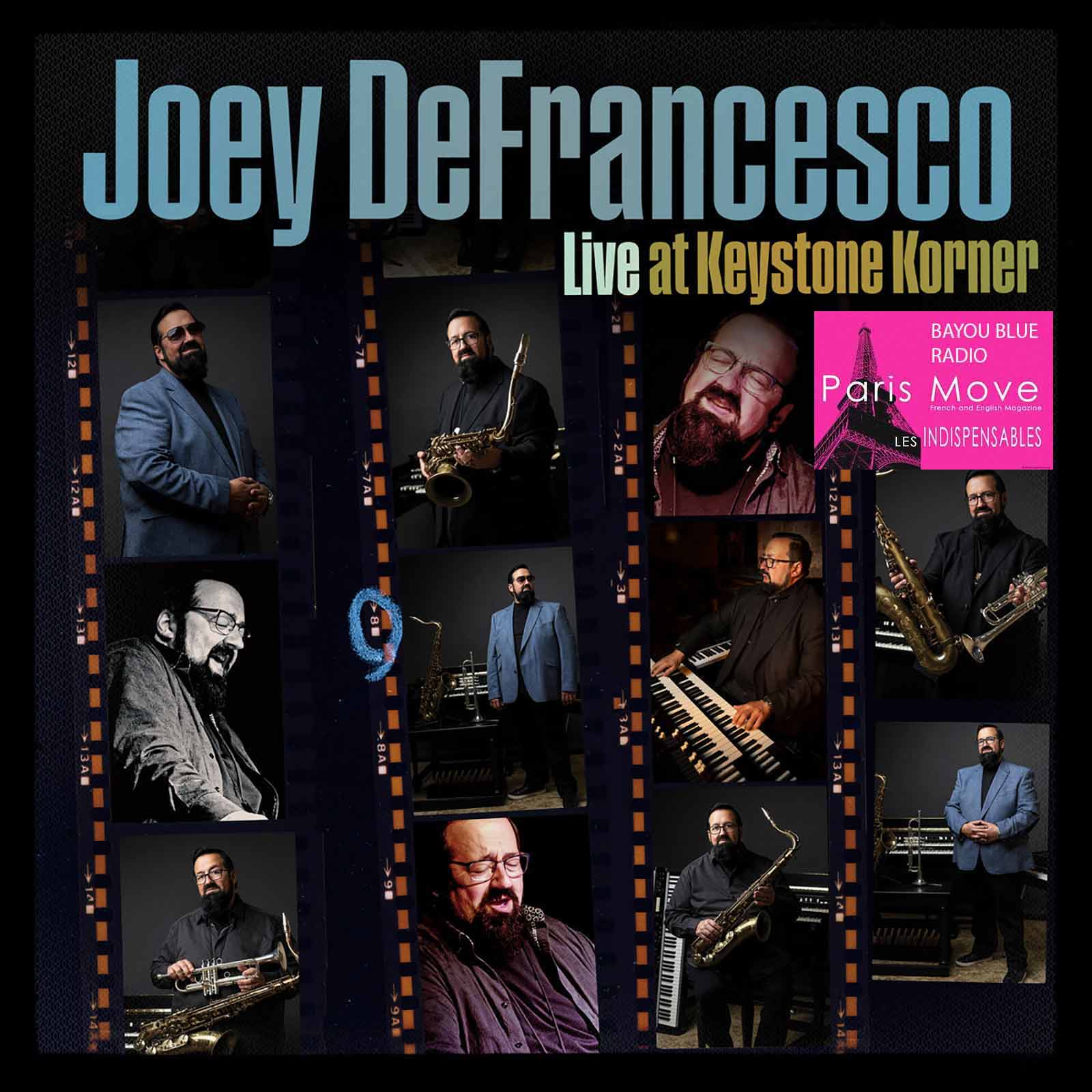
Summary: Joey DeFrancesco’s Live at Keystone Korner captures the legendary Hammond organist in his final recorded performances, revealing the enduring power, freedom and joy of his jazz.
Joey DeFrancesco: Live at Keystone Korner and the Music That Refuses to Die.
Well, it is raining. And as so often happens when the sky turns gray, when the light seems to have withdrawn from the world and the hours take on the uncertain color of memory, nostalgia eventually gets the better of reason. Sometimes all it takes is an album cover, a familiar face, a name we thought we had placed somewhere safely out of reach, for the past to return with almost painful clarity.
Looking at the cover of Live at Keystone Korner by Joey DeFrancesco, who died in 2022, I cannot help feeling something difficult to name. Some musicians survive their own death, not because their names have become monuments, but because their music retains the strange ability to enter our lives as though it had always belonged there. Joey was one of those musicians. He was not simply an organist, nor merely an extraordinary jazz player. He was one of those rare artists who seemed to understand very early that an instrument was not an object placed before him, but an extension of his own breathing. The Hammond organ, trumpet and saxophone were never just instruments in his hands. They were different ways of speaking the same language, until the distinctions between them gradually disappeared and, behind each one, there remained a single unmistakable voice: his own.
That is why I approach Live at Keystone Korner, his first posthumous album, with an emotion that is difficult to conceal. Recorded in Baltimore on August 12, 13 and 14, 2022, only weeks before his death, it is his last known recording as a bandleader. Its release in 2026 inevitably gives the music a particular resonance. Yet we should resist the temptation to turn the album into a musical tomb. Joey DeFrancesco does not play here like a man who knows he is about to disappear. He plays as he always did, with an almost insolent energy, an appetite for sound, a restless curiosity and an instinctive need to keep the music moving. That is precisely what makes the record so moving. Death is nowhere in these performances. It exists only in our ears, because we know what came next.
What strikes me first is that DeFrancesco still seems determined to move beyond everything we thought we knew about him. He could easily have remained within the role jazz history had assigned him: the great Hammond organ player, heir to Jimmy Smith and to a tradition he had become one of the most important figures in carrying into contemporary jazz. Instead, he kept moving. He plays organ through much of the program, but on “Free” he leaves the keyboards behind and picks up the trumpet, while on “Lady G” he turns to tenor saxophone. Lucas Brown moves from guitar to organ on those two pieces, while Anwar Marshall remains behind the drums. The exchange may seem like a small detail, but it reveals something fundamental about DeFrancesco. His musical identity did not depend on a particular instrument. It came before the instrument. Whether sitting behind the Hammond, putting a trumpet to his lips or reaching for the saxophone, he had the same instinct for shaping a phrase, making it breathe, placing it in time and, above all, allowing it to land exactly where it needed to. The timbre changes. The musical thought does not.
It is impossible to speak about Joey DeFrancesco without returning to the organ, because his story is also, in part, the story of an instrument. When the young musician emerged, the Hammond was no longer quite at the center of jazz modernity. Jimmy Smith, Larry Young, Shirley Scott, Richard “Groove” Holmes and many others had already established its importance, while the organ had left a profound mark on soul jazz, blues and rhythm and blues. But as so often happens in jazz, instruments that have enjoyed their moment in the spotlight eventually come to be regarded as representatives of another era. DeFrancesco refused that assignment. He did not pretend the Hammond was something it was not. He did something more important: he showed that it could still become something else. He brought it back into the present, restoring its power, sensuality and earthy character while revealing its ability to engage with contemporary musical languages. His role in the resurgence of the organ in jazz is now widely recognized, but familiar descriptions can sometimes obscure the essential point. Joey did not simply make an old instrument fashionable again. He made it necessary again.
The Hammond possesses a quality DeFrancesco understood instinctively: it can be a soloist, accompanist, bass player, rhythmic engine and harmonic instrument all at once. It can occupy the space of several musicians without ever giving the impression that it is alone. In lesser hands, that abundance can become clutter. In Joey’s hands, it became architecture. His feet and hands, his registrations, attacks and silences created a constantly shifting landscape. He could bring a bass line forward beneath a melody, suddenly thicken a chord, leave room for the drums and then return with a phrase that seemed to have been waiting for precisely that moment. Groove was not simply a matter of virtuosity for DeFrancesco. It was a way of inhabiting time. He did not merely play in tempo. He played inside the tempo, as though every beat contained a depth that had to be explored.
That is where his art becomes particularly compelling, because groove was never the opposite of sophistication in Joey’s music. Jazz has sometimes been divided, rather artificially, between those who value harmonic intelligence and those who embrace the immediate physical pleasure of rhythm, as though thinking and making people move had become incompatible pursuits. DeFrancesco had no use for that distinction. He could be harmonically formidable while remaining deeply connected to the blues, gospel, soul jazz and the pulse that gives jazz its almost physical dimension. His music could think without losing its body. It could be virtuosic without becoming cold, complex without feeling the need to advertise its complexity. That combination helps explain both his longevity and the singular place he continues to occupy.
Live at Keystone Korner makes that philosophy particularly clear. The group consists of only three musicians: DeFrancesco, Lucas Brown and Anwar Marshall. Yet at times the trio sounds like a quartet, even a quintet. The explanation lies not only in the possibilities of the organ, but in the way each musician occupies space. Brown does not simply accompany Joey. He participates in the conversation, leaves room, responds, pushes the music forward and then takes responsibility for the organ himself on two tracks. Marshall, meanwhile, is never reduced to the role of timekeeper. His drumming is living matter, supporting, pressing, holding back and releasing. At the center of this conversation, Joey distributes responsibility with remarkable freedom. He does not need to control everything in order to remain the group’s center of gravity. He understands that jazz begins precisely when musicians stop playing only for themselves.
That trust within the trio may be one of the recording’s most beautiful qualities. These are seasoned musicians who know their craft well enough that they no longer need to prove they can play. Demonstration gives way to listening. The themes are there like doors opening onto somewhere else. There are melodies, motifs and structures, but nothing feels permanently fixed. The music advances through small impulses, exchanges and intuitions. The concert becomes what a concert should be: a place where the work is never entirely finished. A studio can manufacture perfection. A stage creates something more fragile, more unpredictable and, for that very reason, more human. Keystone Korner becomes a space of encounter, and the recording preserves enough air around the musicians to give the listener the feeling of being there, only a few feet away.
The sound itself plays an essential role in creating that sense of proximity. The recording has the precision needed to distinguish the different layers of the trio without turning the music clinical. The organ retains its depth, warmth and slightly gritty power, the quality that gives it so much of its character. The guitar remains vivid. The drums breathe, with all their attack and resonance. But the most important thing lies elsewhere. An excellent recording matters only if it allows us to recover a sense of presence. This one does. What we hear is less a finished product than a moment captured. That is a considerable difference. On a studio album, a musician can become an image in sound. On a great live record, he becomes a body again, a presence in a room, a man playing before other people. Joey DeFrancesco needed that kind of space.
There is also something profoundly American about this music. Not postcard America, but the America of small clubs, churches, blues, gospel, neighborhood jazz and a long musical history in which the boundaries between genres have never been as rigid as historians sometimes pretend. DeFrancesco belonged to that tradition. He understood that jazz had never been a music confined by a definition. It could emerge from bebop, hard bop, blues, soul jazz, gospel or funk and then move somewhere else. That circulation is what makes his music so difficult to reduce to a category. We can call it organ jazz, of course, but that tells us very little. Soul jazz, contemporary jazz, groove: all of those descriptions are accurate, and all are insufficient. Joey DeFrancesco played jazz the way we inhabit a native language, without having to decide with every sentence which grammar to use.
His relationship with different instruments reinforces that impression. It is unusual for a musician to move from organ to trumpet to saxophone without giving the listener the feeling that three different personalities have entered the room. With Joey, the opposite happens. The instruments seem to communicate with one another. His trumpet does not imitate the organ, and his saxophone does not attempt to reproduce his keyboard playing. Yet in all three cases we hear the same conception of phrasing, the same attention to pulse, the same ability to bring the blues into a musical line without reducing it to a formula. He possessed a genuine instrumental intelligence. Each instrument gave him another way to say something, but what he had to say remained fundamentally the same.
On “Free,” when he takes up the trumpet and Lucas Brown moves behind the organ, that continuity becomes almost tangible. The organ has changed hands, but not its function. Freed from the keyboards, Joey projects his musical voice into the room with a different kind of breath. On “Lady G,” the tenor saxophone introduces another color. Again, this is not simply an exhibition of versatility. DeFrancesco is not reminding us that he can play several instruments. He uses them because the music calls for another voice. That distinction matters. With great multi-instrumentalists, virtuosity becomes truly interesting when it stops being visible.
The titles themselves seem, perhaps unintentionally, to form a kind of inner diary: “Awake and Blissed,” “Vibrations in Blue,” “Free,” “Lady G,” “In Times of Reflection,” “Inner Being,” “Roll With It,” “One More Blues.” From the titles alone, one might imagine a journey from awakening to reflection, from inward movement to a final blues. Yet we should resist reading the album solely through what we now know about Joey’s death. To do so would impose upon the music a meaning it did not possess when he played it. What is striking instead is the complete absence of any sense of ending. Even when the music becomes more meditative, it remains directed toward what comes next. DeFrancesco searches, listens and responds. He is not in memory. He is in the present.
That is perhaps what makes the idea of a posthumous album both accurate and inadequate. Yes, the record was released after his death. Yes, it is his last known recording as a leader. Yes, that knowledge inevitably changes the way we listen. But the music itself refuses the posture of a final statement. It is not a farewell. It is not a letter left on a table before departure. It is a concert. And that distinction matters. Joey DeFrancesco does not appear here as a figure frozen in jazz history, but as a musician still searching for something. There is something almost cruel about that realization. A few weeks after these concerts, he was gone. Yet during the hours preserved at Keystone Korner, nothing seems finished.
We begin to understand, then, what the death of a musician changes in our relationship with his work. Before his death, we listened to Joey for what he was. After his death, we also listen to him for what he represents. That is inevitable, but sometimes we have to resist that second reading. An artist should not be condemned to become his own monument. Perhaps the best way to remain faithful to him is to continue listening to his music with the same freedom he brought to his playing. Not to turn every note into a symbol. Not to search every silence for a premonition. Simply to let the music do its work.
Joey DeFrancesco leaves behind a substantial body of work, more than 30 albums, countless collaborations, major critical recognition and an influence extending far beyond the circle of Hammond organ specialists. But numbers, awards and biographies eventually reduce musicians to a series of lines. Music resists that reduction. It is harder to summarize. It demands that we listen. Perhaps that is where Joey’s real legacy lies. He did not simply demonstrate that an old instrument could find a place in modern jazz. He reminded us that tradition survives only when a musician is willing to bring it to life with his own body, his own contradictions and his own desires. The organ he inherited from Jimmy Smith and those who came before him is not the organ he leaves behind. Between the two stand his personality, his time, his encounters, his travels, his explorations and the curiosity that never left him.
There is something else worth recognizing, perhaps the most difficult quality of all to reproduce: pleasure. Joey loved to play. You can hear it. There is something deeply joyful in his music, even when it becomes dark. It is not a naive joy, but one born of an intimate knowledge of music: the pleasure of finding the right note, settling into the groove, making the drums answer, surprising the guitarist, shifting a phrase and feeling it land exactly where it should. It is a craftsman’s pleasure, almost physical. It reminds us that jazz is not only a history of ideas, but also a history of bodies, breath, hands, feet, vibrations and listening. With DeFrancesco, musical intelligence was never separated from the pleasure of playing.
That is why “One More Blues,” the album’s final track, resonates so deeply. One more blues. Nothing could sound simpler. And yet, after hearing Joey move from organ to trumpet, from trumpet to saxophone, after hearing the trio breathe together, the phrase acquires a depth we can no longer ignore. One more blues, as though the musician knew he could always play another. One more blues, like the blues we add to a conversation when we are not yet ready to go home. One more blues, because music never needs to know its final note in order to continue existing.
We know now that Joey will not play another. But he did not know that when he was on that stage. And that ignorance gives the record its most heartbreaking beauty.
So yes, it is raining. The album cover is in front of me, and Joey DeFrancesco is still alive there, as musicians remain alive in photographs taken before time closes the frame. There is something unjust about death, but there is also something extraordinary in the fact that a musician can continue to reach us after he is gone. In the end, I would rather think of Joey not as a musician who disappeared, but as a musician who left behind enough music to ensure that his absence would never be complete.
Live at Keystone Korner may be his final testimony, but it is nothing like a testament. It is a record that breathes, moves forward, searches, grooves and takes risks. A record that refuses to die because it is entirely devoted to that fragile and stubborn thing called the present. Joey DeFrancesco understood that you do not bring a tradition back to life by repeating it, but by giving it a new voice. He did it with the organ, then with the trumpet, then with the saxophone, always carrying that same invisible signature that was unmistakably his.
Today, when we put this record on, there is nothing left to do but listen. Listen to the Hammond breathe, the guitar answer, the drums push the music forward, the trumpet open the space, the saxophone extend the phrase. Listen and accept this strange truth: some musicians disappear, but their music stubbornly refuses to leave us.
Outside, the rain keeps falling.
And somewhere in the silence after the final note, Joey is still playing.
Thierry De Clemensat
Member at Jazz Journalists Association
USA correspondent for Paris-Move and ABS magazine
Editor in chief – Bayou Blue Radio, Bayou Blue News
PARIS-MOVE, October 5th, 2026
Follow PARIS-MOVE on X
::::::::::::::::::::::::
Musicians :
Joey DeFrancesco: Organ (1, 2, 5-8), Trumpet (3), Saxophone (4)
Lucas Brown: Guitar (1, 2, 5-8), Organ (3, 4)
Anwar Marshall: Drums (All)
Track Listing :
Awake and Blissed [Live]
Vibrations in Blue [Live]
Free [Live]
Lady G [Live]
In Times of Reflection [Live]
Inner Being [Live]
Roll With It [Live]
One More Blues [Live]
All songs by Joseph Frederick DeFrancesco • Joey DeFrancesco Music/ Modern Works Publishing (BMI)
Modern Works Music • Modernworkspublishing.com
Producer: Gloria DeFrancesco
Recorded at Keystone Korner in Baltimore, MD – August 12-14, 2022
Live Recording Engineer: Anthony Staiti
Mixed at Tempest Recording in Tempe, AZ
Mixing Engineer: Clarke Rigsby
Mastered at Vault Mastering in Chandler, AZ
Mastering Engineer: Nathan James