| Jazz |

Summary: With Late on Earth, Joel Lyssarides delivers a masterful work, a journey to the heart of the jazz trio, balancing classical precision with pure emotion.
In “Late on Earth,” Joel Lyssarides Proves That Jazz Can’t Be Replicated by an Algorithm
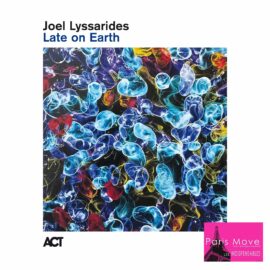
In the landscape of contemporary European jazz, few names carry the weight of legacy and innovation quite like Joel Lyssarides. As a key collaborator with trombonist Nils Landgren and a vital voice in the tribute to the legendary Esbjörn Svensson Trio (e.s.t.) alongside Dan Berglund and Magnus Öström, Lyssarides has long been a sentinel of the “Swedish Sound.” Yet, with his latest album, Late on Earth, he steps fully into his own light, offering a masterwork of form that seeks to elevate structure and substance to equal footing.
The album announces itself from the outset as a work of broad cultural fluency, at once classical, folk, and jazz. Making music, Lyssarides suggests, resembles the search for grains of sand in the desert: an ongoing journey marked by a multitude of small steps. His art feeds on the microscopic: the finest gradations of nuance, subtle harmonic shifts, and a dynamic tension that feels lived-in rather than manufactured.
Each of the album’s twelve pieces unfolds like a distinct voyage, traversing lands both familiar and imagined. Within them, the composer shapes atmospheres with a singular force, imbued with melodies each more arresting than the last. Lyssarides belongs to that generation of musicians who long ago left stylistic borders behind, a versatility evidenced by his work scoring video games and pop productions. And yet, the piano trio remains the beating heart of his work, the formation in which his musical universe unfolds with the greatest spontaneity.
Late on Earth is the result of an unusually prolonged and intense creative process. Over more than four years, the music took shape through a close exchange with producer Andreas Brandis. This creative dialogue encouraged Lyssarides to venture into new, often vulnerable, territories.
“It was almost therapeutic,” he reflects. “On the one hand, Andreas understands what moves me and what my musical capacities are; but I also shared many of my doubts with him. In the end, we decided everything together. It helped enormously. I don’t think I’ve ever managed, on a recording, to capture so honestly who I am and what I feel.” The thought brings a smile: “For the very first time, I even included pieces composed in a major key.”
As the album unfolds, one senses that this pianist moves to his own internal rhythm. In that sense, he stands as the inverse of the character Reiko in Yukio Mishima’s novel Music, who suffers from an emotional paralysis that renders her unable to hear melody. Lyssarides, by contrast, seems to construct entire worlds within his memory; from these worlds emerge compositions like springs of a creativity that is both abundant and rigorously structured.
In an era defined by the rise of the algorithmic, Lyssarides’ philosophy feels like a necessary rebellion.
“Especially at a time when music is increasingly smoothed over digitally, or even entirely generated by AI, Andreas was interested in the exact opposite, the human element,” he says. “In the end, it is often the small imperfections that give life to music. It emerges from immediate experience, capturing the search for oneself, for one’s own sound.”
This search for the “self” through the elements, sand, wind, and tide, mirrors the lyrical depth of the great French poets. To listen to Late on Earth is to feel the same melancholic pull found in Léo Ferré’s maritime masterpiece, Le vieil homme et la mer, where the poet finds his own ghost reflected in the shifting rhythms of the coast:
La marée, je l’ai dans le coeur
Qui me remonte comme un signe
Je meurs de ma petite soeur,
De mon enfant et de mon cygne
Un bateau, ça dépend comment
On l’arrime au port de justesse
Il pleure de mon firmament
Des années lumières et j’en laisse
Je suis le fantôme jersey
Celui qui vient les soirs de frime
Te lancer la brume en baiser
Et te ramasser dans ses rimes
Comme le trémail de juillet
Où luisait le loup solitaire
Celui que je voyais briller
Aux doigts du sable de la terre
Inevitably, this music connects to any literary source of real depth; it is the kind of meaning only an artist who works profoundly can produce. To arrive there requires being uncompromising with oneself and gentle with others. Music is wired into us, jazz lives in the soul, and everything else is mere triviality.
Late on Earth is an album that takes you by the hand and summons you unexpectedly, just when you least anticipate it. It is, quite simply, admirable.
Thierry De Clemensat
Member at Jazz Journalists Association
USA correspondent for Paris-Move and ABS magazine
Editor in chief – Bayou Blue Radio, Bayou Blue News
PARIS-MOVE, March 26th 2026
Follow PARIS-MOVE on X

::::::::::::::::::::::::
Musicians:
Joel Lyssarides, piano
Niklas Fernqvist, bass
Ramus Blixt, drums
Track Listing:
1. Bortom Bergen
2. Mahabalipuram
3. Life in Between
4. In Itinere
5. Sotira
6. Never Alone
7. Raqs Sharqi
8. Folie À Deux
9. Intermission
10. Anemoia
11. Follow the Night
12. Late on Earth