| Jazz |
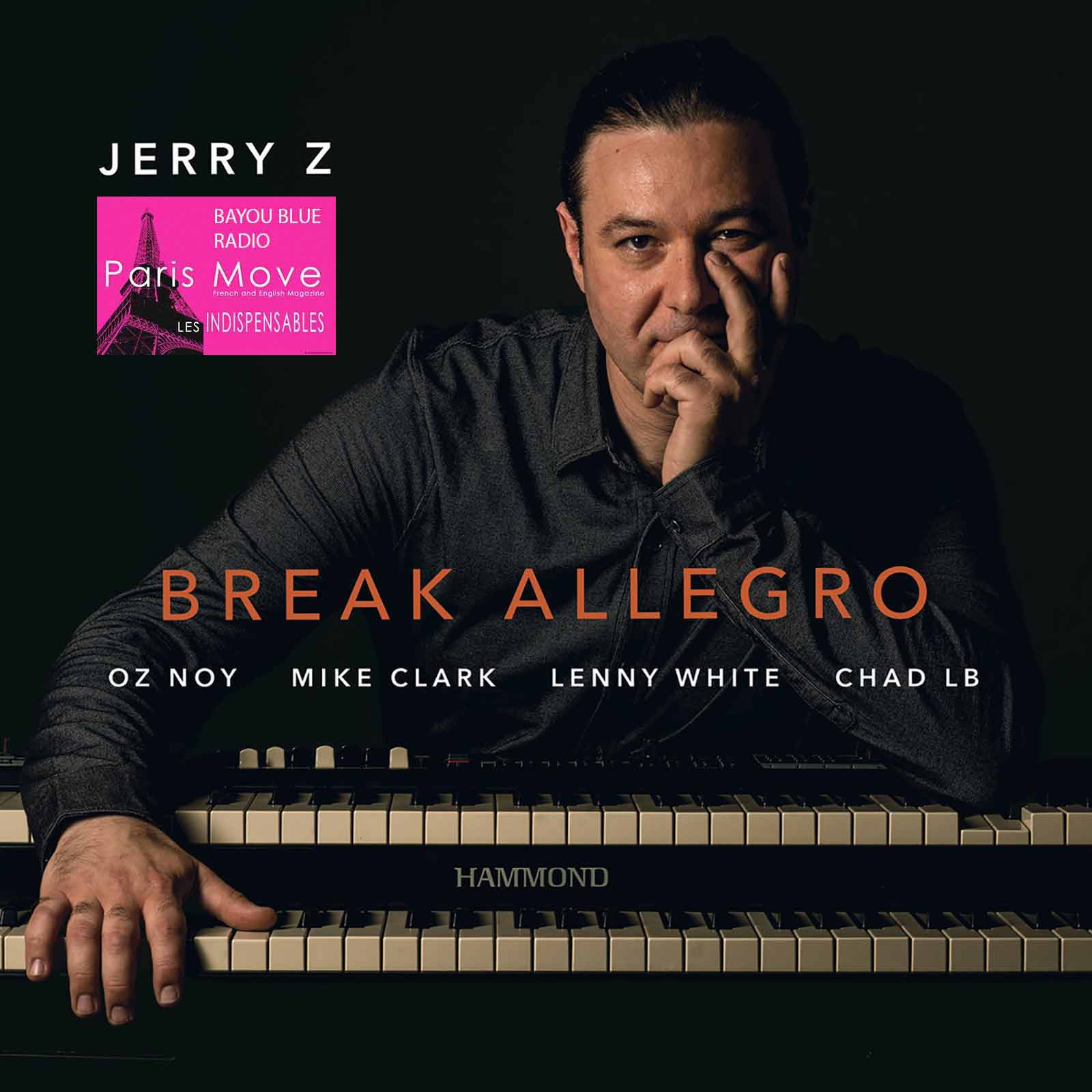
Summary: Jerry Z’s Break Allegro brings the Hammond B3 into a dynamic modern jazz setting, blending jazz, funk, blues and fusion with Mike Clark, Lenny White, Oz Noy and Chad LB.
Jerry Z’s Break Allegro: Reinventing the Hammond B3 Through Jazz, Funk and Blues
How do you innovate on an instrument as burdened by history as the Hammond B3? It is a question that sounds almost provocative because the Hammond carries so much with it: decades of jazz, blues, soul, funk and gospel, along with an entire sonic vocabulary that can be recognized almost instantly. A few notes can summon an era, a club, a musician, a particular idea of groove, or that unmistakable sensation that the music is somehow breathing through the instrument itself. Over the years, the Hammond has become far more than a keyboard. It has acquired its own language, its own habits, its own pantheon of players and, almost inevitably, its own mythology. The challenge, then, is not simply to make the instrument sound different. It is to move it forward without either repeating its past or pretending that past never existed. Jerry Z seems to have been wrestling with that question for some time, and Break Allegro offers an answer that is neither a dramatic break with tradition nor an exercise in nostalgia. Instead, the album puts the Hammond back into motion. It places the instrument inside a band rather than above it, and lets it interact with musicians whose careers have themselves crossed several chapters of modern jazz. From the opening moments of the title track, Jerry Z makes the philosophy clear. The Hammond is powerful, warm and occasionally biting, but it never attempts to dominate the room. The music unfolds almost like a friendly argument between instruments, each one listening for an opening before answering the other. There is a playful quality to it, at times almost cartoonish, with themes that seem to grin while concealing a much more carefully constructed musical architecture underneath. That tension between immediacy and sophistication is one of the album’s first pleasures. Break Allegro is easy to enter, but the longer you stay with it, the more clearly you hear how much craft is hidden beneath its apparent ease.
Jerry Z could have made a very different record. Put a Hammond B3 at the center of an ensemble featuring musicians of this caliber, and the temptation to turn the album into a virtuoso showcase would be understandable. Push the organ forward, stretch out the solos, and let everyone else build a sophisticated backdrop around it. Instead, Jerry Z does something more difficult and, ultimately, more revealing. He makes room. The organ is not an authority assigning functions to the rest of the band. It is a participant. That distinction is central to the album. Jerry Z knows exactly how much the Hammond can do, but he also seems to know when it should do less. He does not fill every available space simply because he can. He allows the music to breathe, gives the other musicians room to develop their own ideas and accepts that a passage may belong to the drums, the guitar or the saxophone. The result is not merely an album featuring several accomplished players. It is an actual conversation among musicians with distinct identities. That sense of collective purpose gives Break Allegro a significance beyond the familiar category of the Hammond organ record. The instrument may be the point of departure, but the destination is the band.
The title track makes that approach especially clear. Its energy is immediate enough to pull in listeners who might not ordinarily think of jazz as an accessible proposition, yet it never settles for being a string of grooves. The themes sometimes suggest scenes or movements, almost as though the music were quietly scoring a film. There is a mischievous quality to the writing, an insistence that sophistication does not have to arrive wearing a serious expression. Yet the apparent playfulness is underpinned by an exacting sense of structure. Every instrument has a role, but none is confined to it. The Hammond supplies harmonic weight and its unmistakable color; the guitar introduces another kind of tension; the drums keep shifting the center of gravity; the saxophone changes the way the music breathes and the way its phrases are divided. Nothing stays fixed for very long. Roles circulate. That is where the album becomes more interesting than a showcase of individual technique. Jerry Z is not trying to make complexity visible. He is trying to make contrasting musical personalities work together without sanding away what makes each of them distinctive. That ability to organize individuality without suppressing it is one of the clearest signs of a mature bandleader.
Mike Clark is crucial to that equation. His presence is not simply a matter of adding a renowned drummer to a Hammond-led session. Clark’s history helps explain the unusual elasticity of the music. Through his work with Herbie Hancock and the Headhunters, among many other projects, he belongs to a generation of drummers who changed the role of rhythm in jazz. Groove, in that world, is not merely a foundation on which soloists can stand. It becomes a musical voice of its own. The drums can comment on a phrase, redirect the momentum, provoke another player or quietly change the destination of an entire passage. On Break Allegro, Clark has the rare ability to make intricate decisions sound completely natural. An accent lands with astonishing precision. A break appears almost casually. The band shifts, finds its balance again and moves on before the listener has had time to analyze what just happened. There is considerable experience behind that ease, but Clark never turns experience into a demonstration of authority. He plays for the music. He gives the pieces their physical pulse, their character and, at times, their sense of humor, while knowing exactly when to leave space for someone else. That restraint matters. Jerry Z has assembled musicians capable of extraordinary things, but the album works because no one seems compelled to prove it at every turn.
The relationship between the drums and the Hammond is particularly important because the B3 comes with its own gravitational pull. It can fill a room almost by itself. It can create a massive sonic presence and establish the identity of a piece within seconds. But presence and domination are not the same thing, and Jerry Z understands the difference. His Hammond can become a sustained texture, a melodic voice, a harmonic foundation, a rhythmic engine or a brief punctuation. Its power is always available, but it is not always deployed at full volume, metaphorically or otherwise. That flexibility allows the music to move between jazz, funk, blues and fusion, with occasional flashes of rock, without sounding like a tour through a list of genres. These traditions are not presented as separate destinations. They are part of the vocabulary. Jerry Z knows them well enough not to have to announce them. The music does not stop to say, here comes the funk, now we are playing blues, and now we are returning to jazz. Those elements simply coexist, as they have in the musical lives of the players themselves.
Oz Noy’s guitar is one of the reasons that coexistence remains so lively. An electric guitar and a Hammond B3 can easily become territorial neighbors, each fighting for the same frequencies, the same rhythmic space and the same attention. Noy and Jerry Z avoid that trap through a remarkably simple principle: they listen to one another. Noy does not merely reinforce what the organ is doing. He responds to it. His guitar can be sharp, muscular and almost abrasive, but it can also become lyrical or understated. It introduces another texture and another way of shaping a musical sentence. When the organ builds a wall of sound, the guitar can cut through it. When Jerry Z establishes an idea, Noy can extend it, bend it or send it in another direction. Their exchanges generate sparks without turning every encounter into a contest. That balance gives the album an electric edge without reducing it to a recreation of 1970s fusion. The history is audible, but it has been metabolized rather than reproduced.
That distinction is important because Break Allegro could easily be misread if the album were reduced to the names on its personnel list. Mike Clark, Lenny White, Oz Noy and Chad LB each bring enough history to the table to justify a separate discussion. But the record’s real interest lies elsewhere. It is in the way those histories become part of a new collective language. Jerry Z does not seem to have assembled a band simply because its members have impressive résumés. He has assembled musicians who can make his compositions breathe. Their backgrounds are present, but they are not displayed like museum pieces. You hear Clark’s relationship with funk, White’s experience with fusion, Noy’s connection to blues and electric jazz, and Chad LB’s command of the modern saxophone tradition. But these influences have become instincts. They emerge in the placement of a note, the shape of a phrase, the timing of an accent or the way a musician responds when another player changes direction. The history is there without becoming the subject of the music.
Road Dog, featuring Lenny White, makes that especially apparent. White’s career runs through some of the most consequential chapters of modern jazz, from his work with Miles Davis to Return to Forever and a long list of collaborations with major figures. But the important question here is not where he has been. It is what he brings to this particular music. White approaches rhythm differently from Clark. He can open the space, stretch the pulse and shift accents in ways that make the music feel as though it is moving through a wider landscape. His playing carries the idea that a drummer does not necessarily exist to keep a band in place. Sometimes the drummer’s job is to move the band. On Road Dog, that quality becomes palpable. The track moves forward without ever traveling in a perfectly straight line. The organ, guitar and drums occasionally seem to lean in different directions before finding one another again. The tension is not a problem to be solved. It is the source of the track’s energy.
Jerry Z’s writing succeeds because it provides enough structure for these personalities to matter without forcing them into predetermined roles. That is harder than it sounds. With an instrument as dominant as the Hammond B3 at the center of a project, the simplest solution would have been to make the organ the unquestioned center of gravity and ask everyone else to orbit around it. Jerry Z does the opposite. He makes the Hammond the beginning of a conversation. The compositions have identities of their own, but they remain open enough for the musicians to reshape them in real time. The result is a record in which arrangement and improvisation do not feel like competing ideas. They reinforce one another.
The two covers deepen that idea. Strange Brew, associated with Eric Clapton, Felix Pappalardi and Gail Collins, could easily have become a respectful trip back to a particular moment in rock history. Jerry Z has little interest in simply paying tribute. He takes the song, keeps what makes it compelling and places it in another musical environment. Oz Noy’s guitar fits naturally into the new setting, while the Hammond alters the song’s center of gravity. The rhythm section gives it another physical dimension, and gradually the familiar material begins to sound less like an artifact being revisited and more like something being rediscovered. That is the difference between reproduction and reinterpretation. The point is not to remind the listener that the musicians know the original. The point is to find out what the original can still become. For Jerry Z, tradition appears to be less a rulebook than a body of material that remains available for transformation.
Bebop, by Dizzy Gillespie, presents a different challenge. Strange Brew carries the memory of psychedelic rock and electric blues; Bebop leads directly into one of the foundational languages of modern jazz. The danger here would have been reverence, an interpretation so respectful that it became almost academic. Jerry Z again chooses movement over preservation. Chad LB brings a different speed and articulation to the material, while the rhythm section has to maintain the tension built into the composition. The Hammond adds a density and harmonic weight that do not belong to the conventional image of bebop, and that collision is exactly what makes the interpretation work. The composition remains recognizable, but it is no longer treated as untouchable. A historic piece meets a contemporary ensemble, and the past remains present without being placed behind glass.
That may be the most important quality of Break Allegro. The album is not afraid of its own history, and it does not need to pretend that history is irrelevant in order to sound contemporary. Its modernity comes from the musicians themselves and from what they choose to do with traditions they have inherited. Jazz does not stay alive by abandoning its past. It stays alive because musicians keep deciding what that past means in the present. Jerry Z understands that tension. The Hammond B3 is unmistakably tied to a particular history, but he refuses to become confined by it. He uses the sound listeners expect, then places it in circumstances they may not expect. That is a much subtler form of renewal than trying to disguise the instrument as something else.
There is also a lightness running through the record that feels particularly revealing. Jerry Z does not seem to believe that serious musicians have to make serious-looking music. Some of the themes are mischievous. Some exchanges seem designed to raise a smile. Certain passages feel as though the musicians are enjoying the joke before the listener has quite figured out what the joke is. Yet none of this is casual in the careless sense. The apparent looseness depends on an extraordinary degree of control. This is one of the paradoxes of mature musicianship: once technique has been fully absorbed, it becomes less visible. It turns into freedom. A player who no longer needs to prove that he can execute a difficult phrase can choose three notes instead, provided they are the right three notes. Jerry Z appears comfortable enough in his own language to make those choices.
That confidence is also audible in the album’s use of space. The Hammond can easily occupy every corner of a recording, but Jerry Z understands that density without contrast quickly becomes exhausting. The music needs air. A phrase needs somewhere to land. The drums sometimes have to pull back so that a guitar line can acquire another dimension. The saxophone needs room to breathe. The organ itself becomes more powerful when it is not constantly operating at maximum intensity. This management of space is one reason the album reveals more of itself with repeated listening. It works perfectly well as a groove-driven record, but closer attention exposes the architecture underneath. What initially feels spontaneous turns out to be carefully balanced.
Chad LB plays an important role in expanding that palette. His saxophone prevents the album from becoming locked into a conversation among Hammond, guitar and drums. He introduces another color and another way of shaping time. His playing can be melodic, nervous, sharp or reflective, and those shifts fit naturally into Jerry Z’s broader conception of the ensemble. Again, the saxophone is not being brought in as decoration. Chad LB becomes part of the group’s identity. That matters because it allows the compositions to remain open even when their basic structures are clearly established.
Jerry Z’s own musical development helps explain why all of this feels so natural. Mastering an instrument to this degree takes years of work, but technique alone cannot produce this kind of openness. A musician has to listen to other musicians, step outside his own vocabulary, absorb unfamiliar approaches and, at times, question habits that once seemed permanent. Musical identity is not built in isolation. It is built through contact, friction and exchange. Break Allegro sounds like the work of an artist who has reached a point where confidence in his own voice makes him more willing, not less, to let other voices change it.
That also explains why the album’s title feels less like a statement than an invitation. Break Allegro is not a proclamation about virtuosity. It is closer to a suggestion that virtuosity can be interrupted, redirected and made more interesting by allowing the music to breathe. The momentum is there. The energy rarely disappears. But the record does not spend its time chasing technical fireworks. It advances through breaks, exchanges and changes of perspective. Just when the listener thinks the shape of a piece has become clear, something shifts. A drum accent changes the balance. A guitar phrase redirects the conversation. A harmonic turn opens another door. In that sense, the title almost describes the music itself: break the forward motion so that it can begin again from somewhere unexpected.
That is ultimately what makes Break Allegro worth hearing as more than another album centered on the Hammond B3. Jerry Z is not trying to prove that the Hammond can still be modern. He treats modernity as something the instrument never lost. The distinction is important. There is no reason to erase the Hammond’s history in order to move beyond it. The real challenge is to stop repeating that history. The organ remains warm, powerful and unmistakable, with its almost physical ability to fill a room, but Jerry Z places it inside an ensemble that refuses simple hierarchies. The principal instrument becomes one voice among several. Paradoxically, that apparent limitation gives it more freedom.
As the album progresses, the element of surprise never quite disappears. You think you know where a track is going, and then a drum figure, a guitar phrase, a harmonic shift or the entrance of the saxophone changes the balance. The original compositions benefit from that flexibility, but so do the covers, which reveal Jerry Z’s instinct for turning familiar material into something less predictable. The album never feels as though it is collecting references for the sake of showing off its cultural knowledge. The references are simply part of the musicians’ musical vocabulary. There is a fundamental difference between a record that displays its influences and one that has absorbed them deeply enough to stop worrying about where one influence ends and another begins.
The reward is an album that can be heard on several levels. You can come to it for the immediate pleasure of the funk, the colors of the blues, the physical force of the Hammond, the rhythmic intelligence of Mike Clark and Lenny White, the electric bite of Oz Noy or the voice of Chad LB’s saxophone. You can also return to the compositions and begin to hear their underlying architecture, the way one musician responds to another and the care with which the arrangements prevent any single voice from overwhelming the rest. That kind of repeatability matters. It suggests that the music has enough depth to remain engaging after the initial rush of recognition has passed.
Break Allegro is, undeniably, a Hammond B3 album. But that description is also too narrow. At its core, this is an album about the collective: about musicians carrying different histories into the same room and finding ways to make those histories coexist without turning them into categories. Jerry Z knows his instrument deeply, but perhaps his most important skill is knowing when to give it less room. That decision gives the music its breathing space and allows every player to contribute to the larger narrative. The Hammond remains central, but it does not rule.
And that may be the album’s quietest achievement. Break Allegro does not need to be a show of strength, even though there is strength everywhere in it. Nor does it argue that jazz must reinvent itself every few minutes to remain relevant. It simply accepts something more fundamental: music keeps evolving when musicians keep listening. Jerry Z takes an instrument loaded with history and places it in a present where jazz, funk, blues and fusion can still meet without asking permission from the traditions that created them. The result is lively, generous, occasionally mischievous and often surprising, but above all deeply musical. To renew an instrument as historically marked as the Hammond B3, Jerry Z suggests, you do not have to make it forget where it came from. You have to give it new voices to answer, new compositions to inhabit and enough freedom for something unexpected to emerge from a sound we thought we already knew.
Thierry De Clemensat
Member at Jazz Journalists Association
USA correspondent for Paris-Move and ABS magazine
Editor in chief – Bayou Blue Radio, Bayou Blue News

PARIS-MOVE, October 1st, 2026
Follow PARIS-MOVE on X
::::::::::::::::::::::::
NYC for the record release concert, @ IRIDIUM – DEC 15, 2026
Musicians :
Jerry Z – Hammond B3
Oz Noy – guitar
Chad LB – tenor saxophone
Mike Clark – drums, tracks 1, 2, 4, 7 & 8
Lenny White – drums, tracks 3, 5, 6 & 8
Joe Dyson – drums, tracks 4 & 6
Daniel Sadownick – percussion, tracks 3 & 8
Track Listing:
- Break Allegro – 7:11 (Jerry Z)
- Rego Park – 6:13 (Jerry Z)
- Strange Brew – 5:16 (Eric Clapton, Felix Pappalardi, Gail Collins)
- Zoya – 5:31 (Jerry Z)
- Road Dog – 7:03 (Jerry Z)
- Angelie – 6:35 (Jerry Z)
- Bebop – 6:04 (Dizzy Gillespie)
- In the Garden – 4:44 (Jerry Z)
Produced by Oz Noy & Jerry Z
Recorded January 2026 at Studio Mozart
Mixing: Kostadin Kamcev
Mastering: Jim Brick, Absolute Audio