
| Jazz |
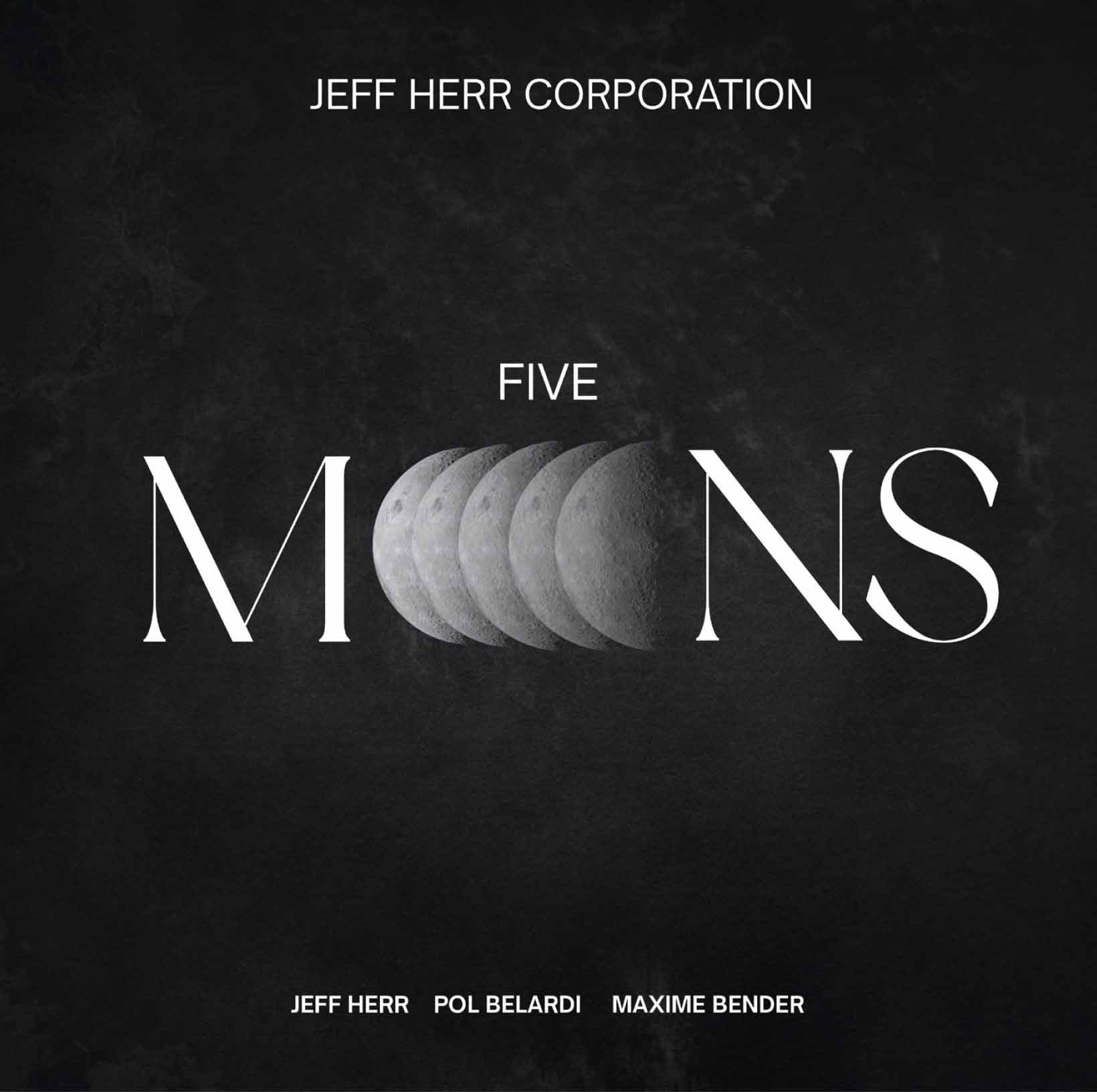
There are albums that reveal their character immediately, and others that ask us to reconsider what we think we know about jazz. Five Moons, the latest project by Luxembourg drummer and composer Jeff Herr, belongs to the latter category. Its appeal lies not simply in the music itself, but in the way it brings together seemingly disparate traditions, allowing acoustic jazz, electronic textures, rock-inflected rhythms and contemporary improvisation to coexist without forcing them into a predetermined formula. What emerges is a musical landscape in which the familiar is continually unsettled, where a groove can become a point of departure rather than a destination, and where the musicians seem less interested in demonstrating their individual abilities than in discovering what might happen when their ideas collide.
Herr’s musical identity has developed in a country whose geographical position has long encouraged movement between cultures. Luxembourg sits at the crossroads of France, Belgium and Germany, a small European nation shaped by the circulation of languages, ideas and people across borders. Such circumstances do not automatically produce a distinctive artistic voice, but they can create an environment in which cultural categories feel less rigid than they do elsewhere. Jazz has always flourished through precisely this kind of exchange. Born from encounters between musical traditions, it has repeatedly renewed itself by absorbing influences that once appeared to belong outside its boundaries. In Luxembourg, where the international character of everyday life is difficult to ignore, that openness has particular resonance. Herr’s music does not attempt to represent the country in any literal sense, yet its refusal to settle comfortably within a single stylistic identity seems entirely consistent with the place from which it emerges.
The Luxembourgish scene has also benefited from musicians and composers willing to establish connections between jazz and other forms of contemporary music. Composer and trumpeter Gast Waltzing is among the figures who have helped demonstrate that jazz can remain rooted in improvisation while engaging with orchestral writing, popular music and broader musical experimentation. Herr belongs to a generation for whom these exchanges are no longer exceptional. The boundaries separating jazz, rock, electronic music and pop have become increasingly porous, although the freedom to cross them does not guarantee that the results will be artistically convincing. The real challenge is to make those influences serve a coherent musical purpose rather than turn them into a catalogue of references. Five Moons is at its most compelling when it meets that challenge, allowing different musical languages to interact without making the listener feel that a stylistic change has been introduced merely for effect.
Herr founded Jeff Herr Corporation in 2004, establishing an ensemble that could explore the possibilities of contemporary jazz beyond the conventional expectations attached to a drummer-led group. The project later entered a period of inactivity lasting five years before being revived in 2025. That return is significant not because it suggests a nostalgic reunion, but because it offers the opportunity to reconsider an existing musical identity in the light of new experiences and changing artistic priorities. A band that resumes its work after such a long interruption cannot simply pick up where it left off. Its members have moved on, their listening has changed, and the musical environment around them has continued to evolve. The question is whether the renewed collaboration can turn that distance into something productive. On Five Moons, the answer is most apparent in the tension between structure and freedom, between the physical immediacy of the groove and the more elusive possibilities opened up by electronics and improvisation.
The album also emerged from a period of sustained collective work. From December 2024 through April 2025, the musicians undertook a residency at Neumünster, creating the conditions for an extended dialogue in which ideas could be tested, discarded, transformed and gradually brought into focus. Such a process matters in music that depends on interaction. Rehearsal is not simply a means of preparing material for performance; it can become a laboratory in which musicians discover how much space a composition needs, when a rhythmic pattern should remain stable and when it must be allowed to dissolve. The most interesting moments in this kind of music often arise not from the execution of a plan but from the willingness to depart from it. A residency offers time for those departures to become meaningful, helping a group develop a shared instinct that cannot be manufactured through technical proficiency alone.
The trio brings together Herr on drums, Maxime Bender on tenor and soprano saxophones, and Pol Belardi on bass and synthesizers. Each contributes a different dimension to the ensemble, but the music depends on the relationships between them rather than on a simple division of roles. Bender’s saxophones can provide a recognisable melodic line, yet they are not confined to the task of carrying a theme above the rhythm section. Their phrases can cut through the arrangement, challenge its momentum or hover at its edges, leaving room for the other musicians to redirect the music. Belardi’s combination of bass and synthesizers is equally important. The bass supplies a physical centre, while the electronic sounds expand the harmonic and atmospheric possibilities of the group. Herr, meanwhile, must do more than maintain time. His drumming determines how the music breathes, when it gathers force and when it can afford to become unstable.
That interaction gives Five Moons much of its character. The groove is present, often insistently so, but it rarely functions as a comfortable resting place. Instead, it creates a framework within which the musicians can explore rhythmic displacement, changes in density and unexpected shifts of atmosphere. Herr understands that a drummer’s authority does not depend on filling every available space. Sometimes the most effective gesture is a sharp accent; at other moments, it is the decision to hold back, allowing a phrase to unfold without immediately defining its direction. The distinction is crucial. A rhythm section can make music feel energetic while leaving it static, just as an intricate arrangement can generate constant activity without producing any real sense of movement. Here, the strongest passages are those in which the pulse remains alive, capable of changing character as the other instruments respond.
Belardi’s synthesizers bring another layer to this exchange. Their presence recalls the period during the 1970s when electric keyboards and electronic timbres began to alter the vocabulary of jazz, expanding the possibilities of harmony, texture and rhythm. The Moog synthesizer became one of the emblematic instruments of that transformation, associated with musicians who wanted to move beyond the established sound of the acoustic ensemble. But the significance of that period was never simply technological. Electronics offered a new way to think about musical space, allowing sustained tones, unusual textures and unfamiliar timbres to become active elements in the composition. Five Moons draws on that history without treating it as a museum piece. The electronic dimension is most effective when it changes the listener’s perception of the ensemble, making the music seem at once more expansive and less predictable.
There is a danger, of course, in treating the presence of synthesizers as an automatic sign of modernity. Electronic sounds can be as formulaic as any acoustic convention, and a reference to the adventurous music of the 1970s can easily become an exercise in stylistic nostalgia. The question is not whether a particular instrument sounds contemporary, but what the musicians are able to do with it. On this album, the combination of bass and synthesizers gives Belardi considerable freedom to move between rhythmic grounding and atmospheric intervention. At times, the electronic textures reinforce the groove; elsewhere, they complicate it, introducing a sense of distance or ambiguity that prevents the music from becoming too predictable. The result is not always seamless, but the occasional friction is part of the appeal. A music that seeks to bring different worlds together should not necessarily eliminate every trace of their difference.
Bender’s contribution is essential to that balance. The tenor and soprano saxophones provide a human, breath-driven presence within a sound world that can otherwise become increasingly abstract. His playing has to negotiate several demands at once: the melodic expectations associated with jazz, the rhythmic energy of the ensemble and the more open possibilities created by the electronic arrangements. The saxophone can act as a guide, giving the listener something to hold on to, but it can also resist that role, extending a phrase or redirecting its momentum. The most revealing exchanges occur when the instrument does not merely sit on top of the rhythm section but becomes part of its internal conversation. At those moments, the music acquires a collective quality that cannot be reduced to the familiar image of a soloist accompanied by a band.
This is where the album’s approach to improvisation becomes particularly interesting. Improvisation is often described as freedom, a word that can obscure the discipline required to make spontaneous decisions meaningful. In a group such as this one, freedom depends on listening as much as on invention. Each musician must remain alert to what the others are doing, recognising when an idea deserves to be developed and when it has reached its natural limit. A rhythmic figure can become a point of departure for the saxophone; a synthesizer texture can change the way the drums are heard; a melodic fragment can return after an apparent disappearance and acquire an entirely different meaning. Such developments are not necessarily dramatic in themselves. Their importance lies in the way they alter the relationship between the musicians and the listener, gradually revealing a structure that may not have been obvious at first.
The influence of rock and pop adds another dimension to the music, particularly in the way the compositions approach repetition and momentum. Jazz has never been entirely separate from popular music, despite the distinctions that critics and institutions have sometimes drawn between them. Its history is filled with exchanges involving blues, rhythm and blues, soul, funk, rock and other forms of music built around a strong rhythmic foundation. Yet the incorporation of these elements can create its own problems. A groove that is too carefully maintained may limit the possibilities of improvisation, while a desire to demonstrate complexity can undermine the directness that made the original rhythmic idea compelling. Five Moons is most persuasive when it avoids that false opposition. Its rhythmic foundations give the music immediate physical appeal, while the improvisational freedom of the trio keeps the arrangements from becoming mechanical.
There are passages in which the music seems to move towards a more expansive, almost cinematic atmosphere, before returning to the concentrated energy of the ensemble. These shifts help prevent the album from becoming a succession of exercises in groove. They also reveal the value of the group’s reduced instrumentation. With only three musicians, every decision carries weight. There is little opportunity to conceal an uncertain transition beneath a thick arrangement, and each new texture changes the balance of the whole. The trio must therefore create variety through interaction rather than accumulation. A change in the drums, a different register from the saxophone or the introduction of an electronic colour can be enough to transform the musical landscape. When the musicians trust these small changes, the music opens up in ways that a more crowded arrangement might obscure.
Still, Five Moons is not without its risks. The desire to combine jazz, electronics, groove, rock and pop can sometimes produce a sense of profusion, as though the music is reluctant to leave any possibility unexplored. There are moments when a passage might benefit from greater restraint, when an idea has already made its point and could be allowed to settle before another is introduced. This is not a question of asking the musicians to simplify their language or abandon their curiosity. On the contrary, the album’s greatest strength is its refusal to accept inherited boundaries. But experimentation becomes more persuasive when it includes the confidence to leave things unfinished, to recognise the expressive value of silence and to allow a musical idea to breathe. The difference between abundance and coherence is often a matter of timing.
That tension is also what makes the record worth returning to. Five Moons does not offer the immediate reassurance of a tightly defined stylistic identity, nor does it seek to make every transition effortless. Its musical language is built around movement, and movement inevitably involves uncertainty. The listener must adjust to changing textures, shifting rhythmic relationships and moments in which the familiar reference point disappears. Such an experience can be demanding, particularly when the music refuses to explain itself. Yet it also offers a form of engagement that is increasingly valuable in a culture accustomed to immediate rewards and easily recognisable categories. The album asks for attention, not as an act of obedience to the artist, but as a willingness to let the music reveal its own logic.
There is something revealing, too, about the decision to revive Jeff Herr Corporation after five years away. In a musical environment that often rewards constant visibility and a steady stream of new releases, an interruption can seem like a liability. But time away may also create the distance necessary to understand what a project is capable of becoming. The renewed ensemble does not need to prove that nothing has changed. Its interest lies precisely in the possibility that the musicians have returned with different experiences, different priorities and a more developed sense of what they want to explore together. The Neumünster residency appears to have provided a setting in which that process could take shape, giving the music room to evolve through sustained collaboration rather than through the pressure to produce an immediate result.
Ultimately, Five Moons is less concerned with defining a new genre than with testing the possibilities of a musical encounter. Its jazz remains recognisable, but it is not confined to the conventions that have historically defined the form. Its electronic textures recall earlier moments of experimentation without becoming trapped in them. Its grooves draw on rock and pop without sacrificing the uncertainty that makes improvisation compelling. These elements do not always achieve a perfect balance, and that imperfection is worth acknowledging. The album’s ambitions occasionally exceed the clarity of its execution, but the underlying curiosity remains genuine. Jeff Herr and his collaborators are not simply borrowing from different musical traditions; they are searching for a way to make those traditions speak to one another in the present.
For my part, Five Moons left me as intrigued as it did amused, in the best sense of the word: entertained by its rhythmic vitality, but also prompted to think about what happens when musicians refuse to remain within the categories assigned to them. I find that refusal particularly welcome in jazz, a music whose history has been repeatedly rewritten by artists who were prepared to challenge the definition of the genre itself. Herr, Bender and Belardi do not resolve every tension in their musical approach, nor do they need to. What matters is that they keep the conversation open. Five Moons is a record of exploration rather than final answers, and its most rewarding moments emerge when the trio allows curiosity to take precedence over certainty. In that respect, the album’s title seems apt: these are not five fixed destinations, but points of light in a musical sky whose shape continues to change as we listen.
Thierry De Clemensat
Member at Jazz Journalists Association
USA correspondent for Paris-Move and ABS magazine
Editor in chief – Bayou Blue Radio, Bayou Blue News

PARIS-MOVE, October 22nd, 2026
Follow PARIS-MOVE on X
::::::::::::::::::::::::
Musicians :
Jeff Herr | drums, programming, sound design
Pol Belardi | electric bass & double bass
Maxime Bender | tenor & soprano saxophone
Track Listing:
- Queen’s Land
- Mercury Dreams
- The Longest Arrival
- Dry Your Eyes
- Cipher Breaker
- Five Moons
- Lightning
- Starwell
Liner Notes:
Charles Stoltz additional sound design
Recording engineer & mixed by Charles Stoltz
Mastered by Alex Hueber at Holtz Sound
Photography & cover layout by Tiffany Matos
Product coordination by Natasja Wallenburg
Graphic design: Natasja Wallenburg & Juan Carlos Villarroel
Jeff Herr plays Essebi Drums
P&C 2026 | www.challengerecords.com