| Classique |
Summary : Jason Robinson’s Blue Salience: For Yusef Lateef reimagines Lateef’s legacy through adventurous jazz, contemporary composition, improvisation and sonic exploration.
Jason Robinson’s Blue Salience: A Living Tribute to Yusef Lateef
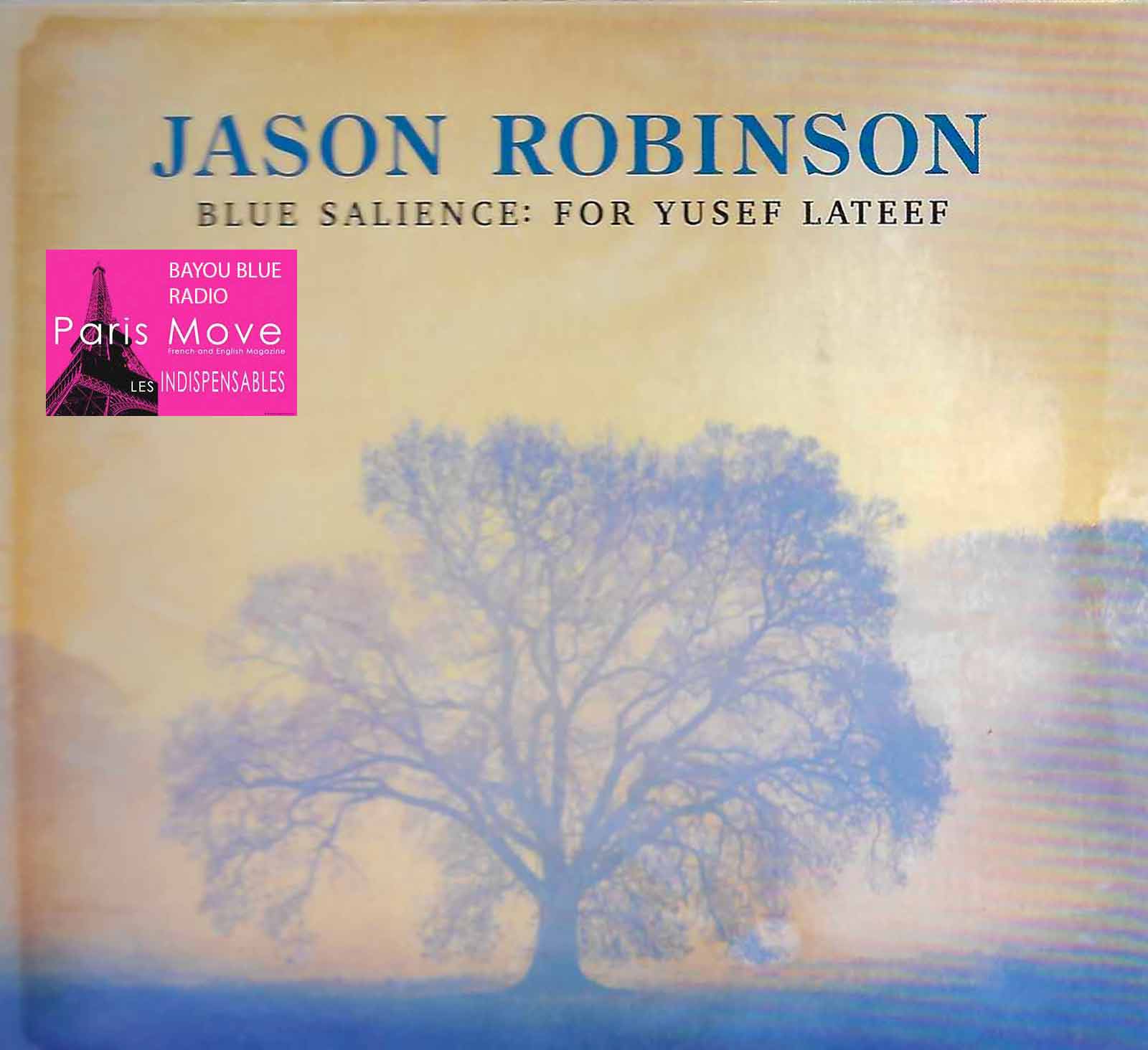
It was one of those mornings that seemed reluctant to get started. The sky was blue, but the color had been softened by an uncertain light, slowly giving way to an almost imperceptible gray, as if the day itself had not quite decided to take possession of the city. Near the mixing console, an album caught my eye. On its cover, a blue tree stood against a yellow background, an oddly quiet presence that seemed almost to be reaching out to me. I picked it up and slipped it into the CD player. A few birds crossed the sky beyond the window, and the first sounds began to emerge through my headphones. The Curved Path. It took only a few minutes to realize that I was hearing something more than another jazz recording, or even the latest work of an accomplished multi-instrumentalist. To me, Jason Robinson is first and foremost a composer, a musician who treats sound as a living material: something to explore, move, reshape and place in conversation with other sounds, other traditions, other ways of imagining the world. With Blue Salience: For Yusef Lateef, he pushes that investigation further, bringing together seventeen musicians in a work whose ambition reaches well beyond the conventions of a tribute album. Marty Ehrlich, Brian Landrus, Allan Chase, Bill Lowe, Richie Barshay and several other major musicians contribute to this expansive sonic architecture, but their presence should not distract from what ultimately matters most. Behind this remarkable gathering of individual voices is a compositional mind constantly arranging, shifting and transforming them, turning separate personalities into parts of something larger. That is where the real fascination of this record begins. Jason Robinson is not trying to recreate Yusef Lateef. He is asking what Lateef made possible.
A tribute to Yusef Lateef was never going to be a simple undertaking. Robinson could have revisited a handful of themes, summoned the sounds most readily associated with Lateef’s career and recreated his singular ability to bring jazz into dialogue with music from around the world, instrumental experimentation, spirituality and composition. Instead, he takes the more difficult road. He does not treat Lateef as a figure to be preserved in memory; he treats him as a point of departure. The distinction is crucial. Lateef never accepted the idea that music should live inside a narrow definition. His work was driven by an almost inexhaustible curiosity and by the conviction that instruments, cultures and musical languages could enter into conversation without surrendering their individual identities. That belief is at the heart of Blue Salience. Robinson is not quoting Lateef in an attempt to bring the past back to life. He is taking Lateef’s principle of freedom and carrying it into his own musical language. He looks at what Lateef discovered, but perhaps even more importantly, at what Lateef left open for others to explore. The tribute therefore becomes something more than an act of remembrance. It becomes a meditation on inheritance. What do we actually do with a legacy once the person who gave it to us is gone? We can preserve it, protect it, place it behind glass and turn it into a monument. Robinson chooses another possibility: he sets it in motion again.
That approach explains the force of The Curved Path, which opens the album. From the first measures, the music seems to resist the straight line. It moves through detours, sudden appearances and layers that accumulate, separate and return. A brass voice surfaces, another instrument answers, percussion suddenly changes the perspective, and then a larger body of sound gathers before dissolving once more. Nothing ever seems entirely still. Yet beneath that sense of perpetual movement is writing of extraordinary precision. This is where Robinson’s particular place in contemporary music becomes clear. He composes as if he were thinking in three dimensions. Instruments are not simply voices placed next to one another; they become surfaces, depths and lines that intersect, recede and reappear. The ensemble begins to feel less like a conventional large group than a living piece of architecture. The seventeen musicians are not there merely to produce a mass of sound. They form a collective material that Robinson shapes with the patience of a sculptor. And yet, within all that carefully constructed detail, there remains the element of unpredictability that belongs to jazz. That may be one of the most compelling qualities of his writing: the score creates a framework for freedom without trying to tame it.
With eleven movements and roughly two hours and fifteen minutes of music, Blue Salience is unapologetic about its scale. But its monumental character has little to do with duration alone. It comes from the sheer number of musical questions Robinson is willing to hold within the same work. Jazz, contemporary music, improvisation, the exploration of timbre, musical traditions from distant horizons and orchestral writing all meet here without any one of them demanding supremacy. One could call it contemporary classical music touched by jazz, but the description quickly becomes too limiting. Robinson is not a classical composer who has decided to borrow a few colors from jazz. He is a musician deeply shaped by the history of jazz who is continually expanding the territory that history makes possible. He does not seem interested in choosing between composition and improvisation, tradition and experimentation. Those oppositions appear to belong to an older way of thinking. What matters to him is the territory between them, the space where one form of musical thought can unsettle another.
To understand the album, it helps to return to Lateef himself, and to his particular conception of music as an ongoing search. Robinson was deeply influenced by Eastern Sounds, but also by Repository of Scales and Melodic Patterns, the book in which Lateef explored his work with melodic structures. The connection is revealing. On one side is a recording that became emblematic; on the other, a work that approaches melody almost as a field of research. Between the two lies the same conception of the artist: a musician is not simply someone who makes things, but someone who keeps looking. Lateef understood that curiosity could become a creative method. Robinson takes that idea seriously. Blue Salience is therefore less an album about Lateef than an album born from a question: How far can Lateef’s ideas still carry us? The question sounds simple, but its implications are profound. It suggests that an artist’s true legacy is not measured only by what later generations preserve or reproduce, but by what they become capable of imagining because that artist came before them.
The titles of the individual movements seem to extend that meditation. Soul Keepers, Blue Salience, Fathom, Bright Spirits, Equipoise, The Cabin, Horizon, Manifold Oneness, Fifth Saga, The Heron, Gates of Truth, The Golden Hue: fragments that give the album an almost contemplative atmosphere. Water, trees, birds, horizons, light and earth return again and again as persistent images. They are not merely poetic decoration. They belong to a conception of music as an inner landscape. Robinson seems to compose in much the same way one might observe a landscape, paying attention not only to what stands immediately before us but also to what is half-hidden beyond it. A percussion figure can become a texture. A breath can acquire the weight of a color. A chord can suddenly open onto an unexpected depth. Listening becomes a form of movement. We are no longer simply following themes and solos in succession; we are moving through a space.
That impression is heightened by the richness of the ensemble. Marty Ehrlich, Allan Chase, Brian Landrus, Felipe Salles, Bill Lowe, Kevin Harris, Avery Sharpe, Richie Barshay and the other musicians are never reduced to the role of accompanists. Robinson knows their individual musical identities and seems to write with them rather than merely for them. Soloists emerge, disappear and return in different contexts, as though their individual voices were constantly being measured against, and reshaped by, the larger body of the ensemble. Robinson himself moves among tenor saxophone, alto flute, percussion, tubular bells, synthesizer and other instruments, constantly changing the perspective without ever turning the performance into a display of virtuosity. Timbre is not an afterthought here. It is part of the composition itself. This may be what most clearly sets Robinson apart from a strain of contemporary jazz that remains tied to the traditional big-band model: for him, sound is not simply the means through which the composition is delivered. Sound is one of the things the composition is about.
The music is complex, but complexity is never its point. It simply asks more of the listener. Blue Salience does not reveal itself completely on a first hearing, and that is part of its richness. You have to go back, listen again to a passage, allow a texture or harmonic progression to settle in before its logic begins to emerge. This is not music that is designed to win you over immediately. Robinson trusts time. He allows certain things to remain unresolved, at least for a while, and accepts that sensation may come before understanding. In that respect, his work occasionally brings to mind certain constructions by Mussorgsky, not because there is any meaningful stylistic resemblance — there plainly is not — but because of the way the music can unfold through forms, masses, contrasts and images. Robinson’s material, however, is unmistakably contemporary, and his language belongs entirely to him. He is neither attempting to imitate concert music nor reproduce the historical vocabulary of jazz. He is building a territory of his own from those inheritances, and from many others besides.
This is why the tribute to Lateef feels so convincing. Robinson understands that genuine fidelity does not always mean reproduction. Sometimes it means continuation. At a moment when the music industry has a tendency to turn the great figures of the past into commemorative repertory, Blue Salience takes the opposite approach. It treats Lateef not as a finished chapter but as a force that remains active. The past is not a photograph kept under glass. It is living material, capable of being changed by the present. That idea reaches well beyond music. It raises a larger question about cultural inheritance: What do we do with the works that came before us? Do we preserve them untouched because of their historical importance, or do we allow them to be reinterpreted, displaced and confronted with questions their creators could not have known? Robinson chooses the second path without hesitation. He does not try to protect Lateef’s legacy from time. He allows time to act upon it.
There is also something in Blue Salience that touches on the idea of hope. Not naive hope, and certainly not the comfort of easy affirmation, but possibility. The music seems to suggest that the future remains open precisely because the boundaries we take for granted can still be moved. Lateef devoted much of his life to that openness. Robinson turns it into the organizing principle of his own composition. Musical cultures no longer have to remain separate compartments. Instruments no longer need to be assigned a single purpose. Jazz does not have to define itself against classical music, or contemporary music against tradition. Everything can circulate. Everything can be questioned. Everything can become material for invention. Perhaps that is what gives the work its deeply human quality. Beneath the scholarship, beneath the sophistication of the writing, there is a remarkably simple impulse: to discover what music can still teach us about ourselves and about the world we inhabit.
I find myself imagining this music performed in a concert hall. It would need an opera house, or at least a space capable of revealing the different depths of its sonic architecture. Not simply for the sake of perfect acoustics, but so that the physical dimension of the composition could be felt: the movement between sections, the breathing, the silences, the shifts in density. Music like this should not merely be heard. It should be experienced across the entire space. That may be why the album asks for so much attention. Its complexity is not the result of a taste for abstraction, but of a desire to make several levels of listening possible at once. The first hearing reveals the landscape. The second begins to reveal its paths. The third brings details into focus that had escaped notice before. And even after several hearings, some things may remain just beyond reach. That is one of the defining qualities of genuinely deep work: it does not exhaust itself simply because we believe we have understood it.
Blue Salience will likely speak most directly to listeners drawn to ambitious contemporary composition, large ensembles, jazz at its most adventurous, and concert music when it is willing to step outside its own boundaries. Someone encountering Robinson for the first time might be unsettled by the density, by the absence of immediate gratification, by the commitment of time the music demands. But it would be a mistake to reserve Robinson for specialists. A demanding work is not necessarily an elitist one. Sometimes it simply asks us to step away, for a little while, from the accelerated way in which we consume music. Blue Salience belongs to that category. It needs to be given time, just as Robinson needed time to build it.
And then there is that blue tree against the yellow background. The more I listen to the album, the more I feel that the image contains the entire project. The tree has roots in the history of jazz, in Yusef Lateef’s investigations, in the music of the world and in the many experiences that shaped Robinson’s thinking. Its trunk is his writing, firm but never static. Its branches reach outward in every direction, some toward improvisation, others toward contemporary music, sonic research, orchestration and new approaches to composition. Its leaves already belong to another time. Perhaps that is, in the end, the most meaningful tribute Jason Robinson could have offered Yusef Lateef: not to try to become his heir, but to accept becoming something else because of him. More than a decade after Lateef’s death, Blue Salience does not close a story. It opens another. And when the final sounds fade from my headphones, the sky beyond the window has changed. The morning blue has grown lighter. The birds are gone. The tree, however, is still there.
Thierry De Clemensat
Member at Jazz Journalists Association
USA correspondent for Paris-Move and ABS magazine
Editor in chief – Bayou Blue Radio, Bayou Blue News

PARIS-MOVE, October 6th, 2026
Follow PARIS-MOVE on X
::::::::::::::::::::::::
Tracklisting:
1.The Curved Path
2.Soul Keepers (Tides Sequence 1)
3.Blue Salience
4.Fathom (Remembering Water)
5.Bright Spirits
6.Equipoise
7.The Cabin
8.Horizon
9.Manifold Oneness
10.Fifth Saga
11.The Heron
12.Gates of Truth
13.The Golden Hue
Composed, conducted, and produced by Jason Robinson (Circumvention Music/ASCAP)
Recorded May 12-14, 2025 at Fraser Performance Studio, WGBH, Boston
Recording engineer: Antonio Oliart
Assistant recording engineer: Téa Mottolese
Additional recording engineered by Jason Robinson
Mixed by Nick Lloyd (Firehouse 12, New Haven, CT) and Jason Robinson
“Dub Spirits” remixed by Marcus Urani (vinyl edition only).
Mastered by Dave Darlington (Bass Hit Recording, New York, NY)
“Dub Spirits” mastered by Jim Fox (Lion Fox Recording Studios) and Dave Darlington.
Assistant producers: George Schuller, Jeremy Cohen (New England Jazz Collaborative)
Text by Yusef Lateef, used by permission
Dramaturgy by Priscilla Maria Page
Session photography by Lucas Mulder
Additional photography by Julian Parker-Burns
Graphic design by Tom Beckham