| Jazz moderne |
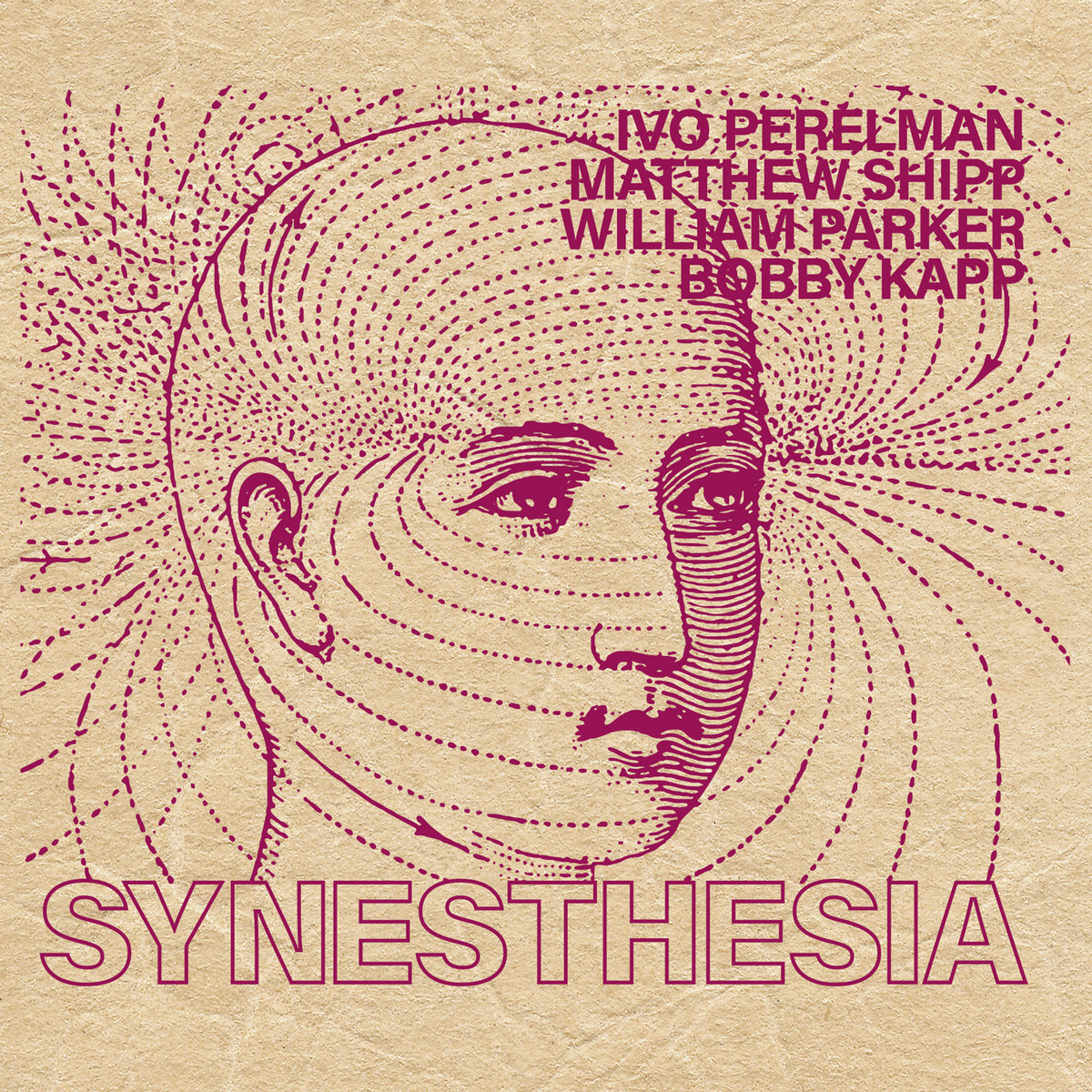
This amazing quartet of Ivo Perelman, Matthew Shipp, William Parker and Bobby Kapp returns with Synesthesia, another remarkable chapter in one of the most compelling ongoing collaborations in contemporary improvised music. Following their acclaimed Ineffable Joy and Heptagon, these four master improvisers once again demonstrate that true collective creation remains one of jazz’s most exhilarating artistic frontiers.
The album’s title is particularly well chosen. Synesthesia is the rare neurological phenomenon in which one sense involuntarily triggers another, colours are heard, sounds are seen, textures become emotions. It is an apt metaphor for this recording, where musical ideas constantly overlap and transform, creating an experience that seems to engage far more than the ear alone. Listening to Synesthesia often feels less like following individual instruments than entering a shifting landscape where sound acquires colour, density and movement.
For decades, Ivo Perelman has been one of the most distinctive voices in modern free jazz. His tenor saxophone possesses an extraordinary emotional vocabulary, capable of whispering with heartbreaking tenderness before erupting into torrents of raw expression only moments later. Yet what makes Perelman such an exceptional improviser is not simply his formidable technique but his gift for storytelling. Every phrase feels necessary, every outburst emerges naturally from what preceded it, every silence carries meaning.
Few pianists understand Perelman’s language more profoundly than Matthew Shipp. One of the central figures of New York’s avant-garde jazz scene, Shipp has developed a pianistic approach that combines harmonic sophistication with remarkable rhythmic freedom. Rather than accompanying the saxophone, he continuously redefines the harmonic landscape beneath it. His crystalline clusters, repeated figures and unexpected melodic fragments provide both structure and instability, constantly inviting the music towards new directions.
At the foundation stands the incomparable William Parker, whose double bass has become one of the defining voices of creative improvised music over the past four decades. Parker is far more than the quartet’s anchor. His bass sings, comments, provokes and consoles. Sometimes it provides a pulse; at other times it seems to float independently, creating a second melodic voice that intertwines effortlessly with Perelman and Shipp. Few bassists possess such authority while remaining so completely devoted to collective interaction.
Completing the ensemble is veteran drummer Bobby Kapp, whose playing epitomises the art of listening. Rather than imposing rhythmic patterns, Kapp allows rhythm itself to remain fluid. His cymbals shimmer like shifting light, his snare punctuates conversations with remarkable sensitivity, and his subtle dynamic control gives the quartet extraordinary flexibility. Throughout Synesthesia, he demonstrates how percussion can shape musical architecture without ever dominating it.
What immediately distinguishes this quartet is the absolute freedom between its members. No instrument assumes permanent leadership. Musical ideas circulate freely, passed from one player to another. Themes emerge collectively, dissolve naturally, only to reappear moments later transformed into something entirely different. The music breathes with the ease of a conversation between old friends who no longer need words to understand each other.
The opening “First Colour Heard” introduces this improvisation world beautifully. Rather than establishing a theme in conventional fashion, the quartet gradually discovers its own vocabulary in real time. Perelman’s tenor cautiously explores the space while Shipp sketches delicate harmonic contours. Parker and Kapp create an elastic rhythmic foundation that never settles into predictability, allowing the music to unfold organically.
The magnificent “Phosphene”, named after the flashes of light perceived without external stimulation, perfectly illustrates the quartet’s fascination with perception itself. Musical ideas flicker into existence before dissolving into unexpected textures. Perelman’s saxophone frequently seems to hover between melody and pure sound, while Shipp’s piano responds with freed and electrified movements that continuously reshape the emotional landscape.
“Blue Taste”, perhaps the emotional heart of the album, embodies the very concept of Synesthesia. Here melancholy is not merely expressed, it becomes tangible. One almost senses colours emerging from sound itself.
“Afterglow” offers some of the album’s most subtle and poetic exchanges before the closing “One Sense”, extending beyond sixteen minutes, concludes the journey and functions as both culmination and synthesis. Everything heard throughout the album seems to converge here. Like a tsunami, yet mastered by four artists at the peak of their talent. Energy rises and recedes in long, natural waves. The improvisation expands without losing coherence, demonstrating the extraordinary architectural instincts shared by all four musicians. Few ensembles can sustain such extended collective improvisation while maintaining such clarity of purpose.
Although firmly rooted in the language of free jazz, Synesthesia reaches well beyond conventional stylistic boundaries. Despite its remarkable sophistication, Synesthesia never becomes an academic exercise. The music remains profoundly human. One constantly senses curiosity, vulnerability, risk and joy. These four great musicians are not demonstrating what they know, they are creating something together, inviting the listener to witness the process in real time.
That spirit of discovery is what makes this quartet so exceptional. After decades at the forefront of creative improvised music, all four musicians continue to play with the openness and curiosity of artists who still believe that genuine surprises remain possible. Every note seems motivated not by virtuosity but by the simple desire to explore what might happen next. Synesthesia therefore rewards attentive listening not because it is difficult, but because it is infinitely rich. Each return reveals new relationships between the instruments, new harmonic colours, new emotional resonances hidden beneath the surface. It is music that refuses to stand still, constantly renewing itself in the listener’s imagination.
Synesthesia reminds us of the extraordinary power of genuine spontaneity. It captures four musicians listening as deeply as they play, transforming improvisation into a living, breathing act of collective creation. The result is an album of remarkable beauty, intelligence and emotional depth, one that confirms Ivo Perelman, Matthew Shipp, William Parker and Bobby Kapp as the most compelling musicians in contemporary creative music.
More than simply another excellent free jazz recording, Synesthesia is an invitation to hear differently. To discover that extraordinary musicians can transform the unpredictable into something profoundly meaningful. It is, quite simply, one of those rare recordings that continues to reveal new dimensions long after the final note has faded.
Frankie Pfeiffer
Editor in chief – PARIS-MOVE
PARIS-MOVE, July 22nd, 2026
Follow PARIS-MOVE on X
::::::::::::::::::::::::
Musicians:
Ivo Perelman – tenor sax
Matthew Shipp – piano
William Parker -bass
Bobby Kapp – drums
Tracklisting:
- First Colour Heard 09:16
- Phosphene 13:05
- Blue Taste 13:46
- Afterglow 09:29
- One Sense 16:19
Recorded, mixed and masterd by Jim Clouse at Parkwest studios
Brooklyn NY (12/2024)
Design by ajax19
Produced by Iannis Koufaelas