
| Funk |
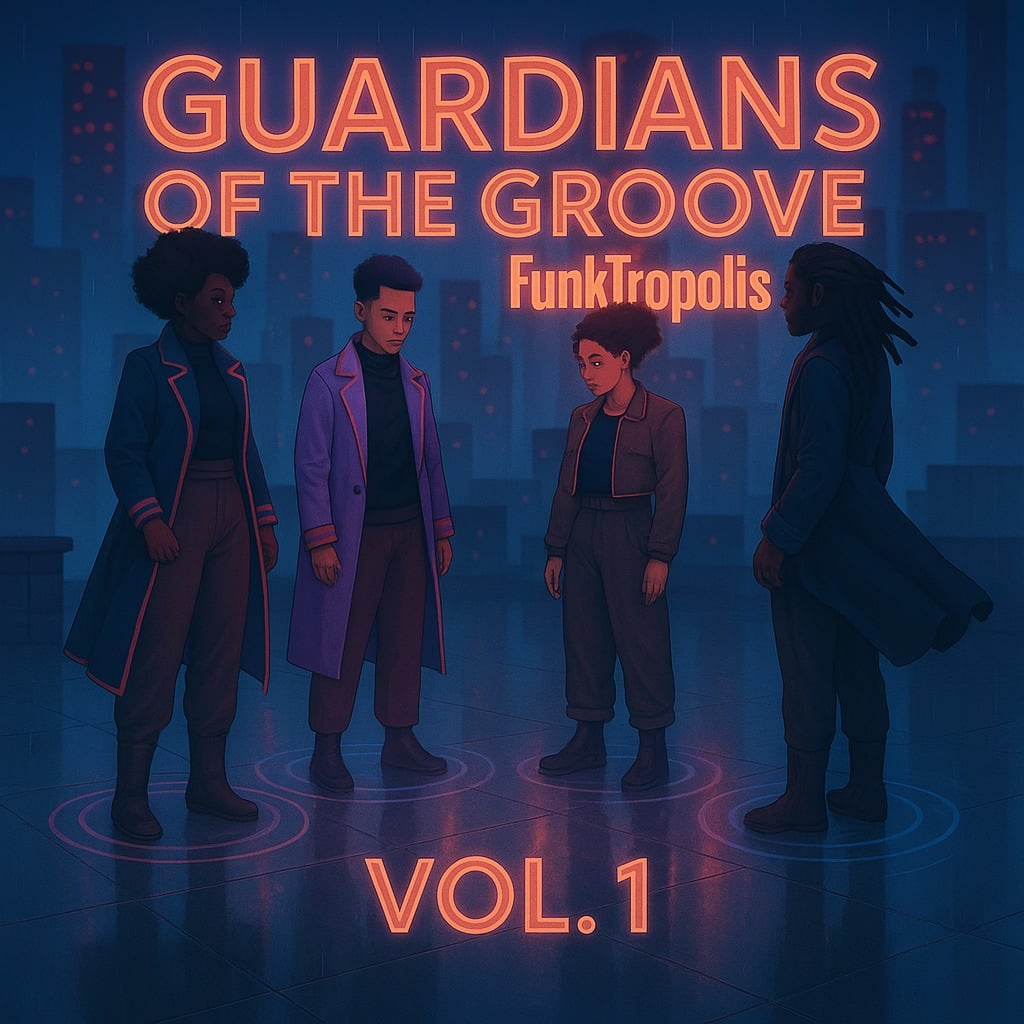
If you have ever crossed the endless flatlands leading into Omaha, a landscape so wide it seems to erase the very notion of edges, you might understand why a late-night FM studio once felt like a secret portal. Back in those days, Funktropolis was less a radio show than a minor act of rebellion against the quiet. Walking into that small studio for the first time, armed with little more than two shy words of English, I felt like a misplaced actor wandering onto the wrong set. Yet the warmth of the place softened everything: the hosts greeting me as though I were a long-lost cousin, the barely audible hum of old speakers, the way the walls seemed to sigh under the weight of decades of music.
Some rooms cling to you not because of what happened inside them but because they whisper something you didn’t know you needed to hear. That studio whispered possibility.
Since then, Funktropolis has traveled its own unpredictable arc, from FM static to web-radio fluidity, from anonymous local cult to a vaguely mythological digital outpost. Its evolution feels oddly emblematic of our time: everything moves, but nothing fully disappears. The show’s latest incarnation brings us an album, funk-rock at first glance, but also a time capsule, a communal handshake, a wink from the past into the circuitry of the present. You won’t find it on the major streaming platforms; instead, you must request it through a Facebook page, the way one used to ring the doorbell of a friend’s house instead of texting from the car. There is something disarmingly human about that.
Funk itself is a shapeshifter. It contains multitudes: the psychotropic swirl of Sly Stone, the cosmic architecture of P-Funk, the tight-jawed discipline of James Brown’s marching orders, the velvety futurism of the Minneapolis Sound. To attempt a taxonomy would be like trying to catalog all the ways light falls on water. Guardian of the Groove – Vol. 1(more familiarly GOTG) doesn’t attempt to shrink that universe; instead, it leans into chaos with joy. It inhabits the Funktropolis ethos: not a thesis but a mood, not a genre but a shared joke in motion, the kind of album that understands holiday parties better than holiday sermons.
At Bayou Blue Radio, our editorial instincts tend to drift elsewhere, toward the historical, the political, the connective tissue between sound and society. The Philadelphia Sound is our perennial north star, with its orchestral density and its unapologetic devotion to arrangement. Listening to GOTG, by contrast, feels like stepping off a train of ideas and onto a dancefloor where the only language spoken is rhythm. It is a reminder that not all music needs to justify itself with argument; some music exists simply to rearrange your heartbeat for a few minutes.
The album gathers a constellation of contributors, Murphy E n FYM, Sly n FYM, Rey n FYM, Rachel n FYM, FYM, Kai n FYM, and Dayton ft. FYM, whose names sound almost like characters in a graphic novel about a lost civilization powered entirely by basslines. The sequencing is surprisingly architectural: bursts of kinetic energy followed by cooler passages, the kind of balance that suggests someone thought long and hard about the stamina of dancers. It’s choreography disguised as tracklisting. And somewhere in that deliberate pacing, the album mutters its only real statement: movement is meaning.
In an era where cultural expression is often overburdened with symbolism, What does it say? What does it respond to? What does it resist? GOTG chooses not to say anything at all. It prefers the honesty of immediacy. No hidden manifesto, no conceptual scaffolding, just the straightforward belief that bodies moving together constitute a kind of temporary republic. There is a soft radicalism in that simplicity.
The fingerprints of our century are everywhere in this record. Looped vocals, digitized textures, the now-expected shimmer of commercial post-production, all of it gives the album a contemporary accent, a reminder that even the most analog-spirited projects must pass through the glowing threshold of the present. Older listeners will detect the funk DNA beneath the circuitry; younger listeners won’t flinch at the processed voices, having grown up in a world where human breath itself seems increasingly edited. This is the album’s quiet magic: it bridges two worlds without announcing the effort.
The mix is sharp, clean, confident, evidence that even music made for simple pleasure can be crafted with meticulous care. And perhaps that is the real counterpoint to our era of disposable sound: that quality, when present, does not need to shout.
What GOTG ultimately offers is something subtler than nostalgia and freer than commentary. It offers continuity. The reassurance that groove remains one of the last universal verbs. That in the right hands, rhythm can be a memory, a future, and a present tense all at once. And that sometimes, after days filled with headlines and screens and the relentless hum of modern life, what we need most is not another explanation, but a beat strong enough to carry us across the room.
Thierry De Clemensat
Member at Jazz Journalists Association
USA correspondent for Paris-Move and ABS magazine
Editor in chief – Bayou Blue Radio, Bayou Blue News
PARIS-MOVE, December 5th 2025
Follow PARIS-MOVE on X

::::::::::::::::::::::::
Order this album from the Funktropolis Facebook page