
| Jazz |
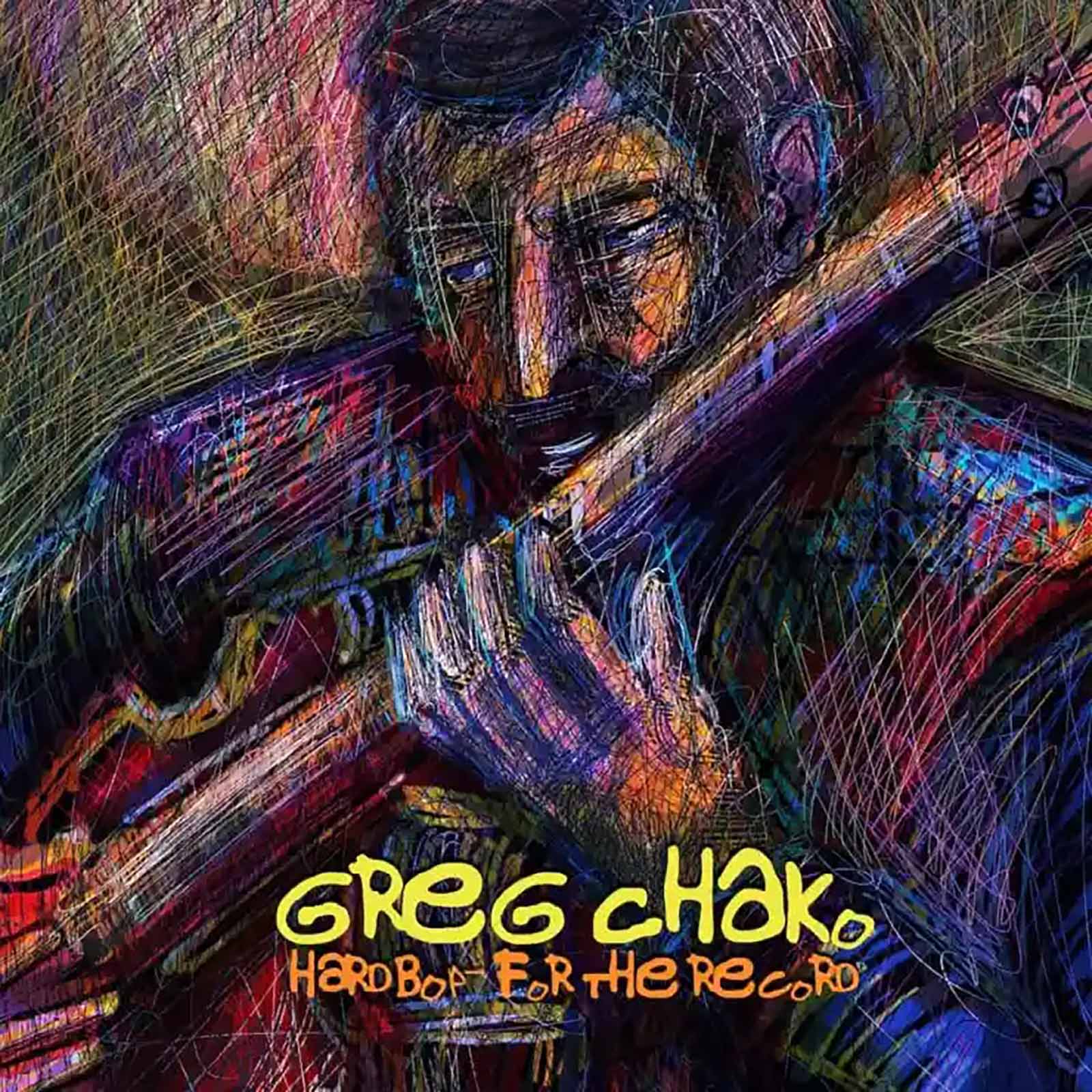
Summary: Greg Chako’s Hard Bop: For the Record blends classic hard bop with his decades of musical experience, cultural influences and deeply personal songwriting.
Greg Chako’s Hard Bop: For the Record: A Jazz Album Rooted in Tradition
By the middle of August, there is a point when summer begins to feel less like the present and more like something we are already preparing to remember. The days are still warm, the evenings can still feel endless, yet somewhere in the back of our minds we know that autumn is approaching. Before long, giant plastic spiders and oversized monsters will begin appearing on lawns and in front of houses, as another American season gets ready to take over the calendar. There is something about this gradual change that also encourages nostalgia, and perhaps that makes August a particularly good time to listen to a record that looks toward the past while remaining firmly concerned with the present. Greg Chako’s Hard Bop: For the Record is deeply rooted in one of jazz’s most influential traditions, but it is not an exercise in musical archaeology. It is the work of a guitarist and composer who has spent decades absorbing different places, musicians and cultures and has reached a point where the tradition can be used as a language rather than a limitation.
Chako’s career makes that distinction important. Born in Cincinnati, he began playing music as a child, eventually attending Berklee College of Music and working with musicians including Junior Cook, Bill Hardman, Bobby Watson, Herb Ellis and Jimmy Raney. His career, however, did not follow a straight line. He stepped away from the guitar for several years in New York, worked in industrial real estate and later returned to professional music after moving to Hong Kong in 1992. From there, his musical life expanded across Hong Kong, Singapore, Shanghai and Japan, where he performed, recorded, taught, organized concerts and worked with musicians from very different cultural backgrounds. His own account of those years describes Asia as some of the most valuable training he received, both as a musician and as a person.
That history can be heard in For the Record, even when the music is firmly speaking the language of hard bop. Chako is not approaching the genre as an outsider attempting to reconstruct a period style. He has lived with jazz for decades, and his experience has given him the freedom to understand its conventions without becoming dependent on them. His official biography describes a body of work that brings together mainstream jazz, hard bop, Latin and world music, with more than 80 original compositions recorded over the course of his career.
The easiest thing Chako could have done with an album devoted to hard bop would have been to revisit the familiar repertoire. There is certainly nothing wrong with doing that, and jazz has always survived through musicians interpreting the work of those who came before them. Yet For the Record becomes more interesting precisely because Chako has chosen to write his own material. The compositions carry the fingerprints of the tradition without sounding as though they were designed simply to imitate it.
The influence of musicians such as Sonny Rollins, Miles Davis and John Coltrane can be sensed in the language, the harmonic movement and the way the themes are developed, but these references are better understood as part of Chako’s musical vocabulary than as quotations. He has spent too much time playing and listening to jazz for the music to sound like an exercise in historical reconstruction. What emerges instead is a personal interpretation of hard bop, shaped by a life that has taken him far beyond the American jazz clubs where the tradition first developed.
That international experience is especially relevant because Chako’s relationship with music has never been confined to one cultural vocabulary. During his years in Singapore, he worked with musicians from different backgrounds and developed his World Beat project, bringing together American jazz with rhythmic traditions from Africa, Cuba, Brazil, India and Asia. His earlier work therefore provides an important context for understanding the music he is making now. The cultural influences are not simply decorations placed on top of a jazz foundation. They have become part of the way he hears rhythm, melody and ensemble interaction.
There is a difference between borrowing from another musical culture and allowing another culture to change the way you hear music. Chako’s career suggests that he experienced the latter. That may help explain why his compositions can remain recognizably connected to hard bop while still having a broader sense of movement and space.
The most striking aspect of his playing is perhaps not what he does when he has the spotlight, but what he does when someone else has it. Chako does not appear particularly interested in filling every available measure simply to demonstrate his technique. His arrangements leave room for the other musicians to establish their own personalities, and that generosity becomes an essential part of the music. The guitar can lead, respond, support or simply step aside. The same is true of the other instruments, and the resulting conversations give the album a sense of balance that is difficult to achieve when every player is competing for attention.
The spaces between the notes matter as well. Silence is not treated as an empty area that needs to be filled. It becomes part of the composition, creating room for a phrase to settle before another musician responds. That quality may seem modest on the page, but it is one of the things that makes repeated listening rewarding. The first time through, one hears the melodies and the overall energy. With subsequent listens, the architecture becomes clearer, particularly the way the musicians support one another without losing their individuality.
Chako’s biography helps explain that instinct. His career has repeatedly required him to function not only as a guitarist but also as a bandleader, promoter, educator, organizer and composer. He has worked in very different environments, from Broadway productions and the Hong Kong Philharmonic to jazz clubs, hotels, festivals and his own concert projects. That breadth of experience appears to have taught him something that cannot easily be learned from a textbook, which is how to make music work as a collective experience.
There is also a more personal story behind For the Record, and it gives the album another layer of meaning. Chako has spoken of writing during a period of illness, with the creative process beginning in a hospital. Heard in that context, the second track, “Second Chance,” takes on a significance that goes beyond its title. The music is not presented as a solemn document of suffering, and that is precisely what makes the idea more affecting. There is joy in the writing, but there is also an awareness of fragility and of the value of being able to return to the creative process.
That theme is consistent with a career that has known interruptions and difficult periods. Chako stepped away from music for years, returned to it in Asia, experienced physical problems that affected his playing and later endured the death of his wife while living in Japan. After that loss, he returned to recording with Where We Find Ourselves, an album of original compositions dedicated to her. His biography also describes his decision to return to formal education later in life, eventually earning advanced degrees in music.
None of this means that For the Record should be heard simply as a biographical document. That would reduce the music to the circumstances surrounding its creation. What the story does provide is a way of understanding the emotional maturity behind the compositions. Chako has had enough experience to know that a musical career is rarely a straight line. There are periods of confidence, periods of uncertainty, long stretches of work and moments when simply continuing becomes an achievement in itself.
That makes the title For the Record particularly intriguing. It can be read in several ways, and there is no need to decide which interpretation Chako intended. For me, the title suggests a musician putting his own ideas down without worrying too much about whether they fit neatly into someone else’s definition of hard bop. After decades spent learning the language, playing within it and absorbing influences from other parts of the world, there is something natural about wanting to make a record on your own terms.
Trusting that instinct may be one of the hardest things for a musician to do. Technical ability can be developed through practice. Knowledge can be acquired through study. Confidence is more complicated, because even accomplished musicians continue to question whether what they are creating is worth hearing. Chako’s long career makes For the Record feel less like an attempt to prove that he belongs in the hard bop tradition and more like a mature artist finally comfortable enough to speak in his own voice.
The critical response to his work reinforces that impression. Jazz Dimensions in Germany has described his music as rich in nuance, incorporating fusion, blues and swing, while Jazz Reviews has emphasized its mixture of cultural and musical sensitivities. Professor Vince Lewis, writing for Just Jazz Guitar, has similarly praised the way Chako’s music crosses geographical and cultural boundaries while communicating the sense of happiness and friendship that music can create.
Those observations are useful, but the album itself is ultimately more persuasive than any description. The hard bop influence is unmistakable, yet the record does not seem interested in presenting the genre as a museum piece. Chako understands that tradition survives when musicians are allowed to interpret it, question it and add something of their own. His guitar playing is precise, but precision is never confused with coldness. The groove remains important, the swing remains intact, and the arrangements retain the discipline expected from the tradition, but there is enough flexibility for the music to breathe.
This is also where his experience as a composer becomes more important than his reputation as a guitarist. A technically accomplished guitarist can make a great solo. A composer has to think about what happens before the solo, what happens afterward and how every instrument contributes to the larger story. Chako seems to understand that distinction. His official biography describes him as a storyteller as much as a performer, and the compositions on For the Record make that description plausible.
For listeners coming to the album for the first time, I would suggest resisting the temptation to treat it simply as another contemporary hard bop recording. Listen first to the ensemble rather than concentrating exclusively on the guitar. Then return to the record and pay attention to how the rhythm section creates space for the horns and how Chako moves between leadership and accompaniment. On another listen, the historical references become easier to identify, but they also become less important because the music has already established its own personality.
That is perhaps the most convincing achievement of For the Record. Chako has clearly listened to the masters, but he does not sound trapped by his admiration for them. He has spent too much of his life moving between cultures, musical environments and professional roles to simply reproduce a style that reached its historical peak generations ago. Instead, he takes the vocabulary of hard bop and allows it to speak through the experiences of a musician who has lived a considerably more complicated musical life.
By mid-August, when summer begins its quiet retreat and we start noticing the first signs of the season ahead, nostalgia can easily become a desire to return to the past. Hard Bop: For the Record offers a more interesting possibility. It reminds us that remembering a musical tradition does not require freezing it in time. A musician can respect the artists who came before him, study their language, carry their influence and still make something that belongs to his own moment.
That is what makes Greg Chako’s record worth spending time with. Beneath the hard bop vocabulary is a career shaped by movement, setbacks, reinvention, cultural encounters and a continuing desire to learn. The result is music that respects its history without surrendering its independence, and perhaps that is the most convincing way for a tradition as resilient as hard bop to remain alive in the 21st century.
Thierry De Clemensat
Member at Jazz Journalists Association
USA correspondent for Paris-Move and ABS magazine
Editor in chief – Bayou Blue Radio, Bayou Blue News

PARIS-MOVE, August 16th, 2026
Follow PARIS-MOVE on X
::::::::::::::::::::::::
To buy this album (September 4, 2026)
Musicians :
Greg Chako, guitar & compositions
Brooks Giles, tenor & soprano saxophones
Spencer Merk, trombone
David Lloyd, bass
Alex Mark, drums
Track Listing :
Mozambique
Second Chance
Ballad to the Bone
Soar With the Wind
Bop For Bud
Mr. Higgins
Time to Play
Mellow-Dee
April Wind
For the Record