
| Jazz |
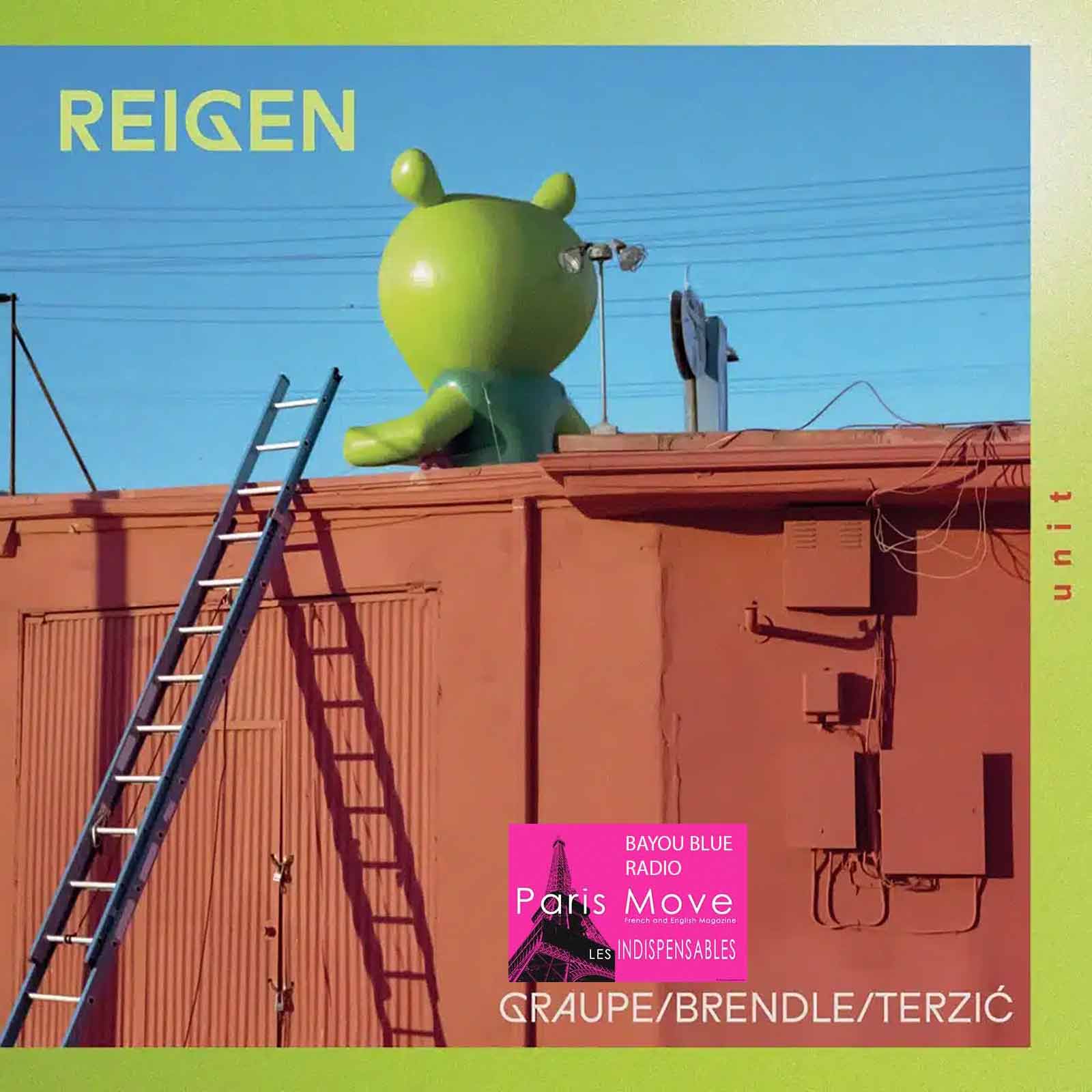
Summary: A review of Reigen, where Ronny Graupe, Damaris Brendle and Dejan Terzić blend jazz, contemporary music and improvisation into a daring, poetic exploration of sound and collective creativity.
Graupe, Brendle & Terzić’s Reigen: Jazz Beyond Boundaries
Sometimes an album cover is enough to unlock a memory we thought we had left behind. Certain graphic designs, particularly those associated with German record releases, possess an uncanny ability to summon an entire world: an era, an artistic sensibility, a way of thinking about music that extends far beyond the object itself. Reigen, the album by guitarist Ronny Graupe, vocalist Damaris Brendle and drummer Dejan Terzić, brings back images I had assumed time had quietly buried. From the opening notes, I find myself in Berlin in the early 1980s, wandering without a destination, simply because the sun was shining and the day invited me to stay outside a little longer. Butterflies drifted across the gardens, disappeared behind buildings and reappeared farther along, as if they, too, were enjoying the freedom of having nowhere in particular to go. Eventually, I would settle at a nearly deserted café terrace, not far from 12a Kantstraße, where Quasimodo had become one of the defining venues in Berlin’s jazz life. Inside, musicians were rehearsing. A few notes escaped into the street, distinct enough to stir my curiosity, too fragmentary to tell me what was being played. I ordered a Dortmund beer and let the music come to me. There was something elusive, poetic and timeless about it, a quality that allowed it to move between different musical worlds without belonging entirely to any of them. Listening to Reigen four decades later, I recognize something of that same sensation. Not because these three musicians are attempting to recreate the sounds of an earlier era, but because they share a distrust of boundaries drawn too neatly and a desire to explore what happens when established musical languages are allowed to unsettle one another. Jazz, contemporary composition, classical music and certain strains of rock converge here without any one tradition being permitted to dictate the terms for long. What matters is not the mere blending of influences, by now a familiar feature of contemporary music, but the transformation that takes place when they come into contact. The distinction between composition and spontaneous invention begins to blur, and the listener is drawn into a musical landscape in which the next turn cannot be taken for granted. This uncertainty is not a rejection of form. It demands an exacting command of the instruments, an intimate knowledge of their possibilities and, above all, an exceptional capacity to listen. Each musician must be willing to take risks without losing sight of the other two. The unpredictable cannot simply be declared into existence. It has to be earned, through discipline, trust and a readiness to venture into territory whose contours emerge only as the music unfolds.
The trio’s instrumentation, built around guitar, drums and voice, is itself an artistic statement. Without the piano, bass or horns that provide familiar points of reference in jazz, the group relinquishes some conventional anchors and opens up a space in which the roles of its instruments can be reimagined. Ronny Graupe’s guitar does far more than introduce a theme or provide harmonic support. It cuts across the sonic landscape, traces angular lines, throws out melodic fragments and sometimes abandons them before they reach any obvious resolution. Its tone can harden into something almost percussive, then soften into a transparency that exposes the silence between the notes. Dejan Terzić’s drumming does not attempt to compensate for the absent bass by establishing a dependable pulse. Instead, it reshapes our perception of time, shifts accents, fractures measures and introduces disruptions that force his partners to reconsider their direction. Damaris Brendle, meanwhile, does not simply fill the space left by the missing instruments. Her voice becomes an integral part of the music’s architecture while retaining the qualities that distinguish it from every other sound in the ensemble: its human presence, its capacity to suggest a story, embody an emotion or deliberately blur the line between language and song. The roles are not abolished; they are made fluid. The guitar can function as percussion, the drums can suggest melodic lines, and the voice can leave conventional singing behind to become a sound in its own right. Such exchanges might amount to little more than a formal exercise were they not grounded in a genuine collective intelligence. Every intervention changes the conditions under which the others can respond. An idea is taken up, challenged or left suspended. A phrase appears to be settling into place before being diverted in an unexpected direction. The music develops through transformation rather than accumulation. These are not three distinct personalities simply sharing the same space, but three musicians engaged in a continuous negotiation, each discovering what is possible through the presence of the others. Their individuality remains unmistakable, yet none attempts to turn that individuality into a claim for dominance. The result is a music that feels perpetually in motion, not because it is constantly changing for the sake of change, but because every decision has consequences for the entire ensemble.
Graupe belongs to a generation of musicians who have helped establish German jazz as a field of restless inquiry, open to international influences and increasingly unwilling to reproduce established models. Born in Karl-Marx-Stadt, now Chemnitz, in the former German Democratic Republic, he came of age near a political and cultural divide whose disappearance would profoundly reshape the European landscape. His subsequent career has unfolded through projects that treat experimentation not as an ornamental addition to an established language, but as a way of questioning the language itself. In his playing, virtuosity cannot be measured solely by speed, harmonic complexity or the number of technical devices at his disposal. It lies in the ability to give each gesture a purpose, to make a phrase speak without necessarily bringing it to completion, to turn an interruption into a musical event rather than a decorative effect. On Reigen, the guitar proposes a direction, introduces a motif and then changes its contours through dissonance, silence or a sudden shift in texture. Graupe does not impose his vocabulary on his partners. He creates possibilities whose outcomes he is prepared to leave uncertain. That willingness requires a deep trust in the other musicians and reflects a conception of creativity that values interaction over individual display. It also speaks to the broader evolution of European jazz, in which performers have expanded the language through encounters with contemporary composition, experimental sound and traditions far beyond the genre’s conventional boundaries. The point is not to replace jazz’s American heritage with some supposedly autonomous European identity. Jazz remains inseparable from the African American experience and the historical circumstances from which it emerged. But a living tradition cannot survive by treating its past as an untouchable monument. Its continuity depends on the freedom to change, to absorb new experiences and to discover possibilities that earlier generations could not have anticipated. Fidelity, in this sense, does not mean repeating inherited forms. It means understanding them well enough to move beyond their familiar uses without losing sight of what made them vital in the first place.
This conception of freedom helps explain why the complexity of Reigen never becomes an exercise in virtuosity for its own sake. Contemporary jazz is not immune to the temptation to treat difficulty as a value in itself. Irregular meters, abrupt changes of tempo, unusual harmonic structures and intricate polyrhythms can signal genuine invention, but they can also become professional badges, repeated until they lose their power to surprise. Sophistication then turns into a code of recognition, a way of demonstrating membership in a particular artistic circle rather than answering an expressive need. A work can be technically impeccable and still feel lifeless. Difficulty matters only when it changes our perception, when it compels us to hear something familiar differently. That is what happens here. Changes of meter are not opportunities for the musicians to display their technical credentials; they alter the relationships among them. A vocal intervention changes the instrumental texture. A rhythmic break forces the guitar to abandon its course. A phrase cut short becomes the starting point for something that could not have been predicted from what came before. Each decision produces consequences that partly escape the person who made it. Improvisation recovers its most demanding meaning: not the freedom to play whatever one wishes, but the capacity to respond intelligently to what is happening. Silence is essential to this process. It is not merely the interval between two sounds, but a space in which tension remains active, a moment when one idea can recede and another emerge. Knowing when to abandon a phrase, interrupt a development or allow an idea to remain unfinished may require more discipline than carrying it toward an apparently satisfying conclusion. This acceptance of incompletion brings the trio close to certain practices in contemporary chamber music, where performers do more than reproduce a score; they participate in shaping its internal balance. It also prevents virtuosity from becoming an assertion of power. Mastery is no longer a means of conquering the sonic landscape, but a way of remaining receptive to the unexpected. The musicians must know what they are doing well enough to relinquish control without relinquishing responsibility.
Damaris Brendle stands at the heart of this enterprise. Trained in jazz and contemporary music, including at the Bern University of the Arts, the Swiss vocalist possesses an extensive command of the voice’s expressive and acoustic possibilities. Yet her training never confines her to technical display. It allows her to move between registers that might otherwise seem incompatible. Her voice can become sharp, almost abrasive, then recover a crystalline melodic clarity that lends a phrase unexpected vulnerability. She sustains a sound until it ceases to be merely a note and becomes a vibration, a physical presence in the room. Elsewhere, she returns to a more familiar melodic line, only to distort or interrupt it, as if refusing to choose between the expression of an emotion and the exploration of sound itself. Such mastery would mean little without an equally developed sense of dramatic purpose. A voice is never simply another instrument. It carries associations, memories, expectations and a human charge that distinguish it from other sounds, even when it deliberately approaches their territory. Brendle plays with that ambiguity, giving the music a depth that belongs neither to conventional lyricism nor to pure abstraction. She can suggest a character, evoke an emotion and then abandon the narrative altogether, turning the voice into a source of tension and unpredictability. Mephisto offers a striking demonstration of her range. The reference to Mephistopheles evokes a European imagination shaped by temptation, transgression and the unsettling of certainties. Yet the trio does not attempt to portray a literary character or provide a musical illustration of a preexisting story. The figure becomes a point of departure, a storehouse of associations from which the musicians construct their own dramatic world. Brendle seems to inhabit a character before stepping away from it, playing with our expectations and producing inflections that hover between unease and irony. Humor prevents the experiment from hardening into solemn posturing. It reminds us that intelligence can express itself through play, misdirection and the pleasure of confounding expectations. Brendle does not make the avant-garde more accessible by adding a reassuring melodic layer. She gives it a human presence, allowing it to unsettle without intimidating and to surprise without sacrificing emotion. Her contribution also challenges a persistent tendency to judge vocalists primarily by their ability to carry a melody or communicate a text. Here, the voice is free to occupy a more ambiguous territory, where meaning is created as much by timbre, breath, articulation and gesture as by words. That freedom does not diminish its expressive power. It expands it.
Dejan Terzić brings to this balance an international perspective and an approach to rhythm that fundamentally reshapes the group’s dynamics. Born in Banja Luka, in the former Yugoslavia, and raised in Nuremberg, the drummer has built a career through collaborations with musicians across the European and international jazz scenes. His trajectory reflects the movement between countries, traditions and artistic communities that has helped renew jazz over recent decades. On Reigen, however, his contribution extends well beyond the mastery of an instrument traditionally expected to organize time and support the other players. Terzić treats the drums as a compositional space in their own right. He creates events, draws lines, shifts the balance of power and unsettles the reference points on which his partners might otherwise rely. A pattern appears to establish a regular pulse, only to be interrupted by an unexpected accent. A passage grows denser before suddenly thinning out, leaving an opening that the guitar or voice can occupy in an unpredictable way. The drums function less as a metronome than as a force of transformation. They can make time feel faster without changing the tempo, create tension through the placement of accents alone or give an almost motionless passage remarkable inner energy. Such mobility demands exceptionally attentive listening. Terzić must anticipate his partners’ possibilities while remaining receptive to the new directions they introduce. The task is not to predict every event, but to recognize the moment when an idea begins to change the group’s balance. The three musicians move across terrain whose broad outlines they understand, even as its precise contours change from one instant to the next. Improvisation becomes a way of making decisions together without relying on a fully predetermined plan. This approach also allows the trio to avoid a familiar trap of experimental music: becoming so preoccupied with disruption that it loses its physical momentum. In Terzić’s playing, changes of meter and displaced accents never sever the music from the body. Even when familiar landmarks disappear, something continues to move. An impulse persists; a tension calls for a response. Beneath the apparent instability, there is an unmistakable sense of direction, though not necessarily one that can be mapped in advance. That underlying continuity gives the music its physical force and keeps its complexity from becoming an abstract exercise.
The title Reigen offers a way into the music without exhausting its mystery. The round dance, an ancient form found in many cultures, is built around shared movement and repetition. Each participant performs individual gestures, but those gestures acquire meaning within a collective pattern that exceeds the individual. Repetition does not mean stillness. With every turn, the body occupies a new position, the movement unfolds in a different moment and the relationship with the other dancers changes. The trio translates this logic into music in which motifs return without ever being reproduced exactly. A melodic idea reappears in fragments, a rhythmic figure shifts into another register, and a vocal entrance changes our understanding of a passage we have already heard. The circle becomes a paradoxical form, at once structured and open, allowing things to return without imposing mechanical repetition. The compositions are neither rigid scores to which the performers must submit nor mere pretexts for unrestricted improvisation. They provide frameworks precise enough to make transformations perceptible, yet flexible enough to accommodate the unexpected. The tension between order and freedom lies at the center of the project. Without structure, improvisation risks scattering in every direction; without freedom, composition becomes a mechanism whose results are known in advance. The trio does not resolve this contradiction. It keeps it alive. Waggle Dance, which refers to the distinctive movements honeybees use to communicate the direction and distance of food sources, extends the idea. The comparison with musicians is not literal, but it suggests a compelling model of collective communication. An accent, a vocal inflection, a guitar motif or a drum figure can convey a signal whose meaning is never entirely fixed in advance. The other musicians take it up, alter it or divert it, generating new responses that become proposals in their own right. The music organizes itself without depending on a permanent center of command. Each player contributes to a collective intelligence that does not erase individual differences but draws energy from them. It would be a mistake to turn this approach into an explicit political manifesto. Music need not be converted into an allegory to possess intellectual substance. Still, the group’s way of working, without a permanently fixed hierarchy and grounded in listening and mutual adjustment, touches on a question that extends well beyond art: how can we build something shared without demanding that everyone surrender their individuality? The music does not answer the question so much as enact one possible response. Cooperation here is neither uniformity nor the suppression of disagreement. It is the ongoing work of making differences productive.
The trio’s humor and taste for dislocation also bring Reigen into the orbit of certain Dadaist concerns, provided we do not reduce that inheritance to a simple celebration of absurdity. Dada emerged during World War I in opposition to a civilization that proclaimed its rationality while organizing violence on an industrial scale. By repurposing objects, challenging artistic conventions and introducing chance into the creative process, Dadaists questioned cultural hierarchies and the mechanisms that sustained them. A century later, it would be misleading to transfer that historical rupture directly into contemporary jazz. The connection lies less in a shared program than in a suspicion of automatic responses and a refusal to treat established forms as self-evident. The trio sometimes appears to prepare a development before veering elsewhere, to build an expectation only to frustrate it or to introduce an incongruous element that changes our understanding of what came before. The absurd becomes a way of loosening constraints, a reminder that music can take itself seriously without claiming unquestionable authority. This freedom also carries a critical dimension in a cultural environment where innovation is routinely turned into a marketing device. Novelty becomes a market category, experimentation a label and complexity a badge of prestige. Acts of rebellion risk becoming conventions as predictable as the ones they set out to challenge. No work can claim to escape this contradiction entirely, and Reigen does not place itself above the musical world in which it exists. But its refusal of easy solutions, its taste for play and its willingness to leave forms open allow it to maintain a healthy distance from its own methods. The trio does not claim aesthetic superiority on the grounds of its daring. It offers an experience whose moments of clarity and opacity are equally integral to the whole, leaving listeners to decide what they make of it. There is something quietly refreshing about that refusal to dictate the terms of reception. The musicians neither explain away the music’s difficulties nor turn them into a test of the listener’s sophistication. They leave room for uncertainty, including the possibility that a passage may resist us, that an apparent dead end may acquire meaning on a later hearing or that the pleasure of listening may arrive before understanding.
This commitment to experimentation should not lead us to set it too neatly against more melodic or immediately accessible forms of jazz. Freedom is not the exclusive property of any one aesthetic, just as complexity is no guarantee of invention. A simple melody can open up an extraordinary expressive space, while a technically sophisticated construction can remain sterile. The real question is one of necessity: Why this particular rupture, this dissonance, this irregularity? What do they allow us to hear or feel that would otherwise remain inaccessible? On Reigen, the techniques matter because they genuinely alter the relationships among the three musicians. Melodies do not disappear, but they can emerge from angular material before withdrawing without reaching a conventional resolution. Rhythms are not abolished, but displaced, fragmented or varied until their identity becomes less immediately recognizable. Unusual sounds do not announce a definitive break with the past; they enlarge the expressive possibilities of the present. This approach allows the trio to move beyond the stale opposition between tradition and modernity. Jazz has always developed through the tension between learning a language and finding ways to transform it. Its vitality depends on the ability to bring memory and invention into the same space. Tradition is not a collection of rules to be preserved intact, but a living material whose meaning changes through contact with new experiences. Experimentation therefore need not proclaim the death of the past in order to assert its own identity. It can instead reveal dimensions that have gone unnoticed, shifting our listening habits and bringing back into circulation possibilities that the repetition of familiar forms has rendered invisible. The question is not whether a musician respects tradition, but what that musician is capable of doing with it. A form remains alive when it can be questioned without being discarded, remembered without being imitated and transformed without losing every trace of its origins. Reigen inhabits that space between recognition and estrangement, drawing on the listener’s musical memory while refusing to let familiarity dictate what comes next.
The album asks for a certain openness, but it does not require specialized technical knowledge. Faced with music this mobile, listeners need only accept that a composition need not follow a straight line, develop a clearly identifiable theme or build toward an obvious climax. Events do not necessarily unfold in a predictable sequence. A motif returns in altered form, a passage breaks off just as a resolution seems near, and a vocal entrance suddenly changes the way we perceive the whole. Such shifts draw attention to details that might remain secondary in a more conventional setting: a change in timbre, a suspension, a displaced accent or the way one instrument recedes just as another begins to assert itself. Listening ceases to be a passive anticipation of what is supposed to happen. It becomes an active process through which we construct our own points of reference as the music unfolds. A thorough knowledge of jazz can certainly deepen the experience, but it is not a prerequisite for entering this world. Sometimes all that is needed is a willingness to be surprised, to recognize an emotion without being able to explain precisely where it comes from or to return to a passage that seemed strange on first hearing. The danger is that abstraction can become an exercise reserved for insiders, as though the intelligence of a work were measured by its ability to discourage those who approach it. Difficulty has genuine value only when it opens up a new field of perception. Reigen succeeds through the balance among its three protagonists. The guitar retains a recognizable presence, the drums sustain a physical energy, and the voice offers a human point of contact to which listeners can attach themselves even when the instrumental structures seem elusive. This combination keeps the experimentation from folding in on itself. It allows different listeners to enter the music through different doors without imposing a single interpretation or pretending that every approach is necessarily equivalent. A living work need not surrender all its secrets on first contact. It need only make us want to continue the encounter. That desire, rather than any particular degree of technical comprehension, may be the most reliable measure of its success.
The careers of these three musicians also reveal the importance of the artistic networks that have shaped contemporary European jazz. Berlin, Bern and other musical centers do not develop in isolation. They depend on exchanges among performers, educational institutions, festivals, small venues, residencies and independent organizations that give unusual projects room to emerge. The movement of artists and ideas has helped create a musical landscape that can no longer be assigned to a single national tradition. The paths taken by Graupe, Brendle and Terzić illustrate this reality, each shaped by different experiences and contexts. Their encounter does not produce a patchwork of juxtaposed styles, but a shared language in continual evolution. It would be tempting to celebrate this situation as proof that artistic freedom has finally been secured. The reality is more complicated. Experimentation requires time, places in which to work and economic conditions that allow musicians to pursue their investigations without having to satisfy market expectations at every turn. International mobility does not guarantee equal resources or visibility for every artistic undertaking. The most adventurous forms of music often depend on fragile institutions, while the channels of distribution tend to favor projects whose identity can be summarized immediately. In this context, Reigen is a reminder of the need to preserve spaces in which music can develop without its future being determined entirely by its ability to win over an audience within the first few bars. This is not to suggest that every experimental work is necessarily more important than a project rooted in an established tradition. It is to recognize that a musical scene remains vital only when several aesthetics can coexist, challenge one another and find audiences without having to conform to a single standard. Artistic freedom is measured not only by what musicians are capable of inventing, but also by the conditions that allow them to keep inventing. A culture that celebrates innovation while making sustained artistic inquiry increasingly difficult risks reducing its own avant-garde to a decorative emblem. The work of musicians such as Graupe, Brendle and Terzić reminds us that genuine experimentation is not a style that can be adopted at will. It is a practice that requires patience, commitment and the freedom to pursue ideas whose value may not be immediately apparent.
I remain particularly drawn to this willingness to take risks because it offers no guarantee of success. Not every listener will necessarily find a way into this music. Some will be captivated by Brendle’s voice, others by Graupe’s guitar or Terzić’s rhythmic imagination. Some may need several hearings to recognize the relationships among the motifs, while others will prefer to preserve a measure of mystery. I would rather have that range of responses than the illusion of a work that immediately yields all its keys. There is a fundamental difference between music that refuses all communication and music that asks listeners to change their habits in order to enter its world. The first risks making opacity an end in itself; the second opens a dialogue whose outcome remains uncertain. Reigen belongs to the latter category. Its complexity does not eliminate pleasure, its strangeness does not exclude poetry, and its humor never diminishes the performers’ rigor. The trio is not trying to convince everyone, much less to prove that the avant-garde has definitively surpassed more traditional forms of jazz. It offers a way of inhabiting music, moving between familiar reference points and unknown territory, accepting that listening will not always be rewarded with an immediate answer. Perhaps this is the difference between a work that merely announces its modernity and one that genuinely puts it to the test. The first advertises its rupture; the second accepts that the rupture will transform both the musicians and those who hear it. There is no guarantee that every risk will lead somewhere, and the music is more compelling for acknowledging that possibility. Its achievements are inseparable from the uncertainty that makes them possible. The trio’s freedom is not the absence of limits, but the willingness to explore what those limits might become when three musicians decide to test them together.
When I think back to that Berlin terrace in the early 1980s, to the light falling across the streets and those few notes whose origins I could not identify, I realize that Reigen revives less an era than a particular openness to encounter. This is not an attempt to romanticize a past that time has supposedly made freer or more authentic. The 1980s had their own constraints, illusions and dead ends. What remains is the sensation of discovering music without needing to classify it, explain it or decide immediately what it was worth. It existed in that moment, in the middle of the city, and the moment itself was enough. Graupe, Brendle and Terzić recover something of that freedom, not by recreating the sounds of a vanished age, but by refusing to assume that everything must be known in advance. The album’s modernity lies in its ability to keep open a space of uncertainty in which listening can renew itself. The circle imagined by the three musicians never amounts to a simple return to the starting point. Each recurrence changes what came before, each break opens a new possibility, and every silence prepares a movement whose destination remains unknown. The music advances without following a straight line, retraces its steps only to move away again, and turns uncertainty into a form of freedom. Sometimes the magic of culture works in precisely this way, not by providing a definitive answer but by awakening the desire to keep listening, to return to a passage and to search elsewhere for what touched us here. That is what I take away from Reigen: the conviction that music can be rigorously constructed without ceasing to be adventurous, intellectually demanding without surrendering emotion, profoundly contemporary without severing its ties to memory. Beyond schools, categories and aesthetic boundaries, there remains the rare possibility of encountering a work that does not ask us to choose between understanding and feeling, but invites us to experience both. Like that walk through Berlin, when a few stray notes seemed to prolong the light, the music does not necessarily reveal its meaning at first glance. It accompanies us for a while, shifts something within us and then continues on its way. And sometimes its greatest richness lies precisely in the freedom to leave things unresolved.
Thierry De Clemensat
Member at Jazz Journalists Association
USA correspondent for Paris-Move and ABS magazine
Editor in chief – Bayou Blue Radio, Bayou Blue News

PARIS-MOVE, October 14th, 2026
Follow PARIS-MOVE on X
::::::::::::::::::::::::
Musicians :
Damaris Brendle | Voice
Ronny Graupe | Guitar
Dejan Terzić | Drums & Percussion
Track Listing:
Kontinuum
Mephista
Reigen
Uberschritt
Hiilue
Growing Up
Mephisto
Reihentanz
Waggle Dance