| Jazz |
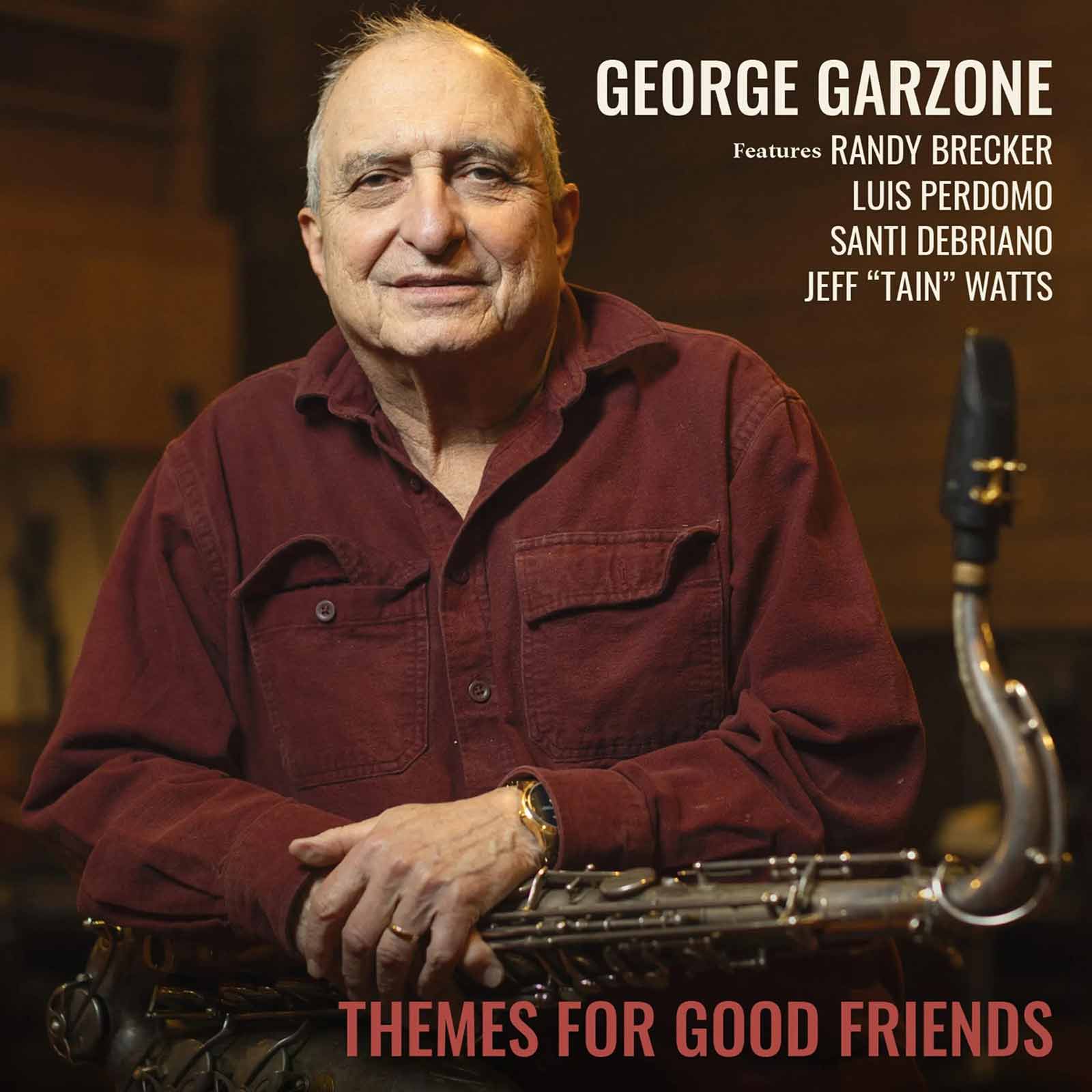
Summary: George Garzone’s Themes for Good Friends brings together Randy Brecker and a stellar quintet for an adventurous, deeply expressive celebration of modern jazz.
George Garzone’s Themes for Good Friends: A Bold Return to Modern Jazz
On a bright Sunday morning, with another day of summer heat already gathering outside, George Garzone’s new album, Themes for Good Friends, offers a remarkably fitting soundtrack. From its opening passages, the record carries a warmth that is both intimate and expansive, with Garzone’s tenor saxophone moving through the music with a fluidity that recalls the fading days of summer. Yet the appeal of the album has little to do with atmosphere alone. What immediately stands out is the sense of musicians listening closely to one another, responding in real time and allowing the music to develop with an ease that can make even the most sophisticated playing sound completely natural.
Some albums announce themselves immediately, not through volume or spectacle but through the unmistakable sense that everything is exactly where it should be. Themes for Good Friends is one of those records. On the surface, it is a straight-ahead jazz session featuring five exceptional musicians: Garzone on tenor saxophone, Randy Brecker on trumpet, Luis Perdomo on piano, Santi Debriano on bass and Jeff “Tain” Watts on drums. Yet within minutes, the familiar boundaries of straight-ahead jazz begin to loosen. These musicians know the tradition so thoroughly that they can move beyond its conventions without ever losing their sense of direction.
That ability comes naturally to Garzone, a musician whose career has been defined by both mastery and curiosity. Born and raised in Boston, he has spent more than five decades performing and teaching, and his influence can be measured in part by the remarkable list of musicians who passed through his classroom at Berklee College of Music, including Joshua Redman, Branford Marsalis, Donny McCaslin, Mark Turner, Seamus Blake and Chris Cheek. This year marks Garzone’s fiftieth year of teaching at Berklee, a milestone that would normally invite reflection on a career and its legacy. Yet Themes for Good Friends sounds remarkably uninterested in looking backward. Garzone still plays as if he were discovering something.
He has recalled that he was ten or eleven when he first heard Stan Getz play tenor saxophone on a record, an experience that changed his life. Getz remains an important point of reference, particularly in Garzone’s warmth and lyricism, although there is also something more searching in his sound, a quality that can evoke Dexter Gordon, John Coltrane and the restless spirit of modern jazz. What makes Garzone compelling is that he does not sound trapped by any of these influences. He carries them with him without allowing them to determine where the music must go next.
The chemistry among the musicians is one of the album’s greatest strengths. Randy Brecker, whose trumpet seems to gain another dimension with every new project, plays with extraordinary energy and imagination, while Perdomo brings an elegant harmonic sensibility that gives the ensemble considerable depth. Debriano anchors the music with a bass sound that is both powerful and flexible, and Watts provides the rhythmic intelligence that allows the performances to move from swing to something considerably more unpredictable without ever losing their center. The musicians continually push one another, listening as carefully as they play, and at several points the performances have the spontaneous intensity of a live recording.
The circumstances behind the album help explain that feeling. After hearing Garzone perform at a New York club, producer Simon Belelty was sufficiently impressed to approach Debriano about creating a recording that would capture the saxophonist at his best. Garzone and Debriano had first met as students in Boston around 1970 and had shared stages throughout their careers. When Debriano proposed assembling a quintet with Brecker, Perdomo and Watts, Garzone immediately embraced the idea. The premise was straightforward enough: bring together five musicians with deep roots in the tradition and see what happens. The result demonstrates why jazz cannot be reduced to a collection of individual reputations. Great players do not automatically make great ensembles. They have to hear one another, respond to one another and leave enough room for surprise. These five musicians clearly do.
The repertoire reinforces that sense of dialogue between generations. Garzone and his colleagues move between original compositions and works associated with some of the central figures of modern jazz without making the distinction feel especially important. John Coltrane’s Theme for Ernie receives an intimate treatment, with Garzone and Perdomo allowing the melody to breathe rather than surrounding it with unnecessary ornament. The performance functions as a tribute to Coltrane, but it also quietly recalls the young Garzone who first heard Getz and decided that the tenor saxophone could change the course of a life. After more than fifty years inside the music, he approaches the composition not as a historical artifact but as something still capable of revealing new possibilities.
Archie Shepp’s U-Jaama brings the entire quintet into sharper focus. Watts gives the performance its muscular rhythmic center while Debriano provides a foundation that allows the horns and piano to stretch without becoming disconnected from the underlying pulse. Brecker and Garzone engage each other with the confidence of musicians who do not need to compete for attention, and Perdomo occupies the spaces between them with remarkable sensitivity. The performance swings, but it also breathes and expands, demonstrating how much freedom can exist inside a form that listeners sometimes assume they already understand.
Debriano’s Ripty Boom offers another opportunity for the ensemble to stretch, while Garzone’s It Will Happen to You, his playful transformation of Jimmy Van Heusen’s It Could Happen to You, shows how easily the musicians can take familiar material and give it another life. There is humor in the title, but there is also a deeper understanding of the way jazz has always treated the standard repertoire. A familiar melody is not a finished object. It is an invitation to reinterpret, reshape and reconsider.
That relationship with jazz history becomes particularly personal in Garzone’s the Mingus That I Knew, a composition inspired by an encounter with Charles Mingus at the Village Vanguard when Garzone was still a young musician. During an intermission, Garzone apparently asked the man sitting behind him to stop smoking a cigar, only to discover that the man was Mingus himself. The story has the quality of a jazz anecdote, but it also reflects the unusual way history operates within this music. The legends are not always distant figures in photographs and record sleeves. For musicians of Garzone’s generation, they were people encountered in clubs, backstage rooms and crowded New York nights.
The album’s emotional center arrives with To Michael Brecker, Garzone’s composition written following Michael Brecker’s death in 2007. With Randy Brecker present, the tribute could easily have become sentimental, but Garzone avoids that temptation. The tenor saxophone and trumpet remain closely intertwined, sharing the melodic statement instead of turning the piece into a conventional display of grief. The performance feels less like a monument than a conversation, which may be the most appropriate tribute of all for a musician whose life has been defined by listening and responding.
That spirit reaches another level in Garzone’s duet with Watts on Coltrane’s Giant Steps. Rather than treating one of the most demanding compositions in the jazz repertoire as a technical obstacle, Garzone appears to take it apart and explore its harmonic architecture from within. The familiar melody does not fully return until the closing moments, giving the performance the sensation of a journey through a composition that generations of jazz musicians have studied, analyzed and feared. Recorded at Rudy Van Gelder’s legendary studio, the performance is a reminder that even one of the most familiar pieces in jazz can remain unsettled in the hands of a musician willing to approach it with curiosity.
That curiosity may be the quality that best defines Themes for Good Friends. There is a temptation to describe musicians with careers as long as Garzone’s in terms of legacy, but legacy can sometimes obscure the music itself. Fifty years of teaching, decades of performing and associations with some of the most important names in American jazz are impressive facts, but they are not what makes this record worth hearing. The music is what matters, and the music sounds immediate.
Themes for Good Friends does not attempt to reinvent jazz, nor does it need to. Instead, it demonstrates that a tradition this deep remains capable of renewal when musicians approach it with imagination rather than reverence. Garzone and his colleagues understand where this music came from, but they are not interested in merely reproducing it. They listen, react, challenge one another and allow the performances to develop organically. The result is an album that feels less like a statement about the past than a reminder that the past is still capable of speaking in the present.
After fifty years of teaching musicians how to find their own voices, Garzone seems to have retained the same lesson for himself. He remains both teacher and student, carrying the influence of Getz, Coltrane, Mingus and generations of jazz musicians while continuing to search for something that belongs entirely to him. Themes for Good Friends is ultimately a celebration of that continuing search, a record in which experience does not lead to complacency but to greater freedom, and where five seasoned musicians demonstrate that the most enduring quality in jazz may still be the willingness to listen, take chances and keep moving forward.
Thierry De Clemensat
Member at Jazz Journalists Association
USA correspondent for Paris-Move and ABS magazine
Editor in chief – Bayou Blue Radio, Bayou Blue News
PARIS-MOVE, September 7th, 2026
Follow PARIS-MOVE on X
::::::::::::::::::::::::
Musicians :
George Garzone · tenor saxophone
Randy Brecker · trumpet (2, 3, 4, 6, 7, 8)
Luis Perdomo · piano
Santi Debriano · bass
Jeff “Tain” Watts · drums
Track Listing :
Theme For Ernie
Ujamma
It Will Happen To You
Ripty-boom
Giant Steps
Just Ring The Bell
Mingus That I Knew
To Michael Brecker
Recorded at Van Gelder Studio, Englewood Cliffs, New Jersey
Recording Engineer: Maureen Sickler
Mixing Engineer: Nancy Conforti
Mastering Engineer: Shane Carroll
Mixing & Mastering at Swan Studios NYC
Liner notes by T.J. English
Produced by Simon Belelty for JOJO RECORDS
©JOJO RECORDS 2026