| Contemporary music |

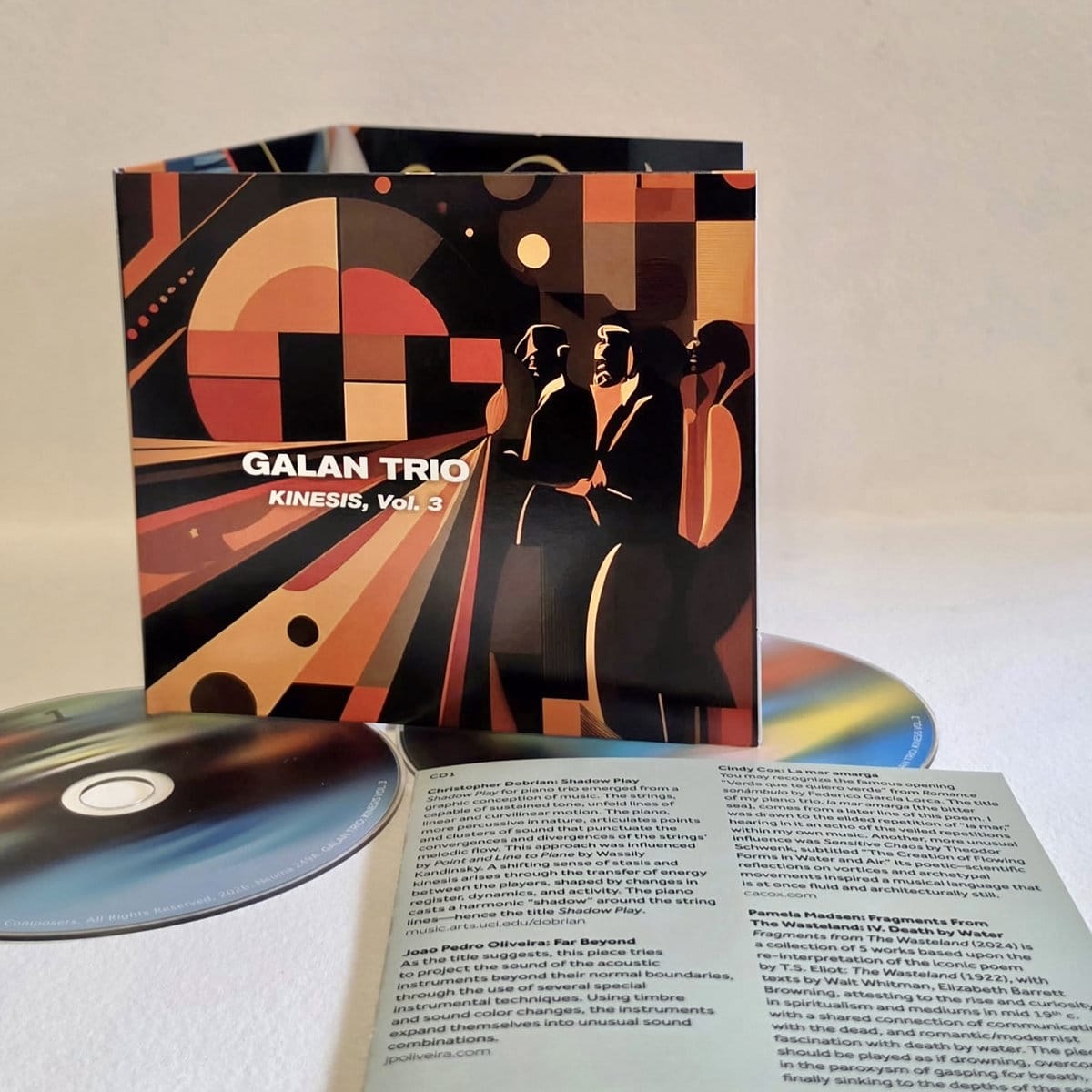
Kinesis, Vol.3: The Galan Trio’s American puzzle gains its third piece and a new dimension.
Two and a half years after Kinesis, Vol.2 closed its South-Central chapter, the Galan Trio returns with a third double album that does something genuinely rare for a long-running series: it doesn’t just continue, it grows. Kinesis, Vol.3 is the sound of an already ambitious project finding new tools to work with, and the result is arguably the richest, most sonically adventurous instalment yet in what is quietly becoming one of the most compelling ongoing commissioning projects in contemporary chamber music.
There’s a useful way to think about where this series stands after three volumes: as pieces of a puzzle whose final picture nobody, not even the trio themselves, has fully seen yet. Each Kinesis album has expanded the geography and the sonic vocabulary of the project without ever losing its throughline, and Vol.3 fits that pattern perfectly, snapping into place alongside its two predecessors while making clear there’s more picture still to reveal. Athens-based pianist Petros Bouras, violinist Babis Karasavvidis and cellist Marina Kolovou have never announced how large this puzzle will eventually be, and that open-endedness is part of what makes the project so exciting to follow. Three volumes in, the only safe prediction is that whatever comes next will surprise you exactly as much as this one does.
What sets Vol.3 apart most obviously from its predecessors is the trio’s first-ever integration of electronics into the Kinesis sound world, a significant evolution for a project that has always treated “motion” as its guiding principle. Where the first two volumes explored movement purely through acoustic interplay between piano, violin and cello, this third chapter widens that idea to include electronic texture and resonance, turning the traditional trio configuration into something closer to a living, reconfigurable sound environment. Christopher Dobrian’s opening “Shadow Play” is the clearest demonstration of this new flexibility: what begins as an almost conversational chamber piece, violin and cello intertwining over sparse piano figures, gradually darkens into something more unstable and percussive, eventually tipping into passages with a jazzy, cinematic pulse. It’s a strong statement of intent for the whole album, proof that “motion”, thirteen works and three volumes in, still has entirely new forms left to take.
João Pedro Oliveira’s “Far Beyond” pushes that instability even further, built on nervy high violin lines suspended over brooding piano and cello textures that refuse to resolve into anything like a conventional melody. It’s a genuinely unsettled piece of writing, and the trio’s control over its constant shifts between near-chaos and fleeting beauty is a real showcase for just how far their ensemble cohesion has developed across this series.
A loose but genuinely affecting thread runs through several of this volume’s most striking pieces: water, both as literal subject and as metaphor for instability. Cindy Cox’s two-part “La mar amarga”, drawn from the poetry of Federico García Lorca, gives the piano an almost elemental role, its rumbling lower register suggesting tidal movement beneath shimmering, tension-filled string writing. Deborah Kavasch’s four-movement suite “From Here to There”, inspired by the water-themed poetry of Salvatore Salerno, packs an impressive amount of contrast into a tight fifteen minutes, moving from a turbulent opening through a hushed “Reflection” and a kinetic “Snow” before closing on the cascading “As Goes the River”. And Pamela Madsen’s “Fragments from the Wasteland: Death by Water” takes the theme somewhere more theatrical entirely, weaving spoken word drawn from T.S. Eliot through dense, unravelling instrumental passages. A genuinely bold formal choice that pays off in the record’s sense of accumulating unease.
Elsewhere, the album carries real historical and emotional weight. Miguel Chuaqui’s “La Búsqueda”, recorded separately at the University of Utah and written to mark the fiftieth anniversary of the Chilean coup d’état, brings a politically charged meditation on memory and loss into the collection, while Patricia Alessandrini’s “Trio (Hommage à Geoff Nuttall)”, which opens the second disc, channels grief into raw, almost visceral string writing and forceful piano clusters. David Volk’s “Appalachian Uprooting” offers a gentler, folk-inflected counterpoint, its interplay between violin and cello carrying the quiet cadence of storytelling rather than confrontation.
The album’s true centrepiece arrives at the very end: Ofer Ben-Amots’ four-part “The Odessa Trio”, a nearly thirty-five-minute epic that functions as both summary and culmination of everything the record has built toward. Moving from the devotional weight of its opening movement through a bittersweet elegy, a tango-inflected intermezzo, and a closing recitative-and-toccata that pushes the trio to its most virtuosic, the piece is a genuine tour de force, the kind of extended, structurally ambitious closer that only a trio with this much collective stamina and trust could pull off convincingly.
What continues to distinguish the Galan Trio across three volumes and thirty-five commissioned works now is not just their individual virtuosity, but their collective refusal to let stylistic range dissolve into inconsistency. Bouras, Karasavvidis and Kolovou approach a piece like Kavasch’s spare, suspended “Sospeso” with the same commitment they bring to Ben-Amots’ sprawling finale, and it’s that consistency of identity, regardless of how far any individual composer pushes the trio’s sound, that has made this series so much more than the sum of its commissions. Recorded in Athens across an eight-month span between May 2024 and January 2025, with mastering by Vaggelis Lappas at Sierra Recordings, the album carries the same meticulous production values that have defined the Kinesis project from its start.
Kinesis, Vol.3 does exactly what a third instalment in an ongoing series should do: it deepens the project’s core idea rather than simply repeating it, and it does so by genuinely expanding the trio’s sonic palette rather than coasting on established goodwill. Thirteen world-premiere recordings, a first foray into electronics, and a closing statement as ambitious as “The Odessa Trio” add up to the most fully realized Kinesis volume yet. Sumptuous, exceptional, and never anything less than fully committed, this is a must, and as good a reason as any to go back and discover the first two pieces of the puzzle if you haven’t already.
Frankie Pfeiffer
Editor in chief – PARIS-MOVE
PARIS-MOVE, September 14th, 2026
Follow PARIS-MOVE on X
::::::::::::::::::::::::
Album on Neuma Records’ website
Musicians :
Petros Bouras: Piano
Babis Karasavvidis: Violin
Marina Kolovou: Cello
Tracklisting:
CD1:
1.Christopher Dobrian: Shadow Play 13:31
2.Joao Pedro Oliveira: Far Beyond 08:32
3.Cindy Cox: La mar amarga – I) Supple, mysterious, and very fast 05:22
4.Cindy Cox: La mar amarga – I) Expressive but very deliberate and even, III) Tempo molto rubato ad libitum 12:00
5.Pamela Madsen: Fragment from the Wasteland: Death by Water 09:11
6.Robert Denham: Pastoral (…and there were birds) 08:16
7.Deborah Kavasch: From Here to There – I) From Here to There 02:14
8.Deborah Kavasch: From Here to There – II) Reflection 01:55
9.Deborah Kavasch: From Here to There – III) Snow 02:12
10.Deborah Kavasch: From Here to There – IV) As Goes the River 02:08
11.David Volk: Appalachian Uprooting 10:27
CD2:
1.Patricia Alessandrini: Trio (Hommage á Geoff Nuttal) 09:14
2.David S. Carter: Sifting Chaparral 06:42
3.Andrés Carrizo: Sospeso 02:04
4.Kevin Zhang: Placed in a Puzzling Light, and Moving 07:15
5.Inés Thiebaut: Syneche 06:37
6.Miguel Chuaqui: La Búsqueda 08:05
7.Ofer Ben-Amots: The Odessa Trio – I) Elohemu Ve’elohey Avotenu 09:58
8.Ofer Ben-Amots: The Odessa Trio – II) Elegy (Memories, Bitter and Sweet…) 04:59
9.Ofer Ben-Amots: The Odessa Trio – II) Intermezzo: Tango Dorfman 06:17
10.Ofer Ben-Amots: The Odessa Trio – IV) Recitative and Toccata 13:30
Producer: Galan Trio
Recording Producer: Nikos Karapiperis
Recording Engineer, Editing: Kostas Katsandonis
Recorded: May 2024 – January 2025 – National and Kapodistrian University of Athens – Athens, Greece
La Búsqueda was recorded on August 31, 2025 at the University of Utah by Miguel Chuaqui.
Mastering: Vaggelis Lappas – Sierra Recordings Studio, Athens, Greece
Design: Philip Blackburn