| Jazz |
Summary: Fumi Tomita’s Yokai! Songs of the Japanese Supernatural transforms Japanese folklore into elegant, imaginative modern jazz.
Fumi Tomita’s Yokai! Turns Japanese Folklore Into Modern Jazz
There are musicians who play music, and there are musicians who seem to investigate the world before they play it. Fumi Tomita belongs to the second category. His curiosity is not an academic ornament, something that can be listed alongside degrees, teaching positions or books on a biography. It appears to be part of the way he hears. He researches before he composes, observes before he writes, gathers stories, images, historical references and fragments of culture, and then somehow turns that material into music. The result is particularly striking on Yokai! Songs of the Japanese Supernatural, an album built around the strange and often elusive creatures of Japanese folklore known as yokai. On paper, this could have been an invitation to musical exoticism: Japanese imagery, a few familiar sonic gestures, perhaps a touch of flute over a conventional jazz setting, all designed to signal that we have entered another world. Tomita does something considerably more interesting. He does not try to reproduce Japan. He does not compose music that tells the listener, “Now you are in Japan.” Instead, he suggests. A color here, a melodic turn there, the particular breath of Carl Clements’ flute, a rhythmic gesture, a certain atmosphere, and suddenly the imagination begins filling in the spaces. The Japanese material is present, but it is never presented as decoration. It is the substance from which the music grows. And that distinction is important because Yokai! is ultimately less interested in showing us a foreign world than in asking us to listen differently.
The word yokai itself may be unfamiliar to many listeners, but the idea behind it is remarkably accessible. It describes an enormous and constantly shifting universe of supernatural creatures, spirits, strange phenomena and unexplained presences in Japanese folklore. What fascinates me about that universe is not simply the creatures themselves, but the older human impulse that created them: the feeling that the world around us may contain more than we can see. Nature, objects, places, sounds and shadows can become carriers of meaning. We give shape to what we cannot explain. We give names to what frightens us. We turn uncertainty into stories, and once something has a story, it becomes easier to live with. Listening to Tomita’s album, I found myself doing exactly what a genuinely curious record can make you do. I started looking elsewhere. I wanted to know who these creatures were, where their stories came from, why particular characteristics had survived across generations and what they might have meant to the people who first imagined them. At that point, the album stopped being simply a collection of compositions inspired by Japanese folklore. It became an invitation to investigate. And that led me, perhaps inevitably, somewhere that might seem very far from ghosts and fox spirits: science. There is an oddly familiar intellectual territory between mythology and modern science, even though the two obviously operate in radically different ways. We look at the world and assume that what we see is what exists. Then science repeatedly demonstrates how incomplete that assumption is. Matter is composed of structures, particles, interactions and forces that cannot be perceived directly. Quarks, with their fractional charges and strange properties, are a particularly useful reminder that reality does not have to resemble our everyday experience of it. I am not suggesting that yokai and particle physics belong to the same category; they plainly do not. What interests me is the human response to the invisible. In both cases, there is something behind appearances, something that requires us to accept that perception is not the same thing as knowledge. Music does this too. A piece can give us an immediate surface and then, if it is good enough, make us wonder what is happening underneath.
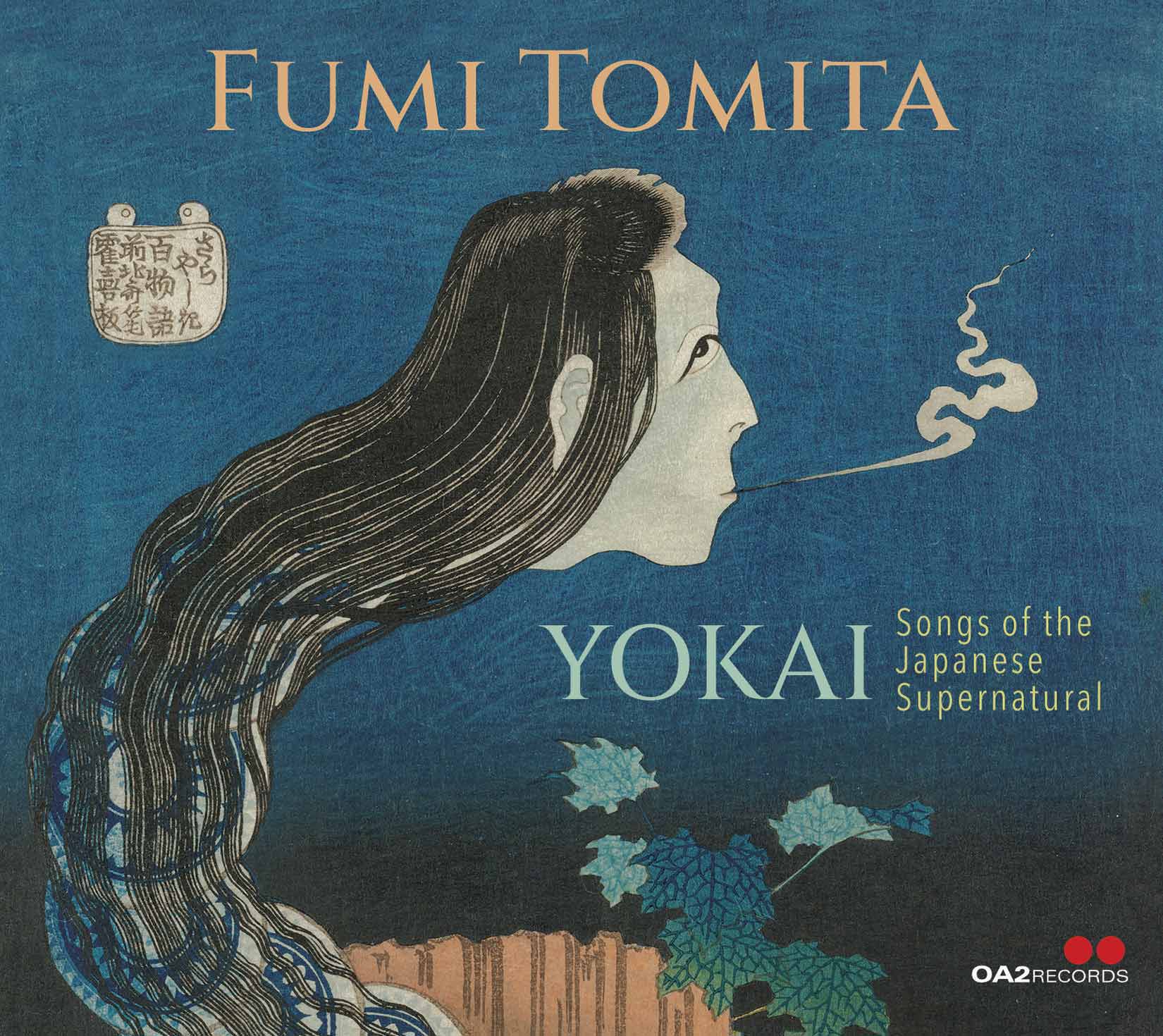
Tomita’s compositions understand that distinction instinctively. They do not attempt to turn each yokai into a literal musical character. There is no cartoonish “monster music,” no obvious sonic shorthand telling us that something frightening is approaching. Instead, Tomita seems more interested in personality than description. He asks what a creature might feel like rather than what it might sound like. That is a subtle but decisive difference. The music becomes interpretation rather than illustration. Nineteenth-century Japanese woodblock prints provided an important source of inspiration, but Tomita does not turn them into sonic postcards. He draws from their imagination, their exaggerated forms, their strange coexistence of the grotesque and the beautiful, and their ability to place the supernatural alongside the ordinary without treating the two as incompatible. That sensibility is all over the album. The music can be airy and lyrical, mysterious and occasionally unsettling, but it also swings. There is always a jazz band somewhere inside the mythology. Fumi Tomita is not attempting to make traditional Japanese music. He is making contemporary jazz from Japanese material, and that is precisely what prevents the project from becoming a caricature. Carl Clements’ flute provides the most immediate suggestion of the album’s Japanese dimension, but even there Tomita resists overstatement. The references arrive in small doses, through tone, phrasing and atmosphere. He understands something that many artists forget: suggestion is often more powerful than explanation. Once everything has been shown to us, there is nothing left for the imagination to do.
That restraint is also central to Tomita’s personality as a musician. His compositions do not seem interested in telling the listener what to feel. They establish a world and leave the door open. You can hear Yokai! without knowing anything about Japanese folklore and still experience it as a coherent jazz album. You do not need to know who Daija is, what Kitsune represents or why Betobeto san is associated with footsteps in the night. The music works before the information arrives. But then curiosity begins to interfere, in the best possible sense. You want to know why the piece sounds the way it does. You search for the story behind the title. You discover the creature, its history and its peculiarities, and suddenly the music you heard five minutes earlier has changed. A flute phrase acquires another meaning. A rhythmic shift can suggest movement rather than simply rhythm. A silence can begin to feel like the moment when something invisible is standing just behind you. That is where research and music meet. Knowledge does not replace listening; it changes the way we listen. This is one of the most appealing things about Tomita’s approach. He does not require the listener to arrive informed. He makes the listener want to become informed. His academic background therefore feels less like a separate intellectual identity than an extension of his musical instinct. At the double bass, he is the physical center of the quartet, but he never seems anxious to demonstrate that he is the composer and leader. His bass establishes the ground, shapes the atmosphere and gives the music its weight, sometimes becoming almost a character itself. The low register has a subterranean quality that seems perfectly suited to a world populated by invisible creatures and hidden presences. Yet Tomita knows how to remain present without taking over. Carl Clements, guitarist Jason Ennis and drummer Gary Fieldman are given room to breathe, and that interaction is crucial. The quartet does not illustrate the stories individually; it allows the stories to emerge from the way the musicians respond to one another. The drums create movement, the guitar adds texture and tension, the flute brings color and the bass holds everything together. The music can be contemplative one moment and suddenly become remarkably mobile the next. It feels less like a soundtrack to folklore than a group of musicians discovering the folklore together.
“Betobeto san” makes that philosophy particularly clear, and it also reveals something else that is easy to overlook in projects involving the supernatural: humor. Betobeto san is associated with the sound of footsteps following someone at night. You walk, the footsteps follow. You turn around, nobody is there. You continue walking, and they return. The solution, however, is wonderfully simple. You politely ask the creature to walk ahead of you, and it does. Here is a supernatural being that respects the basic etiquette of pedestrian traffic. I find that detail irresistible because it changes the entire emotional logic of the story. This is not a monster whose sole purpose is to terrify. It is an annoyance, a mysterious presence with rules of its own. Tomita could have emphasized menace, but instead the music suggests movement, playfulness and a certain mischievousness. That feels entirely appropriate to the larger world of yokai, which is not simply a museum of creatures designed to frighten children. It is populated by absurd beings, transformations, strange encounters and characters whose behavior can be as funny as it is disturbing. The supernatural does not always arrive carrying a threat. Sometimes it arrives carrying a joke. That ambiguity is one of the reasons these stories remain so compelling. Yokai can embody fear, explain the inexplicable, transmit warnings or moral lessons, and entertain at the same time. They belong to a world in which the border between the ordinary and the supernatural is porous. A sound can become a story. A shadow can become a character. An animal can possess an intention. An abandoned object can acquire a personality. To modern ears, that worldview may seem distant, but the underlying human impulse is not. We still invent explanations for what we cannot understand. We still name our fears. We still transform uncertainty into narrative. The forms have changed. The mechanism has not.
“Kitsune,” devoted to the fox, moves into another kind of ambiguity. In Japanese folklore, the fox is associated with intelligence, cunning, transformation and a complicated relationship with the human world. Again, Tomita does not attempt to compress an entire mythology into a few minutes of music. He extracts a personality, a sensation, an atmosphere. The composition works as an evocation rather than a narrative, which may be the only sensible way to approach such material musically. Trying to explain everything usually leaves nothing for the imagination. Tomita gives us just enough. We know that we are listening to a piece inspired by a supernatural fox, but we are free to imagine that fox for ourselves. Jazz improvisation makes that freedom even more meaningful because the music itself is never completely fixed. A structure can be revisited, altered, stretched and transformed, becoming something slightly different each time it is played. The remaining compositions extend this gallery without making it feel like a catalog. “Daija,” centered on the monstrous serpent, carries a heavier and more imposing presence. “Okiku” moves toward a darker atmosphere. “Amabiko,” “Wakana-Hime” and “Kiyomori” continue the exploration of characters whose stories are intertwined with the cultural history from which they emerged. Then comes “Hyakki Yagyo,” the famous Night Parade of the Hundred Demons, a title that seems almost designed to tempt a composer into excess. One could imagine a chaotic procession of supernatural creatures, each demanding its own musical identity. Tomita does not fall into that trap. He does not try to make a hundred monsters audible simultaneously. He organizes the chaos. That may be one of the clearest demonstrations of his compositional intelligence. The piece can suggest agitation, movement and a gathering of forces while remaining architecturally controlled. You hear the parade, but more importantly, you hear musicians who understand how to move through it.
This is what ultimately separates Yokai! from a clever conceptual exercise. It would have been easy to create nine compositions, give each one the name of a supernatural creature, package them under an evocative title and let the concept do the rest. Tomita does not rely on the concept. The music has to stand on its own. The pieces inhabit the same universe without becoming interchangeable. Their atmospheres change, their characters change, their textures shift, but the writing maintains a consistent identity. The album is held together by a persistent belief in suggestion, by a willingness to let swing and improvisation converse with imagery from another cultural world, and by the understanding that jazz is not a closed historical language. That is where Tomita’s academic background becomes particularly revealing. Research is not something added to the music after the fact. It appears to be part of the compositional process itself. He knows the history of jazz, understands its structures and traditions, but he also understands that music is not supposed to remain inside a museum case. It survives by being confronted with new material. I have always liked the idea of the musician as someone who searches. It feels especially relevant now, when almost everything can be instantly accessed, explained, summarized and classified. We have become remarkably efficient at removing mystery from things. Tomita’s music does something almost opposite. It reminds us that a record can still send us somewhere we did not expect to go. I began listening to an album about Japanese folklore and found myself thinking about how societies give form to the invisible, about the relationship between mythology and knowledge, and eventually about our own fascination with realities that cannot be seen directly. That may seem like an unusually long journey for a jazz record. But sometimes that is exactly what I want from music. I want it to move beyond the frame I initially gave it.
The Japanese references, importantly, remain in the service of the music throughout. They never overwhelm the quartet, and that restraint makes the album unusually welcoming. You can know absolutely nothing about yokai and simply listen to the flute, guitar, bass and drums. You can follow the melodies, the rhythmic changes, the spaces between the instruments and the way the musicians respond to one another. Then you can go looking for the stories behind the titles. When you return to the record, you hear it differently. It is a little like looking at a painting after learning what the artist intended to depict. You do not necessarily see more, but you look differently. At its heart, Yokai! Songs of the Japanese Supernatural may therefore be less an album about Japanese monsters than an album about curiosity. The yokai are its apparent subject, but Tomita’s deeper project is to take material connected to his Japanese heritage, place it in conversation with a musical language that developed somewhere else, and allow the two traditions to meet without either one being reduced to the other. Jazz remains jazz. Japanese folklore remains Japanese folklore. But something new appears in the space between them. That space is where the album becomes most interesting. You can listen without knowing anything about its subject and hear elegant, airy, sometimes mysterious and often lyrical jazz carried by a swing that keeps reminding us that behind the ghosts and supernatural creatures are four very real musicians in a room, listening to one another, breathing, reacting and making decisions in real time. But sooner or later, the curious listener is likely to ask the questions Tomita seems to have wanted us to ask all along. Who are these creatures? Why this story? Why this image? Why this music? Those questions do not interrupt the listening experience. They extend it. Knowledge arrives after the music and makes the music larger. Fumi Tomita does not give us a lesson about yokai. He gives us a reason to learn about them. Those are two very different things.
That is what I will ultimately take away from this record. Music can begin almost anywhere: with a woodblock print, a folktale, a writer, a memory, a natural phenomenon, an imaginary creature, a story several centuries old or even a scientific question that appears to have nothing whatsoever to do with jazz. Its boundaries are determined, at least in part, by what a composer is capable of seeing beyond the obvious. Fumi Tomita looks elsewhere. He searches through Japanese folklore, the history of jazz, literature, research and imagination, and then he returns with music. The music does not ask us to believe in monsters. It asks something more interesting: that for a few minutes we accept the possibility that the world is stranger, deeper and less completely understood than what our eyes tell us. That is already a considerable achievement. And sometimes it is exactly what a good record should do. It should not give us every answer. It should leave us with just enough unanswered questions that, when the final note disappears, we find ourselves wanting to put the record back on the turntable.
Thierry De Clemensat
Member at Jazz Journalists Association
USA correspondent for Paris-Move and ABS magazine
Editor in chief – Bayou Blue Radio, Bayou Blue News

PARIS-MOVE, September 24th, 2026
Follow PARIS-MOVE on X
::::::::::::::::::::::::
Musicians:
Carl Clements – saxes & flute
Jason Ennis – guitars
Fumi Tomita – bass
Gary Fieldman – drums
Track Listing:
1 Daija (Monster Snake) 6:51
2 Kitsune (The Fox) 4:39
3 Betobeto san 4:27
4 Wakana-Hime (Princess Wakana) 7:37
5 Kiyomori 4:32
6 Amabiko (Sea Lad) 4:54
7 Genjũ Zukushi Emaki (Beasts Galore) 5:32
8 Okiku 5:14
9 Hyakki Yagyo (Night Parade of 100 Demons) 5:24
All composed by Fumi Tomita, Groovy Tomato Music (ASCAP)
Produced by Fumi Tomita
Recorded by Mark Alan Miller at Northfire Studios, Amherst, MA on August 15-16, 2025
Mixed & mastered by Warren Amerman at Rotary Records, West Springfield, MA
Artist photo by Julian Parker Burns
Cover design & layout by John Bishop