
| Jazz |
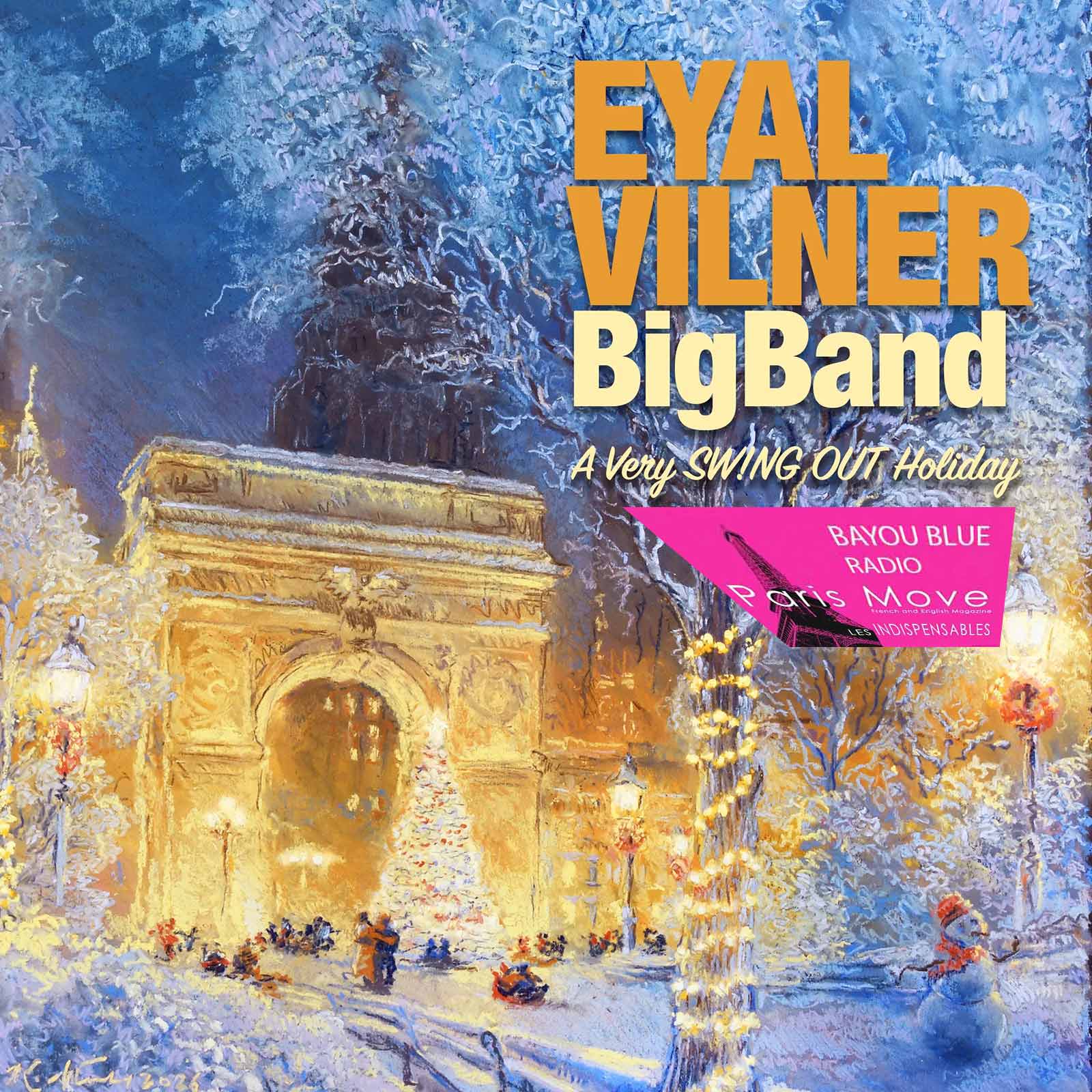
Summary: Eyal Vilner and his Big Band reinvent holiday classics through swinging arrangements, jazz tradition, vibrant improvisation and the infectious spirit of dance.
Eyal Vilner’s A Very SW!NG OUT Holiday: A Fresh Take on the Holiday Songbook.
Halloween is still upon us, with its familiar parade of pumpkins, costumes and autumn festivities, but the musical calendar is already moving to a different rhythm. This is traditionally the time of year when the first albums designed to accompany the holiday season begin to arrive, renewing an annual ritual built around a repertoire whose familiarity is both its greatest asset and its most demanding challenge. How does one breathe new life into melodies so deeply embedded in the collective memory that a few opening notes can summon childhood recollections, movie scenes, family gatherings and an entire cultural landscape shaped by generations of musicians? The exercise might seem destined for repetition, perhaps even an indulgence in nostalgia. Yet the latest project from multi-instrumentalist, composer and arranger Eyal Vilner and his Big Band offers compelling reasons to approach this familiar territory with renewed curiosity. With A Very SW!NG OUT Holiday, due Nov. 6, 2026, Vilner returns to a seasonal repertoire particularly vulnerable to convention, determined to demonstrate that its musical possibilities are far from exhausted. The real challenge is not simply to rearrange familiar melodies, but to restore their capacity to surprise without sacrificing the qualities that have made them part of our cultural inheritance.
That distinction is central to Vilner’s approach. These songs are so firmly established in our collective consciousness that their interpretation can easily become little more than an exercise in recognition. Vilner avoids that trap by neither disguising the material behind an artificial veneer of modernity nor reproducing the orchestral formulas that have secured its popularity. His real achievement lies in the arrangements: the redistribution of instrumental roles, the shifting of harmonic balances, and the careful manipulation of tempo and dynamics. His Big Band becomes an extraordinarily versatile instrument of transformation, capable of combining collective power with the precision of individual expression. From the opening moments of “Sleigh Ride,” listeners are encouraged to abandon their habitual expectations. Luther S. Allison’s piano establishes an intimate, almost domestic atmosphere before the brass and saxophone sections gradually take possession of the musical space. Their entrances, arranged as a succession of individual statements, give the introduction an almost theatrical quality. Each musician contributes a distinctive color until the ensemble discovers its full momentum in a generous, unabashedly swinging orchestration. It is an intelligent opening strategy. Rather than immediately delivering the melody everyone expects, Vilner takes the time to redefine the conditions under which it can be heard. A familiar composition, he reminds us, need never remain captive to its previous interpretations.
The album’s title is a deliberate nod to SW!NG OUT, the stage project developed around the encounter between musicians and dancers, notably at New York’s Joyce Theater, before traveling throughout the United States. This connection is essential to understanding Vilner’s musical philosophy. As he explains, A Very SW!NG OUT Holiday is a celebration of friendship, community, family, music and dance. Beyond the familiar language of holiday promotion, the statement expresses a genuine artistic conviction: Jazz is not merely an exercise in instrumental virtuosity or harmonic sophistication. It is a collective experience, an energy circulating between those who play, those who dance and those who listen. The arrangements draw upon the great orchestras of the Swing Era, while the harmonic sophistication of bebop and the more assertive vocabulary of hard bop add further dimensions. These references, however, are never invoked as historical ornaments. They form a living musical language that Vilner reshapes according to his own artistic priorities. This interplay between memory and movement is one of the most compelling characteristics of his work. It also explains why his albums cannot be reduced to a succession of arrangements designed simply to satisfy admirers of traditional jazz. Behind the music lies a thoughtful reflection on jazz’s social purpose and its enduring capacity to bring people together.
“Deck the Halls” further demonstrates Vilner’s ability to transform the character of a composition. Where the traditional melody naturally invites a lighthearted interpretation, he explores its blues inflections, reshaping the tempo and the relationships between the instrumental sections. The saxophones converse with muted brass, while Josh Lee’s baritone saxophone provides a particularly compelling foundation. The arrangement develops patiently, building tension before opening into a powerful shout chorus. What commands attention is not simply the ensemble’s considerable volume, but the architectural intelligence with which that power is deployed. The sections do more than reinforce a melody: They comment on it, extend it and occasionally challenge it. There is something of Duke Ellington and Billy Strayhorn’s orchestral philosophy in this approach, particularly their conception of a composition as a living organism in which every passage prepares and gives meaning to the next. Vilner’s engagement with this tradition, as well as with composers such as Tadd Dameron, whose harmonic imagination profoundly influenced modern orchestral jazz, is unmistakable. Yet his writing never feels like historical reconstruction. He understands that respecting an inheritance means continuing to develop it.
Imani Rousselle brings another dimension to the album. On “Frosty the Snowman,” her voice finds its place within an evocative orchestral setting, with the saxophones introducing the melody while the brass create an almost cinematic landscape around her. The performance avoids manufactured nostalgia and instead recaptures the childlike spontaneity that helps explain the enduring appeal of these songs. Rousselle possesses a distinctive vocal personality, never allowing herself to be swallowed by the force of the Big Band. Her contribution feels entirely natural within an arrangement that knows when to leave room for breathing. She also appears on “What Are You Doing New Year’s Eve?,” where the arrangement initially favors intimacy before gradually expanding toward a more emphatic orchestral conclusion. Frank Loesser’s composition acquires particular depth in this setting. Behind the familiar association with the transition from one year to the next lies a romantic uncertainty that lends itself remarkably well to this interpretation. The movement from reflection toward collective expression is among the album’s most persuasive moments. Singer and orchestra engage in a genuine dialogue rather than competing for attention.
One of the album’s most welcome qualities is its refusal to confine the holiday season to the Christmas songbook. With “Maoz Tzur” and “Oh Hanukkah,” Vilner broadens the cultural scope of the program, recognizing that the musical traditions associated with this time of year are multiple, distinct in origin yet capable of finding common ground within a shared celebration. “Maoz Tzur,” previously explored on his 2016 album Hanukkah, receives a new orchestral interpretation whose harmonic colors occasionally evoke Ellington and Strayhorn’s Nutcracker Suite. The traditional melody gains unexpected depth through the use of minor and diminished harmonies. There is genuine cultural intelligence in this decision. Vilner does not simply place different repertoires alongside one another to satisfy a superficial notion of diversity. He incorporates them into a coherent musical vision in which each tradition retains its identity while contributing to a broader celebration. That openness deserves recognition at a time when holiday albums frequently rely on a relatively narrow cultural imagination. “Oh Hanukkah,” appearing toward the end of the program, adopts a considerably more expansive energy. The orchestra unfolds with remarkable vigor, supported by writing that leaves ample room for individual expression. Imani Rousselle’s presence, Anthony Hervey’s trumpet contributions and Eran Fink’s rhythmic propulsion help create an infectious finale. Tradition, hard-bop energy, improvisational freedom and the pleasure of collective performance converge in a particularly satisfying synthesis.
“Blue Christmas” offers another successful example of artistic reclamation. The combination of Josh Lee’s baritone saxophone and Ricky Alexander’s clarinet gives the song a distinctive, almost twilight-like atmosphere, which Luther S. Allison’s piano extends with considerable finesse. The reharmonization introduced at the climax prevents the composition from retreating into predictable sentimentality. Instead, it uncovers expressive possibilities within a melody listeners might assume they know by heart. This ability to shift a song’s center of gravity without erasing its personality is among the album’s greatest strengths. Renewal does not necessarily require radical transformation. Sometimes it emerges from a change of perspective, a different distribution of instrumental colors or a carefully placed harmonic tension. A comparable approach informs “Winter Wonderland,” whose opening suggests an almost impressionistic landscape before gradually revealing a pulse designed to draw listeners toward the dance floor. The orchestral colors, Rousselle’s vocal contributions and the rhythmic inflections of the Big Band give the piece a breadth extending well beyond a conventional evocation of winter. The brass, alternately biting and enveloping, lend the performance a distinctive personality. Vilner’s sense of progression is particularly effective: He knows how to transform an atmosphere without forcing transitions or losing sight of the music’s fundamental purpose, making people want to move.
The original compositions provide another important dimension. “Comté Fruité” interrupts the succession of familiar themes with a particularly stimulating display of rhythmic invention. Rapid exchanges between musicians gradually lead into a more intricate construction involving tempo changes, triplets and shifting meters. Vilner once again demonstrates his ability to conceive orchestral writing as a space for freedom, where compositional precision leaves ample room for the unexpected. For dancers, these rhythmic changes create a constantly evolving environment in which movement must respond to the music rather than simply follow it. “Coffee Bean Stomp Jubilee” takes this principle further by incorporating Caleb Teicher’s tap dancing into the instrumental arrangement. This is not a decorative theatrical effect. Rhythm becomes the subject of a genuine conversation between musicians and dancer, with questions of who leads, who responds and who accompanies becoming integral to the composition. The boundary between music and dance is deliberately blurred, recalling the historical relationship between jazz, dance halls and the social spaces in which the music developed. It is a persuasive reminder that rhythm is not merely something to hear. It is something to see, share and physically inhabit.
That collective dimension finds another expression in “Christmas Night in Harlem.” Harlem is not simply a geographical reference or a nostalgic backdrop intended to lend the project historical legitimacy. It represents a living memory of jazz, its orchestras, dance halls and the constant exchange between generations of musicians. Imani Rousselle’s presence, alongside contributions from Julieta Eugenio and Anthony Hervey, helps evoke a wintertime New York in which music remains central to collective life. This reflects one of Vilner’s most enduring convictions: Jazz cannot be understood independently of its social environment. Its history belongs to communities, places and practices that have shaped its evolution just as decisively as the harmonic and instrumental innovations of its greatest creators. Such historical awareness does not diminish the immediate pleasure of listening. It gives that pleasure additional depth. Swing is not simply an orchestral aesthetic or a way of accenting beats. It is also the expression of a popular culture that found in music and dance powerful forms of affirmation, freedom and shared experience.
The album eventually arrives at “Auld Lang Syne,” which functions as a reflective coda after the grand finale. Its piano introduction echoes the opening of “Sleigh Ride,” establishing a subtle continuity between the beginning and the end of the program. The trombones introduce gospel-inspired sonorities before the brass expand into a broader palette incorporating New Orleans marching-band traditions, modern harmonies and the impulses of soul jazz. The result is an orchestral celebration in which collective improvisation gives the composition an almost communal character. The brief “Auld Lang Syne – Reprise,” which closes the record, is especially revealing. It feels like an invitation to witness what happens after the performance is over, when musicians and dancers are no longer constrained by the demands of the show and simply allow the shared moment to continue. Voices, instruments and tap dancing come together in an informal atmosphere that lends the conclusion a welcome humanity. This is not decorative extra material. It captures the album’s essential spirit: music finding its fullest expression in the pleasure of being together.
The achievement also rests on substantial instrumental and orchestral work. The ensemble brings together several generations of musicians, with strong trumpet and trombone sections, a saxophone section whose colors and balances are among the project’s greatest assets, and a rhythm section capable of supporting complex passages without sacrificing the flexibility essential to swing. Vilner gives each musician a meaningful role without dissolving the identity of the ensemble. The Big Band operates not as a uniform mass of sound but as a community of distinct voices united by a common artistic purpose. Luther S. Allison’s piano, Eran Fink’s drums, Ian Hutchison’s bass and the contributions of the various soloists all contribute to this collective construction. The variety of timbres, the precision of the attacks and the exchanges between sections give the recording considerable depth. Behind this coherence lies the accumulated work of an ensemble that has gradually developed a shared musical language. It is what allows Vilner to take liberties with familiar melodies without losing their essential character. He does not impose his signature at the expense of the compositions; he makes that signature the means through which they can be rediscovered.
The recording carries an additional human dimension. Made at Brooklyn’s Bunker Studios in January 2026, the album bears the imprint of the final work of Michael Perez-Cisneros, Vilner’s longtime collaborator, who died unexpectedly just days before its completion. Their professional relationship, extending over approximately 15 years, helped define the sonic identity of the Big Band’s previous productions. This circumstance lends the album’s collective spirit an additional resonance. There is no need to turn a personal loss into an artistic selling point to recognize that music is also shaped by loyalties, collaborations and the contributions of individuals who may never occupy the spotlight. The recording engineer’s work and the trust established between musicians and their collaborators are integral to the final result. An album devoted to celebrating human connections also preserves the trace of an artistic relationship that accompanied Vilner for a decade and a half.
Ultimately, A Very SW!NG OUT Holiday succeeds because it understands that a musical tradition remains alive only when artists are willing to engage with it creatively. Beyond the seasonal repertoire, the album reawakens an entire cultural imagination: the great jazz orchestras, Broadway musicals, American cinema and the popular traditions that have long accompanied the holidays. It recalls an era when songs moved freely between theater stages, dance orchestras, movie studios and family homes, helping create a shared cultural memory. But Vilner never attempts to reproduce that era artificially. He preserves its colors, momentum and generosity while reorganizing them according to a contemporary sensibility. History is neither a refuge nor a museum here. It is living material, open to reinterpretation and transmission. Jazz has always evolved by drawing upon its own roots, and this album offers a persuasive illustration of that enduring process.
Some may argue that the holiday repertoire offers limited opportunities for genuine musical adventure, or that swing has become too familiar a territory to deliver meaningful surprises. Such arguments overlook an essential point: The challenge is not to produce novelty at any cost, but to rediscover the possibilities for sincere expression within established forms. Vilner meets that challenge with elegance, musical intelligence and an infectious generosity of spirit. A Very SW!NG OUT Holiday does more than honor a tradition. It celebrates several, brings them into conversation and restores to them one of their most essential functions: bringing people together. At a time when music is so often consumed in isolation and reduced to an endless succession of interchangeable content, that proposition carries a significance extending well beyond the holiday season. No one expects a seasonal album to reinvent the world. But it can remind us why we continue to listen to music together. On that score, Vilner and his Big Band deliver with conviction. When such orchestral sophistication is combined with such evident pleasure in playing, dancing and sharing, the appropriate response is not hesitation but applause. And plenty of it.
Thierry De Clemensat
Member at Jazz Journalists Association
USA correspondent for Paris-Move and ABS magazine
Editor in chief – Bayou Blue Radio, Bayou Blue News
PARIS-MOVE, October 30th, 2026
Follow PARIS-MOVE on X
::::::::::::::::::::::::
To buy this album (November 6, 2026)
Track Listing:
“Sleigh Ride”
“Deck the Halls”
“Frosty the Snowman”
“What Are You Doing New Year’s Eve?”
“Maoz Tzur”
“Blue Christmas”
“Comté Fruité”
“Christmas Night in Harlem”
“Coffee Bean Stomp Jubilee”
“Winter Wonderland”
“Oh Hanukkah”
“Auld Lang Syne”
“Auld Lang Syne – Reprise”