| Jazz |
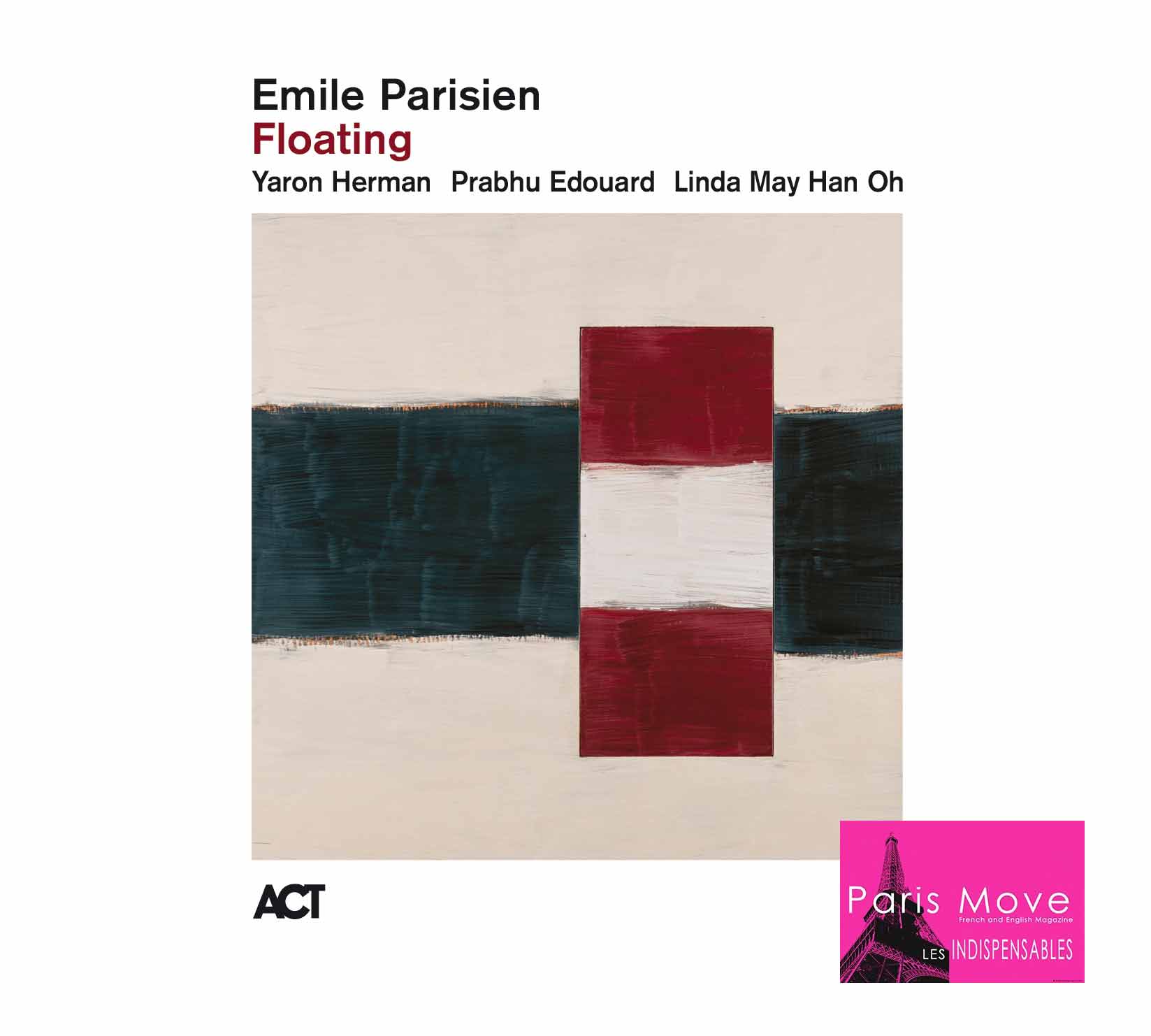
Summary: Emile Parisien’s Floating brings together Yaron Herman, Linda May Han Oh and Prabhu Edouard in a sophisticated jazz quartet built on improvisation, cultural fusion, delicate rhythms and a powerful message of peace.
Emile Parisien’s Floating Finds Its Strength in Listening
I have always had a particular fondness for Emile Parisien, although I have often encountered him in the role of the exceptionally gifted partner, the musician whose presence can transform another artist’s project without necessarily placing himself at its center. Floating changes that perspective. From the opening measures, Parisien’s writing and his soprano saxophone playing command attention, not because he tries to dominate the music, but because he has created an environment in which every sound seems to have a purpose and every musician has enough room to develop an idea.
The album opens with “Asian Songs & Rhythms No. 40,” by Gurdjieff and de Hartmann, and the choice immediately establishes a particular atmosphere. Parisien’s soprano does not simply carry the melody. It seems to move through the composition, sometimes delicately, sometimes with greater urgency, while the musicians around him constantly reshape the space in which the saxophone is heard. There is a sense that Parisien has finally found a configuration perfectly suited to the music he wants to make, one in which technical ability is almost secondary to the quality of the interaction.
That interaction is what makes Floating so interesting. The quartet brings together Parisien with pianist Yaron Herman, bassist Linda May Han Oh and tabla player Prabhu Edouard, four musicians with unmistakable personalities and substantial careers of their own. On paper, the combination could have seemed difficult to predict. Each musician has developed a highly individual musical language, and none of them needs another group simply to demonstrate what they can already do. Yet the music suggests that the real attraction was precisely the possibility of putting these different sensibilities into conversation.
The quartet grew out of a “carte blanche” given to Parisien by the Cité internationale de Paris to close a two year residency. What was initially intended as a meeting and a single musical event gradually revealed a chemistry strong enough to justify another life beyond the concert itself. The forthcoming album, presented as a new chapter in Parisien’s already remarkably varied body of work, brings together musicians whose familiarity with one another is matched by a genuine curiosity about what the others can still discover.
That distinction is important because Floating does not feel like a project assembled around a fashionable concept. It feels lived in. The music has the looseness that comes when musicians already trust one another, but it also retains the alertness of people who have not become too comfortable. They listen closely, leave space and react to one another without turning every exchange into a demonstration of virtuosity.
Parisien has described the album in unusually personal terms, saying that the music is ultimately about peace, poetry, gentleness and love. He has also explained that he wanted to offer a counterweight to a world overwhelmed by worries and conflict, a world in which everything appears to accelerate while moving simultaneously in too many directions. There is a risk whenever a musician describes an album in such idealistic language. The music can begin to sound like an illustration of an idea rather than an experience in its own right. Floating largely avoids that problem because its sense of calm comes from the musicians themselves rather than from a forced message imposed on the material.
The circumstances in which the quartet came together help explain that quality. Parisien was going through an especially demanding period, surrounded by concerts, recording sessions, projects, commitments and the constant pressure that accompanies a musician whose career has become increasingly international and prolific. Instead of responding by adding another layer of activity, he appears to have searched for the opposite. He wanted to step back, allow things to settle and create enough distance to hear what was happening around him.
That desire for suspension is present in the music. Floating rarely sounds hurried, even when the musicians are working with considerable rhythmic complexity. There is movement everywhere, but it is rarely movement for its own sake. The quartet seems interested in what happens when a phrase is allowed to breathe, when a rhythmic figure is given time to change shape and when a musician resists the temptation to say everything at once.
Prabhu Edouard is particularly important to that process. His tabla playing brings a delicacy that can be almost hypnotic, but there is nothing decorative about it. He possesses an extraordinary ability to make rhythm feel like an environment rather than simply a structure. His playing surrounds the other musicians without trapping them, and that distinction gives Parisien an unusual amount of freedom on soprano saxophone.
Parisien has spoken admiringly of Edouard’s ability to move between different musical contexts while retaining his own identity. He has described him as a musician who gives the music “wings,” emphasizing his intelligence, lightness and agility. Listening to the quartet, the description makes sense. Edouard does not appear to be there merely to introduce an element of Indian musical tradition into a European jazz setting. His contribution is much more integrated than that. He changes the way the entire quartet thinks about rhythm.
That is one of the album’s most successful qualities. Its cultural mixture never feels like an exercise in musical tourism. The traditions represented by the four musicians are not placed next to one another for the listener to admire. They interact, overlap and occasionally disappear into one another. What remains is less a demonstration of cultural difference than an example of what can happen when musicians are genuinely interested in listening beyond their own vocabulary.
Linda May Han Oh is an equally revealing presence. Her playing has repeatedly impressed me because of the way she can enter sophisticated and demanding projects without ever making her contribution feel predictable. There is something almost chameleonic about her ability to adapt to a musical environment, but adaptation does not mean anonymity. She has a strong identity as a bassist and composer, and that identity is evident in the way she responds to the other three musicians.
On Floating, the bass often acts as the point of balance between the piano, soprano saxophone and tabla. Han Oh does not simply hold the ensemble together in the traditional sense. She helps determine where the music can go next. Her restraint becomes an active musical choice, and the moments when she steps forward have greater impact precisely because she has not spent the entire performance demanding attention.
Yaron Herman brings another form of sensitivity to the quartet. His piano playing can be lyrical without becoming sentimental and exploratory without losing its emotional center. He understands the importance of space in this music, and that may be one of the reasons the quartet never feels overcrowded. There are plenty of ideas, but there is no need to prove that four highly accomplished musicians are capable of producing them.
That is perhaps where Floating distinguishes itself most clearly. Parisien has surrounded himself with musicians who could easily fill every available second with information, yet the album repeatedly demonstrates the value of restraint. Silence, hesitation, repetition and small changes in texture become part of the musical vocabulary. The listener is invited to pay attention not only to what is being played but also to the decisions being made about what does not need to be played.
This becomes particularly meaningful when placed against Parisien’s own description of the album as a kind of gentle reset. He has said that he opened himself completely to the music while going through a difficult period and that he believes gentleness is the best way to approach conflict. It would be easy to reduce that idea to a pleasant sentiment, but the music gives it greater substance. There is tension in Floating. There are moments of uncertainty and passages in which the musicians push against one another. The calm is not the absence of conflict. It comes from the ability to remain in conversation while conflict exists.
That may also explain why the quartet works so naturally despite the individuality of its members. The musicians do not attempt to erase their differences in order to create harmony. They use those differences. Parisien’s soprano has its own sharpness and fragility, Herman brings a distinct pianistic language, Han Oh gives the music its deep sense of balance, and Edouard introduces rhythmic possibilities that continually shift the perspective. None of these voices needs to become the dominant one.
The best ensembles often emerge this way, through friendship, coincidence and mutual respect rather than through an elaborate plan. Looking at the careers of these four musicians, their association might initially appear surprising, but the deeper one listens, the more logical it becomes. Their musical backgrounds are different, yet they share a commitment to exploration, careful listening and a willingness to treat the ensemble as something larger than the sum of its individual reputations.
There is also something refreshing about the absence of ego. In an era when musicians are increasingly encouraged to turn every release into an event and every collaboration into a statement, Floating seems more interested in the music itself. Parisien does not need to remind the listener how accomplished these musicians are. Their history is already there. What matters is what they do with one another now.
For that reason, the album deserves to be heard patiently. It is not necessarily a record that reveals everything on a first encounter. The listener should resist the temptation to treat the soprano saxophone as the sole narrative voice and instead follow the exchanges between the four musicians. Listen to the tabla underneath the saxophone, to the bass responding to the piano, to the spaces that appear between phrases and to the subtle changes that occur when one musician decides to leave room for another.
The album’s title becomes increasingly appropriate in that context. Floating suggests movement without a fixed destination, a state in which the music remains suspended long enough for unexpected connections to emerge. That feeling is not achieved through softness alone. It comes from control, trust and an unusual willingness to let the music develop without constantly forcing it toward a conclusion.
Parisien’s idea of a “gentle reset” therefore feels less like a promotional description than a useful way of understanding what the quartet has achieved. The musicians have created a space in which different traditions can meet without one being asked to dominate the others, and in which individuality remains intact without becoming isolation.
There is a genuine message of peace here, but it is better heard than explained. It exists in the way these musicians make room for one another, in the patience of the arrangements, in Edouard’s remarkable rhythmic sensitivity, in Han Oh’s understated authority, in Herman’s ability to create space and in Parisien’s increasingly confident command of the soprano. The album does not need a slogan because the music already makes the argument.
What stays with the listener, ultimately, is not a grand declaration but a particular feeling of having spent time in the company of four musicians who trust each other enough to listen. At a moment when so much contemporary life seems organized around speed, noise and constant reaction, that quality feels unusually valuable. Floating does not try to escape the world that produced it. It simply creates another way of moving through it, with greater attention, greater patience and, perhaps most importantly, a little more room for another voice to be heard.
Thierry De Clemensat
Member at Jazz Journalists Association
USA correspondent for Paris-Move and ABS magazine
Editor in chief – Bayou Blue Radio, Bayou Blue News
PARIS-MOVE, August 20th, 2026
Follow PARIS-MOVE on X
::::::::::::::::::::::::
Musicians :
Emile Parisien: soprano saxophone
Yaron Herman: piano
Prabhu Edouard: tabla, percussion, vocals
Linda May Han Oh: double bass, vocals
Track Listing :
01 Asian Songs & Rhythms, No.40 – Gurdjieff & de Hartmann 04:57
02 Bonbon – Emile Parisien 05:14
03 Olive Branch – Yaron Herman 04:49
04 Badhra – Anouar Brahem 06:19
05 Portal – Yaron Herman/ Emile Parisien 06:18
06 66 – Emile Parisien 05:20
07 Ruth – Yaron Herman 04:38
08 Nusrat – Yaron Herman 04:54
09 As it comes and as it goes – Linda May Han Oh 01:52
10 El Toro – Yaron Herman 03:19
11 Arco – Yaron Herman 03:2
Cover Art, Passenger Red White, 1999 © Sean Scully
Design by Siggi Loc