| Jazz moderne |
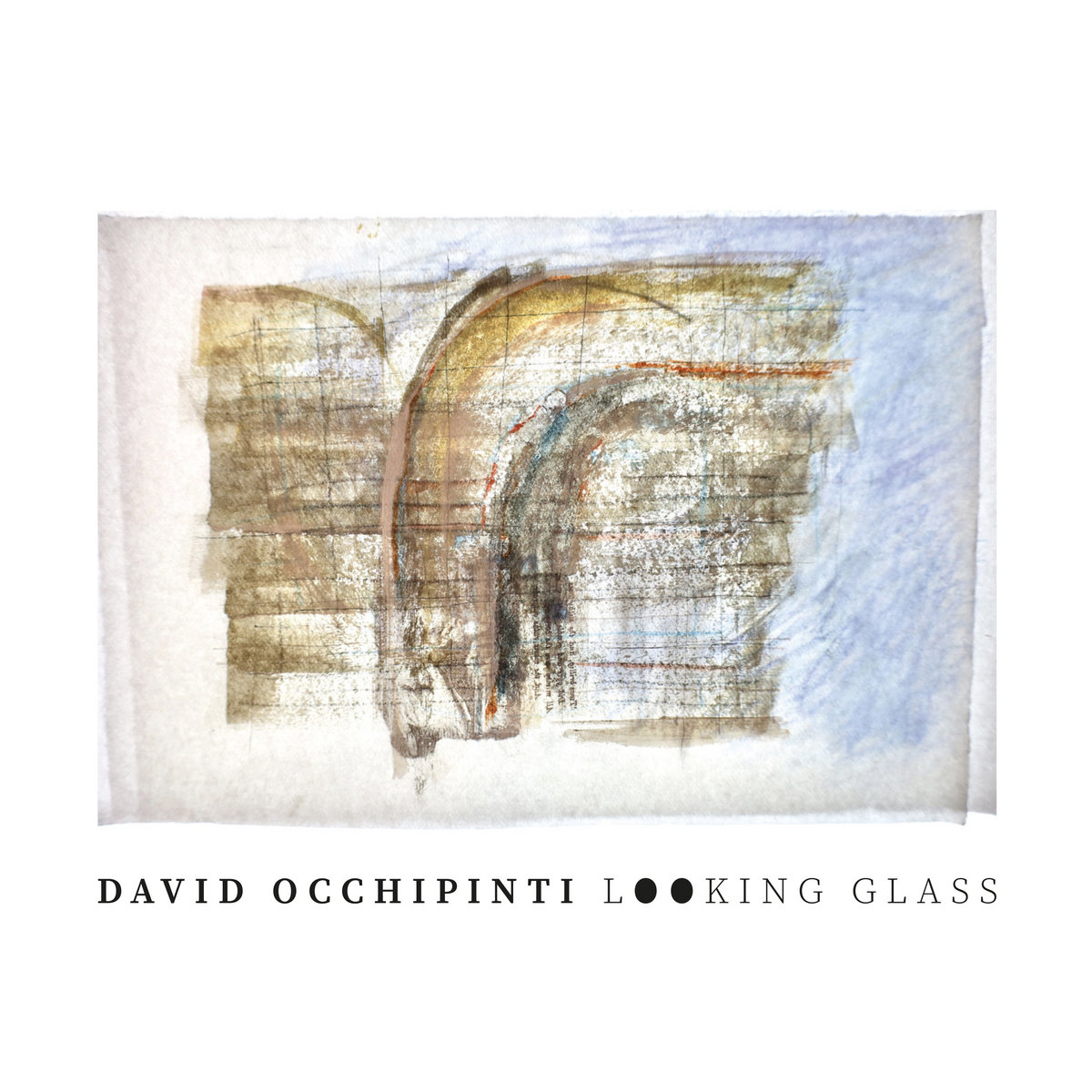
There are albums that expand a genre from within, and others that gently dissolve its boundaries until something entirely new begins to emerge. Looking Glass, the latest work by Canadian composer and guitarist David Occhipinti, belongs firmly to the latter category. It is a strikingly original recording in which modern jazz, contemporary writing, and free improvisation converge into a single, shimmering sound world.
Already widely recognized through multiple Chalmers Arts Fellowships and JUNO Award nominations, David Occhipinti has long occupied a unique position in Canadian creative music: one where composition and experimentation are not separate activities but intertwined aspects of the same artistic impulse. With Looking Glass, he pushes this philosophy further than ever before.
At the core of the album is a remarkably unusual ensemble: electric guitar and string trio. There is no rhythm section, no harmonic support from keyboards, no saxo, no trumpet, no grounding bass instrument, and no drums or percussion. Instead, the music rests entirely on the interaction between Occhipinti’s electric guitar and the strings of Aline Homzy (violin), Steven Dann (viola), and Maria Zachariadou (cello). This stripped-down instrumentation creates an atmosphere of extraordinary transparency. Every gesture is exposed, every texture audible, every nuance magnified.
What emerges is not a limitation but a liberation. The absence of traditional jazz infrastructure allows the music to float freely between thoughtful, intimate jazz and the unpredictability of improvisation. The string trio does not function as accompaniment but as an equal conversational partner, while the guitar becomes at times textural sculptor, and at times destabilizing force.
The album opens with the first of the “Six Bagatelles” (1–6), a sequence of miniature pieces lasting under ninety seconds each. Far from being sketches or interludes, these concise works feel like distilled musical thoughts, brief, sharp, and often surprisingly evocative. Together, they function like a set of fragmented reflections in a cracked mirror, each one offering a slightly altered perspective on the album’s musical language.
This fragmentation is not accidental. The influence of Dadaist aesthetics is clearly present throughout Looking Glass, not as a stylistic imitation but as a conceptual framework: the disruption of expectation, the juxtaposition of contrasting elements, and the embrace of musical ambiguity.
At the same time, references to Lewis Carroll, particularly in titles such as “The Frumious Bandersnatch”, suggest a parallel fascination with absurdity, transformation, and the logic of dreamlike narratives.
The long central work, “The Frumious Bandersnatch”, is the album’s most expansive statement, lasting nearly fourteen minutes. Here, Occhipinti explores the full potential of his modified electric guitar, using extended techniques that push the instrument far beyond conventional sound production. Harmonics, prepared effects, unusual articulations, and textural distortions create an evolving sonic landscape that feels both meticulously composed and unpredictably alive. The string trio responds with equal imagination, sometimes mirroring the guitar’s fractured gestures, sometimes resisting them, sometimes drifting into entirely independent trajectories. The result is a piece of remarkable narrative tension, where form seems to continuously emerge and dissolve. Purely Dadaist music.
As the album progresses into its final section, three special guest artists expand the palette in fascinating ways.
On “Sonyshnyky”, vibraphonist Beverley Johnston introduces a shimmering, luminous resonance, adding a fragile metallic glow to the ensemble sound. Her presence feels like a moment of suspended light within the album’s intricate architecture.
On “Who’s your Dada?”, soprano Charlotte Mundy brings a striking vocal presence that amplifies the album’s conceptual connection to Dadaist art. Her voice is used not simply as lyrical expression but as an instrument of sound, capable of sudden shifts in colour, articulation, and emotional tone.
Finally, mezzo-soprano Alex Hetherington appears on two deeply expressive tracks: “You Stepped Out” and “Sotto le Stelle”. In the latter, a particularly moving dedication to Occhipinti’s stepmother Maria Occhipinti, the voice takes on a reflective, almost elegiac quality.
Across all these works, what is most striking is the coherence of Occhipinti’s vision. Despite the diversity of approaches – miniatures, extended composition, vocal works, improvisational passages – the album never feels fragmented. Instead, it resembles a carefully constructed world seen from multiple angles, where each piece illuminates a different facet of the same artistic idea.
Occhipinti proves to be a highly original voice on electric guitar. Rather than asserting dominance, he engages in constant dialogue with the ensemble, shaping the music through suggestion, interruption, colour, and transformation. His approach to extended techniques is never self-indulgent; it serves the compositional narrative at every moment.
What makes Looking Glass particularly compelling is its refusal to settle into a single identity. It is at once composed and improvised, structured and free, lyrical and abstract, intimate and disorienting. Yet these oppositions never feel contradictory. Instead, they coexist naturally, like reflections shifting across the surface of a mirror.
With this release, David Occhipinti confirms his place among the most distinctive and imaginative composers.
Looking Glass is not simply an album to be listened to, it is an experience to be entered, explored, and revisited, each time revealing new distortions, new reflections, and new meanings within its intricate sonic mirror.
Frankie Pfeiffer
Editor in chief – PARIS-MOVE
PARIS-MOVE, July 2nd, 2026
Follow PARIS-MOVE on X
::::::::::::::::::::::::
Tracklisting:
Six Bagatelles 1 00:48
Six Bagatelles 2 01:28
Six Bagatelles 3 00:43
Six Bagatelles 4 01:19
Six Bagatelles 5 01:06
Six Bagatelles 6 01:12
The Frumious Bandersnatch 13:38
Sonyshnyky (Sunflowers – dedicated to Ukraine – feat. Beverley Johnston) 02:01
Sotto le Stelle (dedicated to Maria Occhipinti – feat. Alex Hetherington) 03:55
Who’s your Dada? (feat. Charlotte Mundy) 05:49
You Stepped Out (feat. Alex Hetherington) 05:27
Music for Guitar and String Trio (last 4 tracks include special guests)
All compositions by David Occhipinti
Lyrics by David Occhipinti
Track 9, Sotto le Stelle, is dedicated to David’s wonderful stepmother, Maria Occhipinti
Musicians:
David Occhipinti – guitar
Aline Homzy – violin
Steven Dann – viola
Maria Zachariadou – cello
Special guests:
Beverley Johnston – vibraphone, crotales (08)
Alex Hetherington – mezzo-soprano (09, 11)
Charlotte Mundy – soprano (10)
Recorded at Revolution Studios – Toronto, Canada – April 03 & 04, 2024
Recording engineer: Luke Schindler
Assistant Engineers: Matteo Peraccini, Christine Stoesser
Mixing engineer: Occdav
Mastered by Sean Magee at Abbey Road Studios – London, England
Cover art: Mascia Manunza
Design: Cristina Cannas
Photography: Jen Squires