| Jazz |
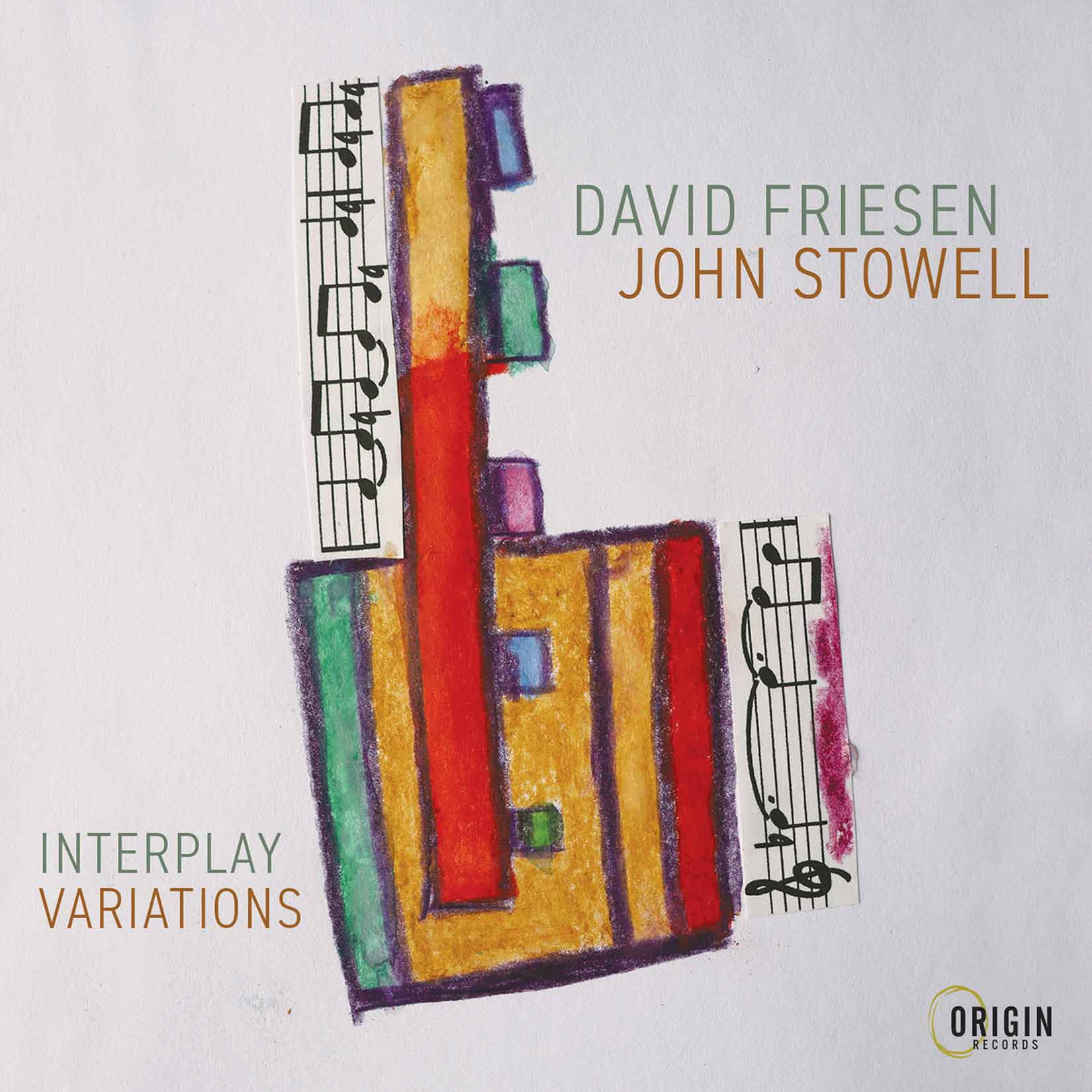
Some friendships endure for decades, but their true measure lies not simply in the memories they preserve, but in the ability to keep creating together without surrendering to nostalgia. On Interplay Variations, bassist David Friesen and guitarist John Stowell return to a musical conversation that began half a century ago, drawing on both their long-standing bond and the different paths their careers have taken. Rather than attempting to recreate an earlier era or turn their reunion into an event in itself, they offer an understated, remarkably refined work of chamber-like intimacy, in which a lean instrumental palette reveals an exceptional command of listening. Thirteen compositions, most of them brief, make up this quietly compelling album. Its ambition is never to impress through sheer display, but to explore what happens when two musicians, having reached a point in their lives when they no longer need to prove anything, meet on equal terms. In a jazz landscape where virtuosity can sometimes become indistinguishable from an accumulation of effects, Friesen and Stowell embrace a different idea of invention: music in which every note matters, silence helps shape the conversation, and the quality of a response counts for more than the brilliance of an individual gesture. Such restraint is no retreat from ambition. It demands deep instrumental knowledge, hard-won trust and the ability, acquired over years of playing together, to make improvisation feel less like a succession of performances than a genuine conversation.
To understand what makes this partnership distinctive, it helps to return to the 1960s, when John Stowell was playing in rhythm-and-blues groups before gradually broadening his musical horizons. His career eventually took him into a more personal exploration of jazz, alongside recording projects and a substantial commitment to teaching. That trajectory, which diverged from some of the more conventional paths through the jazz world, helps explain his distinctive approach to the guitar, built around harmonic flexibility, precise phrasing and a constant search for balance between density and transparency. Stowell never treats the guitar merely as a vehicle for melody or as a means of supporting a soloist. His playing can suggest several voices at once, alter the character of a chord through an almost imperceptible shift, or leave a phrase unresolved rather than force it toward an obvious conclusion. His technique is impressive precisely because it rarely calls attention to itself. Difficult musical ideas emerge with an apparent naturalness that belies the thought behind them. A duo setting brings these qualities into particularly sharp focus. Without a larger ensemble to fill the space, every decision becomes audible, every inflection affects the conversation, and every silence gives the other musician room to respond.
David Friesen’s career has taken a different but equally expansive course. A bassist, composer, pianist and educator, he has worked with an extraordinary range of jazz artists, including Chick Corea, Michael Brecker, Stan Getz, Dexter Gordon, Joe Henderson, Sam Rivers, Dizzy Gillespie and Mal Waldron. The diversity of those collaborations reflects more than professional versatility. It speaks to his ability to inhabit contrasting musical environments without losing his own identity. His work composing for animated films has also brought him into contact with different narrative demands, sharpening his sensitivity to musical pacing, shifts in atmosphere and the relationship between movement and duration. In Friesen’s hands, the bass moves well beyond its traditional role as the rhythmic and harmonic foundation of an ensemble. It becomes an independent melodic voice, capable of suggesting a new direction, shifting the harmonic balance or briefly suspending a piece’s forward motion. That independence is essential to his partnership with Stowell. The bass does not simply accompany the guitar, nor does the guitar seek to dominate the musical space. Their roles continually shift, overlap and exchange places as the improvisation unfolds, held together by an alertness to each other’s smallest gestures.
Their shared history stretches back roughly half a century, encompassing earlier collaborations that included the albums Through the Looking Glass and Other Mansions. Since those early encounters, both musicians have accumulated experiences onstage, in the studio and as composers that have expanded their musical vocabularies without erasing the affinities that first brought them together. Interplay Variations is therefore more than the resumption of a partnership after a long interval. It is the continuation of an artistic relationship capable of absorbing the passage of time. There is a fundamental difference between reviving a successful formula and rediscovering, years later, the conditions for genuine musical openness. The former is an exercise in repetition; the latter requires musicians to listen anew, recognize what has changed and make room for the people they have become. That is where experience acquires its real value. It cannot guarantee inspiration or artistic success, but it can help players move beyond individual reflexes and develop a shared language strong enough to accommodate the unexpected. Friesen and Stowell’s familiarity with one another does not eliminate risk. It makes a subtler kind of risk possible: allowing an idea to change in response to another rather than insisting on controlling its development.
That quality of listening finds one of its clearest expressions in “Colors Within Another,” one of the album’s most revealing pieces. Almost everything unfolds through nuances, inflections and subtle shifts in the relationship between guitar and bass. Stowell shapes his phrases without crowding the space, leaving Friesen free to extend an idea, alter its meaning or suggest an unexpected direction. The bass does not merely reinforce the harmonic structure; it emerges as an independent voice, capable of changing the perspective of the music as a whole. The distinction between musical statement and response begins to dissolve. Each instrument seems to discover, in the other’s playing, a possibility that had not previously existed. The title offers an apt description of the process: the musicians’ colors do not simply blend but reveal shades that might otherwise have remained hidden. The achievement lies in the ability to generate emotion without underlining it, to suggest depth without resorting to grand gestures. Rather than presenting a performance to be admired from a distance, the music invites listeners into a conversation whose smallest details contain much of its richness.
The remaining compositions explore this aesthetic from different angles. “Night Music” favors an introspective atmosphere, while “Covered in Blue” and “Affectionately Yours” give greater prominence to melody. “Deepening the Affection” extends the album’s emotional dimension without slipping into sentimentality, while “Sphere’s (Only) Waltz” plays with the familiar contours of a dance form. “Tom’s Call for Peace” introduces a more explicit gravity, and “Area Code Sorrows” suggests a distinctly contemporary setting for melancholy, though none of these titles demands a single interpretation. All 13 tracks, composed and arranged by Friesen and Stowell, are miniatures, many lasting less than three minutes. Such brevity imposes a particular discipline: establish an atmosphere, develop an idea and bring it to a convincing close without sacrificing spontaneity to the need for resolution. The format encourages concentration, but it also carries a risk. Some sketches can feel as though they end just when their ideas begin to open up. The duo generally avoids that pitfall by treating brevity as a compositional principle rather than a limitation imposed from outside. The album does not manufacture an overarching drama. Instead, it offers a succession of distinct perspectives, connected by a shared commitment to clarity and economy.
That economy of means sometimes brings the music close to chamber jazz, without diminishing its improvisational spirit. The comparison is useful because, as in a classical chamber ensemble, cohesion depends on the balance of voices, the precision of each entrance and a shared understanding of musical architecture. But where a fully notated performance follows a structure established in advance, jazz improvisation requires musicians to invent both the content and the direction of the music as they play. Friesen and Stowell bring these demands together with remarkable fluidity. Their performances have the precision of musicians who know one another’s capabilities intimately, yet retain the uncertainty that makes invention possible. A phrase may veer in an unexpected direction, a chord may alter the course of a melody, or an intervention may give way to silence rather than prompt an immediate answer. This is not a carefully managed alternation between soloist and accompanist. It is an ongoing negotiation in which each musician is willing to revise an initial intention. That is the deeper meaning of mastery here: not the ability to anticipate everything, but the ability to preserve musical coherence when the unexpected occurs.
The significance of this approach extends beyond the pleasure of hearing two accomplished instrumentalists at work. Contemporary jazz, at least in some of its manifestations, remains caught between competing demands: it must continually renew its language while demonstrating its command of the traditions that shaped it. That tension can encourage musicians to accumulate stylistic markers and technical complexities that sometimes become ends in themselves. Friesen and Stowell choose another path. They neither reject harmonic sophistication nor downplay technical rigor; they simply refuse to make either the center of their music. Their work reminds us that innovation does not always require rupture, just as depth does not depend on the number of notes played. There is a particular kind of daring in restraint, in finding the right note rather than playing all the notes available. In a duo without drums or piano, that discipline becomes especially apparent. The two instruments must carry the melody, harmony, movement and breathing room on their own. Every miscalculation is exposed, but so is every moment of discovery.
Interplay Variations does not overturn the conventions of jazz or claim to offer a new definition of improvisation. Its achievement lies elsewhere, in the ability to turn a long shared history into something musically alive in the present. Fidelity, for these two artists, does not mean preserving an old formula intact. It means recognizing what time has changed in each of them and allowing those changes to become creative resources. Friesen brings the experience of a musician who has moved through widely different musical worlds, from jazz performance to compositions written for the screen. Stowell brings that of a guitarist whose harmonic explorations and teaching have helped refine a deeply personal approach to improvisation. Their reunion does not erase those differences; it gives them room to speak. What matters, then, is not simply the endurance of a friendship but the possibility of continuing to surprise one another after decades of playing. Familiarity can make a musical conversation predictable. Here, it seems to offer the opposite: greater freedom.
With Interplay Variations, Friesen and Stowell have made a restrained, cohesive and deeply engaging album whose strength lies in its refusal of unnecessary effects. These 13 pieces demand neither prior admiration nor specialized knowledge. They invite listeners to follow two instrumental voices as they answer, diverge and continually redefine their balance. Attentive jazz listeners will appreciate the harmonic subtleties and freedom of the playing; others can simply enjoy the melodic clarity, the breathing room and the conversational quality of the music. Either way, the essential achievement lies in the relationship between the musicians, sustained by precision, trust and an unwavering attention to detail. At a time when novelty is often confused with rupture and virtuosity with sheer abundance, their album offers a quieter but more enduring lesson: experience has artistic value only when it remains open to the unknown. Fifty years after they first met, Friesen and Stowell are not trying to celebrate who they once were. They are still discovering what they can become together.
Thierry De Clemensat
Member at Jazz Journalists Association
USA correspondent for Paris-Move and ABS magazine
Editor in chief – Bayou Blue Radio, Bayou Blue News
PARIS-MOVE, October 26th, 2026
Follow PARIS-MOVE on X
::::::::::::::::::::::::
Musicians:
David Friesen – Hemage bass
John Stowell – guitar
Track Listing:
1 Night Music 3:11
2 Covered in Blue 2:41
3 Affectionately Yours 1:45
4 Deepening the Affection 1:58
5 Sphere’s (Only) Waltz 2:22
6 Tom’s Call for Peace 4:09
7 Colors Within Another 2:28
8 Just Around the Corner 2:34
9 Area Code Sorrows 3:18
10 As You Like It 4:36
11 Everybody’s Heart 2:39
12 Springtime’s Promised Blush 2:03
13 I’m Laughing at You 3:00
All music composed & arranged by David Friesen & John Stowell
All compositions published by Color Pool Music (BMI) / Bug Music (BMG Chrysalis)
Produced by David Friesen & John Stowell
Recorded and mixed by Mike Doolin at House of Doolescu, Portland, OR, July 2026 Portland, Oregon
Mastering by Dana White at Specialized Mastering, Portland, Oregon
Paintings by David Friesen
Photograph by Norm Eder
Cover design & layout by John Bishop