
| Jazz |
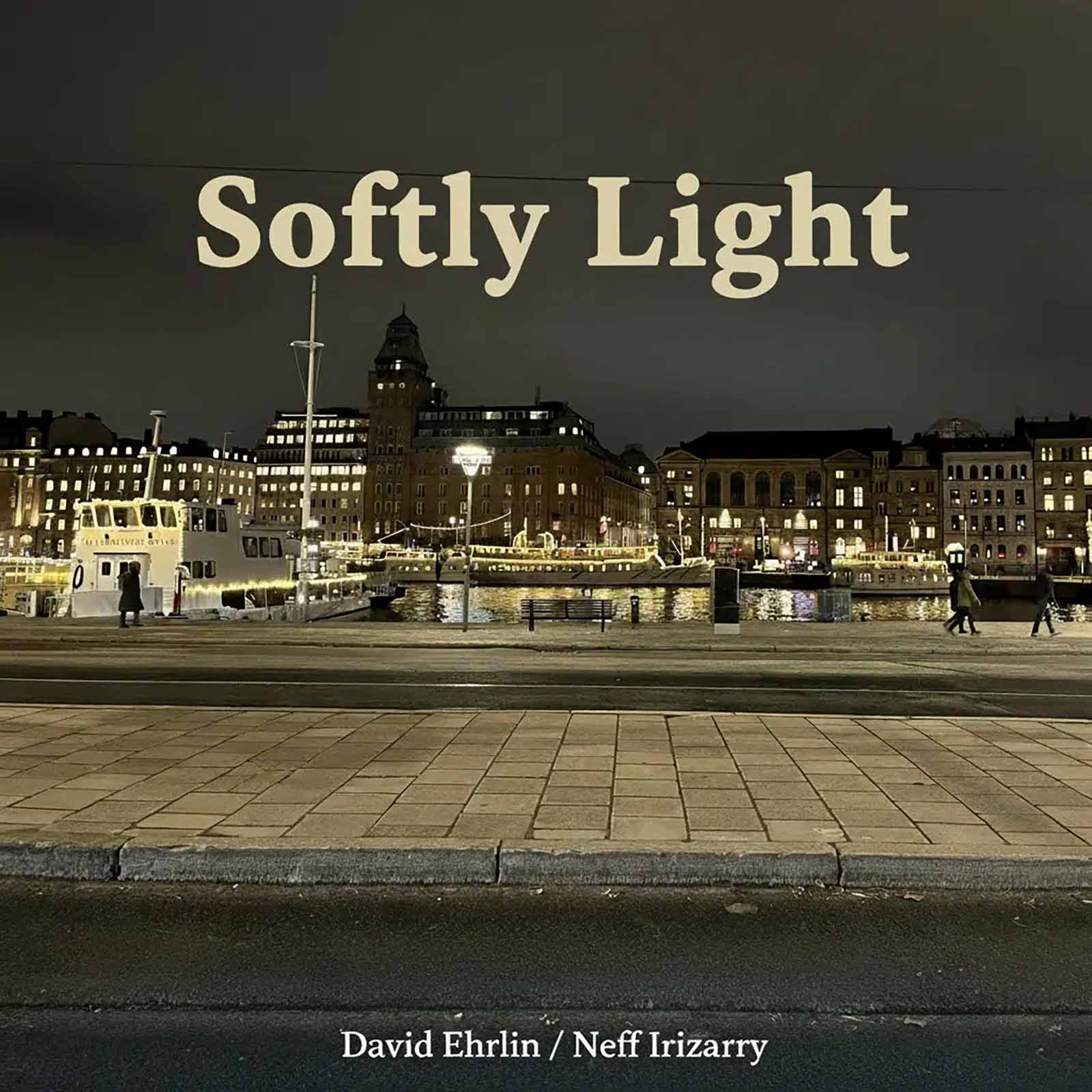
Summary : David Ehrlin and Neff Irizarry unite Nordic jazz, Latin rhythms and quiet lyricism on Softly Light.
David Ehrlin and Neff Irizarry: Where Nordic Jazz Meets Latin Soul
In Softly Light, saxophonist David Ehrlin and guitarist Neff Irizarry make a persuasive case for a kind of musical dialogue that has become increasingly rare: one in which cultural difference is neither advertised as novelty nor smoothed into a marketable uniformity, but allowed to shape the music from within. Their nine compositions draw on Nordic introspection, the rhythmic vitality of Latin jazz and the lingering influence of the jazz tradition without reducing any of these elements to stylistic decoration. The result is an album less concerned with demonstrating virtuosity than with discovering what two distinct musical sensibilities can reveal to each other. Its quietness is not an absence of conviction. It is the condition that allows the music to speak.
Ehrlin’s saxophone and Irizarry’s guitar form the center of this conversation, supported by bassist Tobias Grenholm and drummer Antti Ojala. The ensemble favors space, restraint and an attentive balance between individual expression and collective movement. Phrases are allowed to breathe; melodies emerge without being forced toward an obvious climax; rhythmic accents lend momentum without disturbing the music’s reflective character. Such discretion requires more than technical command. It depends on the musicians’ willingness to listen, to leave room for uncertainty and to understand silence as part of the composition. On Softly Light, the most telling exchanges often occur not in moments of display but in the transitions between one phrase and the next.
For Ehrlin, this approach follows a period of renewed engagement with the music of his childhood. In Hymns for Saxophone, he returned to sacred melodies that had accompanied his early life, exploring the emotional residue of religious music without allowing nostalgia to dictate the interpretation. That project suggested an interest in what survives after belief has changed or receded: the melody remembered, the ritual transformed into memory, the sound that continues to carry meaning beyond its original setting. Softly Light extends that inquiry into a broader musical landscape. Here, recollection is not confined to personal history. It becomes a way of approaching other traditions with curiosity rather than possession.
The collaboration took shape in the fall of 2025, when Ehrlin and Irizarry discovered a shared sensibility beneath their different backgrounds. Irizarry brought decades of experience in Latin and contemporary jazz, along with an understanding of Puerto Rican sabor, the expressive flavor and rhythmic character that cannot be reduced to a set of accents. Ehrlin’s musical language is more closely associated with the Nordic preference for space, understatement and melodic clarity. Irizarry has described the creative potential of bringing Puerto Rican sabor together with Nordic sisu, a Finnish term suggesting determination, endurance and inner resolve. The contrast could easily have become a formula. Instead, it supplies the album with a productive tension: warmth without excess, restraint without frigidity, rhythmic freedom held within a carefully considered structure.
The title track establishes this balance. Its lightness is not merely a matter of tempo or mood, but of touch: the musicians seem to approach the melody from different directions, allowing its contours to emerge gradually. Ehrlin’s saxophone carries a clear, singing line, while Irizarry’s guitar provides both harmonic support and a quietly responsive countervoice. Neither instrument attempts to dominate the other. Their exchange suggests that intimacy in music is not achieved by erasing difference but by making difference audible without turning it into conflict. The piece sets the album’s emotional register, inviting the listener into a world where subtle shifts in phrasing and tone matter more than dramatic gestures.
“Baltic Love Song” gives this inwardness a geographical dimension. Inspired by Irizarry’s time in Riga, the composition evokes a meeting between personal experience and the atmosphere of a northern European city, without relying on postcard imagery. Its sense of place resides in the music’s measured pace and understated melancholy. The melody seems to look outward even as it turns inward, suggesting how travel can alter one’s sense of belonging. A place becomes more than a backdrop; it enters the imagination and changes the way familiar musical gestures are heard. The piece also reflects the album’s broader refusal to treat cultural exchange as a superficial juxtaposition. The Baltic setting does not merely color the music. It becomes part of the emotional logic through which the musicians shape it.
“Great Grandfather” reaches further into the past, drawing on the story of Ehrlin’s great-grandfather, August Bernhard Andersson. After his father died in an alcohol-related accident, Andersson chose a life of sobriety and faith. The composition approaches this history without turning it into a sentimental narrative. Its significance lies in the way a private family memory becomes musical reflection, carrying the weight of an inherited decision across generations. The piece raises a question that runs quietly through Softly Light: what do we receive from those who came before us, and what do we choose to preserve? Memory here is neither an archive nor a monument. It is a living presence, shaped by the person who remembers and transformed each time the past is brought into the present.
The album’s dialogue with jazz history becomes explicit in “Blue in Green,” the composition associated with Miles Davis and Bill Evans on Kind of Blue, released in 1959. Few pieces have acquired such a durable place in the jazz imagination. Its influence can be heard in generations of musicians drawn to its harmonic ambiguity, unhurried development and capacity to suggest emotion without defining it too precisely. Reinterpreting it is therefore a delicate undertaking: reverence can easily become imitation, while an insistence on originality can obscure the qualities that made the music endure. Ehrlin and Irizarry navigate between those risks by treating the composition as a space for renewed listening rather than an object to be reproduced. Their approach honors its atmosphere while allowing their own musical identities to remain present. As the centenary of Davis’s birth approaches in 2026, the performance also serves as a reminder that the legacy of jazz is not preserved through repetition alone. It remains alive when musicians find new reasons to enter its unresolved questions.
A different lineage comes into focus with “Fundas da Paixão,” a tribute to Antônio Carlos Jobim. The Brazilian composer’s music has long offered jazz musicians a model for combining melodic sophistication with rhythmic subtlety, and his influence extends well beyond the conventions of bossa nova. Ehrlin and Irizarry approach this inheritance with an appreciation for its understated emotional power. The melody is allowed to unfold without being burdened by reverence, and the arrangement avoids the temptation to turn Brazilian influence into an instantly recognizable stylistic signal. What remains is a sense of lyrical continuity, in which the music’s warmth comes from the relationship between melody, harmony and phrasing rather than from any exaggerated display of sentiment.
“Azul y Oro” moves into more overtly rhythmic territory. Its Nordic Afro-Cuban character and six-beat meter bring a different kind of energy to the album, challenging the idea that the musicians’ preference for restraint must lead to a uniform mood. The rhythmic design gives the ensemble a more pronounced forward motion, while the interplay between saxophone and guitar preserves the transparency that defines the record as a whole. Here, cultural encounter becomes a practical musical question: how can different rhythmic instincts coexist without one being reduced to an ornament of the other? The answer lies in the composition’s balance of structure and flexibility. The pulse remains clear, but it leaves room for the musicians to respond to one another, allowing the music to move between discipline and spontaneity.
“Late Night” returns to a more solitary atmosphere, evoking the unsettled consciousness of insomnia. Its mood is intimate without becoming claustrophobic, and traces of Swedish folk music lend the piece a familiar yet elusive character. Night, in this setting, is not simply a theme but a state of attention: the hour when thoughts return without invitation, memories acquire new weight and ordinary sounds seem to carry hidden meanings. The musicians resist the obvious devices of nocturnal music. Rather than relying on darkness for its own sake, they explore the peculiar clarity that can emerge when the world grows quiet. The result is less a portrait of sleeplessness than an account of the mind moving through it.
Across these nine compositions, Softly Light develops a coherent musical language without insisting on a single emotional destination. Its achievement lies in the way it brings together personal history, geographical memory and the shared inheritance of jazz while preserving the particular character of each. The record’s restraint is not an aesthetic alibi for a lack of ideas; it is the means through which those ideas become legible. The musicians trust melody to carry complexity, rhythm to suggest movement without demanding spectacle, and silence to give sound its proper weight. At a time when musical identities are often packaged as easily identifiable categories, their collaboration proposes a more demanding alternative: exchange as a process of attention, in which listening matters as much as speaking.
The album ultimately asks for a form of engagement that contemporary culture does not always encourage. It does not seek to overwhelm the listener or turn every moment into a statement. Its meanings accumulate slowly, through the recurrence of a phrase, the hesitation before a resolution, the subtle change in the relationship between two instruments. What begins as a meeting between Nordic and Puerto Rican sensibilities becomes something less easily classified: a meditation on inheritance, displacement, faith, affection and the fragile continuity between past and present. In Softly Light, the quiet is never empty. It is where memory settles, where traditions meet without losing their contours, and where music discovers that its deepest expression may depend not on saying more, but on learning what is worth hearing.
Thierry De Clemensat
Member at Jazz Journalists Association
USA correspondent for Paris-Move and ABS magazine
Editor in chief – Bayou Blue Radio, Bayou Blue News

PARIS-MOVE, October 20th, 2026
Follow PARIS-MOVE on X
::::::::::::::::::::::::
Musicians :
David Ehrlin | Tenor Sax
Neff Irizarry | Guitars
Tobias Grenholm | Acoustic Bass
Antti Ojala | Drums
Track Listing
Azul y Oro / Blue and Gold
Softly Light
Baltic Love Song
Blue in Green
Scandinavian Seasons
Late Night
Great Grandfather
Fundas da Paixão/The Depths of Passion
Blue in Green (Extended)