| Jazz |
Summary: Daniel García’s The Hero’s Journey is a deeply personal solo piano album that blends jazz, classical influences and flamenco into a moving reflection on grief, resilience and human connection.
Daniel García’s The Hero’s Journey: A Profound Solo Piano Exploration of Loss and Renewal
One of ACT Music’s enduring strengths has always been its ability to identify artists who move effortlessly between the worlds of classical music and jazz, musicians capable of building luminous bridges between traditions without ever sounding constrained by either. With Daniel García, however, the journey extends even further. His music feels less like a meeting point between genres than a passage through parallel universes existing within the same artistic landscape.
The room was quiet by the time I pressed play. Outside, the day had largely dissolved into darkness, the distractions of work and routine finally giving way to the kind of stillness that certain records seem to require. Some albums can accompany everyday life without demanding much in return. The Hero’s Journey is not one of them. Daniel García’s latest work invites a different kind of listening, one built on patience, attention and emotional openness. From the very first notes, it became clear that this was less an album than a conversation unfolding in real time.
I deliberately waited until evening to write these lines. There are albums that demand more than casual attention, records that ask for silence, patience and a willingness to surrender to their internal logic. The Hero’s Journey is one of them.
The story behind the album sheds considerable light on its emotional weight. In late 2024, discussions began with ACT regarding García’s fourth recording project. When label executives Andreas Brandis and Michael Gottfried suggested a solo piano album, the pianist immediately embraced the idea. He began composing without hesitation.
For those who have followed García’s career, The Hero’s Journey feels both like a continuation and a transformation. Over the years, the Madrid-born pianist has established himself as one of Europe’s most distinctive musical voices, combining jazz improvisation, classical discipline and Iberian influences into a language entirely his own. Previous recordings showcased his technical brilliance and compositional imagination, but this new project strips away many of the surrounding layers, revealing an artist working with unusual vulnerability and clarity. If earlier albums demonstrated García’s versatility, The Hero’s Journey reveals something even more compelling: his willingness to place his inner life at the center of the music.
Then life intervened.
In early 2025, García’s father received the devastating and entirely unexpected diagnosis of terminal cancer. As the months passed, his condition steadily deteriorated before he died in December 2025. Nearly all of the album’s composition, planning and recording took place during that difficult period. García spent two afternoons and long evenings in June 2025 alone at the piano, working alongside pre-recorded material in Madrid’s Camaleón Studios while he and his family were living through the painful reality of anticipatory grief, carrying the burden of an inevitable loss that had not yet arrived but was already deeply present.
I only learned this story after my first listen.
Yet during that initial encounter with the album, I found myself wondering where its unusual emotional depth originated. There is something remarkably rare in these compositions, a sense of inner gravity that cannot be explained simply by cultural background, stylistic influences or technical mastery. From the opening moments to the final piece, I allowed myself to drift with the music, searching for the source of that feeling.
What is remarkable is that none of these compositions descend into sadness. García never indulges in despair, nor does he seek easy emotional effects. Instead, a gentle nostalgia lingers throughout the record, appearing in fleeting harmonies, subtle melodic turns and carefully shaded textures. It is a presence rather than a statement.
At this point, the pianist’s own words help illuminate the intellectual framework supporting the emotional core of the work.
“I have long been fascinated by the figure of the hero,” García explains. “Not some invincible movie superhero, but rather the idea of an ordinary person constantly facing new challenges that must be overcome.”
The pianist has long been drawn to archetypes and to Joseph Campbell’s concept of the monomyth, outlined in The Hero with a Thousand Faces. Campbell’s theory of the universal narrative journey famously provided the structural foundation for the Star Wars saga. For García, however, the appeal lies elsewhere.
“What I love about this approach is the idea that, deep down, human beings are not so different from one another.”
That belief resonates throughout the album. The music unfolds less as a collection of standalone compositions than as a sequence of emotional and psychological chapters. Each piece feels connected to a larger narrative arc. Characters emerge. Obstacles appear. Moments of doubt give way to resilience. New landscapes open unexpectedly before us.
Being Spanish, García naturally carries traces of flamenco within his artistic vocabulary, and attentive listeners will occasionally encounter rhythmic gestures or melodic echoes that point toward those roots. Yet the piano itself ultimately becomes the album’s central protagonist. It transforms from track to track, moving through different scenes like an actor inhabiting multiple roles within the same story.
The piece “Allies” perhaps illustrates this most clearly. Built around a subtle sense of forward motion, it feels like a moment of encounter within the broader narrative, a chapter in which companionship and solidarity become essential forces. Elsewhere, García’s touch alternates between crystalline delicacy and rhythmic insistence, creating a constantly shifting emotional landscape that rewards close listening.
García himself offers an explanation that may help newcomers approach his work.
“I struggle to categorize my music,” he says. “It’s like trying to put the sea inside a box. Eventually it overflows. I love classical music. I love Middle Eastern music. I love rock. I love singer-songwriters. Inspiration can come from anywhere.”
The statement feels entirely consistent with what unfolds across The Hero’s Journey. Boundaries dissolve. Influences coexist without conflict. The album never sounds like a fusion project attempting to combine disparate elements. Instead, it feels like the natural expression of a musician who has absorbed many languages and speaks them fluently.
Listening to García’s work, I could not help but think of Léo Ferré, the great Franco-Italian poet, songwriter and one of the most singular artistic voices of the twentieth century. Ferré himself moved freely between styles and traditions, refusing artistic confinement. One suspects he might have appreciated García’s refusal to choose between worlds.
The spirit of independence extends beyond the music itself and into the album’s very construction. Every sound heard on the record was shaped by García personally.
“Everything is me,” he says with a smile.
The album was conceived from the outset as something he could reproduce on stage. Alongside the piano, listeners encounter pre-recorded applause samples, vocal passages and transformed sound loops that have been carefully reworked and integrated into the compositions. The result is a deeply personal sonic environment, crafted by a single artistic vision while remaining remarkably open and expansive.
Ultimately, The Hero’s Journey succeeds because it operates simultaneously on multiple levels. It is an intimate reflection on loss and resilience. It is an exploration of universal storytelling. It is a technical achievement. It is a meditation on identity, memory and transformation.
Above all, it is a profoundly human record.
There is also an undeniable irony embedded within the album’s title. While García was drawing inspiration from Campbell’s universal model of the hero’s journey, he was simultaneously living through a profoundly personal version of that same narrative. The unexpected diagnosis of his father, the long months of uncertainty, the experience of accompanying a loved one toward an inevitable farewell and, finally, the act of transforming that emotional upheaval into art all mirror the stages of departure, trial and return that define the archetypal journey.
Perhaps that is why the album resonates so deeply. The hero García evokes is not a mythical figure endowed with extraordinary powers. He is the ordinary individual who continues moving forward despite uncertainty, grief and fear. Through this lens, The Hero’s Journey becomes more than a collection of compositions. It becomes testimony.
By the final notes, one senses that the journey belongs not only to the artist but also to the listener. We emerge from the experience changed, however subtly, carrying with us fragments of García’s reflections on loss, resilience and hope. In that sense, the album fulfills the highest purpose of art: it transforms private experience into something universal.
For the sake of art itself, I can only hope these reflections encourage readers to discover this remarkable European musician.
In The Hero’s Journey, Daniel García has created a work of singular beauty, one that unites intellectual ambition, emotional honesty and poetic grace. Like all meaningful journeys, its destination matters less than the path itself, and this is a path well worth following.
Thierry De Clemensat
Member at Jazz Journalists Association
USA correspondent for Paris-Move and ABS magazine
Editor in chief – Bayou Blue Radio, Bayou Blue News
PARIS-MOVE, June 5th, 2026
Follow PARIS-MOVE on X
::::::::::::::::::::::::
Musician:
Daniel García piano, synths, vocals, claps
Track Listing:
01 Life in a Crystal Bottle 03:16
02 The Call to Adventure 05:20
03 Refusal of the Call 01:16
04 Meeting the Mentor 03:05
05 Crossing the Threshold 01:59
06 Tests 03:21
07 Allies 02:59
08 Enemies 02:50
09 Approach to the Inmost Cave 04:19
10 The Ordeal 02:56
11 The Reward 01:25
12 The Sacrifice 03:23
13 The Resurrection 03:4
Composed and produced by Daniel García
Recorded at Camaleon Music Studio in Madrid, Spain, on 17 – 18 June 2025
Mixed and mastered by Shayan Fathi
Photo by Rob Lewis
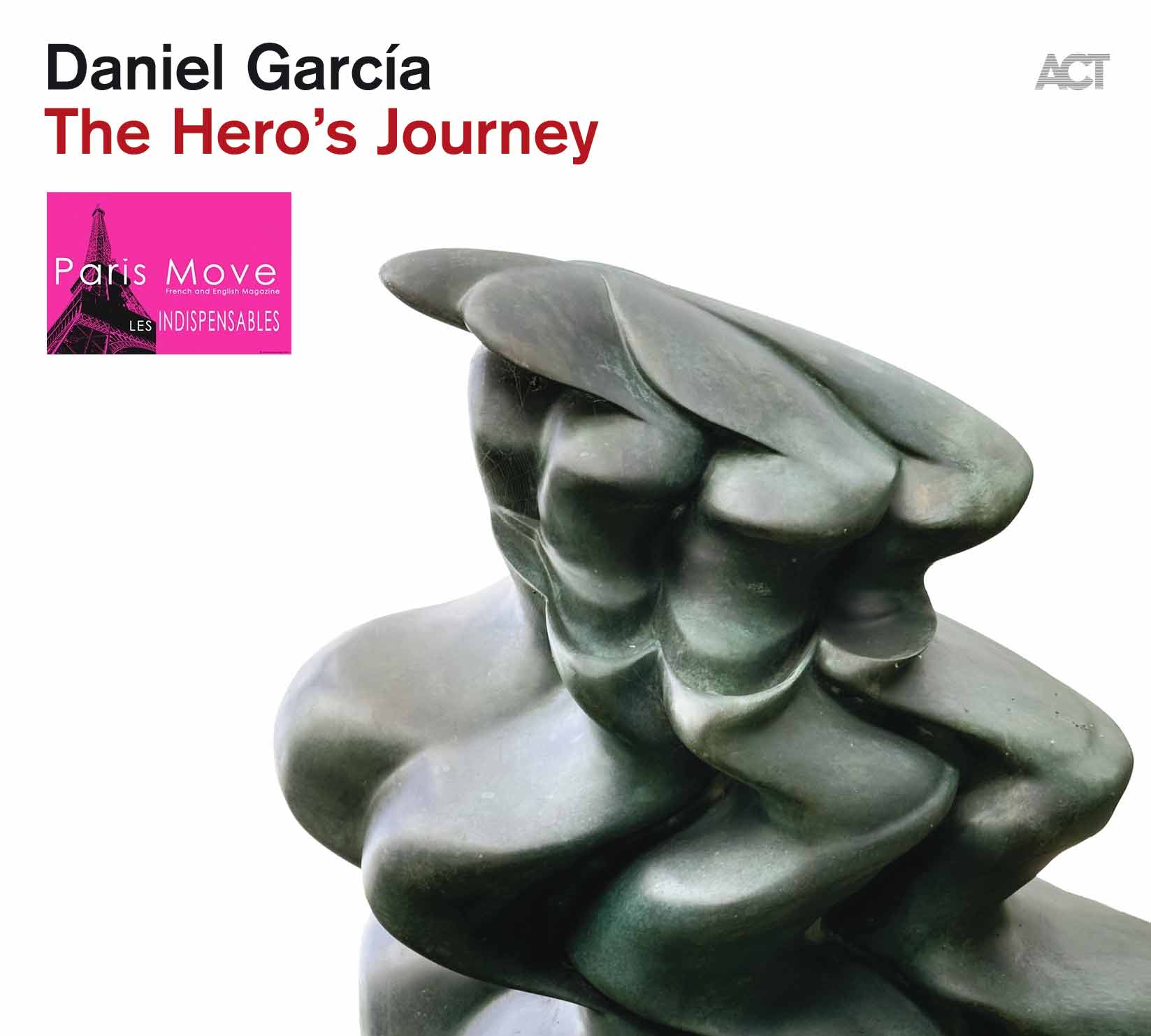
Cover art by Anthony Cragg/ ACT Art Collection
Design by Siggi Loch