| Jazz |
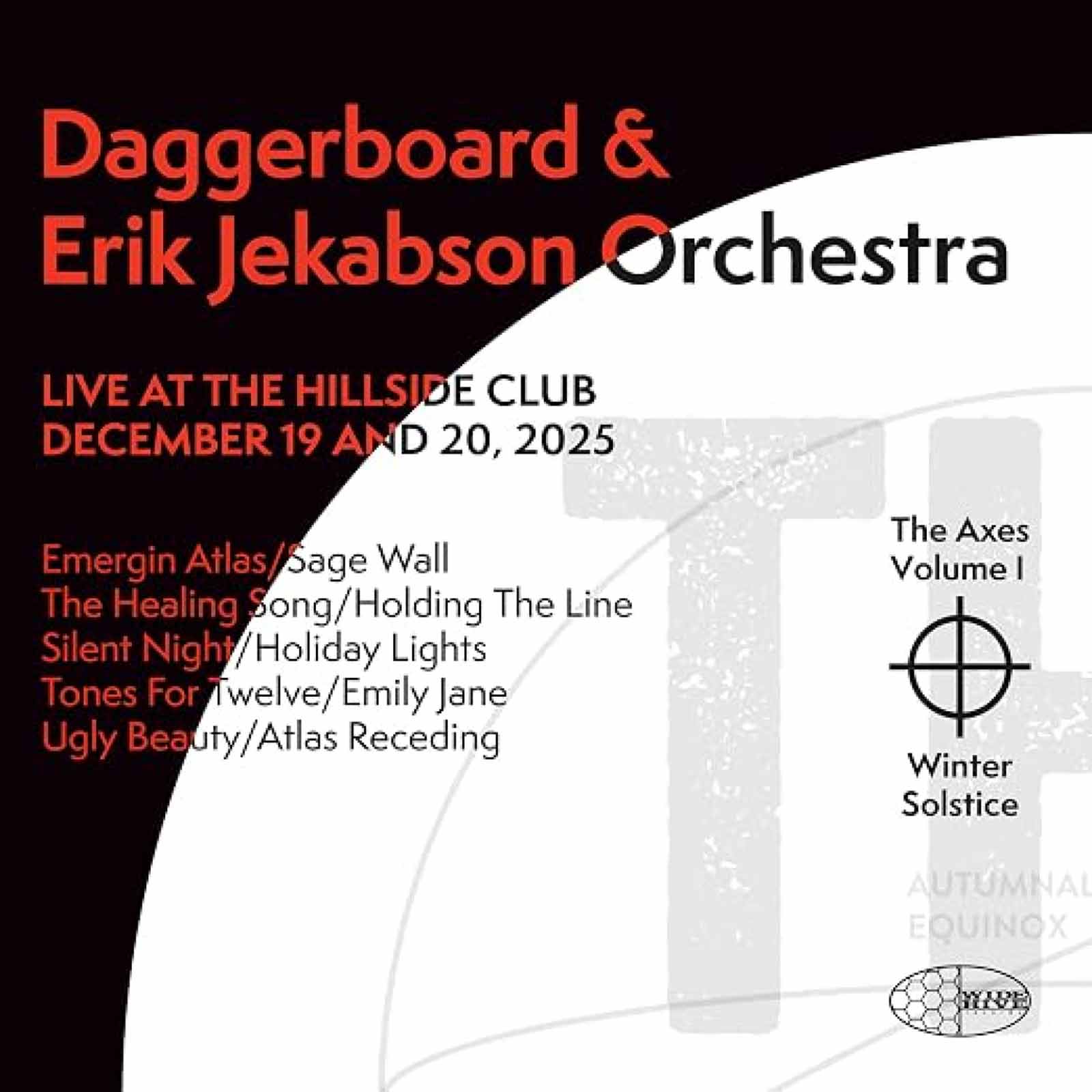
Great music deserves better than this. That is the inescapable conclusion of listening to The Axes, Volume IV: Winter Solstice (Live at The Hillside Club: Berkeley, California December 19 and 20, 2025), the latest album by Daggerboard and Erik Jekabson. The compositions are excellent, the musicians are outstanding, and the musical ideas are consistently compelling. Yet the recording and mixing are so badly handled that the sound becomes a serious obstacle to appreciating what is otherwise a rewarding musical experience. Released in September and received only recently, the album left me with a frustration all the more acute because I know how much these musicians have to offer. The midrange is overwhelmingly prominent, the high frequencies are piercing, and at times the sound is almost unbearable. Turning down the volume becomes a necessity rather than a choice. It is difficult to understand how music of such quality could be presented in a recording that does so little to serve it.
Erik Jekabson remains an extraordinary musician, composer and arranger. His compositions reveal a deep understanding of both jazz and classical music, not as separate traditions to be artificially combined, but as musical languages capable of enriching one another. There is a strong melodic sensibility at work here, along with an evident gift for orchestration and a genuine feeling for the movement of a musical phrase. Jekabson knows how to build an arrangement without sacrificing its natural flow, how to give the different instrumental voices room to develop, and how to preserve the freedom of jazz within a carefully constructed musical framework. His writing is sophisticated without becoming self-important, and its richness never obscures the importance of melody. The orchestra is not simply there to accompany the soloists or provide a grander setting for improvisation. It is an essential part of the composition itself, contributing to its character, its momentum and its emotional depth. These are compositions that deserve repeated listening, and the musicians bring them to life with intelligence, precision and conviction. The tragedy is that the recording makes it unnecessarily difficult to appreciate the full extent of their achievement.
The problem goes far beyond the occasional imperfection one might reasonably expect from a live album. The sound is fundamentally unbalanced, with an excessive concentration in the midrange and high frequencies that cut into the ears rather than opening up the music. The result is tiring and, at moments, genuinely unpleasant. The orchestral textures lose their natural depth, the instrumental colors become harsh, and the overall presentation lacks the openness required by compositions of this kind. This is especially unfortunate because Jekabson’s writing depends on the interplay of different voices, the subtle relationships between instrumental sections and the gradual development of melodic and harmonic ideas. Such music needs room to breathe. Instead, the listener is left struggling with the sound rather than surrendering to the music. I have often been impressed by live recordings from major jazz ensembles, particularly the WDR Big Band, where the quality of the recording allows the richness of the arrangements and the individuality of the musicians to emerge naturally. The comparison makes the shortcomings here all the more apparent. There is no reason to expect every independent production to have the resources of a major broadcasting institution, but a recording should at least respect the music it has been entrusted to preserve. Here, the technical execution falls so far below the artistic level of the performances that it becomes impossible to ignore.
I would have loved to be in the room at the Hillside Club in Berkeley on December 19 and 20, 2025. Jekabson’s compositions are precisely the kind of music that invites one to experience the orchestra directly, to hear the instrumental voices interact in real time and to appreciate the subtlety of the arrangements without the mediation of a flawed recording. The atmosphere of the venue, the proximity of the musicians and the natural blending of the instruments might have offered an altogether different experience. Of course, there is no way to know how the concerts actually sounded in the room. But the thought of what these performances might have been like only reinforces my regret that the album does not do them justice. A live recording should preserve something of the event itself, allowing listeners who were not present to experience the vitality and character of the performance. It should bring the music closer, not make it harder to hear. With Winter Solstice, the compositions remain strong enough to reward attention, but the listener must work around the sound to appreciate them. That is a frustrating position to be in when the music itself is so good.
What matters most is that the disappointment should not be mistaken for a criticism of Jekabson or the musicians who perform his work. Quite the opposite. Their achievement makes the deficiencies of the recording more difficult to accept. The compositions are imaginative, melodically rich and beautifully conceived; the musicians are clearly capable of doing them full justice. The failure lies in the recording and mixing, which diminish the impact of the performances and prevent the album from realizing its full potential. This is not a case of music that falls short of its ambitions, but of a production that fails to meet the demands of the music. I would have welcomed an album in which the orchestral detail, the harmonic richness and the natural dynamics of the ensemble could be heard with the clarity they deserve. Instead, Winter Solstice leaves the listener with the sense of a missed opportunity, made all the more regrettable by the quality of what lies beneath the technical shortcomings. Erik Jekabson and his musicians have given us excellent compositions and outstanding performances. The recording should have been worthy of them. As it stands, the music deserves admiration, while the sound deserves a much harsher verdict.
Thierry De Clemensat
Member at Jazz Journalists Association
USA correspondent for Paris-Move and ABS magazine
Editor in chief – Bayou Blue Radio, Bayou Blue News
PARIS-MOVE, October 16th, 2026
Follow PARIS-MOVE on X
::::::::::::::::::::::::
Musicians :
Conductors: Charith Premawardhana who also plays Viola, and Erik Jekabson who also plays Trumpet and Flugelhorn.
Violin: Anthony Blea
Violin: Alisa Rose
Viola: Darcy Rindt
Cello: Ben Davis
Flute: Mary Fettig
Oboe: Dana Bauer
Clarinet/saxophone: Harvey Wainapel
Bassoon: Paul Hanson
French Horn: Wayne Van Lieu
Trombone: Jeff Cressman
Percussion: Kjall Nordeson
Guitar: Jordan Samuels
Piano: Matt Clark
Trumpet : Max Miller-Loran
Bass: Dan Feiszli
Drums: James Beauton
Gregory Howe : Vocals
Katrina Vila : Vocals
Track Listing :
- Emerging Atlas
- Sage Wall
- The Healing Song
- Holding The Line
- Silent Night
- Holiday Lights
- Tones For Twelve
- Emily Jane
- Ugly Beauty
- Atlas Receding
There are also two original vocal songs Holding the Line which features Gregory Howe and Katrina Vila sings Holliday Lights.