| Jazz |
Summary: Clay Giberson’s “Moment’s Notice” brings together David Ambrosio and John Bishop in a thoughtful jazz trio shaped by Coltrane, Jarrett, Silver, Shorter and Haden, blending tradition, improvisation and a distinctly personal voice.
Clay Giberson’s Moment’s Notice: A Jazz Trio Between Memory and Freedom
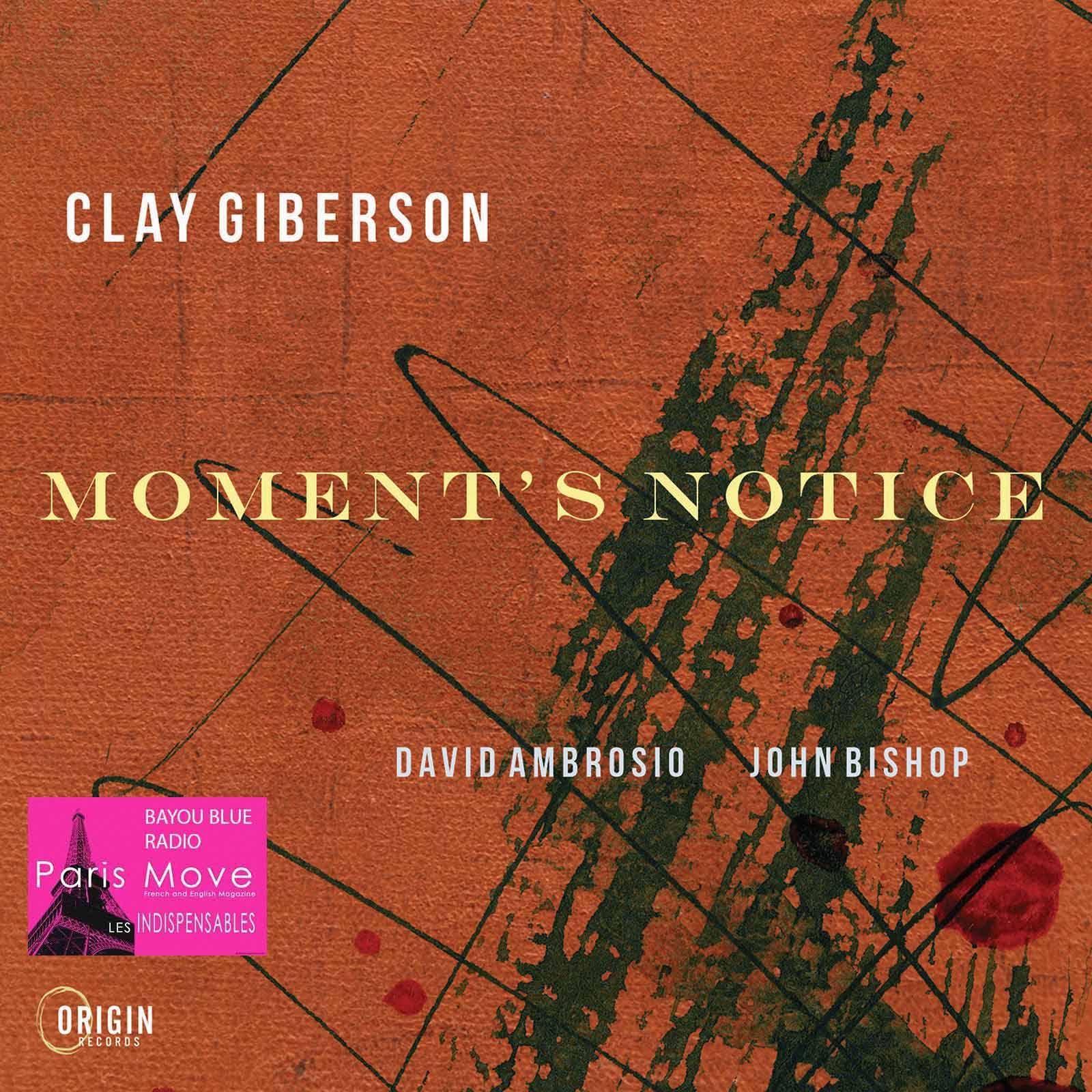
The coffee was still steaming in the studio, while outside the gray sky seemed to promise several days of rain without offering the slightest drop in temperature. One of those days when the sky appears to have settled low over the city, heavy and almost motionless, while you turn to music in search of another kind of light. On the desk, an album with autumn-colored artwork had been waiting for some time. I had kept looking at it without ever quite taking the time to stop and listen. Eventually, though, there was nothing left to do but open it, or rather, play it. I put the record on, pressed play and let the music enter the room. From the opening measures of “Upper Road,” I knew I was not going to be disappointed. Something opens immediately, a world unmistakably belonging to pianist and keyboardist Clay Giberson, yet one that could not have taken this particular shape without the two musicians beside him, bassist David Ambrosio and drummer John Bishop. What strikes you first is the trio’s lightness. It is a deceptive lightness, because underneath it lies music of remarkable density, full of detours, breathing spaces, quiet tensions and subtle harmonic shifts. Nothing is demonstrative. Nothing seems eager to remind us that these three men know how to play. They simply play, and the music takes care of the rest. Giberson lets his fingers move across the keyboard with the apparent ease that only comes from years spent living with an instrument. At times, the notes seem to rise from the piano like golden autumn leaves caught in the wind, but that sense of freedom rests on remarkably solid architecture. The melody remains at the heart of everything, even when the harmony grows more intricate. That is one of the first strengths of “Moment’s Notice”: it never sacrifices the song within the music to the sophistication of its writing. The trio possesses that rare intelligence that knows how to be extraordinarily precise without ever sounding calculated.
Clay Giberson arrives with an album that, at first glance, might seem to draw heavily on repertoire we already know. But that would be to misunderstand what is happening here. “Moment’s Notice” is not simply a collection of covers surrounding a few original compositions. It feels more like a journey through the pianist’s musical memory, a way of looking backward in order to understand what shaped him and, more importantly, what he is doing with those influences now. Giberson’s own compositions are few, but their placement is crucial. “Upper Road” and “Speak” carry his signature, and their presence is enough to reveal the identity of the musician behind every other interpretation. “Upper Road,” in particular, immediately establishes the distinctive relationship among piano, bass and drums. Giberson does not try to fill every available space. He allows Ambrosio into the conversation, lets Bishop shape the sense of time, then takes the word again. There is something almost conversational in the construction of the piece. Everything sounds so coherent that you might imagine it had been mapped out in advance, until a small inflection, a rhythmic shift or a response from the bass reminds you that this is music in which the present moment still has a say. That is where the title begins to reveal its meaning. “Moment’s Notice” suggests the ability to respond in an instant, to change direction without having to announce the change beforehand. Jazz has always existed within that tension between what is prepared and what can never be fully prepared. Giberson understands that tension beautifully.
After “Upper Road,” the trio gradually moves through a repertoire that gives us a clearer sense of the pianist’s musical references. “St. James Infirmary,” credited to Irving Mills in the program, is among the first moments when it becomes obvious that we are not going to hear a faithful recreation of the familiar version. Giberson takes the material — a few chords, a recognizable melodic line — and allows it to change through the interaction of the three musicians. The song retains its memory, but it is no longer trapped inside its past. It moves toward a post-bop sensibility, with a harmonic freedom that gives it a new kind of breath. David Ambrosio’s bass is essential here. It does not merely support the piano; it catches the chords, makes them bounce, sends them back toward Giberson, while John Bishop enters with a precision that never interrupts the flow. The result is elegant, but more importantly, it feels completely natural. I like the way this trio transforms music without ever announcing the transformation. No one seems to say, look at what I am doing to this composition. The music simply moves somewhere else. And that changes everything. A successful reinterpretation does not attempt to erase the original; it allows us to understand why the original remains alive. Here, “St. James Infirmary” becomes fresh material, and suddenly a few familiar chords seem to take flight, bouncing through the room as though Merlin himself had decided to awaken a few musical spells inside an abandoned house.
That way of looking differently at music we thought we already knew becomes the real thread running through the album. It is especially clear when the trio turns to Keith Jarrett’s “So Tender.” There is always a moment of caution when a piece so closely associated with a musician whose imprint is so powerful comes into view. Following Keith Jarrett is no simple proposition. You might even wonder why anyone would take the risk. But that caution quickly gives way to anticipation: from what angle will Clay Giberson make us hear this music? That is precisely what makes the listening so compelling. The trio never attempts to reproduce Jarrett. It retains something of his world, naturally, because a composition cannot be entirely separated from the memory of the person who created it, but it introduces its own breathing into that memory. There is Keith Jarrett, and at the same time something that is no longer entirely Keith Jarrett. That is where the adventure begins. Ambrosio changes the depth of the piece, Bishop changes its breathing, and Giberson can then place his own vocabulary inside music we thought we knew. We find ourselves in a particularly agreeable territory: close enough to the original to recognize it immediately, but far enough away to want to keep listening.
The same principle emerges in Horace Silver’s “Mayreh.” Silver belongs to a history of jazz that many listeners know almost instinctively, but Giberson never treats that history as decoration. He sets it in motion. The melody becomes a point of departure rather than a destination. The three musicians know they are working within a long tradition of piano trios, hard bop, post-bop and modern jazz, yet they show no desire to lock themselves inside a category. Perhaps that is part of what makes this music so satisfying: it has a powerful memory without becoming nostalgic. The past is present, but it is never turned into a museum. The compositions of Silver, Jarrett, Shorter, Haden and Coltrane are not here simply to remind us that jazz once produced great music. They are here because these works still have something to say. Giberson listens to his predecessors as one might listen to old interlocutors who are still perfectly capable of answering what we play today.
David Ambrosio is an ideal partner for such an undertaking. His background helps explain the breadth of the musical perspective. A musician and composer deeply rooted in the New York scene, he has developed an approach shaped by jazz, classical composition and Afro-Cuban music. His understanding of rhythm therefore comes from more than one tradition. His bass carries that diversity without ever needing to advertise it. It can provide harmonic foundation, melodic line, counterpoint or simply the presence that keeps the music moving. There is something in Ambrosio’s playing that one encounters in musicians who have lived with music long enough to no longer feel the need to prove anything. He listens. And in a trio, listening may be the most important skill of all. Every bass intervention seems to respond to what has just happened while quietly preparing what might come next. It never closes a door; it opens another. When Giberson moves slightly away from the theme, Ambrosio does not immediately pull him back. He follows, accompanies, and eventually offers him a way home.
John Bishop possesses much the same intelligence behind the drums. His career is extensive, and his collaborations with Lee Konitz, Slide Hampton, Benny Golson, Bobby Hutcherson, Ernestine Anderson, Dr. Lonnie Smith, Sonny Fortune, Herb Ellis, Gary Peacock, Buddy DeFranco, Carla Bley and Steve Swallow testify to a long engagement with very different styles and personalities. But once again, the list itself is less important than what those encounters have left in his playing. Bishop seems to understand that drums are not simply about keeping time. They can be color, breath, punctuation, sometimes even silence. On “Moment’s Notice,” he draws upon that experience without ever displaying it. His drumming is precise but never rigid, attentive to the movements of piano and bass while leaving the trio enough room to breathe. This may be one of the album’s quiet secrets: each musician has a voice strong enough to be immediately recognizable, yet none tries to impose that voice at the expense of the others.
That collective conception becomes even more revealing on “Speak,” Giberson’s other composition. Here the pianist seems to open the door to his own world a little wider. We hear his relationship with jazz, certainly, but also something broader: an understanding of classical music, formal construction and the possibilities offered by keyboards. Giberson is a pianist, but also a keyboardist, and that distinction matters. It allows him to think differently about texture and space. Yet he never turns the trio into a technological demonstration. Everything remains at the service of the music. “Speak” lives up to its title because the piece seems almost literally to speak, but it never speaks alone. There is always an answer. The piano proposes, the bass responds, the drums enter, the piano returns. This exchange of questions and answers is one of the album’s most appealing qualities. We never know exactly who is leading and who is following, and eventually the distinction becomes irrelevant. The music belongs to all three.
When Wayne Shorter’s “Beauty and the Beast” arrives, the risk is once again considerable. Shorter is one of those composers whose work carries such a powerful personality that an overly cautious interpretation can quickly become pointless, while an overly ambitious rewriting can make the original strength disappear. Giberson chooses a third path. He seeks neither reproduction nor rupture, but appropriation. The theme remains, yet it is seen from another angle. The harmonies take on a different light, silences become more significant, Bishop’s drums establish another kind of breathing, and Ambrosio’s bass contributes to the feeling that the piece has shifted without losing its identity. That is precisely what one hopes for from an interpretation: not simply to recognize what we already know, but to discover something we had never heard in quite the same way before.
There is, in this approach, a form of respect for jazz history that seems far more interesting than reverence. Reverence freezes. Respect allows something to continue. Giberson belongs to the second category. He does not build monuments around the musicians he admires. He puts them back to work. He takes their music into his own time and asks what it can still produce. That is how Keith Jarrett, Horace Silver, Wayne Shorter, Charlie Haden and John Coltrane can coexist with his own compositions without the whole thing feeling artificial. Generations answer one another. Languages cross paths. Influences are neither concealed nor reproduced note for note. There is a constant circulation, a continual exchange between memory and the present.
“Poinciana” adds another dimension to the journey. The melody is familiar enough to awaken something immediately in the listener, but here it becomes a space for freedom. The trio gives it room to breathe. Giberson plays with the melody without ever losing it, Ambrosio provides the depth that prevents the whole thing from becoming too airy, and Bishop maintains a supple, almost invisible pulse. Once again, complexity hides behind simplicity. You could listen casually and simply enjoy its beauty. But if you stop and listen more closely, an entire process of construction comes into view. The instruments answer one another, the spaces are carefully shaped without ever sounding calculated, and the melody remains sufficiently present to keep the listener oriented. That ability to maintain a clear line within rich writing is one of Giberson’s signatures.
Charlie Haden’s “First Song” slows the movement further and allows the trio to explore another kind of intimacy. Haden himself is an essential figure in a conception of jazz where melody and space matter as much as virtuosity. It is therefore hardly surprising that the piece finds such a natural home here. Ambrosio can fully develop his sense of line, while Bishop knows how much silence to leave around each note. Giberson, meanwhile, has no need to fill every space. He understands that the piano can sometimes say more by stepping back. This economy is not a weakness. It becomes a way of intensifying the act of listening. We are far removed from pianistic display. What matters is no longer the number of notes, but their weight, their placement and their duration.
And then comes the title track, John Coltrane’s “Moment’s Notice.” The choice may seem almost inevitable, given how deeply the piece belongs to the history of modern jazz, but it remains a risk. Coltrane is everywhere in contemporary jazz, sometimes as a conscious influence, sometimes as a more subterranean presence. Giberson does not turn the composition into an exercise in bravura. He approaches it as he does the other pieces, with respect, but above all with a desire to hear what it can become between his hands and those of his partners. The composition retains its power, but it is not treated as a sacred object. It is alive. Perhaps that is the best way to honor Coltrane: not by building him a mausoleum, but by continuing to play his music.
It is worth returning to the title because it captures the spirit of the album so well. “Moment’s Notice” evokes urgency, the ability to make a decision in the instant, to respond to what someone else is doing. A jazz trio can never plan everything. It can rehearse, prepare, discuss arrangements and work through harmonies, but an essential part of what happens in the studio or onstage is born in the moment. A breath from the bass can alter a piano phrase. A gesture from the drums can shift the felt tempo. A single note can open a direction no one had imagined a few seconds earlier. That vulnerability is what keeps music alive. Giberson, Ambrosio and Bishop seem to trust one another enough to accept that uncertainty. They do not merely play alongside one another. They play together.
That complicity is all the more apparent because this is not a trio of musicians artificially assembled for a recording. They have already had time to meet onstage, to understand one another’s ways of breathing and constructing music. The result is a particular fluidity. You do not hear the adjustment period that can emerge when three strong personalities meet for the first time. Each seems to know when to speak, when to remain silent, when to let another musician move forward. And that familiarity is precisely what allows the music to remain open. Trust is one of the hardest things to capture on a recording. Here, you can hear it.
The album also says something about the way jazz continues to live beyond the official narratives we build around it. Clay Giberson belongs to a Pacific Northwest scene in which musicians, venues, labels, teachers and artists have spent decades maintaining a genuine musical community. John Bishop is himself an important part of that history. That matters because jazz is not simply a succession of geniuses and masterpieces. It is also an everyday practice, a life of clubs, studios, rehearsals, encounters and transmission. It is music built over time. “Moment’s Notice” carries that history without needing to explain it. You hear it in the way the musicians know one another, in their refusal to rush, in the confidence that comes with experience.
Perhaps that is also why I keep thinking about the coffee that slowly went cold while I listened. There is something slightly old-fashioned about sitting down with an album and genuinely giving it time. Everything today encourages us to move quickly to the next thing. One song leads to another, then another, and sometimes music becomes little more than a succession of streams. “Moment’s Notice” resists that logic. It asks you to stay. Some things are immediate; others reveal themselves only after several listens. You notice a bass line you had missed, a shift in the drums, a harmonic change that seemed insignificant at first but eventually becomes essential. This is an album that rewards listening to it as a whole, the way you look at a landscape whose details only begin to emerge after you have spent a few minutes standing in front of it.
Ultimately, what Clay Giberson offers us may be a way of talking about the history of jazz without ever turning it into a lesson. He shows us his influences by allowing them to play. He shows us his admiration by transforming it. He shows us his own identity by placing his two compositions among those of musicians he has listened to for years. And that is where the album finds its balance. “Upper Road” and “Speak” are not simply two personal breaths in the middle of a program of covers. They are the two points that allow us to understand the whole. They say: this is where I am. Everything around them says: this is where I come from. And somewhere between the two, a musician takes shape.
There is something generous about this approach. Giberson does not try to confine jazz within a definition. He does not claim that one era is superior to another, or that one way of playing is more authentic than another. He takes what interests him, confronts it with his own experience, and then shares it. It is a very old way of keeping music alive, and perhaps precisely for that reason it remains a very modern one. Jazz musicians have always borrowed, transformed and rearranged. They have always listened to those who came before them before finding their own voices. The problem is never influence. The problem would be having nothing to do with it. Here, Giberson has plenty to say.
The choice of David Ambrosio and John Bishop makes even more sense in that light. They are not simply two excellent accompanists chosen for their ability to support a pianist. They are musicians capable of shifting the music themselves. Ambrosio brings his experience as a composer, his relationship with classical and Afro-Cuban traditions, and his knowledge of contemporary jazz. Bishop brings an immense memory of the American scene, a precision acquired through contact with generations of musicians, and the ability to turn the drums into a language of their own. Giberson can therefore take risks because he knows that behind him, or beside him, the other two will understand. That is what makes this trio strong enough to be free.
And freedom is probably the word that best fits this album. Not spectacular freedom, the kind that seeks to dismantle everything simply to prove that it is free, but a much more difficult freedom: the freedom that comes from knowing the rules well enough to know when to move them. Giberson knows jazz. He knows its history, its forms, its harmonies, its great pianists and its great composers. But he does not seem interested in living inside that history. He wants to move through it. He goes from Jarrett to Silver, from Shorter to Haden, from Coltrane to his own compositions, without ever needing to erect barriers between eras. Music becomes common ground.
It probably takes a musician’s full life to arrive at an album like this. A life of stages, study, encounters, listening, travel, rehearsals and collaborations. A life long enough to understand that originality does not necessarily mean turning your back on everything that came before. It can also mean looking at that history with different eyes. “Moment’s Notice” is bold because it takes on works that have already been played magnificently. It is risky because every interpretation immediately invites comparison. But Giberson is not trying to win that comparison. In a way, he refuses to play the game at all. He would rather offer his own vision.
And it is precisely that vision that ultimately makes itself heard. When we listen to “Beauty and the Beast,” we hear Wayne Shorter, but we also hear Giberson. When “So Tender” arrives, Keith Jarrett’s presence remains, but it does not prevent the trio from speaking in its own voice. When Silver, Haden or Coltrane appear, they become doors opening onto different worlds. And when Giberson returns with “Upper Road” or “Speak,” we understand that all these musics have nourished something that now belongs to him. The influences do not disappear; they are transformed into language.
Then the album ends. The coffee has been cold for a long time. Outside, the sky is still gray, and perhaps the rain has finally begun to fall. The room has not changed, and yet it is no longer quite the same. Perhaps that is what I ask of an album: that it do more than fill time, that it slightly alter the way we look at what surrounds us when the silence returns. “Moment’s Notice” has that capacity. It does not claim to reinvent jazz, and fortunately it does not need to. It does something more difficult: it listens to it. It listens to its history, its great names, its melodies, its forms, and then asks what they can still say today. With David Ambrosio and John Bishop, Clay Giberson creates music that can be deeply studied without becoming heavy, complex without becoming demonstrative, elegant without becoming merely polite, and profoundly respectful of its references without ever becoming nostalgic. He reminds us that great works are not fixed objects, that they can continue to move without being betrayed, and that music with a long history can still find new ways to speak. Sometimes all it takes is three musicians, a studio, a little time, a cup of coffee slowly going cold and a few old compositions that someone is willing to look at differently. Then we listen, we recognize certain things, we discover others, and little by little we begin to smile because what we are hearing gives us pleasure. Perhaps, in the end, that is what matters most.
The coffee was still steaming in the studio, while outside the gray sky seemed determined to promise several days of rain without offering the slightest change in temperature. It was one of those days when the sky hangs low, heavy and almost motionless, and you find yourself looking to music for another kind of light. On the desk, an album with autumn-colored artwork had been waiting for me for some time. I had looked at it more than once without ever quite stopping to listen. Eventually, of course, the time came. I put the record on, pressed play and let the music take over the room. From the first measures of “Upper Road,” it was clear that I had made the right decision. A world opens almost immediately, unmistakably Clay Giberson’s, yet impossible to imagine in quite this form without bassist David Ambrosio and drummer John Bishop. What catches the ear first is the trio’s lightness. But it is a deceptive lightness, because beneath that apparent ease is music of considerable substance, full of side roads, breathing spaces, restrained tensions and tiny harmonic movements. Nothing is pushed forward for effect. Nothing feels like an announcement of virtuosity. These three musicians simply play, and the music does the talking. Giberson moves across the keyboard with the kind of effortless fluency that only comes after years of intimate work with an instrument. Now and then, the notes seem to rise like autumn leaves caught in a current of air, turning and drifting before settling somewhere out of sight. Yet beneath that freedom is an architecture of extraordinary solidity. The melody never disappears, even when the harmonic language becomes more involved, and that may be one of the album’s greatest strengths. “Moment’s Notice” never allows the sophistication of the writing to overwhelm the song itself. It knows that intelligence in music does not have to announce itself.
Thierry De Clemensat
Member at Jazz Journalists Association
USA correspondent for Paris-Move and ABS magazine
Editor in chief – Bayou Blue Radio, Bayou Blue News

PARIS-MOVE, October 1st, 2026
Follow PARIS-MOVE on X
::::::::::::::::::::::::
Album on Origin Records’ website
Musicians :
Clay Giberson, piano/keyboards
David Ambrosio, bass
John Bishop, drums
Track Listing:
1 Upper Road 7:06
2 St. James Infirmary 5:38
3 So Tender 8:02
4 Mayreh 7:32
5 Poinciana 5:57
6 Speak 8:13
7 Beauty and the Beast 7:19
8 First Song 5:17
9 Moment’s Notice 7:18
Produced by Clay Giberson
Recorded by Clay Giberson at Gyberspace, Portland, OR, July 14th 2025, additional recording December 2025
Mixed by Bob Stark at Bob Stark Sound, Portland, OR
Mastered by David Glasser at Airshow Inc., Boulder, Colorado
Photo of Clay by Rachel Hadiashar
Cover design & layout by John Bishop