| Jazz |
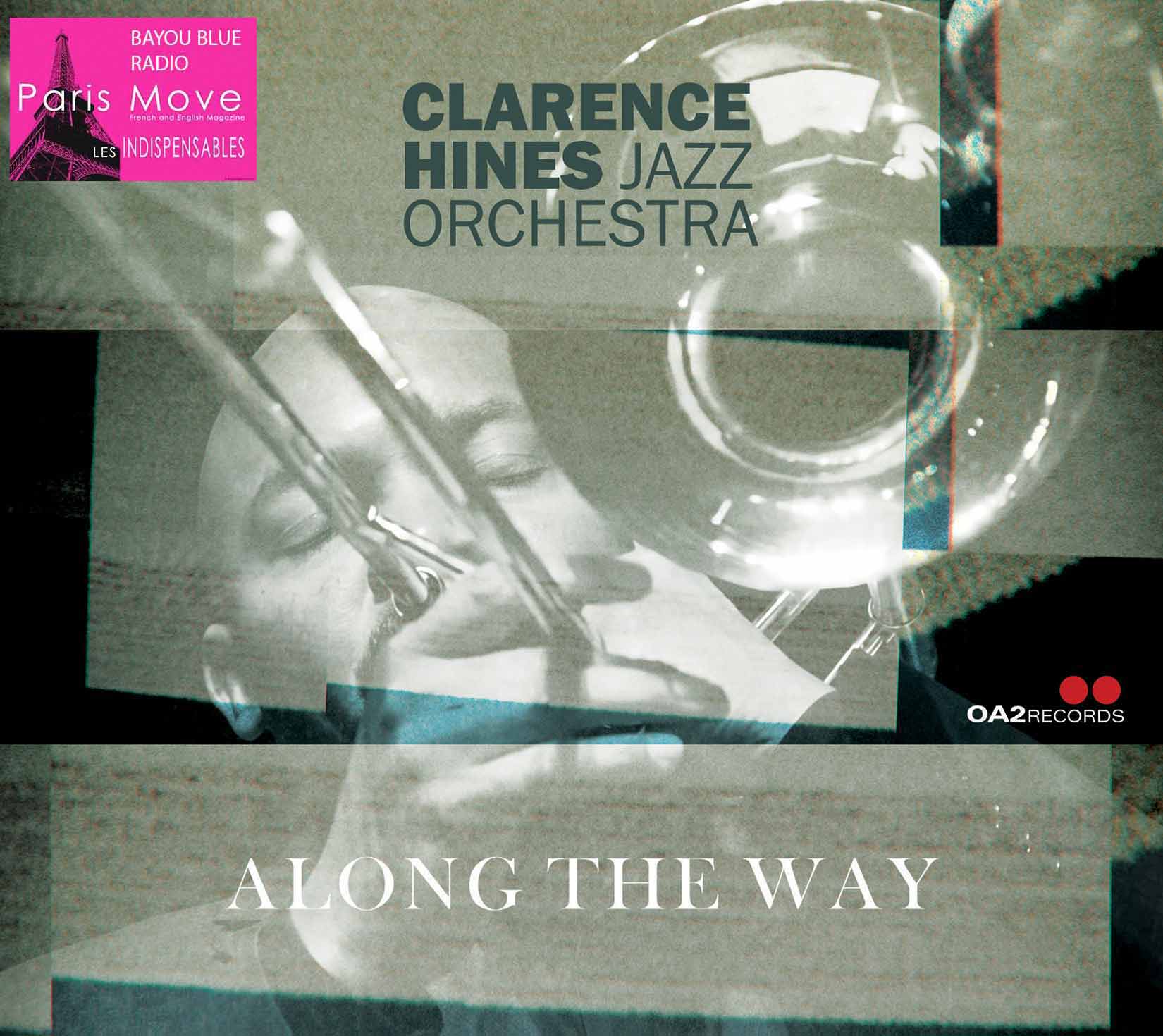
Often, when autumn begins to show the first signs of its arrival, I find myself slipping back into that nostalgic mood that seems to accompany the changing of the seasons. Sometimes all it takes is a different kind of light, a lower sky, or simply an album covers for that particular form of nostalgia to return, a feeling that is neither really sadness nor really melancholy, but rather the strange sensation of finding something again that we were not necessarily looking for. This Monday, two albums with black-and-white covers came along to reinforce that feeling. The first is the album by trombonist and composer Clarence Hines, who makes his debut as a leader with Along the Way.
From the very first notes, we enter a form of contemporary jazz that keeps its feet firmly planted in the past while refusing to become trapped there. There is an obvious knowledge in this music of what jazz has produced at its most exciting throughout its history, but there is also a desire to make that heritage live in the present. And what could be more natural, for a trombonist and composer, than a large ensemble with which to bring that ambition to life? With nearly twenty musicians gathered around him, Hines has created a genuine sonic laboratory. All of the tracks are his own compositions, with the exception of Carry On, by Lynne Arriale, and April Green, by Vernice “Bunky” Green. Yet these two compositions from outside his own repertoire never break the balance of the album; on the contrary, they fit naturally into an overall vision that gives the record a remarkable coherence.
One has to give Clarence Hines credit for a quality that has become rare enough to deserve mention: he knows how to write for a large ensemble without ever giving the big band the heaviness that is sometimes associated with it. The more musicians there are, the greater the risk of losing that sense of breathing, flexibility and unpredictability that is precisely what makes jazz so appealing. None of that happens here. The rhythm sections remain mobile, the soloists are given real space, and the different sections of the orchestra seem to be constantly talking to one another. Hines does not think of the brass as a mass whose only purpose is to produce power; he uses the instruments as distinct voices, capable of answering one another, overlapping, disappearing and then returning. This is probably where one of the album’s great strengths can be found, in the writing itself. On the first listen, we are carried along by the richness of the arrangements and by the contributions of the different soloists; with subsequent listens, we begin to discover a much more precise architecture, in which every instrument seems to have its place within a construction that never feels fixed. The music breathes, moves forward, sometimes returns to something it has already touched, and then heads off somewhere else. There is something in this way of bringing the orchestra to life that directly recalls the great orchestral writing of jazz in the 1950s, but with a conception of sound that unquestionably belongs to our own time.
To understand this music, it is also necessary to look at Clarence Hines’s career. His path has been built at the crossroads of several worlds, between performance, composition and arranging. He has worked alongside musicians as different as John Pizzarelli, Diane Schuur, David Sanborn and Maceo Parker, and he has also performed with symphony orchestras and jazz ensembles. This diversity is not without consequences for his writing. Hines belongs to a generation of musicians for whom jazz is not a boundary, but a starting point. His work as an arranger has led him to write for professional and university ensembles, while his compositions have been presented in venues and at festivals devoted both to jazz and to orchestral music. It becomes easier to understand, then, why Along the Way can sometimes give the impression of quietly crossing the boundaries between several musical worlds. There are passages that bring to mind funk, or even certain forms of rock, but they never give the impression of an artificial collage. These influences seem instead to have been absorbed, digested and then incorporated into a writing that remains deeply attached to jazz.
It is precisely this freedom that makes the album so interesting. Hines looks toward the 1950s, but he is not trying to reproduce an era. He takes certain principles of writing, certain colors, a certain conception of the large ensemble, and then confronts them with his own experience. The modernity lies less in the compositions themselves than in the way they are arranged and orchestrated. This is where the composer seems to be having the most fun, particularly with the wind instruments. The brass becomes a constantly moving musical material, and its effectiveness becomes clearer and clearer as the album is heard again. What may have seemed relatively conventional on the first listen gradually reveals a much more carefully worked-out form of writing. A phrase passes from one section to another, one section answers another, the voices cross paths, and yet the whole thing retains a remarkable clarity. Hines thus manages to resolve one of the most delicate problems of the large ensemble: giving the collective a real sense of power without sacrificing individuality. The orchestra never overwhelms the soloists, and the soloists never seem to be trying to escape from the orchestra. Everyone contributes to a shared construction.
April Green brings another color to this ensemble. The choice of this composition by Vernice “Bunky” Green is obviously not insignificant. It introduces a more romantic, almost contemplative dimension, allowing us once again to appreciate the richness of Hines’s orchestral writing. The large ensemble is no longer simply a matter of power; it becomes a way of working with nuances, silences and space. This piece contributes to the sense of breathing room that runs through the album. Carry On also plays a particular role in the balance of the record, allowing Hines to show how his musical language can welcome a composition that does not belong to him. Far from trying to impose his signature at all costs, he seems instead to want to understand how this music can find its place within his orchestral world. Perhaps that is also where the maturity of an arranger can be measured: not in the ability to transform everything, but in knowing what should be preserved.
There is something deeply American in this way of allowing influences to circulate, of bringing jazz into conversation with popular music, large ensembles with small ones, sophisticated writing with improvisation. Clarence Hines is part of this history without trying to sum it up. His album is nourished by an enormous heritage, but it does not sound like a historical demonstration. There is enough life, movement and sometimes even humor in these compositions for us to quickly forget the sophistication of the writing itself. And that is probably a good thing. A jazz album does not exist to explain to us how it works; it should first make us want to listen to it again. Along the Way has precisely that quality. The more we return to it, the more details appear, without the immediate pleasure of listening ever disappearing.
And then comes What’s Up With That?, the final track, which begins with a nicely handled drum solo before gradually allowing the orchestra to take back its place. We might expect a conclusion, but the piece gives more of a feeling of an opening. It has that particular energy that could just as easily announce an encore onstage as prepare the way for the next chapter. Perhaps Clarence Hines is already thinking about the next album; perhaps this feeling is simply the result of writing that refuses to close the door completely. In the end, it does not really matter. What remains is the sensation of having traveled through an album that belongs to an old tradition while being deeply alive at the same time. At a time when music sometimes seems condemned to move faster, to multiply its effects and to seek our attention immediately, Along the Way chooses another sense of time. The time of listening, of arranging, of nuance and of musicians meeting one another.
Perhaps that is also why this album fits so well with this autumn mood. It does not try to make us forget the passing of time; it simply reminds us that the past can still serve as material for the present. And if 2026 is not over yet, we will certainly want to keep an ear open to what the coming months may bring. In the meantime, with this first album as a leader, Clarence Hines has reminded us that a large ensemble can still be a wonderful space for freedom, surprise and breathing room.
Thierry De Clemensat
Member at Jazz Journalists Association
USA correspondent for Paris-Move and ABS magazine
Editor in chief – Bayou Blue Radio, Bayou Blue News
PARIS-MOVE, September 28th, 2026
Follow PARIS-MOVE on X
::::::::::::::::::::::::
Musicians:
Todd DelGiudice – alto & soprano sax, flute
Michael Emmert – alto sax, flute
Lenard Simpson – alto sax (4)
Doug Stone – tenor sax, clarinet
Fernando Cruz – tenor sax, clarinet
Karli Bunn – bari sax, bass clarinet
Clarence Hines – trombone
Bernie Greenlee – trombone
B. Walden Shaw – trombone
Gina Benalcazar – bass trombone
Bijon Watson – trumpet, flugelhorn
Clay Jenkins – trumpet (3, 5, 6)
Mark Filsinger – trumpet, flugelhorn
Dave Hart – trumpet, flugelhorn
Ray Callender – trumpet, flugelhorn
Joshua Bowlus – piano
Emiliano Lasansky – bass
Jared Schonig – drums
Track Listing:
1 In Transit 5:46
Solos: Stone (tnr), Hines (tbn), Bowlus (pno)
2 Carry On 6:56
Bowlus (pno), DelGiudice (alto)
3 A Tad of Thad 7:31
Schonig (dms), Jenkins (tpt), Stone (tnr)
4 April Green 7:44
Simpson (alto)
5 All This Time 7:41
Jenkins (tpt), Bowlus (pno)
6 Altered States 8:27
DelGiudice (sop), Clay Jenkins (tpt)
7 Evening Song 7:37
Hines (tbn), Bowlus (pno)
8 What’s Up With That? 7:18
Produced by Clarence Hines
Assembly & rough mix by Clarence Hines, Jacksonville, FL
Mixed & mastered by Dave Darlington at Bass Hit Studio, New York
Cover design & layout by John Bishop
All musicians recorded themselves remotely at home:
Los Angeles, CA: Jared Schonig – drums (Jan 2022); Emiliano Lasansky – bass (Feb 2022)
Jacksonville, FL: Joshua Bowlus – piano (Apr 2022); Todd DelGiudice – alto sax, soprano sax, flute (Jul-Aug 2022); Michael Emmert – alto sax, flute (Oct 2022); Fernando Cruz – tenor sax, clarinet (Oct 2022); Clarence Hines – trombone (Dec 2022); Ray Callender – trumpet, flugelhorn (Mar 2023); Bernie Greenlee – trombone (Nov-Dec 2023); B. Walden Shaw – trombone (Dec 2023)
Dorchester, MA: Bijon Watson – trumpet, flugelhorn (May-Jun 2022)
Baton Rouge, LA: Doug Stone – tenor sax, clarinet (Oct 2022)
Chicago, IL: Karli Bunn – bari sax, bass clarinet (Jan 2023); Lenard Simpson – alto sax (track 4) (Jun 2023)
New York, NY: Gina Benalcazar – bass trombone (Jan 2023)
Buffalo, NY: Mark Filsinger – trumpet, flugelhorn (Jan 2023)
Miami, FL: Dave Hart – trumpet, flugelhorn (Jan 2023)
Rochester, NY: Clay Jenkins – trumpet (May 2026)