| Contemporary music |

Christopher Shultis, Waldmusik (2002–2016): Fourteen Years of Walking, Distilled Into Sound
Waldmusik, Christopher Shultis’ extraordinary release on Neuma Records, is the sound of fourteen years of solitary walking in woods and mountains on three continents, slowly and patiently turned into eight pieces of music. It is a deeply beautiful, deeply considered album, and a genuinely great one.
The story of Waldmusik begins in the summer of 2003, during a three-month residency at the Wurlitzer Foundation in Taos, New Mexico. In the very first entry he posted to his newly built personal website, Shultis announced his plan to write a piece connected to a short, almost haiku-like text: walking in woods/ listening…/ what I hear. That phrase, he recalls in the album’s liner notes, became “a lifelong creative mantra”, even though, in a telling twist, the actual piece he set out to write that summer never got finished, and the Taos residency instead produced a different work entirely, the song cycle that opens his first Neuma album.
Waldmusik kept circling in the back of his mind for over a decade before the music gathered here finally took shape, and Shultis is candid that the person who wrote those original words in 2003 “was no longer the same person” by the time the cycle was complete. That sense of long, unhurried becoming is woven into every piece on this record.
Central to the whole project is Shultis’s own practice of what Henry David Thoreau called “sauntering”, walking for hours at a stretch with no destination and no worldly agenda, purely in order to quiet the mind. What Jack Kerouac will also do, inspired by Thoreau. Over years of doing exactly that in the mountains of New Mexico, the woods of Pennsylvania, the temples and peaks of South Korea, and the forests around Heidelberg, Germany, Shultis found that his thinking slowed, his attention sharpened, and he arrived, as he puts it, “at a place where I could truly listen”. Waldmusik, he says, “is not just a collection of pieces; it is a document of my journey to a place where I could truly listen. The woods of New Mexico, Pennsylvania, South Korea, and Germany were where I learned to listen. This album is the sound of what I heard there”.
Elsewhere, reflecting on his larger creative philosophy, Shultis has spoken of composing from a place of pure necessity rather than ambition – writing, as he once put it, simply because a piece “needs to exist”, and trying, in the spirit of composer Morton Feldman’s famous phrase, to become “the artist deep in thought” each time he sits down to work.
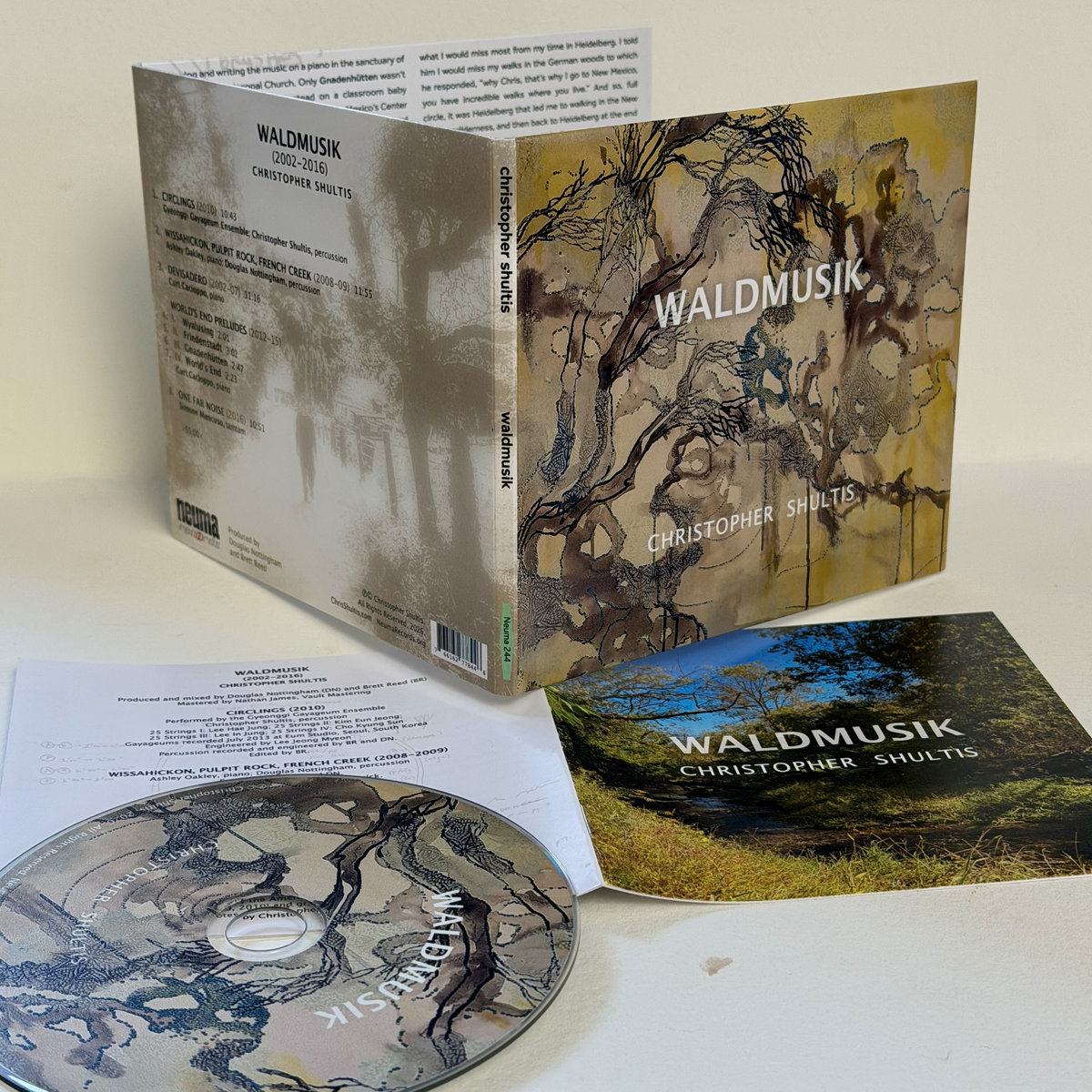
Christopher Shultis is Distinguished Professor Emeritus at the University of New Mexico, where he taught percussion, composition and musicology for over three decades and received the university’s highest faculty honour, its Annual Research Lecture award, in 2010. A two-time Fulbright Fellow to Germany — first at RWTH Aachen in 1993–94, then at the University of Heidelberg in 1999–2000 — he is also an internationally recognized scholar of John Cage. As a performer, his roots run deep in the percussion world: he spent years as an orchestral and solo percussionist and conducted the University of New Mexico Percussion Ensemble, working directly with composers including Lou Harrison, Konrad Boehmer, Cage himself, Michael Colgrass, James Tenney and Christian Wolff. His earlier Neuma release, An Illusion of Desire, documented his experimental beginnings as a composer, Waldmusik captures the fully-notated, nature-rooted voice he’s developed since the mid-1990s. Throughout the project, he’s worked closely with his wife, the visual artist Hee Sook Kim, who contributed the album’s striking cover art and design and who, by Shultis’s own account in the liner notes, made his full-time life as a composer possible in the first place. He dedicates the album to her.
The album opens with “Circlings” (2010), written for the Gyeonggi Gayageum Ensemble and built from Shultis’s own field recordings made during walks in the mountains and temples of South Korea — the sound of water, insects, and Buddhist monks chanting, woven together with electronics by Thomas DeLio and the shimmering, plucked textures of four gayageums, the traditional 25-string Korean zither. The piece carries a quietly dramatic backstory: its title and structure were partly inspired by an experience of genuinely getting lost, not in the New Mexico wilderness Shultis knew so well, but in the deceptively thick woods of Pennsylvania’s French Creek, where he and Hee Sook Kim once had to be located by park rangers after wandering in circles during a heat wave. As Shultis writes in his program note, “in the woods, all directions seem the right ones”, and “Circlings” captures that disorientation beautifully, treating distance and silence between sounds as expressive material in their own right, much the way traditional Korean music itself does.
“Wissahickon, Pulpit Rock, French Creek” (2008–09) moves the listener into the Pennsylvania woods that first unsettled Shultis after years of New Mexico solitude – he’s spoken candidly about how shocking it was to discover how hard real quiet was to find there. Scored for piano and percussion, performed here by Ashley Oakley and Douglas Nottingham, the piece’s three movements are named for three specific trails: Wissahickon Creek near Philadelphia (a spot once walked and written about by Edgar Allan Poe), Pulpit Rock on the Appalachian Trail, where Shultis recorded the pure silence he’d later fold into “Circlings”, and French Creek, where a recording of his own footsteps in fallen leaves was startlingly interrupted by a nuclear-plant emergency siren test, a jolt he and a flock of startled blue jays shared in equal measure. The music itself favours texture and gesture over melody, closer to an acoustic portrait of specific stones and streams than a conventional “nature piece”.
At the album’s centre sit two major piano cycles performed with real authority by pianist Curt Cacioppo, who grew up an hour from the site at the heart of this story and has spent decades studying Native American music and tradition. “Devisadero” (2002–07), formally titled Devisadero: Six Preludes for Piano Solo, takes its name from a trail outside Taos that Shultis walked first in 2002 and again in 2007, with the music itself only crystallizing between those two walks. Its six movements – “Walking”, “Wind Blowing”, “Fly Buzzing, Ant Running”, “Walking (Return)”, “Bird Chirping, Rustling Leaf” and “Wind Stopping” – carry the open, sun-struck spaciousness of high desert trails, built from clear, reduced gestures with generous room left between the notes.
“World’s End Preludes” (2012–15) is the album’s emotional and historical heart. Also performed by Cacioppo, the four-movement cycle follows a genuinely harrowing piece of American history that Shultis uncovered through his own walking: the path taken in 1781–82 by Moravian bishop John Ettwein and a group of Christian-converted Lenape from Wyalusing, Pennsylvania (near the present-day World’s End State Park) across the state and into Ohio, where they settled a village called Gnadenhütten, “Cabins of Grace”. There, on March 8, 1782, all ninety-six Lenape residents, having been permitted by a Pennsylvania militia to spend their final night in prayer, were massacred. Shultis traced that same path himself on foot, and the four movements – “Wyalusing”, “Friedenstadt”, built around fragments of Moravian hymns, “Gnadenhütten”, and “World’s End”, whose title nods to T. S. Eliot – trace it musically, moving from frantic unease to a harsh, concentrated reckoning and finally toward something like peace. Fittingly, when performed as part of this specific sequence, the cycle’s ending is marked by a Lenape rattle belonging to Cacioppo himself, meaning that, as Shultis puts it in his notes, in Waldmusik “it is the sound of the Lenape we hear last” before the album moves on.
The record closes with “One Far Noise” (2016), written for the celebrated Italian percussionist Simone Mancuso and scored for tamtam and electronics. Its title comes from a line in the journals of Thomas Merton, “to have the only one far noise is not equivalent to silence”, and the piece was composed while Shultis was living and walking near Heidelberg, Germany, along the Philosophenweg. What began as an idea about a single “noisy” sound building, through repetition, into something overwhelming was transformed by the beauty of those German woods into something gentler: the piece closes with an actual recording of birdsong Shultis captured on that trail, a quiet duet between real birds and Mancuso’s tamtam that brings the whole fourteen-year journey full circle, ending not with a bang but with a kind of listening.
Waldmusik asks real patience of its listener, this isn’t music built on catchy themes or dramatic arcs, and it rewards exactly the kind of unhurried, attentive listening that produced it in the first place. But that patience pays off enormously. Across its eight tracks, the album moves fluidly between acoustic chamber writing and electroacoustic sound art, between the exotic plucked strings of Korean temple music and the stark, harrowing weight of American colonial history, never once feeling like a loosely connected sampler. What holds it all together is Shultis’s own voice: restrained, unshowy, deeply attentive to space and silence, and animated throughout by a genuine spiritual seriousness that never tips into sentimentality. It’s the sound of an artist who has spent decades learning, quite literally, how to listen, and who has now found a way to let the rest of us listen in too.
Waldmusik is a rich, deeply personal and genuinely moving body of work, a fourteen-year pilgrimage distilled into fifty-five minutes of music that rewards close, repeated listening with ever-deeper layers of meaning. From the mountains of South Korea to the haunted trails of Pennsylvania to the birdsong of the German Odenwald, Christopher Shultis has built something rare: an album that is simultaneously a scholarly achievement, a historical reckoning, and a quiet, deeply felt act of gratitude. A great album, and a genuine labour of love.
Frankie Pfeiffer
Editor in chief – PARIS-MOVE
PARIS-MOVE, October 4th, 2026
Follow PARIS-MOVE on X
:::::::::::::::::::::
Order the album on the Bandcamp
Order the album on NEUMA Records’ website
Tracklisting
- Circlings (2010) – 10:43
- Wissahickon, Pulpit Rock, French Creek (2008–09) – 11:54
- Devisadero (2002–07) – 11:15
- World’s End Preludes (2012–15): I. Wyalusing – 2:00
- World’s End Preludes (2012–15): II. Friedenstadt – 3:02
- World’s End Preludes (2012–15): III. Gnadenhütten – 2:46
- World’s End Preludes (2012–15): IV. World’s End – 2:22
- One Far Noise (2016) – 10:51
Total running time: 55:00
Musicians
Christopher Shultis – percussion, composition
Gyeonggi Gayageum Ensemble – Lee Hae Jung, Kim Eun Jeong, Lee In Jung, Cho Kyung Sun (25-string gayageums), track 1
Ashley Oakley – piano, track 2
Douglas Nottingham – percussion, track 2
Curt Cacioppo – piano, tracks 3–7
Simone Mancuso – tamtam, track 8
Produced and mixed by Douglas Nottingham (DN) and Brett Reed (BR)
Mastered by Nathan James, Vault Mastering
All music published by the American Composers Alliance (BMI)
Cover art (Nirvana 20, 2019) and graphic design by Hee Sook Kim
Liner notes by Christopher Shultis © 2025