| Jazz |
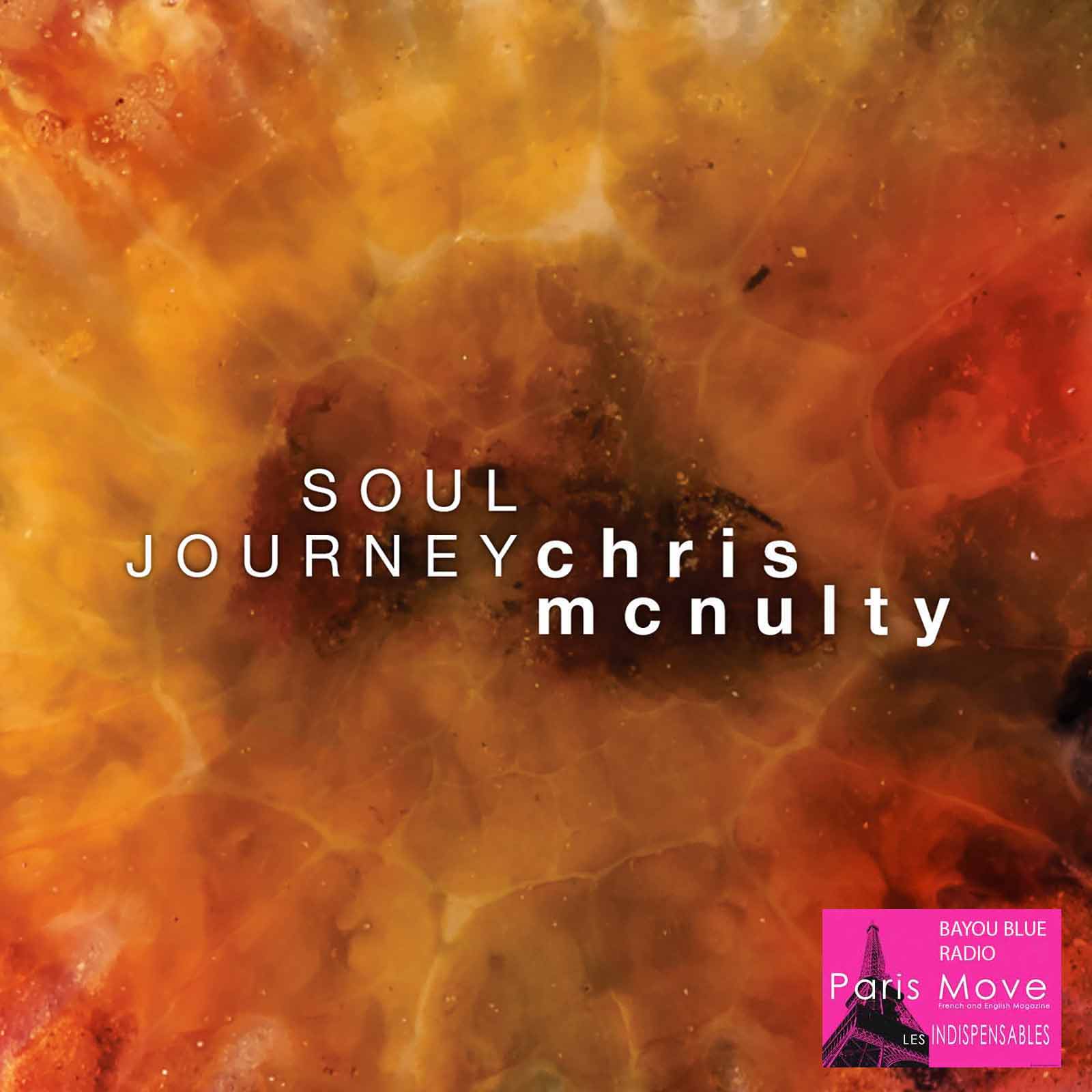
Summary: Chris McNulty’s “Soul Journey” blends jazz, classical influences and poetic vocals into an intimate, sophisticated and deeply personal album.
Chris McNulty’s “Soul Journey”: An Intimate Journey Through Jazz
Sometimes an album gets lost. It happens. A record is sent out, disappears somewhere along the way, and by the time it finally finds its way back to us, days or weeks may have passed, sometimes even longer. Then, just when we have almost stopped thinking about it, a CD with a red cover slips out of an envelope. We put it into the player, perhaps without expecting very much, and suddenly something quite singular appears. A voice comes first, with music unfolding behind it, and almost immediately there is the feeling that we are listening to something that does not quite fit into the usual categories. The style is unusual, but what makes it compelling is not simply its originality, nor even the technical ability of the singer. There is something more elusive happening. With Soul Journey, her eighth album, Australian vocalist and composer Chris McNulty, who has lived and worked in New York for many years, brings together influences that seem to come from different sides of the world, and somehow makes them belong in the same room. It is deliciously unsettling at first, the kind of record that asks you to slow down rather than rush toward an immediate conclusion. So you settle in, put on the headphones, connect them to the big digital mixing desk, and listen. When an album is genuinely exceptional, you can usually feel it very quickly. On the opening track, “Secrets That We Keep,” McNulty’s voice almost becomes another instrument, while the saxophone takes on the role of narrator. It is clever, to say the least, and there is a real intelligence in the way the two seem to speak to each other. Then “Elegy for Olga” arrives, and something becomes clear: Chris McNulty is not simply a vocalist who also writes songs. She is a musician and a composer first, and the voice is one of the tools she uses to create situations, landscapes and emotional spaces that seem to correspond to a very personal inner world. That distinction matters, because Soul Journey is not really an album built around a singer. It is an album built around a musician who happens to have an extraordinary voice.
I had not heard McNulty’s earlier recordings, so I came to Soul Journey without any particular expectations. After looking back at her career, however, I was not especially surprised to discover that her recordings and performances have received strong reviews and four- and five-star notices from publications including DownBeat, JazzTimes, The Irish Times and Jazzwise. Her reputation did not appear overnight, and Soul Journey makes it easy to understand why. There is also something particularly interesting about the way she approaches a song such as “Blue in Green,” associated with Miles Davis, or the Italian standard “Estate,” written by Bruno Martino in 1960 and subsequently interpreted by countless artists. McNulty does not simply sing these pieces. She inhabits them, reshapes them and, at times, almost seems to use her voice as a brass instrument. The words become only one part of the expression. The rest comes through tone, breath, phrasing and the strange warmth of her sound. This kind of vocal approach was certainly familiar in parts of jazz during the 1970s, when singers were increasingly willing to treat the voice as an instrument rather than simply as a vehicle for lyrics, but McNulty does something else with the idea. She gives it her own poetic character. Most importantly, she does not seem afraid of silence. She does not try to fill every available space, and because of that, the other musicians have room to enter, to comment and sometimes to interrupt the emotional line of the voice. That is one of the things I particularly appreciate about this album. Nothing seems desperate to prove that it belongs there. The music has the confidence to wait.
There is also a fascinating meeting of musical cultures beneath Soul Journey. By now, most listeners understand that one of the deep connections between Australia, Europe and the United States is classical music, even if Australians may approach that tradition with a somewhat different perspective. These are nevertheless shared roots, and they can be felt here without ever becoming an obvious stylistic statement. McNulty’s relationship with classical music seems to emerge less through quotation than through her attention to melody, structure, arrangement and color. Her Australian background and her long experience in New York give the album an unusually broad perspective, and that international character is one of its quiet strengths. Soul Journey feels like an intimate space that McNulty has opened for the listener, a place containing all of her complexity without feeling the need to explain it. There is nostalgia throughout the record, but it is never nostalgia for its own sake. The melodies carry memories, sometimes gently and sometimes with a little more weight, while the arrangements allow those melodies to breathe. This becomes particularly apparent in her treatment of “Estate.” It would have been very easy to turn such a familiar song into another polished jazz standard, beautifully sung and quickly forgotten. Instead, McNulty takes the composition apart just enough to make it her own. She complicates it without making the complexity obvious. The music becomes richer, deeper and more spacious, and somehow the listener does not notice how much has changed until the piece has already taken hold. That is a difficult thing to achieve. It is also where McNulty’s technical ability becomes most interesting, because technique is never presented as a demonstration. She is clearly a highly accomplished vocalist, but what remains with you is not the technique itself. It is the emotion that survives underneath it.
The album ultimately rests on McNulty’s compositions and her approach to musical arrangements, and while there is nothing here that needs to be described as revolutionary, that does not make Soul Journey any less valuable. Not every worthwhile jazz album needs to reinvent the music. Sometimes the real challenge is to work inside a tradition, understand its language, respect its history and still find a way to say something that feels personal. McNulty does exactly that. There is a quiet passion in this record, but it is never careless. Everything feels considered, from the writing to the vocal work to the way the instruments are allowed to interact. She seems to know when a melody needs another voice and when it is better to leave it alone. She also understands that a good arrangement is not necessarily the one with the most things happening in it. Quite often, the opposite is true. The spaces between the sounds are just as important as the sounds themselves. For that reason, I would strongly recommend listening to Soul Journey in the order in which the tracks have been placed. The album has a progression, and although each song can stand on its own, something is lost if we treat the record simply as a collection of individual tracks. There is a journey here, and the title is not misleading. The further you go, the more the pieces begin to speak to one another.
In the end, what stays with me is the quality of the compositions, the voice and the recording itself, but also something much simpler and perhaps much harder to achieve. Soul Journey remains in the mind after the music has stopped. It is difficult to leave an album like this without finding one of its melodies returning unexpectedly during the day, without hearing a phrase from McNulty’s voice in your head or remembering the way a saxophone entered a passage, almost as if it had been waiting for the right moment. This, for me, is one of the real tests of a successful album. Technical excellence can impress you during the first listen, and sophisticated arrangements can make you admire the musicians, but an album becomes something else when the music follows you after you have taken off the headphones. Soul Journey does that. It does not shout for attention, it does not try to convince us that it is important, and it certainly does not need to announce itself as a masterpiece. It simply unfolds, patiently and intelligently, and allows Chris McNulty’s voice, compositions and musical imagination to do the work. Perhaps that is why the album feels so personal. You do not have the impression that she is trying to show you everything she can do. Instead, she seems to be inviting you into a particular place, letting you stay there for a while, and trusting that when you eventually leave, something will come with you. In the case of Soul Journey, it does.
Thierry De Clemensat
Member at Jazz Journalists Association
USA correspondent for Paris-Move and ABS magazine
Editor in chief – Bayou Blue Radio, Bayou Blue News

PARIS-MOVE, September 4th, 2026
Follow PARIS-MOVE on X
::::::::::::::::::::::::
Compositions and lyrics by Chris McNulty (tracks: 1, 2, 3, 5, 6, 9, 10)
Musicians :
Voice – Chris McNulty
Piano – Brett Williams (tracks: 1, 2, 3, 5, 6, 7, 9, 10, 13)
Piano – John Di Martino (tracks: 4, 8, 11, 12)
Bass – Ben Robertson (tracks: 1, 2, 3, 5, 6, 7, 9, 10)
Drums – Lewis Pierre (tracks: 1, 3, 5, 6, 7, 10)
Saxophones (tenor/sop) – Carl Mackey (tracks: 1, 3, 5, 7)
Flutes, bass clarinet, clarinet – Tony Hicks (tracks: 1, 3, 5)
Flugel, trumpet – Gianni Marinucci (tracks: 1, 5)
Track Listing :
Secrets That We Keep
Elegy For Olga
Gratitude
Estate
The Waiting Game
The Blessing
Nothing Like You
It Never Entered My Mind
Beneath The Winter Sun
Flying Still
All My Tomorrows
There’s No Such Thing As Love
Alfie
Core Ensemble Arrangements:
Chris McNulty & John Di Martino (tracks: 3, 5)
Chris McNulty (tracks: 2, 4, 6, 7, 8, 9, 11, 12, 13)
John Di Martino (tracks: 1,10)
Woodwind and Flugel Arrangements:
Mirko Guerrini (tracks: 1, 3, 5)
Additional Background Vocal Arrangements:
Chris McNulty (tracks: 3, 5, 6)
Produced by Chris McNulty
Recorded at Brian Brown Studios, University of Melbourne, Aug 2025 (tracks: 1, 2, 3, 5, 6, 7, 8, 10, 13)
Session engineer: Patrick Telfer
Recorded at Trading 8s Music, Paramus, NJ, Sep 2025 (tracks: 4, 8, 11, 12)
Session engineer: Chris Sulit
Vocal overdubs recorded at TVOG, Bakery Hill, Ballarat, Sep-Nov 2025
Pearl Coast Jazz Studios, Soldiers Hill, Ballarat, Nov-Dec 2025
Session engineer: Dav Byrne
Mixed: Dav Byrne, TVOG, Bakery Hill, Ballarat
Final Mix and Mastering: David Darlington,
Bass Hit Studios, NYC, January 2026