| Blues, Jazz |
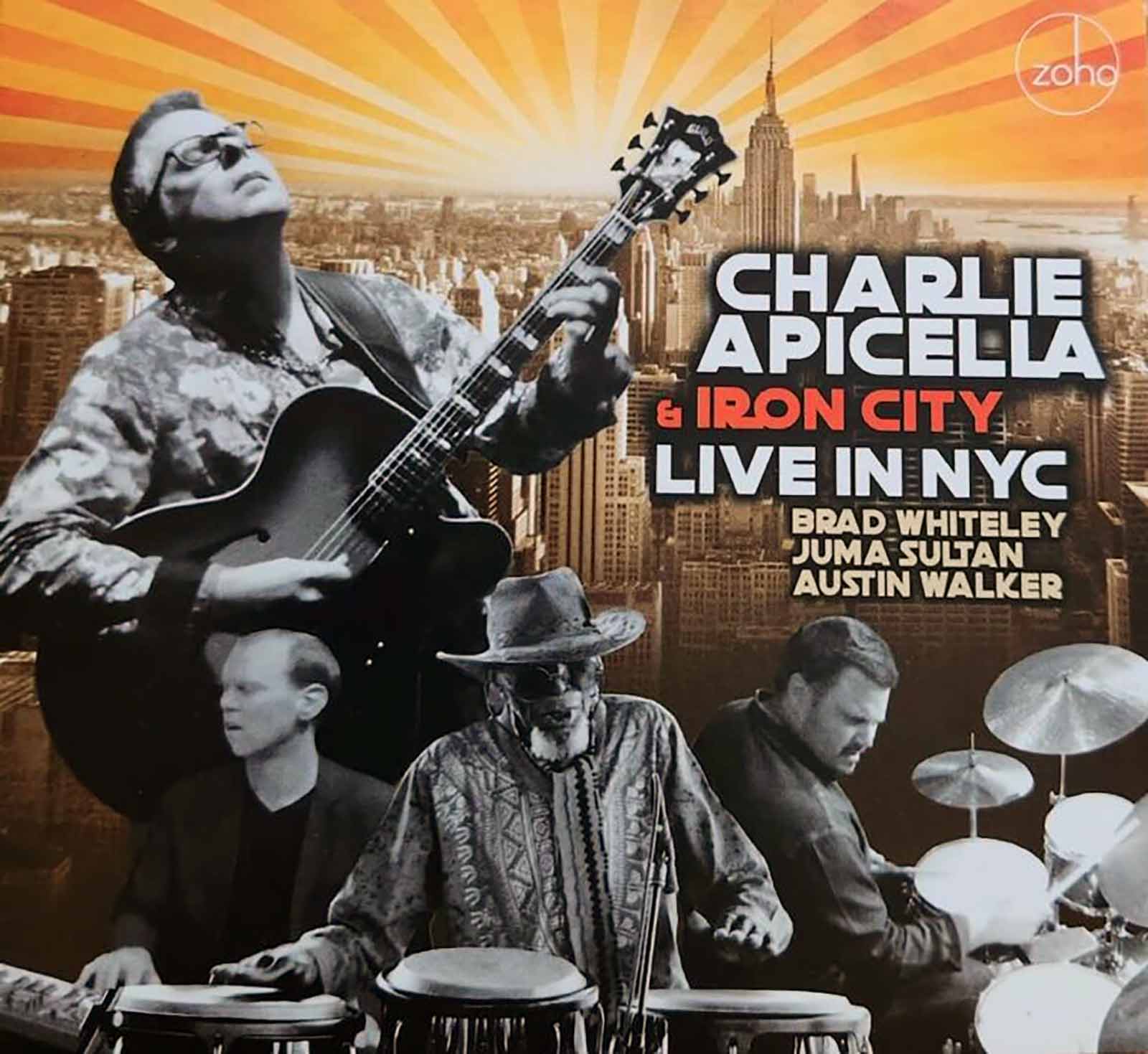
Charlie Apicella’s Live in NYC: Where Blues and Jazz Meet Without Borders
Recorded in New York City, where jazz history and reinvention constantly collide, Live in NYC captures guitarist Charlie Apicella at a moment of synthesis. In a musical landscape saturated with virtuosos and stylistic hybrids, this album stands out not by volume or spectacle, but by clarity of voice. It is, quite simply, one of the most effective ways to understand who Apicella is as a musician.
There are, after all, so many musicians on planet Earth that an alien could easily lose its head, and in doing so, overlook an artist like Charlie Apicella. Until recently, my own awareness of his work came largely through DownBeat readers, who placed him at numbers 84 and 86 in the magazine’s annual polls. But credentials begin to accumulate quickly: Apicella is a lecturer and curator for the Yusef Lateef estate; he has collaborated with institutions such as Lincoln Center, Vanderbilt University, Williams College, and the Newport Jazz and Folk Festival Foundation; and he has recorded or shared the stage with artists including Dave Holland, Sonny Fortune, John Blake Jr., and Avery Sharpe. When an album like Live in NYC finally lands in your hands, closer attention becomes unavoidable.
That attention is immediately rewarded. The album opens with a reworking of “Oye Como Va,” and from the first notes it is clear that Apicella has no interest in retracing the path laid down by Carlos Santana. Instead, he moves decisively into another register, one defined by detail, restraint, and a finely calibrated guitar touch that feels entirely his own. The performance navigates the space between blues and jazz, occasionally recalling the supple precision associated with artists like Keb’ Mo’, where looseness and control coexist without tension.
As a young guitarist, Apicella had the opportunity to meet his idol, B.B. King, who offered him guidance and shared stories that appear to have left a deep imprint. That influence surfaces most clearly in “Remembering B.B. King,” a tribute that avoids mimicry and instead channels a sense of respect and continuity. It feels less like a quotation than a conversation across generations.
What makes Live in NYC particularly compelling is Apicella’s comfort inhabiting two traditions at once. Blues and jazz are not treated as opposing forces or marketing labels, but as complementary languages. Only two tracks on the album are drawn from other artists, and even those selections may evoke memories of recordings from the 1970s and 1980s.
Apicella’s playing remains consistently elegant, and before long the question of genre recedes entirely. What takes its place is substance.
Beneath the album’s accessibility lies a surprising degree of structural complexity. This is music that depends on near–Swiss-watch precision; without it, such hybrid forms can easily collapse into pleasant but forgettable background sound. Here, that risk is avoided. Apicella demonstrates a sharp sense of composition and arrangement, placing each note with intent, achieving maximum expressive effect without excess.
The album also arrives at a moment when this kind of synthesis feels especially relevant. As contemporary audiences rediscover the value of live performance and push back against rigid stylistic boundaries, Live in NYC feels aligned with a broader movement, one that favors fluency over purity and depth over categorization. The setting oscillates between the intimacy of a club and the openness of a festival stage. A Hammond organ anchors the sound in tradition, while rhythms slip effortlessly between Latin, blues, soul, and jazz, creating a sense of motion that never feels forced.
Above all, this is an album of pleasure. Apicella pays homage not only to B.B. King but also to Jimi Hendrix, again without imitation. What he offers instead is perspective, his own way of reframing their influence through a contemporary lens. The result is a rare recording, capable of drawing in devoted blues listeners and committed jazz fans alike. For those accustomed to highly cerebral or densely complex music, Live in NYC also provides something quietly restorative: depth without heaviness, sophistication without strain.
It is worth noting that Charlie Apicella has also released two albums with OA2 Records—Groove Machine (2018) and The Griot Speaks (2022)—both available HERE.
In the end, Live in NYC succeeds because it refuses to choose sides. It is an album built on balance, between tradition and individuality, complexity and ease, reverence and originality, and in doing so, it brings Charlie Apicella sharply into focus.
Thierry De Clemensat
Member at Jazz Journalists Association
USA correspondent for Paris-Move and ABS magazine
Editor in chief – Bayou Blue Radio, Bayou Blue News
PARIS-MOVE, January 29th 2026
Follow PARIS-MOVE on X

::::::::::::::::::::::::
Musicians :
Charlie Apicella, guitar
Brad Whiteley, organ
Juma Sultan, congas
Austin Walker, Dream
Track Listing :
Oye Como Va
Lemond Rind
B.B King
Idris
64 Cadillac
Remembering Jimmy Hendrix
Big Boss
Can’t Help Falling In Love
Sparks