| Jazz |
Trappings of Sleep: Caroline Davis, Grey McMurray, and Qasim Naqvi in the Art of Composing the Unseen
There are mornings when the world takes a little longer to come into focus. The first rays of sunlight find their way into the studio, touching familiar objects without quite revealing them. Everything is in its place, and yet everything seems momentarily suspended: the instruments, the furniture, the silence between two sounds. Listening to Trappings of Sleep in that state of mind, I found myself drawn into an atmosphere that felt less like the beginning of a conventional jazz record than the opening sequence of a film. There was something of David Lynch in the experience: the familiar made strange, the ordinary charged with an inexplicable presence, a quiet tension suggesting that something is about to happen without ever telling us exactly what.
The music of Caroline Davis, Grey McMurray, and Qasim Naqvi inhabits precisely that uncertain territory. It does not announce itself. It invites us in, asking us to adjust our ears and accept that the most significant events may occur almost imperceptibly. Released on October 30, 2026, Trappings of Sleep brings together alto saxophone, electric guitar, electronics, and drums. Yet such a description, however accurate, says little about the experience of listening. What matters is not simply the combination of instruments, but the way three musicians create a shared environment in which sound can emerge, recede, mutate, and return in unexpected forms.
The trio did not begin with a carefully designed project or an elaborate artistic manifesto. Its origins were more informal: a performance in a Brooklyn bar, where three musicians, already familiar with one another through New York’s experimental and improvised music community, discovered an immediate musical connection. There was no grand declaration of intent, no predetermined aesthetic to defend. There was simply the recognition that these distinct musical personalities could listen to one another in a particularly fertile way. Over time, whenever their schedules allowed, they returned to that connection, gradually developing a common language without forcing it into a fixed identity.
That history is audible throughout the album. These musicians do not sound like three individual artists negotiating their respective territories. They sound like people who have learned to recognize one another’s gestures before those gestures have fully taken shape. A guitar texture suggests a direction that the drums subtly redirect; a saxophone phrase opens a space that neither of the other instruments rushes to fill. The result is music built as much on anticipation as on action. Silence, hesitation, and the possibility of interruption become active elements of the composition.
A decisive moment in the making of Trappings of Sleep came in 2025, during a performance in the Jazz Vespers series at Saint Peter’s Church in New York. The trio explored Alice Coltrane’s Journey to Satchidananda in a setting whose acoustics became part of the musical experience. Saint Peter’s is not simply a room in which music happens. Its resonant architecture changes the behavior of sound. Notes linger; decay becomes part of the musical material; the distance between an instrument and its reflection seems to expand. In such a space, the musicians were encouraged to think beyond the immediate attack of a note and consider what remained after it had been played.
The encounter with Alice Coltrane’s music was equally significant. Journey to Satchidananda is an album in which repetition, spiritual concentration, and a distinctive sense of musical time become inseparable. Its influence here should not be understood as imitation. Rather, it offered a point of departure, an invitation to consider how a musical idea might unfold without being hurried toward a conclusion. The trio approached that possibility through its own sensibility, attentive to the relationship between sustained sound, rhythmic motion, and the freedom that emerges when musicians trust the space around them.
After the performance, Qasim Naqvi shared a recording with producer Sun Chung. That document became the starting point for a studio project. Chung recognized something compelling in the trio’s unspoken rapport: a musical relationship with its own internal logic, yet still open to surprise. The invitation to make an album did not mean transferring the spontaneity of the performance into a more rigid framework. It meant finding a way to preserve that freedom while giving it compositional form.
Each musician contributed original material. The pieces were written individually before the trio came together to rehearse, but the writing was deliberately left open. The goal was not to reproduce a finished score with absolute precision at every turn. It was to create forms capable of changing under the pressure of performance, compositions that could serve as meeting places rather than instructions. This distinction is central to the album. The music has shape, but it never feels imprisoned by it. It knows where it is going without pretending to know everything that might happen along the way.
Caroline Davis brings to the project a musical imagination that has consistently resisted narrow definitions of jazz. A saxophonist, composer, electronic musician, and activist based in Brooklyn, she has developed a practice in which technical curiosity and social engagement coexist. Her work moves between contemporary improvisation, composition, electronic sound, and a wide range of collaborative contexts. She has performed with an impressive range of musicians while maintaining a body of work that reflects a distinct artistic identity.
Davis’s approach to the alto saxophone is particularly well suited to this trio. Her sound can be direct and sharply articulated, but it can also become almost weightless, a line that seems to hover rather than advance. She understands that an instrument need not occupy the foreground simply because it is capable of doing so. At times, her playing appears to emerge from the surrounding texture; at others, it cuts through with a clarity that changes the balance of the entire piece. Her use of electronics further complicates the distinction between acoustic gesture and constructed environment. The saxophone is not merely a voice placed on top of the music. It becomes part of a shifting field of sound.
There is also a broader dimension to Davis’s artistic practice. Her work has been connected to initiatives addressing gender equity in music and to projects supporting incarcerated people and those seeking creative opportunities beyond prison walls. These commitments are not decorative additions to an artistic biography. They reflect a belief in music as a means of connection, a practice capable of opening spaces that institutions and social conventions often keep closed. In Trappings of Sleep, that sensibility finds an aesthetic counterpart: an insistence that listening requires openness, attention, and a willingness to reconsider boundaries.
Grey McMurray occupies a different but equally essential position within the trio. A guitarist, producer, and singer, he has worked across a remarkably varied musical landscape, collaborating with artists from Gil Scott-Heron and Meshell Ndegeocello to Tyondai Braxton, So Percussion, and John Cale. His playing has a quality that is particularly valuable in music built around interaction: he can be unmistakably present without becoming intrusive. Knowing when not to dominate can be as important as knowing when to take the lead.
McMurray’s guitar does not function as a conventional harmonic anchor. Its role is more elusive. A chord appears as a brief architectural suggestion; a melodic fragment dissolves into texture; an electric sound hovers somewhere between a recognizable guitar and something more abstract. He seems less interested in establishing a stable landscape than in altering the atmosphere of the one already there. His contribution gives the trio a distinctive sense of depth, sometimes delicate, sometimes unsettling, often difficult to locate precisely.
Qasim Naqvi, meanwhile, brings an understanding of rhythm that extends well beyond the conventional responsibilities of a drummer. Known in part for his work with the minimalist trio Dawn of Midi, he is also a composer and synthesist whose projects have crossed the worlds of film, dance, installation, chamber music, and orchestral composition. This breadth of experience helps explain the unusual role he plays in Trappings of Sleep.
Naqvi does not simply provide the rhythmic foundation. He shapes the movement of the music, sometimes through a clearly defined pulse, sometimes by withholding it, sometimes by creating the impression that time has slipped slightly out of alignment. His drumming can be precise without sounding mechanical, active without becoming insistent. The drums are not there to settle the music into a predictable pattern. They make its movement more complex, creating the conditions in which the other musicians can take risks.
The album’s title offers another way into its world. It comes from a memory recalled by McMurray: half-asleep in a large hotel conference room, listening to a lecture about sleep delivered by a speaker he could barely see. The situation was ordinary, almost absurd. Yet the words and repetitions of the lecture began to take on a different quality as fatigue blurred the boundaries between attention and unconsciousness. What had been intended as an explanation of sleep became, in that half-waking state, something stranger and more open-ended.
The anecdote is more than a curious origin story. It captures something essential about the album’s atmosphere. Trappings of Sleep is concerned with the unstable frontier between awareness and disappearance, between what we can identify and what remains just beyond our grasp. Its nine compositions seem to inhabit different stages of that transition. Some are alert and searching; others drift, circle, or momentarily lose their bearings. The music does not attempt to illustrate sleep. It explores the peculiar logic of a mind that is still listening even as it begins to let go.
The opening track, “Three,” establishes this sensibility without offering a conventional introduction. It feels like an invitation into a space whose dimensions are not immediately clear. “Out of the Way of It” continues the exploration, suggesting movement without insisting on a destination. “Mono Lake” allows the trio to inhabit a particular atmosphere rather than simply pass through it. The music seems to widen, as if the instruments were gradually discovering the proportions of the room around them.
The title track turns inward. Its phrases unfold with a measured, suspended quality, resisting the expectation that every gesture must lead to a clearly defined resolution. “The Toy” introduces another kind of play, though the word should not be mistaken for lightness or simplicity. There is a curiosity here, an interest in the way musical objects can be handled, transformed, and made unfamiliar. “Say It” and “Media Training” further complicate the relationship between expression and structure, between what is communicated and what remains unresolved.
“Pulse,” composed by Davis, brings another perspective to the album’s exploration of time. Its title might suggest a return to rhythm’s most fundamental function, but the trio is not interested in reducing music to a simple heartbeat. Pulse can be a physical sensation, a point of reference, or something that becomes perceptible only when it is interrupted. The final piece, “Joust,” brings the record to a more charged conclusion. Its interplay has a sharper edge, a sense of confrontation and movement, but the music remains governed by the principle that has shaped everything before it: no gesture exists in isolation. Every action changes the conditions for the next one.
The album was recorded on May 23 and 24, 2025, at The Bridge Studio in Brooklyn. Amon Drum and Greg Tock handled the recording, Rick Kwan mixed the album, and Taylor Deupree mastered it. Sun Chung produced the session. These details matter because the album’s identity depends on a careful balance between clarity and atmosphere. The instruments remain distinct, yet their sounds interact in ways that make the boundaries between them feel porous. The production does not impose an artificial sense of grandeur. It gives the music room to breathe.
What emerges is a record that challenges one of the most persistent assumptions about improvisation: that freedom is necessarily the opposite of structure. In Trappings of Sleep, the two are not opposing forces. Composition provides a framework, but one designed to remain permeable. Improvisation does not destroy the written material; it tests it, stretches it, and reveals possibilities that may not have been apparent when the pieces were first conceived. The musicians are not trying to escape form. They are trying to keep it alive.
This is also why the trio’s long-standing relationship matters. Its music depends on a level of trust that cannot be manufactured in a single rehearsal. Listening becomes a form of shared memory. Each musician responds not only to what is being played in the present, but to what has already happened between them, to gestures and decisions accumulated over years of collaboration. The music can therefore move with remarkable economy. A small shift in the guitar, a change in the pressure of the drums, a saxophone phrase left unresolved: each can alter the direction of the ensemble.
There is something particularly compelling about this approach in the context of New York’s experimental music scene, where artists have long moved between jazz, contemporary composition, electronic music, and other forms of creative practice. The most interesting work often emerges not from combining genres as if they were ingredients in a recipe, but from refusing to accept that those categories should determine what music can become. Davis, McMurray, and Naqvi share that refusal. Their backgrounds are different, their musical vocabularies distinct, but the album does not turn those differences into a catalogue of individual achievements. It makes them part of a common language.
That language is not always immediately accessible, and this is one of the record’s strengths. Trappings of Sleep does not reward passive listening. It asks for attention, but not the kind that seeks to identify every technical detail or follow a predetermined narrative. It asks us to remain present, to accept uncertainty, to hear the spaces between events as carefully as the events themselves. There are moments when the music seems to withdraw just as we think we have understood it. Then a new sound appears, changing the meaning of what came before.
Perhaps that is why the album feels so close to the experience of waking from a dream. We remember fragments, sensations, a particular light, the emotional residue of something whose details have already begun to disappear. The mind tries to reconstruct a sequence, but the sequence resists. What remains is not a story in the conventional sense, but a state of perception. The music operates in much the same way. It leaves traces rather than explanations.
When I return to those first rays of sunlight in the studio, I realize that the opening image was not simply a way of entering the album. It was already part of its subject. There is a moment, just before the day becomes fully visible, when the world seems to exist between two states. Nothing has disappeared, but nothing has quite settled into place. Trappings of Sleep occupies that interval. Its music is neither fully awake nor entirely surrendered to the dream. It moves between the two, finding in that movement a remarkable freedom.
Perhaps the most revealing image is not that of a dream, but of a comma. A comma does not end a sentence. It suspends it, opens a small space, and allows the thought to continue in another direction. It creates time without bringing language to a halt. In this trio’s music, that suspension becomes an aesthetic principle. A phrase does not have to conclude when expected; a rhythm can pause without losing its force; a sound can linger long enough to become something else.
The comma, in other words, becomes the work itself. It is the space in which the musicians meet, the interval in which listening turns into invention. By the time the final notes of Trappings of Sleep have faded, what remains is not the satisfaction of a neatly closed statement, but the sense that something is still unfolding somewhere beyond the recording. The album ends. The listening does not.
Thierry De Clemensat
Member at Jazz Journalists Association
USA correspondent for Paris-Move and ABS magazine
Editor in chief – Bayou Blue Radio, Bayou Blue News

PARIS-MOVE, November 6th, 2026
Follow PARIS-MOVE on X
::::::::::::::::::::::::
Musicians:
Caroline Davis: alto saxophone, electronics
Grey Mcmurray: electric guitar
Qasim Naqvi: drums
Track Listing:
Three – 5:05
Out of the Way of it – 4:02
Mono Lake – 7:43
Trappings of Sleep – 4:30
The Toy – 4:44
Say it – 4:16
Media Training – 3:58
Pulse – 4:00
Joust – 6:17
Recorded: May 23-24, 2025
The Bridge Studio, Brooklyn NY
Engineer: Amon Drum, Greg Tock
Mix engineer: Rick Kwan
Mastering: Taylor Deupree
Photos: IJ Biermann
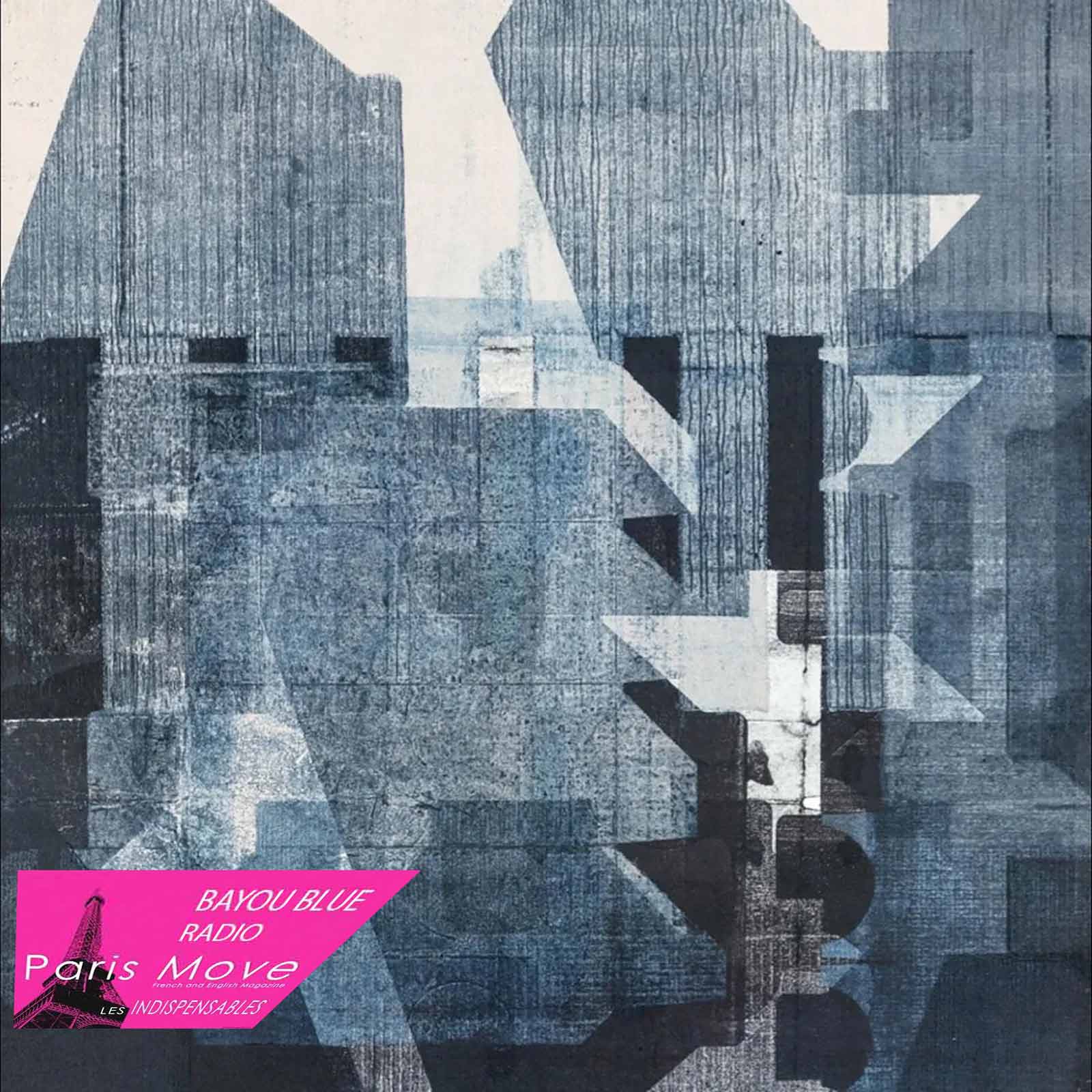
Cover Art: Laura Charlton
Design: Matthew Appleton
Produced by Sun Chung