| Jazz |
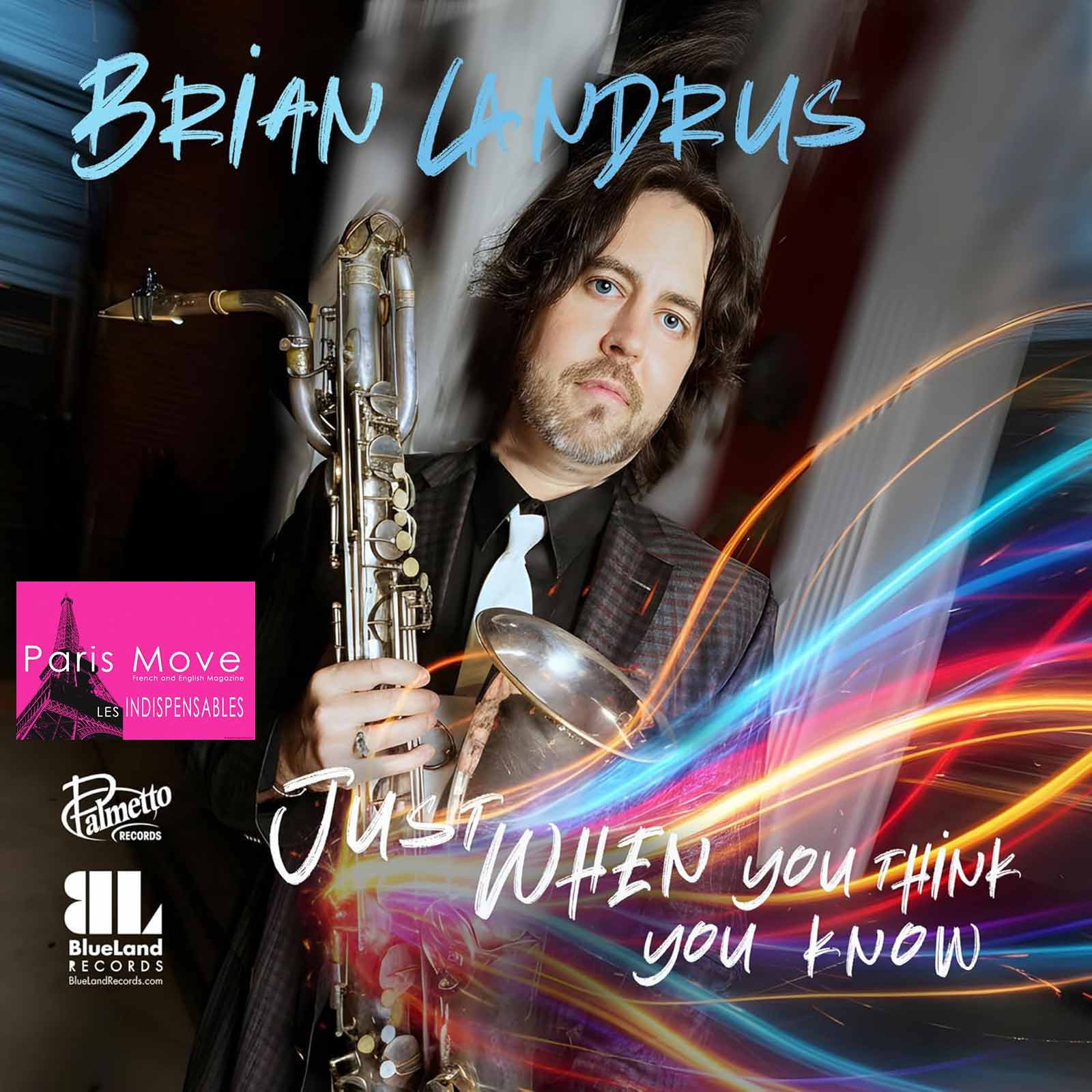
An explorer of low-register sonorities and a composer with an ear tuned as much to architecture as to atmosphere, Brian Landrus has steadily built a body of work that resists easy categorization. On Just When You Think You Know, he advances that trajectory with a recording that is less a stylistic pivot than a deepening, harmonically denser, orchestrationally more refined, and compositionally more integrated than much of his earlier output.
Landrus’s melodic sensibility, long shaped by the lyric expansiveness of Duke Ellington, manifests here not in imitation but in structural thinking. Ellington’s influence can be heard in Landrus’s approach to voicing: chords are rarely presented as block harmonies. Instead, they unfold in layered registral strata, often anchored by the baritone saxophone or bass clarinet in the lower tessitura, with upper voices entering in staggered motion. The result is a floating verticality, harmony that feels suspended rather than stacked.
Harmonically, the album leans into extended tertian structures and modal interchange, but with a notable preference for ambiguous tonal centers. Several pieces pivot around pedal points in the low winds, allowing upper instruments to cycle through shifting harmonic colors, Lydian inflections giving way to darker Dorian or Aeolian textures. Landrus frequently employs nonfunctional harmonic motion: parallel planing in the inner voices, chromatic mediant relationships, and subtle reharmonizations that destabilize the listener’s expectation of cadence. The effect is expressionist without veering into abstraction.
Orchestration is central to the album’s impact. Writing specifically for this ensemble, Landrus demonstrates an acute understanding of instrumental character. The baritone saxophone does not simply provide weight; it often operates as a counter-melodic engine, its grainy resonance offsetting brighter timbres above. The bass clarinet, by contrast, is deployed for its pliancy, capable of both velvety legato lines and incisive rhythmic articulation. Flute passages are rarely ornamental; they function as timbral light sources, cutting through denser textures with a transparent clarity.
In ensemble passages, Landrus favors contrapuntal interplay over unison power. Lines intersect, diverge and recombine, suggesting an affinity with chamber music traditions as much as with jazz big band writing. One hears, at times, echoes of contemporary orchestral jazz, the expansive palette associated with his earlier large-scale project Generations, but compressed here into a more intimate, flexible format. The rhythmic language, too, is elastic. Grooves emerge and recede. Funk-derived syncopations surface in the rhythm section, only to dissolve into rubato passages that feel almost through-composed.
There are moments where the music recalls the textural explorations of modern large-ensemble jazz composers, yet Landrus’s voice remains distinct in its emphasis on low-frequency warmth. Where some contemporary writers privilege brightness and density, he leans into depth, cultivating a sonic floor from which harmonic color can bloom. The interplay between bass instruments and percussion often produces a subtle polyrhythmic undercurrent, lending propulsion without overt display.
“Dear Fred,” written in memory of a friend who died in 2024, serves as both emotional and structural centerpiece. The composition begins with spare voicings, open intervals, sustained tones in the lower winds, before gradually introducing richer harmonic extensions. The melody, deceptively simple, is harmonized with shifting inner voices that alter its emotional shading with each recurrence. By the final statement, the theme feels transformed, not through virtuosic embellishment but through cumulative harmonic weight. It is a study in restraint, and in the expressive potential of orchestral shading.
Throughout the album’s fourteen tracks, Landrus demonstrates a composer’s patience. Themes are introduced economically, developed through variation rather than repetition, and often refracted through changes in instrumentation. A motif stated on baritone saxophone may reappear on flute, reharmonized and rhythmically displaced. This technique not only reinforces cohesion but underscores Landrus’s identity as a multi-instrumentalist who understands each instrument from the inside out.
The record’s stylistic hybridity, touches of fusion, hints of world-music rhythmic cycles, occasional funk undertones, never feels additive or cosmetic. Instead, these elements are integrated at the compositional level. Rhythmic cells migrate across sections; harmonic frameworks accommodate modal inflections drawn from non-Western traditions without exoticism. The result is music that feels globally aware yet structurally rigorous.
Landrus has long been recognized by critics at publications such as DownBeat and JazzTimes, and the praise that greeted earlier projects positioned him as a forward-thinking orchestrator. Just When You Think You Know reinforces that reputation while narrowing the lens. It is perhaps his most distilled statement: a work where harmonic sophistication, orchestral nuance and personal expression converge.
If the album suggests anything, it is that Landrus views jazz not as a fixed idiom but as a permeable framework, one capable of absorbing classical coloration, modal ambiguity and rhythmic hybridity without losing its core identity. The music respects the tradition’s past even as it refracts it through a contemporary prism. And in doing so, it confirms Landrus as a composer who understands that innovation often lies not in abandoning form, but in deepening it.
Thierry De Clemensat
Member at Jazz Journalists Association
USA correspondent for Paris-Move and ABS magazine
Editor in chief – Bayou Blue Radio, Bayou Blue News
PARIS-MOVE, February 27th 2026
Follow PARIS-MOVE on X

::::::::::::::::::::::::
Musicians:
Brian Landrus – baritone & tenor saxophones, bass and contralto clarinet, flute, alto flute, & bass flute
Zaccai Curtis – piano, Rhodes, keyboards
Lonnie Plaxico – acoustic and electric bass
Rudy Royston – drums and percussion
John Kilgore – recording and mixing engineer and producer
Alan Silverman – mastering engineer
Track Listing:
All In Time
Continuance
Untold Story
One Year
Dear Fred
Averse
El Perro Sigma
Beyond
Trance
From The Night
Just When You Think You Know
Under Dark
Something Special
Paroxysm