| Jazz |
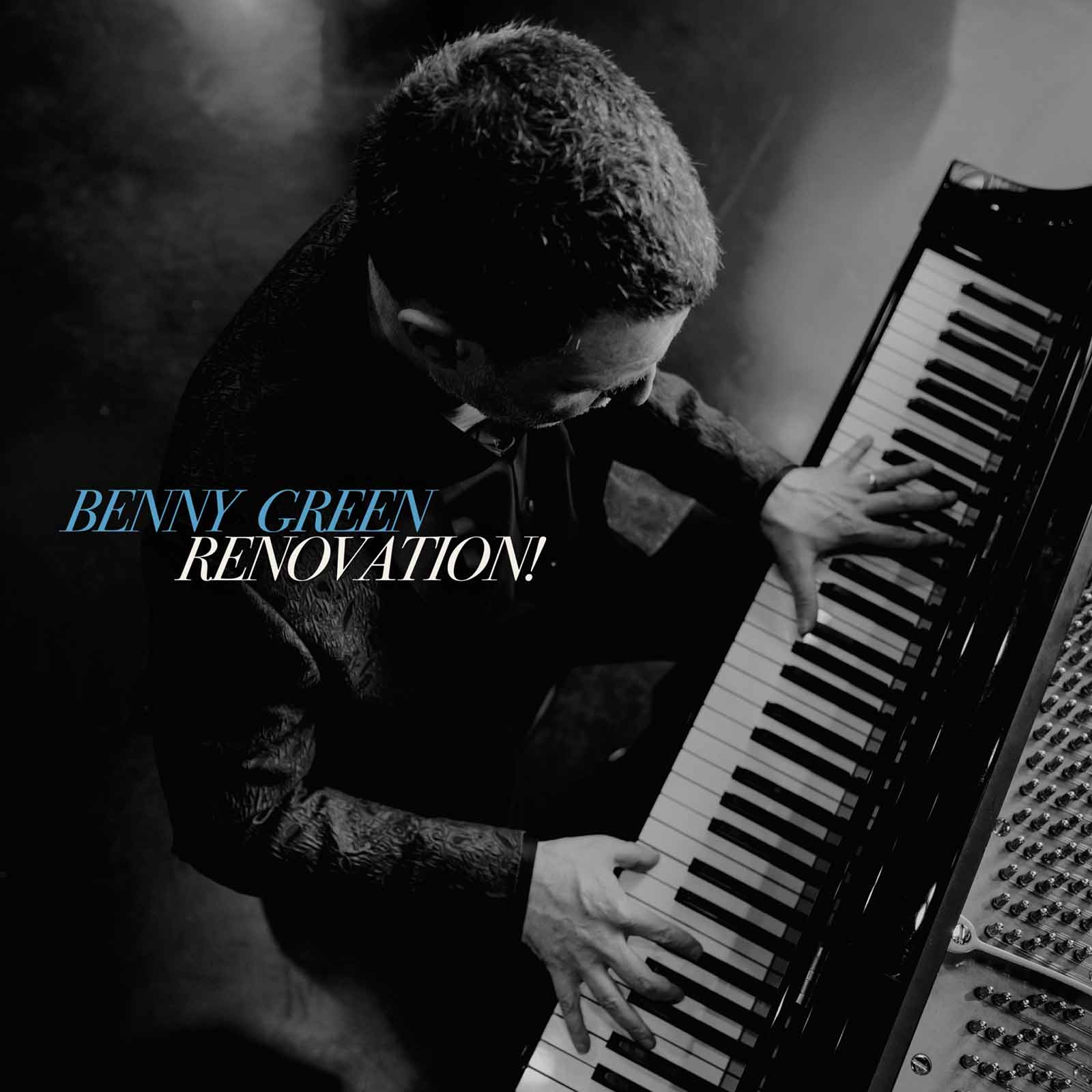
Summary: Benny Green’s Renovation! is a powerful live solo piano album that blends jazz tradition, virtuosity and personal freedom while paying tribute to the musicians who shaped his remarkable career.
Benny Green’s Renovation!: A Bold Solo Piano Journey Through Jazz History
Benny Green has spent most of his career proving that he belongs in the company of jazz’s great piano tradition. With Renovation! he does something considerably more interesting: he asks what happens when a pianist who has spent decades inside the classic jazz trio finally removes the trio altogether. The answer is not a display of virtuosity for its own sake. It is a confrontation, intimate and demanding, between a musician and his instrument. Green is alone at the piano, performing live, without a bassist to reinforce his harmony, without a drummer to shape his time and without another musician to absorb the pressure of a sudden change in direction. Every decision is exposed. Every rhythmic idea has to carry its own weight. That makes Renovation! one of the more revealing statements of Green’s long career.
Recorded live at Dizzy’s Club in New York, the album represents a particularly important moment for a musician whose professional life has been largely defined by collaboration. For more than four decades, Green has worked extensively within the piano, bass and drums format, one of the fundamental structures of modern jazz. Here, however, he deliberately removes two thirds of that equation. What remains is not an empty space but an enormous field of possibilities. The piano has to provide the harmony, rhythm, melody and momentum, while Green simultaneously becomes accompanist, soloist, arranger and storyteller. It is an almost unreasonable amount of responsibility to place on one musician, which is precisely why the performance is so revealing.
The title Renovation! feels particularly appropriate because Green is not abandoning his musical past. He is rebuilding it. The materials are all there: blues, swing, standards, the rhythmic vocabulary of the Jazz Messengers, the elegance of Oscar Peterson and the long history of jazz pianists who learned to make one instrument sound like an entire ensemble. But Green rearranges those materials according to his own logic. He does not treat tradition as something to be preserved behind glass. He treats it as something alive, something that can still be taken apart, examined and reconstructed.
Oscar Peterson is inevitably part of that conversation. Green was one of Peterson’s protégés, and the older pianist’s influence can be heard in Green’s extraordinary command of the keyboard, his rhythmic confidence and his refusal to separate technique from musical expression. Yet listening to Renovation! simply as an extension of Peterson’s legacy would be to misunderstand what Green has accomplished. Peterson is one of the voices in the room, but he is not the only one, and he certainly does not have the final word. Green has spent decades absorbing influences from across the history of jazz piano and turning them into a language that is unmistakably his own.
That language becomes especially powerful when the music is stripped down. In an ensemble, even the most adventurous pianist is constantly negotiating with other personalities. A bassist may respond to a harmonic change, a drummer may alter the pulse, a horn player may introduce a new phrase. Solo piano removes that negotiation. Green can change direction at the exact moment he feels the impulse to do so. He can stretch a phrase, interrupt it, accelerate, slow down or suddenly introduce a completely different harmonic idea without having to signal anything to anyone else. The freedom is absolute, but so is the responsibility.
Green has explained that the isolation of the 2020 lockdown gave him an unexpected opportunity to rethink his relationship with solo piano. After decades of working primarily with trios, the enforced solitude allowed him to explore what he describes as the vast freedom of playing alone. His observation is more profound than it may initially sound. Without the particular chemistry of musical partners, which is always subjective and dependent on the people involved, Green could explore every musical direction without having to communicate spontaneous changes to another player. The piano became not merely an instrument but a space in which he could think aloud.
That idea is at the center of Renovation! Green is not simply taking familiar compositions and decorating them with improvisation. He is examining what happens when a piece is reduced to its essential components and then rebuilt in real time. The process is almost architectural. A melody becomes a foundation, harmony becomes structure, rhythm becomes movement and improvisation becomes the process of changing the building while you are still standing inside it.
The history of Green’s relationship with Art Blakey makes this approach even more compelling. During his years with the Jazz Messengers, Blakey would occasionally silence the snare drum and send the other musicians offstage during a performance, leaving Green alone to play an extended piano medley. For a young musician, this was both an extraordinary challenge and an education in musical survival. Blakey was effectively asking Green to prove that he could occupy the entire stage by himself. Decades later, the experience seems almost prophetic. What was once an ordeal imposed by a bandleader has become a deliberate artistic choice.
The connection becomes even more striking when considering Green’s 1988 recording with the Jazz Messengers in Milan. Blakey gave him the opportunity to play “I’ll Never Be the Same,” a performance that became the only solo piano track in the Jazz Messengers’ recorded discography. Green had been listening to versions by Art Tatum and by Louis Armstrong with Oscar Peterson, and his choice emerged almost spontaneously. That small episode contains much of the story of Green’s musical development. He listens deeply to the past, but he does not remain there. He takes what he hears and uses it as raw material for something new.
“This Here,” Bobby Timmons’ blues waltz, is another moment when that history comes sharply into focus. The composition is deeply associated with the Jazz Messengers tradition, yet Green approaches it without turning the performance into a museum piece. The blues is unmistakable, but there is a looseness and sense of play in his interpretation that makes the piece feel freshly discovered. Green knows exactly where the music comes from, which gives him the confidence to move it somewhere else.
That confidence runs through the entire album. Green does not appear anxious about demonstrating his credentials. There is no sense that he is standing at the piano saying, look how much I know about jazz. Instead, he sounds like someone who has internalized so much musical history that he no longer needs to announce it. The references are there for listeners who recognize them, but they never become obstacles for listeners who do not. A knowledgeable jazz fan may hear Art Tatum, Cedar Walton, Hank Jones, Thelonious Monk, Oscar Peterson or the Blue Note tradition. Another listener may simply hear a pianist creating an extraordinarily rich musical world.
“Cedar Would,” his tribute to Cedar Walton, illustrates this approach particularly well. Green acknowledges one of the pianists who helped shape his understanding of the music, but he does not attempt to reproduce Walton’s sound. Instead, he shows what influence looks like after it has been processed by another musician. That is the difference between imitation and inheritance. Imitation reproduces the surface. Inheritance changes the person who receives it.
Green’s playing has always been marked by this ability to combine seemingly contradictory qualities. There is an almost classical discipline in his technique, but his phrasing remains deeply rooted in jazz. There is an intellectual complexity in his harmonic thinking, but the music rarely feels academic. There is extraordinary precision, yet there is also humor and spontaneity. He can play with astonishing speed without allowing speed to become the point. He can make a technically demanding passage sound conversational, almost casual, as though the difficulty exists only for the musician and not for the listener.
“Two Sleepy People” is particularly revealing in this respect. The performance demands a concentration that few pianists can sustain, yet Green does not allow that concentration to become stiffness. The music occupies a fascinating space between classical control and jazz freedom. Every note seems carefully placed, but the overall effect remains alive and unpredictable. That tension is one of the defining characteristics of Green’s playing.
His musical background helps explain it. Green began piano lessons as a child and was already performing professionally at a remarkably young age. His development brought him into contact with some of the most important musicians in modern jazz, including Betty Carter, Art Blakey, Freddie Hubbard and Ray Brown. Each represented a different musical education. Carter demanded sensitivity to phrasing and emotional nuance. Blakey demanded swing, authority and the ability to respond instantly. Brown represented one of the great traditions of bass and trio interaction. Peterson embodied a particular kind of pianistic command. Green absorbed all of these lessons without allowing any one of them to define him completely.
That accumulated history is audible in the solo format. When Green plays alone, he is not actually alone in a musical sense. His hands carry the memory of the musicians he has played with and listened to. His rhythmic decisions reflect decades of ensemble experience. His harmonic language carries the fingerprints of pianists from several generations. His sense of structure reflects the discipline of someone who has spent much of his life working inside demanding bands. The absence of other musicians therefore makes his history more audible, not less.
This is why it is tempting to argue that Green may actually be at his most revealing as a solo pianist. His musical personality is dense and highly developed, and the trio format necessarily imposes a degree of negotiation. That negotiation can be thrilling, but it also means that some of Green’s ideas have to coexist with the ideas of others. Alone, he has complete control over the narrative. He can allow an idea to expand until it becomes almost abstract or bring it back to a blues phrase in an instant.
There is also something deeply physical about his playing. Green is often described through the language of virtuosity, but that word can make jazz musicians sound like athletes when they are actually storytellers. What matters in Green’s case is not simply how many notes he can play or how quickly he can play them. It is the weight he gives those notes, the rhythmic placement, the harmonic tension and the sense of anticipation he creates. His technique matters because it gives him options. The technique is the vocabulary, not the story.
That distinction is crucial to understanding Renovation!. There are moments when Green’s hands seem almost impossibly busy, but the music never feels crowded for the sake of being crowded. There are other moments when he does surprisingly little, allowing a melody to breathe. The contrast gives the album its shape. Green understands that silence can be as important as sound, particularly when there is no rhythm section to fill the space.
The live audience adds another dimension. This is not the controlled environment of a studio session where a musician can stop, edit and begin again. The audience is present, listening and responding. Green has the freedom to react to that atmosphere, and that possibility introduces an element of risk. The performance therefore becomes a genuine event rather than simply a document of technical proficiency.
That intimacy is particularly important because solo piano can easily become self-indulgent. Without other musicians to interrupt or redirect the pianist, a performance can turn into a private monologue that happens to have an audience. Green largely avoids that problem because his sense of rhythm and melody remains fundamentally communicative. Even when the music becomes intellectually sophisticated, he never seems to forget that someone is listening.
There is warmth in the performances that prevents the album from becoming an exercise in pianistic archaeology. Green is clearly fascinated by the past, but he is not sentimental about it. He can honor the musicians who shaped him while maintaining enough distance to make his own choices. The result is a record that feels deeply informed by jazz history without sounding trapped by it.
That may be the most important thing about Renovation!. American jazz has always lived in the tension between tradition and reinvention. Every generation inherits a vocabulary and then has to decide what to do with it. Green is now at a point in his career where he can hear several generations at once. Instead of choosing between preservation and innovation, he demonstrates that the two can exist in the same performance.
His relationship with the piano is therefore less about mastery than about conversation. He has mastered the instrument long ago. The interesting question now is what the instrument allows him to discover about himself. The piano knows what it can do, as Harold Mabern Jr. famously suggested. Green’s challenge is to discover what he can do with it after a lifetime of listening to everyone who came before him.
Renovation! is consequently not just another solo piano album by an established jazz musician. It is a statement about artistic maturity. Green is no longer required to prove that he can play fast, swing hard or navigate complex harmony. Those abilities are assumed. What remains is the far more difficult task of deciding what deserves to be said. And Green has plenty to say.
There is history in this music, but there is also humor. There is intellectual rigor, but there is pleasure. There is reverence for the musicians who came before him, but there is no submission to them. Green carries Oscar Peterson, Art Tatum, Art Blakey, Cedar Walton and the larger history of jazz piano with him, but he does not disappear beneath their shadows. He has taken their lessons and made them part of his own internal language.
That is ultimately what makes Benny Green so difficult to place in a single category. He is a traditionalist who remains restless. He is a virtuoso who understands restraint. He is a historian who does not sound nostalgic. He is a musician deeply shaped by collaboration who has discovered an extraordinary degree of freedom in solitude.
Renovation! captures that contradiction beautifully. It sounds like a pianist looking backward and forward at the same time, listening to the entire history of jazz while refusing to become imprisoned by it. Green has spent his life learning how other musicians speak. Here, sitting alone at the piano, he finally has the luxury of speaking without interruption.
The remarkable thing is that the solitude never sounds empty. Green fills it with blues, swing, memory, technique, humor, discipline and invention. The piano becomes an orchestra, a rhythm section, a laboratory and a conversation partner. What begins as a solo performance gradually feels like a dialogue with an entire musical culture.
And perhaps that is the most convincing way to hear Benny Green today. Not simply as Oscar Peterson’s protégé, not simply as a former Jazz Messenger and not merely as a virtuoso pianist, but as an artist who has reached the point in his career where his influences no longer compete for attention. They have become part of him. Renovation! is what happens when a lifetime of listening is transformed into a language of its own.
Thierry De Clemensat
Member at Jazz Journalists Association
USA correspondent for Paris-Move and ABS magazine
Editor in chief – Bayou Blue Radio, Bayou Blue News

PARIS-MOVE, August 30th, 2026
Follow PARIS-MOVE on X
::::::::::::::::::::::::
Musician:
Benny Green: piano, compositions
Tracklisting:
- For Duke Pearson
- Constitutional
- Cedar Would
- This Here
- Hi-Fly
- Two Sleepy People
- Seoul Station
- Blues for Junior
- My Girl Bill
- The Night We Called it a Day
- Wiggin’
- Sophy’s Chant
- Ernie’s Uncle
Tour dates:
Sept 10-11 – SFJAZZ Ray Brown Centennial with Christian McBride and Gregory Hutchinson
Sept 17 – University of Tennessee Chattanooga
Sept 19-20 – Studio 176 sponsored by 88 Keys Productions (Philadelphia, PA)
Sept 22 – Jazz, TX (San Antonio, TX)
Sept 23 – Monks (Austin, TX)
Sept 25-26 – The Jazz Corner (Hilton Head, SC)
Sept 28-29 – University of Missouri, Kansas City
Sept 30 – Crystal Bridges (Arkansas)
Oct 1 – Keystone Korner (Baltimore, MD)
Oct 22-25 – Dizzy’s with Carl Allen Tribute to Jazz Messengers
Oct 31 – Scullers (Boston, MA)
Nov 1 – William Paterson with Carl Allen Tribute to Jazz Messengers
Nov 6 – University of New Hampshire
Nov 12-15 – Cotton Club Tokyo, Japan
Nov 19-22 – JazzCultural (NYC)
Nov 30 – Kuumbwa (Santa Cruz, CA)