| Jazz |
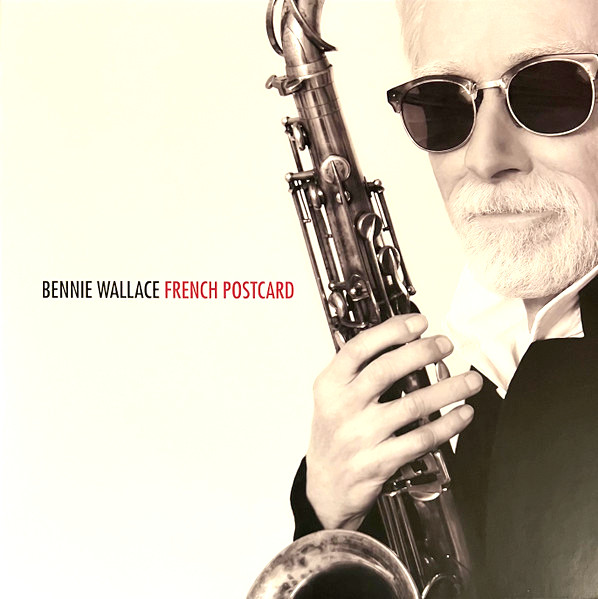
“All the music you will hear on this record is as it was played. Everybody in the room, playing live to analog tape, no edits. So, set your clock back to 1958, and I hope you enjoy this French Postcard.” – Bennie Wallace.
There are albums that we like. There are albums that we admire. And then there are albums that we appreciate, that we admire AND that we listen to and listen to again because they become essential to us. French Postcard belongs unequivocally to that last category.
This superb LP, the inaugural release of BackCountry Jazz Records, is much more than a collection of standards and original compositions. It is a love letter to the golden age of jazz recording, when musicians gathered in the same room, listened deeply to one another, and created music in real time, without technological intervention. Recorded live to two-track analog tape, mastered all-analog by Kevin Gray, and pressed on high-quality vinyl at RTI, French Postcard captures something that has become increasingly rare in modern music: authenticity.
From the first notes, the listener understands that this is not a typical contemporary jazz production. There is no artificial sheen, no excessive studio manipulation, no digital sterility. Instead, the sound is warm, rich, organic, and astonishingly lifelike. One can almost visualize the musicians standing together at New York’s Sear Sound studio. The air around the instruments is palpable. The acoustic space breathes naturally. The music feels alive.
Many audiophiles often describe certain digital recordings as “cold” or “metallic.” Whether one fully agrees with that assessment or not, French Postcard demonstrates beyond doubt what makes a great analog recording so seductive. The tenor saxophone possesses body and texture. The cymbals shimmer without harshness. The bass resonates with natural wood and string vibrations. The piano blooms beautifully into the room. Every instrument occupies its own space while remaining part of a cohesive whole.
Born in Chattanooga, Tennessee, Bennie Wallace has long occupied a unique place in modern jazz. Over a career spanning more than five decades, he has built a reputation as one of the most distinctive tenor saxophonists of his generation, capable of drawing inspiration from Coleman Hawkins, Lester Young, Sonny Rollins, and Ben Webster while always sounding unmistakably like himself.
Wallace has never been a musician interested in trends. Throughout his career he has pursued his own path, recording everything from adventurous originals to deeply personal interpretations of standards and tributes to jazz masters. What makes his playing so compelling is his ability to combine intellectual sophistication with emotional directness. Every solo tells a story.
On French Postcard his tenor saxophone sounds magnificent. Warm, expressive, lyrical, and occasionally playful, it serves as the album’s emotional centre.
Wallace has also an exceptional sextet. These are not merely excellent musicians; they are artists who have spent decades mastering the language of jazz. With the exception of vibraphonist Simon Moullier, the four musicians, Anthony Wilson, Donald Vega, Peter Washington and Herlin Riley, have long associations with Wallace and their complicity as well as their complementarity is strongly felt in this new album.
Bennie’s strength also lies in this ability to create both comfort and surprise. He does not offer us an ensemble of musicians based on virtuosity or spectacular effects. And this restraint is assumed, claimed. Bennie favors emotional coherence, and the record draws from it a form of continuous depth. Each musician listens, reacts and contributes fully, in a real dialogue with the others. Where many musicians allow an implicit hierarchy to emerge, the ensemble formed by Bennie and his musicians is based on a real equality of roles.
Anthony Wilson (guitar) is one of the most elegant guitarists in contemporary jazz, equally comfortable with swing, modern jazz, and sophisticated harmonic textures.
Simon Moullier (vibraphone) brings freshness and colour throughout the album. His vibraphone often functions like a second melodic voice, adding brightness and transparency to the ensemble.
Donald Vega (piano) contributes a masterclass in tasteful accompaniment and inventive improvisation. His touch combines power, lyricism, and swing.
Peter Washington (bass) remains one of the most respected bassists in jazz. His pulse is impeccable, his lines are melodic, and his presence anchors every performance.
Herlin Riley (drums), celebrated for his work with Wynton Marsalis and many others, provides the perfect balance of drive, elegance, and subtlety.
Together, these musicians do not simply accompany Wallace, they engage in continuous conversation with him.
But outstanding sound alone would mean little without great music. Fortunately, French Postcard is overflowing with it. The LP is beautifully balanced between timeless standards, popular classics, and Bennie Wallace originals.
With a traditional African-American spiritual, “Joshua Fit the Battle of Jericho”, the album opens with infectious energy. The ensemble immediately demonstrates its cohesion, while the analog recording captures every nuance of the performance.
“Srubie”, a Bennie Wallace original, is one of the album’s most personal moments. The composition combines memorable melodic ideas with ample space for improvisation.
Two tracks are Antônio Carlos Jobim’s covers: “How Insensitive” (on side A) and “Desafinado” (on side B). The performance captures the relaxed elegance at the heart of Brazilian music and the charismatic relaxed groove and elegant phrasing make these two tracks some of the album’s most seductive performances.
With “Handcuffs”, another Bennie Wallace original, we enjoy one of the adventurous tracks of the LP. The composition allows the ensemble to stretch harmonically and rhythmically while maintaining the album’s overall warmth and accessibility. Through this track we see Bennie’s gift as a composer, and his talent to offer us tracks that will span the ages and which will remain engraved in the history of jazz of this century.
Last track, “‘Round Midnight”, a famous Thelonious Monk’s composition, is a fitting conclusion to that fantastic album. Wallace approaches Monk’s immortal masterpiece with deep respect while bringing his own voice to the music. Monk’s music is not presented as a museum piece or a historical reconstruction. With Bennie she remains alive, more than ever, spontaneous and deeply human. Each note played by the musicians reminds us that jazz remains above all an art of transmission.
What makes French Postcard exceptional is not only the quality of the playing, nor even the superb analog sound. It is the feeling of trust. Trust between musicians. In an age where recordings can be endlessly edited, corrected, and manipulated, Wallace and his colleagues have chosen another path. They invite us into the room with them and ask us to experience jazz as a living, breathing art form. The result is a record that feels timeless.
French Postcard is not background music. It deserves careful listening. Put the LP on the turntable. Lower the stylus. Sit comfortably. Listen to the music and the space between the notes. Listen to the way the musicians react to one another. Listen to the warmth of the analog tape. Listen to the best that jazz has to offer!
French Postcard is a triumph, musically, artistically, and sonically.
One can only hope that BackCountry Jazz Records continues along this path and gives us many more vinyl releases of such extraordinary quality. If this magnificent LP is any indication of the label’s future direction, jazz lovers and audiophiles alike have every reason to be excited.
An absolute must-have for anyone who loves great jazz, great musicians, and great sound. One of the most striking and luminous jazz records of this year 2026, a work which deserves attention and repeated listening.
Frankie Pfeiffer
Editor in chief – PARIS-MOVE
PARIS-MOVE, June 22nd, 2026
Follow PARIS-MOVE on X
::::::::::::::::::::::::
Musicians :
Bennie Wallace: saxophone, tenor
Anthony Wilson: guitar
Simon Moullier: vibraphone
Donald Vega: piano
Peter Washington: bass
Herlin Riley: drums
LP Tracklisting:
Side A:
A1: Joshua Fit The Battle Of Jericho 4:23
A2: Srubie 6:31
A3: How Insensitive 5:50
A4: Tennessee Waltz 5:09
Side B:
B1: Handcuffs 6:59
B2: These Foolish Things 5:01
B3: Desafinado 6:32
B4: ‘Round Midnight 4:45
Recorded December 10 and 12, 2024 at Sear Sound, NYC
Produced by Bennie Wallace, Joe Harley
Recording Engineer: James Farber
Assistant Engineer: Steve Sacco
Executive-Producer – Alain De Coster, Cathy De Coster
Mastered by Kevin Gray
Album Design: John Sellards
Cover Photography, Design: Carol Friedman
Back Cover Photography by Jeanette Wallace
Liner Photography by Anna Yatskevich