| Jazz |
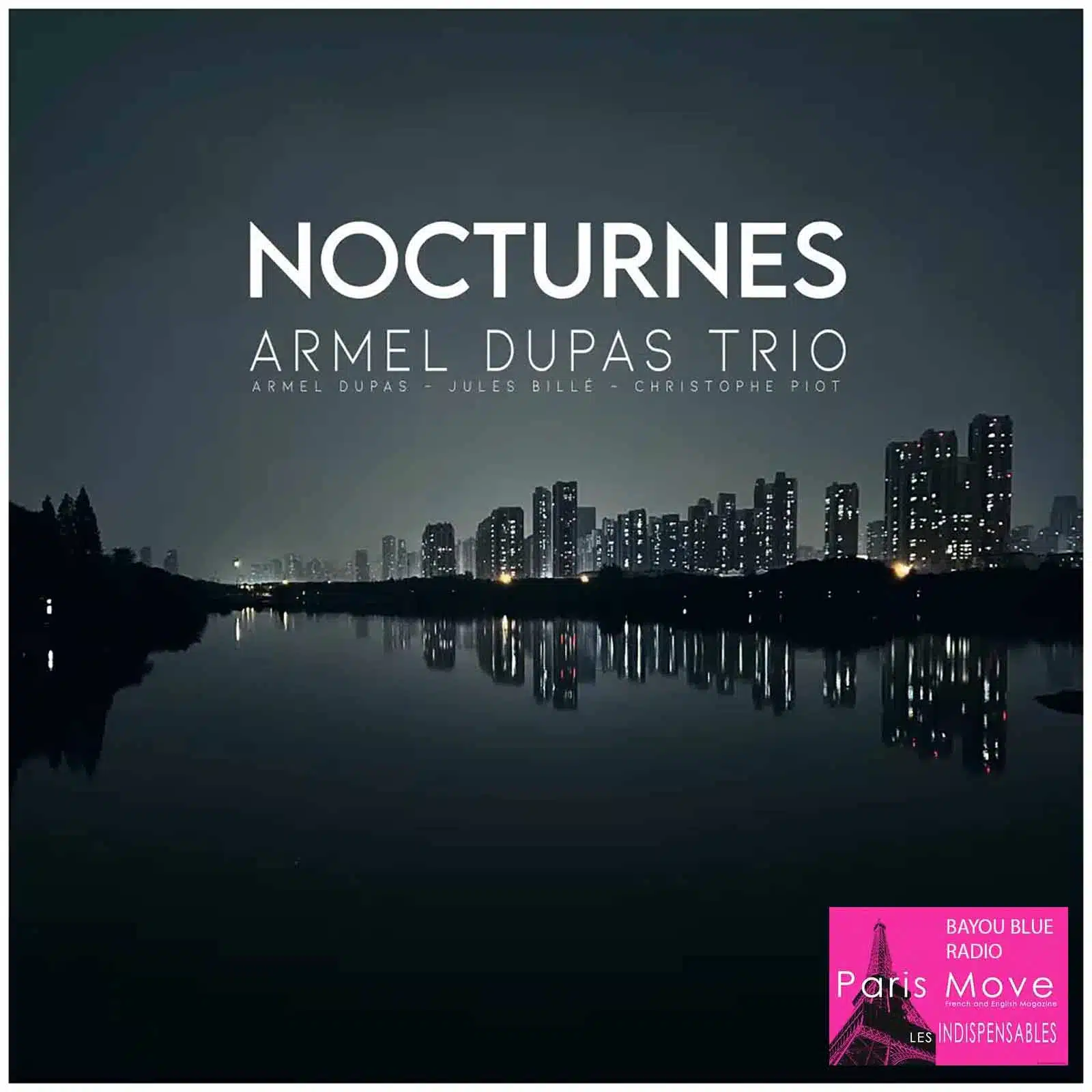
Summary: Pianist Armel Dupas and his trio explore the delicate balance of intimacy, reinvention and musical freedom on Nocturnes, an album that reaffirms the enduring power of lyrical jazz.
Nocturnes: Armel Dupas and the Quiet Art of Reinvention
When I left France a few years ago, I did so with a growing sense of disillusionment about the musical environment I was leaving behind. It was not a question of talent. France has no shortage of exceptional musicians, accomplished instrumentalists and composers with the imagination to stand alongside the best anywhere. What troubled me was the gap between that abundance of talent and the conditions under which artists were expected to create. Too often, the pressure to establish a name, secure bookings, attract attention and keep a career moving seemed to overshadow the more fundamental question of what a musician actually had to say. Albums increasingly felt like calling cards, carefully assembled demonstrations of competence designed to open professional doors rather than fully realized artistic statements. In a relatively small domestic market, where opportunities can be scarce and the same networks often determine who gets heard, the distinction between making music and making oneself visible can become uncomfortably blurred.
Since moving to the United States, I have discovered a cultural diversity that has changed the way I listen. Different traditions coexist, musical languages intersect, and artists draw on influences that do not always fit neatly into established categories. This diversity does not guarantee excellence, but it creates possibilities, encourages unexpected encounters and reminds us that music thrives when artists are free to move beyond familiar boundaries. Over time, I have come to value those musicians who release fewer records but have something unmistakably their own to express. They are not necessarily the most visible, and they may not always be the most prolific, but their work carries the conviction of an individual voice. Armel Dupas has long belonged to that category for me. His approach to the piano, his instinct for melody and his refusal to confuse musical substance with technical display have given his work a distinctive identity. With Nocturnes, recorded with bassist Jules Billé and drummer Christophe Piot, he brings that sensibility into particularly sharp focus. Across seven tracks, the trio develops a sound that is intimate without being insular, lyrical without becoming sentimental, and sophisticated without asking the listener to admire its sophistication. What emerges is not simply a collection of well-played compositions, but a carefully considered musical statement about memory, change and the possibility of finding calm without turning away from the complexities of life. The album rewards attention, but it never demands it. That distinction matters. Nocturnes trusts the listener to come closer, to follow the music at a natural pace and to discover its subtleties without being told what to feel.
From the opening measures of “Le Rescapé,” the trio establishes an atmosphere of quiet assurance. The rhythm section begins with a supple, finely shaded interplay that gives the music both direction and room to breathe. Christophe Piot’s drumming provides a sense of movement without imposing a rigid framework, while Jules Billé’s bass brings a depth and flexibility that immediately make it more than a supporting instrument. When Dupas enters on piano, he does not take over a musical space that has been waiting for its leader. He joins a conversation already underway, adding a melodic voice that changes the shape of the music without disturbing its balance. The effect is immediate. Rather than directing attention toward individual feats of technique, the performance draws the ear into the relationships among the instruments, into the small shifts of emphasis, the spaces between phrases and the way one musician’s gesture invites a response from another. This is the first indication of what makes Nocturnes so engaging. The trio does not operate according to the familiar hierarchy in which the pianist leads, the bassist anchors and the drummer keeps everything moving. Each musician contributes to the development of the music, and each remains alert to the possibilities opened by the others. The result is a collective voice that feels both deliberate and spontaneous. Dupas’s playing is central to this balance, but its strength lies in what it allows the music to become. His melodic lines have a natural clarity, and his harmonic choices introduce complexity without obscuring the emotional direction of a piece.
He knows when to develop an idea and when to leave it alone, when to let a phrase settle and when to move it somewhere unexpected. Such restraint can be mistaken for simplicity, particularly in a musical culture that often equates virtuosity with the sheer quantity of notes or the intensity of a performance. Yet the discipline required to make a complex musical idea sound inevitable is considerable. The finest musicians understand that not every possibility needs to be explored and that an expressive gesture loses something when it is made merely to attract attention. “Le Rescapé” succeeds because nothing feels superfluous. The arrangement has shape, the rhythm section remains alert to every shift in the piano line, and the music develops with a sense of purpose that never becomes mechanical. There is an almost physical quality to the listening experience, as though the sound were being shaped in the room rather than projected toward an audience. By the end of the opening piece, the trio has established the central principle of the album: the most compelling musical exchanges are not necessarily those in which each performer has the chance to stand out, but those in which individual voices become more expressive through their relationship with one another.
The felt piano around which Nocturnes was recorded plays a decisive role in shaping that relationship. Its softened attack and muted resonance give the instrument a particular intimacy, reducing the brilliance associated with a conventional concert grand and bringing the listener closer to the texture of each note. The effect is not merely atmospheric. It changes the way the music unfolds. Notes seem to emerge rather than announce themselves; chords retain their presence without overwhelming the surrounding space, and melodic phrases acquire a delicacy that does not diminish their emotional weight. The piano becomes less concerned with projection than with nuance, less interested in filling a room than in creating a space in which the smallest musical details can be heard. That choice might easily have resulted in an album whose appeal depended on a carefully cultivated mood, the kind of understated sound that can be mistaken for depth simply because it is quiet. Dupas avoids that trap by making the instrument’s distinctive timbre part of a broader compositional approach. The sound encourages him to reconsider the relationship between melody and silence, between a note and the resonance that follows it, between what the music states and what it leaves unresolved. As a result, the spaces around the notes become as important as the notes themselves. Billé’s bass can subtly redirect the harmony, Piot’s drums can introduce a shift in momentum, and the piano can respond without having to assert itself through volume or force. The entire ensemble benefits from this reduced sense of separation between foreground and background. One naturally thinks of Bill Evans, whose conception of the piano trio transformed the relationship between soloist and rhythm section, and of John Taylor, whose playing combined harmonic imagination with an unusually open approach to interaction. There are also affinities with the sonic sensibility associated with ECM, particularly its emphasis on clarity, atmosphere and the expressive possibilities of space. But these connections should be understood as part of a musical lineage rather than as evidence of imitation. Dupas is working within a tradition that has always depended on the ability to absorb influences and make them personal. Innovation in jazz does not necessarily require the invention of an entirely new language.
It can arise from the transformation of familiar elements, from a change in emphasis, a different sense of timing or a willingness to explore what happens when a musician gives an established form more room to breathe. Nocturnes finds its individuality in precisely this kind of transformation. Its sound is recognizable without being formulaic, and its lyricism emerges from the music rather than from a desire to create a particular emotional effect. The felt piano is not a decorative signature. It is the instrument through which the album establishes its distinctive relationship with time, texture and the listener.
The title Nocturnes suggests a world in which the pace of everyday life has slowed sufficiently for other kinds of attention to become possible. Night can soften familiar outlines, alter our sense of distance and bring memories closer without necessarily making them easier to understand. Dupas draws on this quality without reducing the album to a conventional meditation on darkness or melancholy. Several of the compositions evoke departures, personal upheaval and the uncertain process of beginning again. “Leaving The City,” for instance, suggests the experience of leaving behind a familiar environment and confronting the possibilities that open up beyond it. “Quand tout s’effondre” points toward moments when the structures on which we have relied begin to give way. Yet the music never insists on a literal narrative. It does not require the listener to know the circumstances that inspired a composition, nor does it attempt to explain an emotional experience that music can express more effectively by leaving it open. This is where Dupas’s writing becomes particularly compelling.
The personal dimension of the music gives it substance, but the absence of explicit storytelling allows that substance to resonate beyond the composer’s own experience. A listener may hear a departure, a disappointment, an unexpected change or a moment of uncertainty and recognize something from a different life. The compositions offer points of entry rather than prescribed interpretations. Their emotional power lies in their ability to accommodate different memories without losing their own identity. The danger with music built around contemplation is that it can become too comfortable in its own melancholy, treating sadness as an aesthetic destination rather than an experience through which one might move. Nocturnes is more generous than that. Its quietness does not suggest withdrawal, and its reflective character does not imply resignation. Beneath the surface, there is a persistent sense of movement, a feeling that the past is being reconsidered rather than simply mourned. The album acknowledges that change carries losses, but it does not allow those losses to determine everything that follows. There remains the possibility of rebuilding, of finding a different perspective and of discovering that what once seemed like an ending can become the beginning of something else. This is why the music ultimately moves toward serenity rather than nostalgia. Its calm is not the innocence of someone untouched by difficulty, but the more complicated calm of someone who has learned to live with uncertainty. That distinction gives Nocturnes its emotional maturity. The music does not deny the darkness that sometimes accompanies change, but neither does it confuse darkness with truth. There are moments when a phrase seems to hover between resolution and departure, when the bass gently shifts the ground beneath the piano or the drums suggest a new direction without fully defining it. These details sustain the music’s sense of possibility. Night, in this album, is not the absence of light. It is the condition under which a different kind of light becomes visible.
The interpretations of songs by Joni Mitchell and Emilíana Torrini extend this exploration of memory, identity and transformation. Their inclusion also reveals something important about Dupas’s understanding of jazz. He does not treat the genre as a closed territory whose artistic legitimacy depends on keeping its distance from popular music. Mitchell has long occupied a singular place in contemporary songwriting, combining harmonic sophistication, formal freedom and an unusually direct relationship between musical structure and personal expression. Her songs often move beyond conventional forms while remaining grounded in melodies that are both memorable and emotionally complex. Torrini’s work, by contrast, can draw its strength from restraint, vulnerability and the subtle construction of atmosphere. Bringing these two musical worlds into an acoustic jazz trio is not simply a way of introducing familiar material into a new setting.
It creates an opportunity to explore what happens when songs shaped by different artistic sensibilities are reconsidered through the same musical language. The challenge is to transform them without diminishing what made them distinctive in the first place. A lesser arrangement might retain the melody while surrounding it with elaborate harmonies and instrumental passages intended primarily to display the performers’ abilities. Such an approach can be technically impressive and emotionally unconvincing. A genuine reinterpretation requires a deeper understanding of the song’s internal structure, its tensions and the particular qualities that allow it to endure. On Nocturnes, the material is approached as something living rather than fixed. The piano reshapes the melodic lines and harmonic relationships, while bass and drums introduce a different sense of movement and proportion. The songs are not simply transferred into jazz arrangements; they are reconsidered from within the trio’s own sensibility.
Their identities remain recognizable, but they are no longer bound to the familiar contours of their original performances. This kind of freedom is central to the history of jazz, which has continually drawn on standards, popular songs and musical traditions beyond its immediate boundaries. The most successful interpretations do not merely demonstrate that a melody can be adapted. They reveal possibilities that were present all along but had not yet been heard in quite that way. Dupas’s approach is consistent with the broader character of the album. He is less interested in displaying the distance between the original songs and his arrangements than in discovering the common ground between them. The result is a repertoire that feels coherent without becoming uniform. The original compositions and the reinterpreted songs belong to the same emotional landscape, where memory and change remain in constant conversation. The familiar melodies also provide an accessible point of entry for listeners who may not follow contemporary jazz closely, but accessibility is not achieved by simplifying the music. It comes from the clarity of the melodic writing and the trio’s ability to communicate without unnecessary elaboration. A song can be immediately inviting and still reward repeated listening. In Nocturnes, familiarity becomes an opening toward discovery rather than a substitute for it.
Although Dupas naturally occupies the foreground, the album would be considerably less persuasive without the contributions of Billé and Piot. I came to Nocturnes without knowing either musician’s work, yet Billé’s playing quickly became one of its most compelling features. His bass does more than establish the harmonic foundation. It influences the direction of the music, extends the piano’s ideas and introduces subtle shifts that change the way a phrase is perceived. In a piano trio, the relationship between piano and bass often determines the depth and flexibility of the ensemble. The drummer can supply momentum, alter the rhythmic emphasis and create textures, but the exchange between the two harmonic instruments frequently establishes the music’s underlying logic. Billé brings a quiet authority to that exchange. His playing does not compete for attention, yet it gradually reveals how much the trio depends on his ability to sustain the music while remaining responsive to its changing direction. There is a difference between a bassist who supports a pianist and one who helps create the conditions in which the pianist can think more freely. Billé belongs to the latter category. His presence allows Dupas to leave harmonic ideas unresolved, extend a melodic line or move away from an expected progression without sacrificing the coherence of the composition. Piot’s drumming is equally important to the album’s character.
His approach is flexible without becoming vague, and his sense of rhythm gives the music movement without forcing it into predictable patterns. He understands that the spaces between phrases are not empty places that need to be filled. Restraint, in this context, is not an absence of activity but a way of directing attention toward what matters. Piot’s playing supports the music’s changing levels of intensity while preserving the freedom of the other instruments. His broader curiosity about sound, including his exploration of birdsong and its rhythmic possibilities, reflects an interest in listening that extends beyond the conventional boundaries of instrumental technique. It would be misleading to claim that this work directly determines everything he plays on Nocturnes, but it suggests an approach to music in which rhythm and sound are understood as part of a wider field of experience. That openness is well suited to a trio whose identity depends on the interaction of three distinct voices. The result is not a collection of individual performances placed side by side, but a genuinely shared musical language. Each musician knows when to contribute, when to sustain an idea and when to leave room for someone else. Such communication requires more than technical proficiency. It demands patience, trust and the willingness to let the music take precedence over individual display. Formed in 2021, the trio has had time to develop its repertoire and refine the relationships that make this kind of interplay possible. Nocturnes sounds like the work of an ensemble that has moved beyond the need to establish itself through conspicuous gestures. Its musicians understand the value of what they can accomplish together, and their restraint allows the compositions to retain both clarity and depth.
The album also raises a larger question about the circumstances in which European jazz is created and heard. France has a substantial musical infrastructure, respected conservatories, active festivals and artists who have developed distinctive approaches to the genre. Yet the existence of this cultural wealth does not guarantee that musicians will find a sustainable path to an international audience. A relatively small domestic market can make careers precarious, particularly for artists who work outside the support of established labels with extensive distribution and promotional networks. Recording a strong album is only the beginning.
Musicians must find venues willing to present their work, build relationships with programmers, finance travel and maintain visibility in a market where new releases appear faster than most listeners can absorb them. Labels with an established international presence can make a decisive difference, but access to such support remains uneven. The result is a persistent gap between the quality of some European recordings and their ability to circulate widely and remain part of the musical conversation. Digital platforms have opened important new possibilities. An independently produced album can now reach listeners thousands of miles from where it was recorded, and the international audience for Dupas’s work demonstrates that a jazz rooted in melody, acoustic sound and thoughtful composition can cross geographical boundaries. But distribution should not be confused with economic security or lasting recognition. Online listening does not necessarily translate into concert opportunities, sustainable income or a deeper relationship between artists and audiences. A recording may accumulate streams without leaving a lasting impression, while another, heard by a comparatively small number of people, may become part of their lives for years. The distinction matters because the value of music cannot be measured entirely by the number of times it is played. Nocturnes invites a different kind of engagement. It asks listeners to slow down, to follow the evolution of a phrase and to return to a piece for reasons beyond immediate familiarity. This is not an elitist demand for specialized knowledge.
It is an invitation to experience music as something more than background sound or a succession of easily consumed products. The album is accessible precisely because it does not confuse complexity with difficulty. Its melodic clarity offers an immediate point of contact, while its harmonic details and instrumental exchanges reveal themselves gradually. Listeners do not need to know the history of the piano trio to appreciate the relationship between the musicians, just as they do not need to recognize every reference to understand the emotional direction of a composition. This balance between sophistication and openness helps explain the album’s potential to resonate with audiences in both Europe and the United States. Its identity is firmly established, but its appeal is not confined to a particular scene, nationality or conception of what jazz should sound like.
What ultimately distinguishes Nocturnes is the way it brings musical rigor and apparent simplicity into the same space. Dupas does not seem interested in proving how much he can play. He is concerned instead with what deserves to be played, how much room a note needs and how a composition can retain its force without being overloaded. This is not a retreat from ambition. It is a different understanding of what ambition can mean. In a musical environment that often rewards novelty, constant production and conspicuous self-promotion, there is value in an artist who trusts the strength of a composition enough to resist unnecessary embellishment. The trio’s restraint is not an attempt to hide its abilities. It is the result of musicians who understand that technical mastery acquires its fullest meaning when it serves an expressive purpose. The piano, bass and drums retain their individual voices, but none is treated as an end in itself. Their interaction creates something that could not have emerged from any one of them alone. That balance gives the album its coherence and allows its emotional character to develop without becoming repetitive. The original compositions and the reinterpreted songs belong to a common world, shaped by departures, uncertainty, memory and the possibility of renewal. The felt piano provides a distinctive sonic framework, while Billé and Piot give the music its depth and mobility. Nothing feels added merely to satisfy an external expectation, yet every piece has enough individuality to stand on its own.
This is the achievement that matters most to me. Nocturnes does not claim to transform the history of jazz, and it does not need to. Its importance lies in the clarity of its artistic purpose and the consistency with which the trio realizes it. The album demonstrates what an independent project can accomplish when its musicians possess a shared vision and the confidence to pursue it without constantly seeking validation. It also offers a quiet rebuke to the idea that music must reproduce the rhythms of the marketplace in order to remain relevant. An album can take time to mature, invite repeated listening and offer something that becomes more valuable through familiarity rather than less. It can speak directly to the listener without reducing its musical language to the simplest possible terms. Most of all, it can preserve a sense of discovery in a culture that increasingly treats attention as a scarce commodity to be captured and exploited.
I hear in Nocturnes the reason certain musicians continue to matter to me, particularly when I think back to the sense of frustration that accompanied my departure from France. What I missed was not simply a particular sound or a familiar musical tradition, but artists whose identities were strong enough to resist the pressures of their surroundings. Dupas is one of those musicians. His work is personal without being self-absorbed, lyrical without becoming sentimental, and rooted in jazz without being confined by its conventions. With Billé and Piot, he has created an album that turns these qualities into a genuinely collective achievement. Their music does not deny the uncertainty that accompanies change, nor does it attempt to transform every difficult experience into an uplifting conclusion. Instead, it suggests that serenity can emerge from a willingness to look honestly at the past while remaining open to what comes next.
That is a more persuasive form of optimism than the kind that simply ignores difficulty. The album’s seven tracks establish their own rhythm, moving between introspection and quiet momentum, between familiar melodic shapes and the freedom of improvisation. The music never insists on its importance, but it leaves a lasting impression because it understands that emotional depth cannot be manufactured through force alone. Sometimes it comes from a pause, a subtle shift in harmony or a bass line that changes the meaning of a phrase without drawing attention to itself. These are small gestures, but they are the substance of the album. As Nocturnes unfolds, the feeling grows that each instrument has found exactly where it belongs, and that the music has reached a point where nothing more needs to be said simply for the sake of saying it. This is not minimalism as a pose, but concentration as an artistic principle. The title finally comes to represent more than the atmosphere of the recordings. Night becomes a metaphor for the kind of attention that modern life so often denies us: an opportunity to listen without rushing toward a conclusion, to allow memories to surface without being overwhelmed by them, and to discover that uncertainty need not exclude hope. In a musical landscape where visibility can seem more important than creation, Nocturnes proposes a different set of priorities.
Technique serves emotion, intelligence serves sensitivity, and the success of the ensemble matters more than individual display. For me, this is the strongest confirmation yet of what makes Armel Dupas such an interesting artist. With this trio, he reminds us that jazz does not need to multiply its effects to remain alive, nor abandon its artistic demands to reach listeners beyond national borders. Sometimes all it takes is three musicians, a piano with a softened voice and compositions strong enough to let silence speak. By the usual standards of promotion and production, that may seem like very little. By the standards that matter to anyone who believes music should deepen our experience of the world, it is a great deal. Nocturnes does not attempt to dominate the listener or dictate an emotional response.
It simply creates the conditions in which listening becomes meaningful again. And that, ultimately, is its quiet triumph.
Thierry De Clemensat
Member at Jazz Journalists Association
USA correspondent for Paris-Move and ABS magazine
Editor in chief – Bayou Blue Radio, Bayou Blue News

PARIS-MOVE, October 15th, 2026
Follow PARIS-MOVE on X
::::::::::::::::::::::::
Musicians :
Armel Dupas | Piano
Jules Billé | Double Bass
Christophe Piot | Drums
Track Listing :
Le Rescapé
Marcie
Serenade
Les Signes
Leaving The City
Quand tout s’effondre
Comme un écho lointain