| Jazz |
Anthony Stanco’s My Way: Impressive Musicianship, Limited Discovery
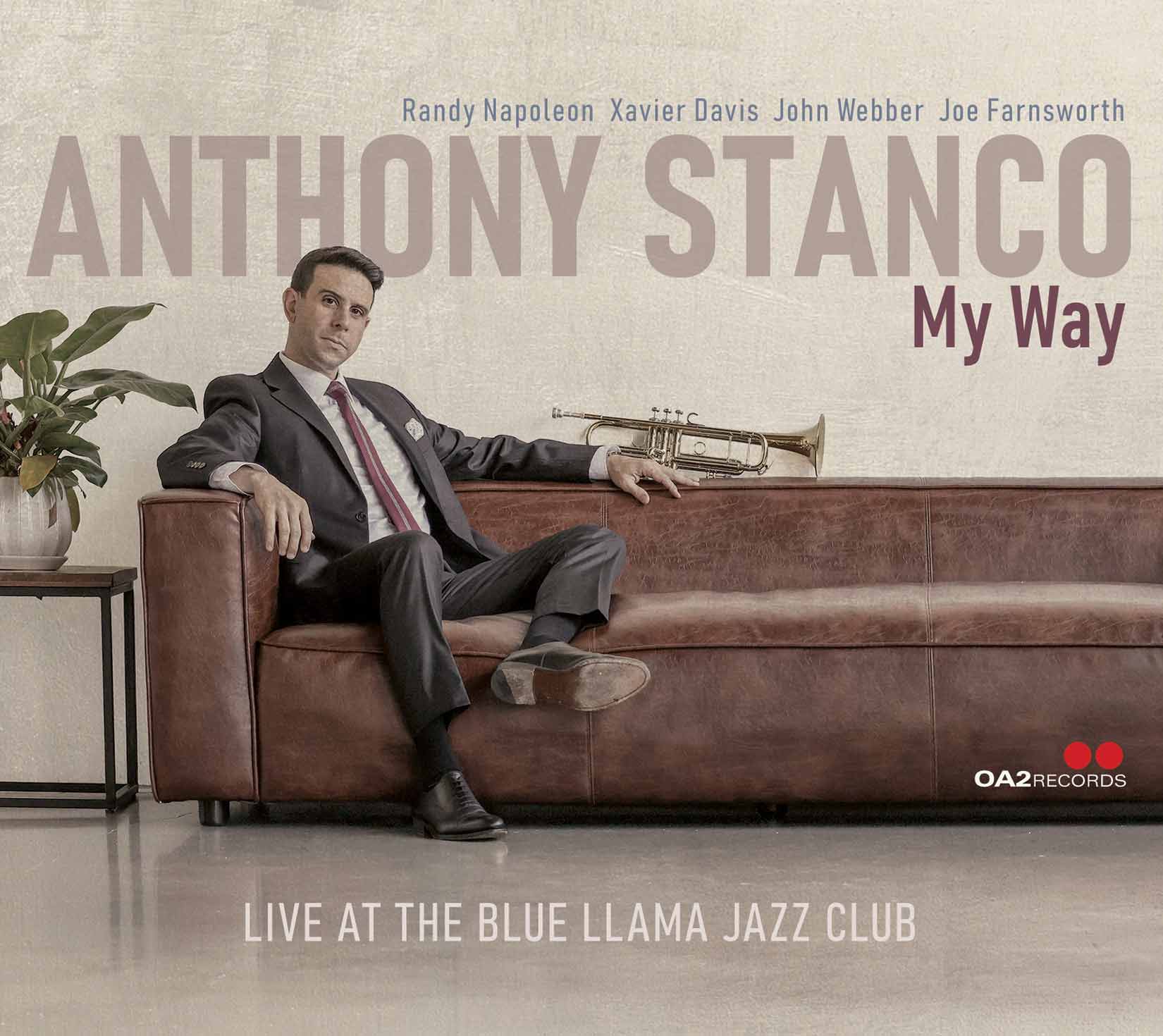
Barely a year after the release of Live at the Alluvion, a particularly successful album, trumpeter Anthony Stanco returns with My Way (Live at the Blue Llama Jazz Club), another live recording rooted in tradition, ensemble interplay and the pleasures of straight-ahead jazz. The quick follow-up offers a useful opportunity to assess Stanco’s development, but it also exposes a difference in artistic ambition between the two albums. Where Live at the Alluvion made a convincing case for the possibilities of his musical approach, My Way is more content to demonstrate how effectively he and his colleagues can work within established forms. The performances are polished, the playing is assured, and the musicians clearly enjoy one another’s company. What is less evident is a sustained effort to take the music somewhere unexpected. Stanco remains an excellent trumpeter, equipped with a commanding technique, a well-defined sound and a strong sense of melodic direction. The limitation here is not his ability but the material and the choices made in shaping the performance. My Way delivers a satisfying evening of jazz, yet too rarely turns technical accomplishment and collective rapport into a compelling artistic statement.
“Pete’s Alibi,” the opening track, sets the tone with an energetic performance driven by a brisk tempo, crisp rhythmic support and an immediate sense of ensemble cohesion. Stanco enters with confidence, articulating his lines cleanly and navigating the tune’s changes with the ease of a musician thoroughly at home in the modern jazz vocabulary. The rhythm section maintains a firm pulse, giving the soloist room to stretch out without sacrificing forward motion. The performance is effective, but its strengths are also revealing. The energy remains high, the ensemble stays tight, and the music moves efficiently from one idea to the next; what it does not consistently produce is a sense of tension, surprise or meaningful transformation. Stanco’s command of the trumpet is apparent, but technical fluency alone cannot provide an entire performance with a distinctive identity. The opening establishes a standard of professionalism that the quartet largely sustains, yet it offers only limited evidence that the musicians are prepared to challenge their own habits. A more adventurous approach to dynamics, phrasing or the development of the solo might have given the performance a stronger narrative arc. Instead, the music relies primarily on momentum and execution. There is nothing wrong with a straight-ahead performance that values swing and clarity, but when those qualities dominate without sufficient contrast, even accomplished playing can begin to feel predictable.
Stanco’s connection to Detroit and its jazz heritage provides an important context for his musical outlook. His playing reflects a tradition in which melodic definition, rhythmic authority and the transmission of established musical values matter as much as individual display. He does not approach improvisation as an opportunity to dismantle the framework of a tune, but as a way to work intelligently within it. That orientation is perfectly legitimate, and the album benefits from his respect for the tradition. The question is how much individuality he brings to it. For this performance, he is joined by guitarist Randy Napoleon, pianist Xavier Davis, bassist John Webber and drummer Joe Farnsworth, a formidable group whose collective experience is evident throughout. Napoleon offers an effective alternative voice to Stanco’s trumpet, using the guitar’s lighter attack and harmonic flexibility to create a more understated counterpoint. Davis provides solid harmonic support, while Webber and Farnsworth maintain a dependable rhythmic foundation. The ensemble is well balanced, and the musicians rarely sound uncomfortable or uncertain. Yet their fluency sometimes works against the album. The exchanges are so consistently smooth that they seldom generate much friction or redirect the music in an unexpected direction. Napoleon’s presence could have prompted more extended exchanges between guitar and trumpet, while Davis might have been given greater space to alter the harmonic atmosphere rather than primarily reinforce it. The group’s cohesion is unquestionable; what remains less convincing is the degree to which that cohesion produces genuinely distinctive musical encounters.
The repertoire reinforces this impression. Stanco contributes three original compositions, Napoleon one, and the rest of the program draws on familiar material from the jazz tradition and the American songbook. The original pieces are among the album’s most revealing moments because they offer a clearer sense of what these musicians have to say for themselves. Stanco demonstrates a feel for melodic construction, organizing his ideas around recognizable themes rather than relying exclusively on the accumulation of technically impressive phrases. Napoleon brings a thoughtful approach to the guitar, balancing harmonic detail with a flexible sense of ensemble interaction. Their compositions give the performance a more personal character, and they expose a weakness in the overall programming: the balance between original material and familiar repertoire does not always work in the album’s favor. The standards provide an immediate point of connection for the audience, but they also place greater responsibility on the arrangements and improvisations to justify their presence. Too often, the musicians’ interpretations remain enjoyable without substantially altering the listener’s understanding of the material. More original compositions, or more distinctive arrangements of the established repertoire, might have given the album a stronger identity. The issue is not that standards should be avoided, but that familiarity needs to be matched by an interpretive choice that makes a tune feel newly considered rather than simply well performed.
The quartet’s interpretation of “Mona Lisa,” the Ray Evans and Jay Livingston song made famous by Nat King Cole, offers a particularly clear example of both Stanco’s strengths and the album’s more restrained ambitions. Faced with a melody whose associations are difficult to escape, the trumpeter wisely avoids turning the performance into a display of technical virtuosity. His phrasing is supple, his tone warm, and his attention to the melody gives the tune room to breathe. At certain moments, he evokes the vocal tenderness associated with Cole, not by imitating the singer but by shaping the phrases with a comparable sense of ease and lyrical continuity. This is one of the recording’s more persuasive performances because Stanco recognizes that the melody itself should remain the focus. He does not overload it with embellishments or force it into an unnecessarily elaborate arrangement. The restraint is welcome, and the performance demonstrates that his musical personality is not confined to fast passages or emphatic soloing. Yet the interpretation also raises a broader question about the album’s artistic direction. The performance succeeds largely because Stanco exercises restraint and allows the song to carry its own emotional weight. One wishes that this sensitivity to space, nuance and melodic character informed more of the program. Elsewhere, the emphasis on energy and instrumental assurance sometimes leaves too little room for the subtler elements that make jazz memorable beyond the immediate pleasure of a well-executed solo.
That tension between display and expression is central to My Way. Stanco has the technique, musical intelligence and stage presence to sustain a live performance, and his playing consistently reflects a serious commitment to the music. He understands how to shape an improvisation, maintain rhythmic clarity and remain responsive to his partners. He also communicates a genuine enthusiasm for performing before an audience. These are substantial strengths, but they do not automatically translate into compelling musical development. A solo can be cleanly articulated and harmonically sound while remaining short on dramatic progression; an ensemble can swing convincingly without generating the tension that makes an interaction memorable. On My Way, the musicians occasionally settle into precisely this territory. The performances maintain their momentum, but some improvisations seem to confirm the players’ command of the material rather than test its possibilities. More sharply differentiated solo structures, changes in density and intensity, or longer exchanges that allowed one musician’s ideas to redirect another’s might have produced a more dynamic listening experience. The quartet has the resources to create such moments. What is missing is not competence but a greater willingness to risk a less predictable outcome.
The live setting adds warmth and immediacy, and the audience’s presence reinforces the sense that these musicians are communicating directly with their listeners. But a live recording is not compelling simply because it captures a successful performance in front of an appreciative crowd. Its strongest moments should reveal something that might be less apparent in a studio setting: the unexpected turn in a solo, the rhythmic exchange that changes the direction of a tune, or the spontaneous interaction that gives a familiar melody a new character. My Way has flashes of this vitality, but it does not sustain that level of discovery throughout the program. The quartet’s professionalism ensures that the music rarely falters, yet the absence of more pronounced contrasts makes the album less involving as a complete listening experience. The performances are enjoyable individually, but their cumulative effect is somewhat uniform. Greater variation in tempo and mood, more adventurous transitions between soloists, and a clearer sense of how each selection contributes to the album’s overall trajectory would have given the recording a stronger artistic profile.
These criticisms should not be mistaken for a dismissal of the album. My Way is a well-played, often appealing recording by musicians who understand the demands of the jazz tradition and meet them with confidence. Stanco’s trumpet remains the principal attraction, combining technical assurance with a clear melodic sensibility, while Napoleon, Davis, Webber and Farnsworth provide the kind of responsive support that allows a soloist to feel secure without being constrained. The problem is that the quality of the musicianship occasionally masks the limits of the artistic conception. The album offers ample evidence of what its players can do, but less evidence of what they are determined to discover. That distinction matters when comparing it with Live at the Alluvion, which suggested a greater willingness to explore the music’s possibilities. My Way is more conservative in its choices, more reliant on established vocabulary and less consistent in creating moments that linger after the performance ends. It is polished and frequently satisfying, but its strongest qualities are those of execution rather than invention.
Ultimately, My Way confirms Anthony Stanco’s standing as an accomplished trumpeter while leaving some questions about the direction of his artistic development. His talent is not in doubt, nor is his ability to bring together a group of musicians capable of delivering a coherent and engaging performance. What this album demonstrates is that technical excellence, a strong ensemble and a sincere commitment to tradition are necessary ingredients for a successful jazz recording, but they are not always sufficient to make one exceptional. Stanco’s next step need not involve abandoning the Detroit tradition or pursuing experimentation for its own sake. It might simply mean trusting his original compositions more fully, allowing his solos to take greater structural risks and encouraging his collaborators to push their exchanges beyond the most comfortable solutions. The quieter reading of “Mona Lisa” suggests how effective he can be when nuance takes precedence over display. More of that interpretive discrimination, combined with the energy and command evident throughout the album, could produce a more distinctive result. My Way remains a credible and enjoyable live recording, even if its inspiration is less consistent than its musicianship. It does not fully capitalize on the promise of Live at the Alluvion, but it leaves the essential point intact: Anthony Stanco is an excellent trumpeter, and the most interesting chapter of his musical story may still lie ahead.
Thierry De Clemensat
Member at Jazz Journalists Association
USA correspondent for Paris-Move and ABS magazine
Editor in chief – Bayou Blue Radio, Bayou Blue News
PARIS-MOVE, October 27th, 2026
Follow PARIS-MOVE on X
::::::::::::::::::::::::
Musicians:
Anthony Stanco – trumpet/flugelhorn
Randy Napoleon – guitar
Xavier Davis – piano
John Webber – bass
Joe Farnsworth – drums
Track Listing:
1 Pete’s Alibi 4:24 Candoli
2 Mack the Knife 8:25 Weill/Brecht
3 Tango Italiano 5:21 Stanco
4 Mona Lisa 6:50 Livingston/Evans
5 Negroni, No Twist 8:49 Stanco
6 Sicilian Shuffle 6:10 Napoleon
7 Nessun Dorma 5:17 Puccini
8 Josie Rosie 11:45 Stanco
Credits:
Produced by Anthony Stanco
Executive Producer & Liner Notes: Don Hicks
Recorded by Jacob Wargo at
Blue Llama Jazz Club Ann Arbor, MI, on March 8, 2026
Mixed & mastered by Corey DeRushia at Troubadour Recording Studios, Lansing, MI
Photography by Alirna Korieva
Cover design & layout by John Bishop