
| Contemporary music |

Anna Rubin: Powehi – Bees, Black Holes and Migrant Voices in a Dazzling Double Album of MusicStories
In my opinion, Powehi, the double CD by American composer Anna Rubin on the great Neuma Records label, is an album you walk into, like a house with many rooms, each with a different light. Over two discs and almost two hours, you meet a swarm of bees, two grand pianos facing a black hole, a praying robot monk, a storm that speaks three languages, a night full of half-heard conversations, and a young girl crossing the Sonoran Desert. It is intelligent, poetic, theatrical, sometimes funny and sometimes devastating, and it is one of the most compelling releases I have heard this year. The mark could only be the highest one on Paris-Move: a must.
Anna Rubin calls her works “MusicStories”, and the subtitle of the album, MusicStories for Voice, Piano, and Electronics, says it all. Her music is propelled by a love of the speaking and singing voice and by environmental and political concerns, and what she does with them is rare: she tells stories in sound, with the same weight given to the words and to the music. Narrators, a soprano, pianists, a cellist, recorded interviews, poems, field recordings and electronic textures all serve the story, and none of them is a mere accessory.
To understand why this album sounds the way it does, it helps to read the short text she wrote in 2021, Reflections on Composing. She describes a musical imagination based on a kind of “textural synesthesia”, not of sound and colour but of sound and shape, texture, energy and space. Her method begins “with a vacuum” that attracts a textural image, an energy, a scale fragment, and very often a social issue; when enough of these components are gathered, the dance between the whole and the details can begin. She even lists the images that haunt her music: broken sobs of laughter, silken shawls in gusts of wind, the heavy slide of amber honey, a wild bee swarm and the depthless solidity of a black hole. Two of them are on this album.
Her path explains the rest. She started piano at seven, surrounded by classical, jazz and folk music at home and by Jewish music in the synagogue, a heritage she still calls intrinsic to her identity, and a source of the cantorial inflections that run through her work. A long illness in childhood turned her inward and nourished a rich fantasy life. As a young adult in California she was an organizer and activist before turning to music, studying at CalArts with Mel Powell, Earle Brown and Pauline Oliveros, and helping to found the Independent Composers Association in Los Angeles.
In 1982 she discovered electronic music in Amsterdam, where a 24-track recorder felt to her like “the key to the Enigma code”, and her first electronic piece processed a woman’s laughter in countless variations, the method she still uses: find a primal sound, make countless variations of it, then shape them into a work. She later studied with Charles Dodge at Brooklyn College, received her doctorate at Princeton with Paul Lansky, taught at Oberlin and then for sixteen years at the University of Maryland, Baltimore County, and served as president of the International Alliance for Women in Music. Her music has been recorded on Capstone, Albany, SEAMUS and Neuma, among others, and performed from Carnegie Hall to Baden-Baden.
From this life comes a body of music in which an acoustic piano, a baroque oboe, an oud, a zheng, a computer and a microphone are all equally natural instruments. Powehi gathers pieces written between 2010 and 2023 and shows her at the peak of her powers.
CD1: the hive and the black hole
“Everything Goes Bee” opens the album in a spirit of play and sensuality. The soprano Susan Botti and the violinist Airi Yoshioka, who form the remarkable Duo della Luna, perform a setting of excerpts from Canadian poet Di Brandt’s poem “Interspecies Communication”, a celebration of honeybees that does not forget the danger pesticides pose to them. Botti’s voice moves from the operatic to the intimate, the violin dances around it, and the electronics evoke swarms and the slow making of honey. It is joyful, and the joy has an edge.
“For the Love of Bees” (almost 22 minutes, six pieces) is for me one of the great achievements of the album. Pianist Sandrine Erdely-Sayo and actor Pamela Fields perform a suite in which each movement takes one feature of bees as a natural metaphor and a particular pianistic challenge, in the tradition of the étude. Behind the writing you can hear Debussy, Chopin, Bartók, Messiaen and the Cuban jazz giant Chucho Valdés. “Swarm” is a buzzing mass of rapidly repeated clusters of three to seven notes, a sort of “megatrill” in a free atonal language. “Sting” sets quick stepwise lines against sharp, stinging dyads. “Solitary”, about the ground bees who live alone, is lyrical, chromatic and almost romantic. “Myth of the Assassin Bees” (in the notation excerpt she shows in her reflections it carries a Portuguese-language title, “Las abelhas assessinas”) is a fast, syncopated tour de force of cross-hand virtuosity with jazzy chords. “HoneyQueen” suspends time with slow, sustained six- to nine-note chords that never resolve. And “Ode to Bees and Their Keepers” takes the symmetry of the hive as its model, expanding and contracting from the centre of the keyboard while echoes of the earlier movements return. The piano writing is brilliant and the performance is thrilling; the narration adds a warm, human voice that turns the suite into a small theatre in which every movement is a scene.
“The Beekeepers” (nearly 11 minutes) changes the point of view entirely. Rubin recorded Caroline and Jeff Crooks, beekeepers in Maryland, along with their bees, and blended their voices with ambient and computer-generated sounds and with a live cello. Michal Schmidt’s cello, at the same time singing and percussive, guides us into the world of a backyard apiary. This sonic portrait was commissioned by cellist Madeleine Shapiro for a series of pieces about the environment, and it is intimate, documentary and poetic at once: you do not just hear about bees, you feel why they matter.
“Powehi: The Darkest Heart of the Galaxy” crowns the first disc and gives the album its name. Powehi is the Hawaiian word for black hole, and Rubin’s piece, commissioned by the Piano on the Rocks International Festival in Sedona, Arizona, was planned for 2020, delayed by the pandemic and premiered in 2022. Two pianists, Sandrine Erdely-Sayo and Cynthia Raim, join actor Pamela Fields as narrator, in seven movements: “Prelude”, “Gravity”, “Dark Matter”, “Dark Energy”, “Black Holes”, “Gravitational Waves” and the title piece. Two pianos can sound almost like a full orchestra, and Rubin uses that power with relish: lush harmonies, delicate melodies, flashes of joyous dance, complex rhythms interlocking, and an energy that swells and ebbs in cycles, like the forces it describes. It is a work that makes astrophysics sound like a love story, and that finds, in the darkest object in the universe, a source of light. The two pianists, both outstanding artists (Erdely-Sayo, trained at the Paris Conservatoire, is a Grammy-nominated Liszt interpreter; Raim studied with Rudolf Serkin and won the Clara Haskil prize), play with astonishing force and finesse.
CD2: voices, machines and nights
The second disc turns to fixed media, music created in the studio from recorded sounds and electronics, and it is a world as rich as the first.
“Automaton Monk” (9:27) is based on “Monk Automaton, c. 1560” by Rebecca Morgan Frank, a poem about one of the first known mechanical sculptures, a praying monk, and, through it, about our age of robots. Voices of three readers are cut, stretched and set in motion, and Rubin captures the moods of the poem, ironic, erotic, humorous, catastrophic, dystopian, with real wit. You will smile, and then you may shiver.
“A Storm Event” (10:57) began as the soundtrack to an exhibition of twelve large pen-and-ink drawings by the Saigon-born artist and architect Yen Ha. Her poem is heard in English, French and Vietnamese, around natural and heavily processed sounds, in cycles of accumulation and dissipation that mirror the way the drawings themselves are built. It is a storm in the mind as much as in the sky, and a lovely demonstration of how voices in different languages become pure music.
“Late at Night” (7:23) is a meditation on the almost-heard: subtle and harsh conversations, fragments of speech from poets Jenny Johnson and Laura Donnelly, recorded during a residency at the Virginia Center for the Creative Arts, drifting through dreamlike night sounds. Listen to it in the dark, with headphones.
“Second Nature” (10:55), written for choreographer Doug Hamby and the Baltimore Dance Project, starts quietly and gently before moving into continuous motion, with kaleidoscopic changes that echo the dancers’ shifting relationships, metallic and percussive sounds and fast-changing melodic patterns. You do not need to see the dance to feel the movement.
“Karina’s Journey” (9:41) is the emotional heart of the second disc, and in my opinion one of the finest pieces on the album. It tells the story of Karina Aquihautl Villagran, who as a child, at the age of seven, travelled north from Mexico with her cousin to join her parents in the United States. Her own voice is embedded in subtle ambient textures evoking her Mexican heritage and the Sonoran Desert. Rubin does not underline, does not moralize, does not need to: the courage, the fear and the resilience are all there in Karina’s words and in the space around them. It is part of Rubin’s growing commitment to migrant justice, which also produced a project built from the stories of women migrants, and it is impossible to listen to without being deeply moved.
“If I Could Sing Like a Bird” (10:08), co-composed with Momilani Ramstrum, closes the album in an unexpected, liberating way. Ramstrum improvised vocally using a MIDI glove of her own invention, from the other side of the country, and Rubin added the sounds of her surroundings in Maryland: footsteps, insects, birds, creeks, but also construction work, cars, planes and lawnmowers. Synthesized sounds created in Csound complete the picture. The piece flows between bird, human voice and machine, and it ends the journey on a question that hangs in the air: what do we hear when we really listen to the world as it is, with all its beauty and noise?
With 21 tracks and almost two hours of music, Powehi asks for time and attention, and it rewards them with interest. It is an album to explore in chapters: one evening for the bees, one for the cosmos, one for the second disc and its fixed-media dreams. And then, once you know the rooms, to walk through the whole house.
It is also an album of remarkable human warmth. Behind the experimental techniques, the electronics and the astrophysics, there is a composer who believes that music can bear witness, to a threatened insect, to a girl on a long road, to the strange shadow of a machine that prays, and who does it with humour, tenderness and an extraordinary ear. The recording and mastering by Alan Wonneberger, and Philip Blackburn’s design, do justice to this richness, with a clear and spacious sound where the piano, the voices and the electronics all have room to breathe.
Anna Rubin wrote, in her reflections, that music has always been for her “a refuge, a solace, a gift” that lifts her into a state of flow and gratitude. You can feel it in every minute of this record. Powehi is imaginative, courageous, beautifully performed and deeply moving: a remarkable double album that deserves to be heard, and heard again. An absolute must.
Frankie Pfeiffer
Editor in chief – PARIS-MOVE
PARIS-MOVE, October 19th, 2026
Follow PARIS-MOVE on X
:::::::::::::::::::::
To order the album and the Bandcamp
To order the album on Neuma Records’ website
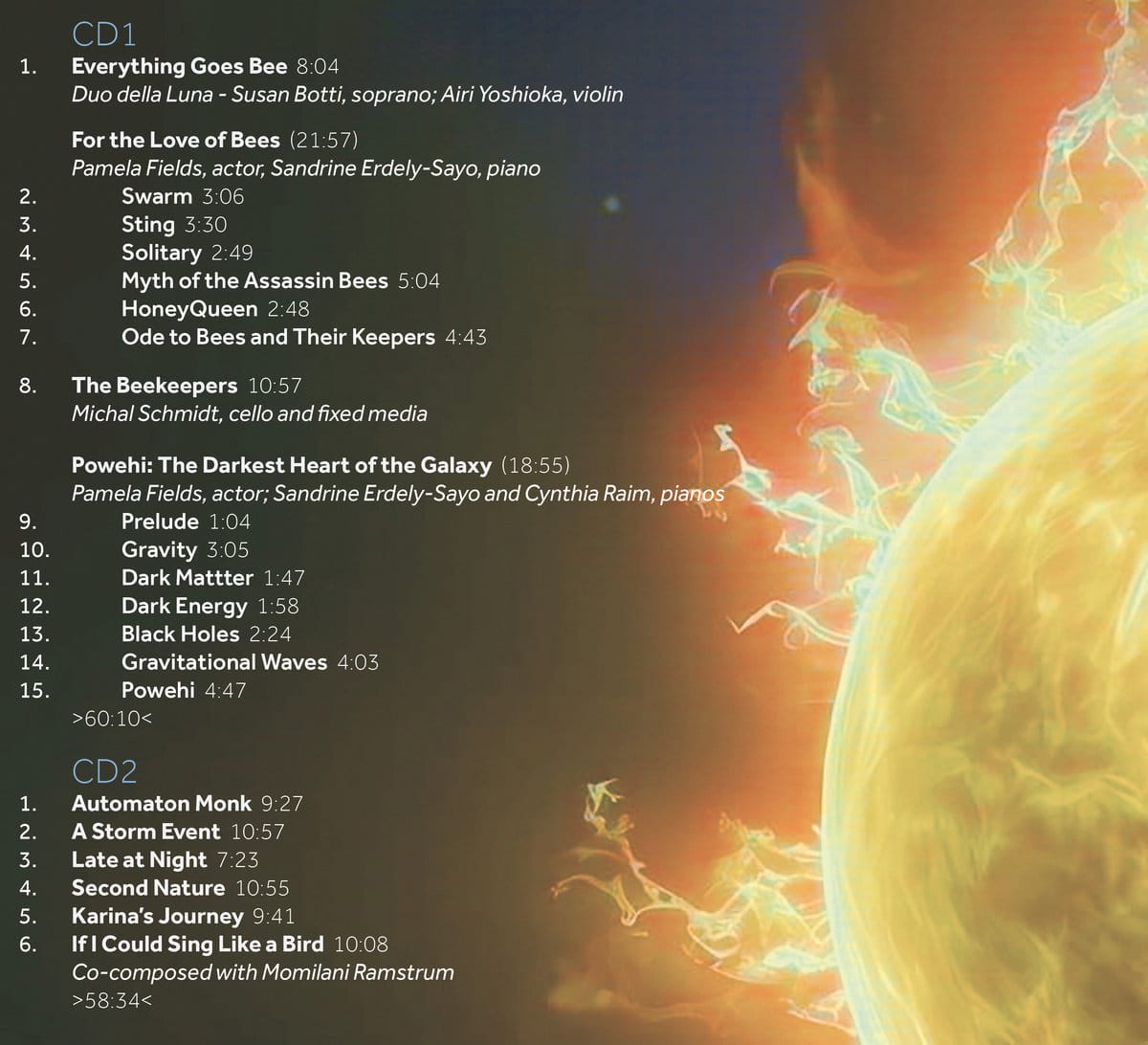
Tracklisting:
CD1
- Everything Goes Bee 8:04
Duo della Luna – Susan Botti, soprano; Airi Yoshioka, violin
For the Love of Bees (21:57)
Pamela Fields, actor, Sandrine Erdely-Sayo, piano
- Swarm 3:06
- Sting 3:30
- Solitary 2:49
- Myth of the Assassin Bees 5:04
- HoneyQueen 2:48
- Ode to Bees and Their Keepers 4:43
- The Beekeepers 10:57
Michal Schmidt, cello and fixed media
Powehi: The Darkest Heart of the Galaxy (18:55)
Pamela Fields, actor; Sandrine Erdely-Sayo and Cynthia Raim, pianos
- Prelude 1:04
- Gravity 3:05
- Dark Mattter 1:47
- Dark Energy 1:58
- Black Holes 2:24
- Gravitational Waves 4:03
- Powehi 4:47
Total CD1: 60:10
CD2
- Automaton Monk 9:27
- A Storm Event 10:57
- Late at Night 7:23
- Second Nature 10:55
- Karina’s Journey 9:41
- If I Could Sing Like a Bird 10:08
Co-composed with Momilani Ramstrum
Total CD2: 58:34
Musicians and credits:
Anna Rubin – composer
Susan Botti – soprano, and Airi Yoshioka – violin (Duo della Luna): “Everything Goes Bee”
Pamela Fields – actor, and Sandrine Erdely-Sayo – piano: “For the Love of Bees”
Michal Schmidt – cello and fixed media: “The Beekeepers”
Pamela Fields – actor, Sandrine Erdely-Sayo and Cynthia Raim – pianos: “Powehi: The Darkest Heart of the Galaxy”
Momilani Ramstrum – co-composer and vocal improvisation (MIDI glove): “If I Could Sing Like a Bird”
Recording and mastering: Alan Wonneberger
Design: Philip Blackburn
Neuma Records – CD Neuma 207 – 2 CDs – 2025