| Jazz |
From Saint Petersburg to Smalls: How Anna Found Her Voice in New York Jazz
On a cold February day in 2017, a young singer arrived in New York for the first time. She had never been to the United States before. Still carrying her suitcase, she went straight from the airport to Smalls Jazz Club, the legendary Greenwich Village basement that has launched, broken, and reborn countless jazz careers. As she crossed the threshold, something clicked. The music. The room. The city she had followed obsessively for years through livestreams from thousands of miles away, back in Saint Petersburg. In that moment, Anna felt a sense of recognition, an almost physical certainty that she had found her place.
That moment now feels inevitable, though nothing about Anna’s journey has been straightforward.
From a strictly personal point of view, there are two kinds of vocal artists: creators, and interpreters. The latter are sometimes underestimated, yet the greatest among them possess a rare gift, the ability to inhabit intention. Through phrasing, texture, and breath, they act out the emotional subtext of lyrics and melodies. Anna belongs firmly in this lineage.
Her voice carries a beautiful, finely grained texture, capable of nuance rather than force, suggestion rather than declaration. Brazilian inflections surface naturally, but never at the expense of her own identity. The result is something original, poetic, and quietly tender.
To understand this album is to understand the path that led to it. Anna was born in the former Soviet Union, roughly eighteen hours from Moscow. As a child, she was fascinated by horses, symbols of strength, movement, elegance, and an unspoken poetry. Those images stayed with her, shaping not only her imagination but her emotional relationship to sound. They followed her through her studies at the Saint Petersburg Conservatory, where discipline and classical rigor formed the foundation of her technique.
A decade ago, she moved to Italy, where another turning point awaited. There, she met jazz legend Sheila Jordan, whose influence on vocal jazz, rooted in emotional truth rather than virtuosity, cannot be overstated. Jordan recognized something essential in Anna and encouraged her to take a leap that would redefine her life: move to New York.
After a first album released on the Japanese Venus label, recorded with an Italian ensemble, Anna made that leap in 2017. That year marked her artistic arrival with what would become her third album, produced in New York for Venus Records. Reach for Tomorrow is not simply a collection of songs; it is a musical memoir, built from moments and chapters that trace a long, deeply personal journey. The album unfolds through intimate musical conversations, particularly with guitarists she chose as close collaborators, dialogues that feel less like performance and more like confession.
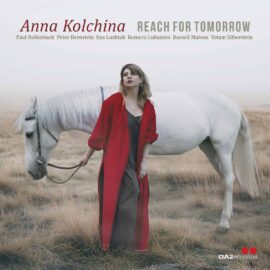
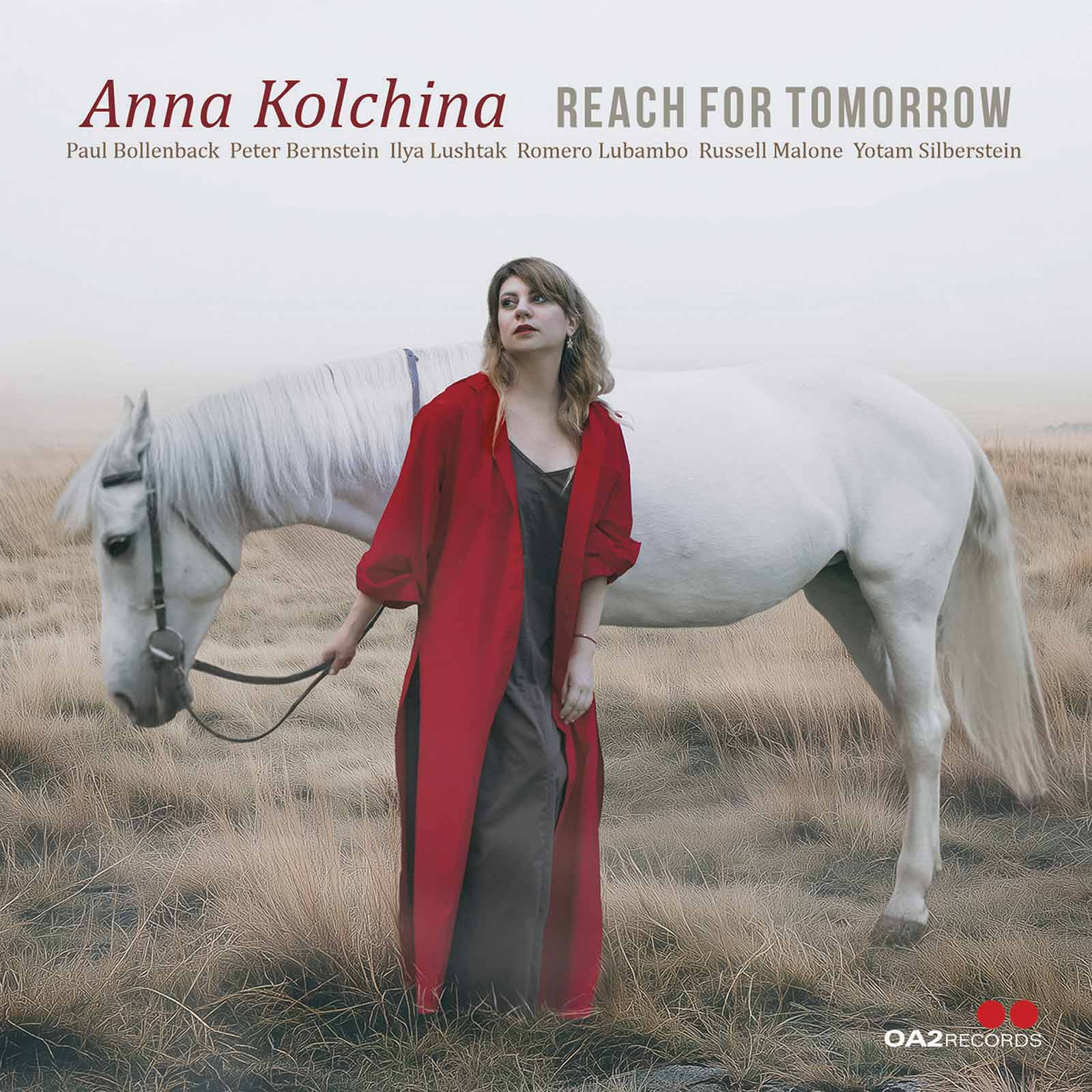
Hovering throughout is her totem animal, the horse, an emblem of elegance, nobility, and forward motion. It is not a metaphor imposed after the fact, but a presence that has accompanied her from childhood to the present, a quiet source of inspiration shaping her dreams.
The musicians assembled for this record are exceptional, but their greatest contribution is not virtuosity, it is restraint. They offer Anna something increasingly rare in contemporary production: space. Producers and trained listeners will immediately notice the absence of excess. The voice is not buried beneath layers of effects, compression, or ornamental instrumentation. Instead, the production embraces clarity and simplicity, allowing every inflection to register. It is a reminder that strong artistic choices often lie in what is left out.
This approach matters all the more given Anna’s background. Voices shaped by classical training are notoriously delicate to record. Their dynamic range, tonal purity, and precision can easily feel out of place in jazz contexts, where flexibility and rhythmic elasticity are paramount. Successful transitions from classical technique to jazz interpretation are rare. What makes it work here is repertoire selection: songs that give the voice time to settle, to breathe, to unfold naturally within the arrangement. The music does not rush her. It trusts her.
Beyond the technical achievement lies something more profound. These are interpretations of striking emotional accuracy, not only in the voice itself, but in the articulation of the texts. Each lyric feels considered, inhabited, and understood. In this sense, Anna aligns herself with a lineage of classic jazz interpreters, from Sheila Jordan to Carmen McRae, artists for whom emotional truth mattered more than stylistic display.
There is, undeniably, a retro quality to the album. A sense of classicism. A respect for form. In another context, that might feel conservative. Here, it feels honest. When the album ends, it becomes clear that it could not have been otherwise. Given Anna’s trajectory, jazz may not have been the most obvious destination at the outset. Yet the seriousness and integrity of her approach command respect.
More importantly, her journey offers something valuable to younger vocalists who feel boxed in by genre, background, or expectation. Anna’s path suggests that musical identity is not about abandoning where one comes from, but about carrying it forward, allowing it to evolve. What emerges is not a stylistic compromise, but a deeper coherence.
After returning home from that first New York trip, Anna could not shake the city from her thoughts. Before long, she made the decision to settle there permanently. Later in 2017, she recorded her third album for Venus Records with a formidable New York lineup: pianist John Di Martino, bassist Peter Washington, and drummer Willie Jones III. The session marked more than a career milestone, it signaled her full integration into the living, breathing ecosystem of New York jazz.
Jazz has always been a global language, shaped by migration, displacement, and reinvention. Anna’s story fits squarely within that tradition. From the former Soviet Union to Italy, from Saint Petersburg livestreams to a basement club in Greenwich Village, her journey reflects what New York continues to represent: a place where personal histories converge, transform, and find voice.
We eagerly await the next chapter of this career. If Reach for Tomorrow is any indication, it will leave more than a fleeting impression. It will leave traces, and perhaps, for some listeners, a renewed faith in the quiet power of interpretation, intention, and beauty itself.
Thierry De Clemensat
Member at Jazz Journalists Association
USA correspondent for Paris-Move and ABS magazine
Editor in chief – Bayou Blue Radio, Bayou Blue News
PARIS-MOVE, January 24th 2026
Follow PARIS-MOVE on X

::::::::::::::::::::::::
Musicians:
Anna Kolchina – vocals
With Guitarists:
Paul Bollenback – electric (9,11)
Peter Bernstein – electric (3,4,5)
Ilya Lushtak – electric (1)
Romero Lubambo – acoustic (7,10)
Russell Malone – electric (8)
Yotam Silberstein – acoustic (2,6), electric (12)
Track Listing:
1 Dancing in the Dark 3:43
2 You and the Night and the Music 2:40
3 Who Can I Turn To? 3:02
4 Invitation 1:59
5 All or Nothing at All 2:36
6 Right from the Start 2:33
7 What Now My Love? 4:12
8 Vacation from the Blues 4:29
9 Wrap Your Troubles in Dreams 2:45
10 So Many Stars 2:52
11 Whistling Away the Dark 4:23
12 Reach for Tomorrow 2:55
Produced by Anna Kolchina
Recorded Feb. 2023 – Jan. 2025 by Dave Darlington (2-12) at Bass Hit Studio, New York
Recorded on July 15, 2021 by Graham Hawthorne (1) at OneTwoSeven Studio, New York
Mixed and mastered by Dave Darlington at Bass Hit Studio, New York
Photography by Tanya Magnani
Cover design & layout by John Bishop