
| Jazz |
Andy Sheppard’s Salt Catchers: The Quiet Art of Musical Freedom
On his latest trio recording, the British saxophonist finds an especially rewarding musical partner in Italian pianist Rita Marcotulli. Together, they explore the delicate balance between composition and improvisation, creating a work of melodic depth, understated elegance and rare intimacy. With a contribution from the late Carla Bley, Salt Catchers also offers a reminder that jazz’s enduring vitality lies in the freedom to listen, take risks and leave room for others.
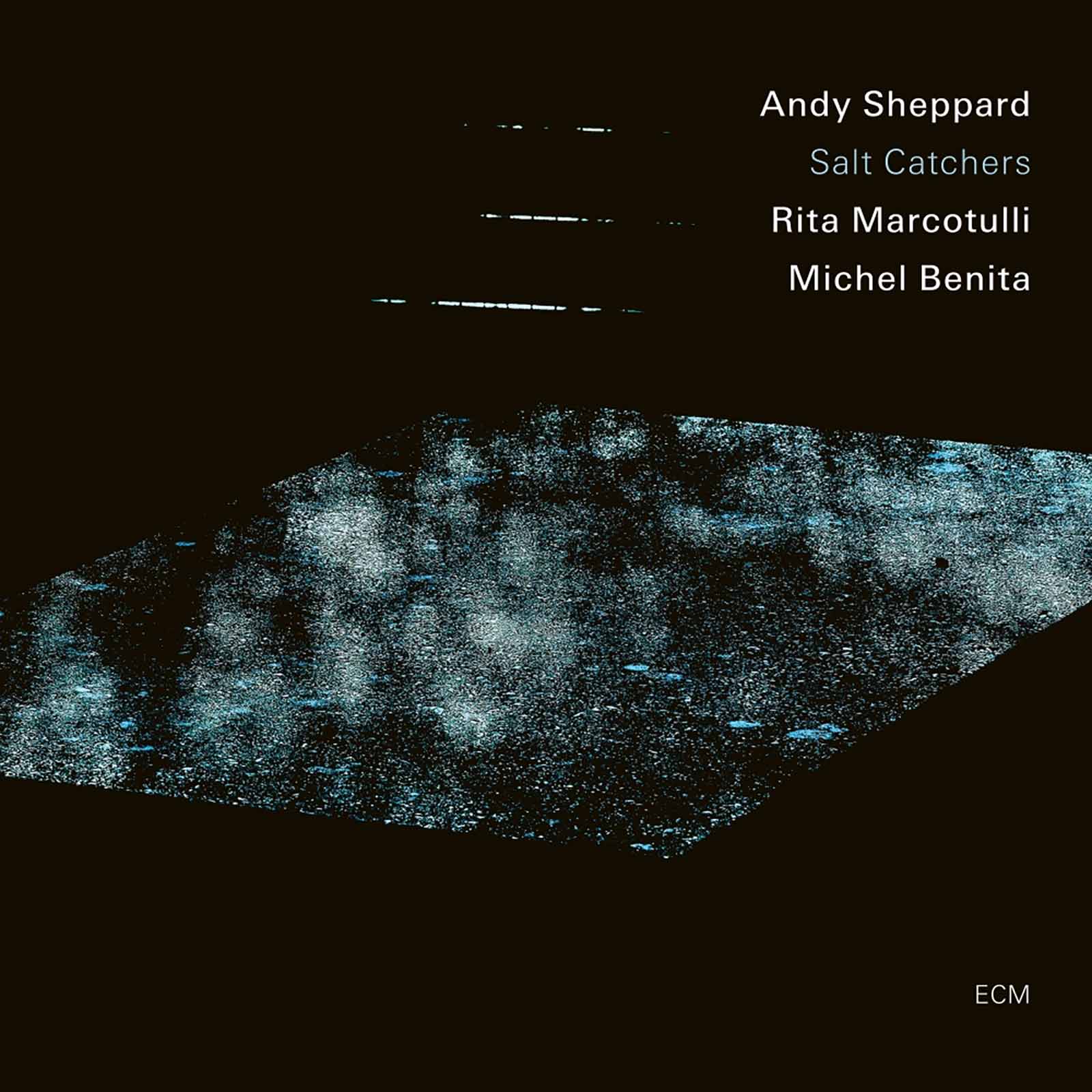
Some albums are events simply because of the musician at their center. A new release by Andy Sheppard is invariably one of them. On Salt Catchers, the British saxophonist brings together Italian pianist Rita Marcotulli and French bassist Michel Benita in a trio built around melodic subtlety, expressive freedom and an unusually refined sense of musical space. The meeting of these three distinctive figures in European jazz creates a setting in which composition and improvisation engage in a remarkably fluid conversation.
What immediately stands out is the relationship between Sheppard and Marcotulli. The Roman pianist has a rare ability to draw on different musical traditions without making their influences feel like a collection of borrowed gestures. Her career, shaped by an openness to diverse cultures and musical experiences, has produced a personal language in which compositional discipline never comes at the expense of spontaneity. Opposite her, Sheppard brings a sound that is unmistakably his own, favoring breath, melodic contour and restraint over sheer display. He has little interest in dominating the musical landscape. Instead, he creates the space, shares it with his partners and allows them to reshape it.
That rapport is the real heart of Salt Catchers. Marcotulli is never merely accompanying the saxophonist, nor does Sheppard attempt to impose a fixed direction on the music. Ideas move freely between them. It is a conversation in which silence can carry as much weight as a note. Sheppard’s compositions seem designed precisely to encourage this kind of freedom. Their melodic identities are clear, but they never become so rigid that they restrict interpretation. The music remains open to revision, expansion and unexpected turns, shaped by the musicians’ instincts as much as by the written material. That sense of possibility gives the album its natural flow and coherence.
Michel Benita’s presence, however, invites some reservations. The French bassist, whose career has brought him into contact with many of the leading figures in international jazz, provides a solid harmonic foundation and a strong instrumental personality. Yet his approach does not always suit the restraint this music demands. At times, I find his playing overly talkative, when a lighter touch might have allowed the delicate exchanges between piano and saxophone to unfold more fully. In a setting this intimate, the question of how much space each musician occupies becomes crucial. Fortunately, the recording’s balance allows the listener to return quickly to the central attraction: the dialogue between Marcotulli and Sheppard. This is not to dismiss Benita’s musicianship. It is simply to acknowledge that the success of a trio sometimes depends less on the strength of each individual voice than on knowing when to step back.
With eight original compositions by Sheppard and a contribution by Carla Bley, Salt Catchers also belongs to a larger musical story. This is hardly the saxophonist’s first exploration of intimate ensemble playing. His work with Trio Libero, his quartet recordings Surrounded By Sea and Romaria, and his long association with Bley and bassist Steve Swallow all point to a sustained interest in collective freedom. Over the years, Sheppard has developed an aesthetic in which composition is not a fixed framework but an invitation to the musicians. The point is not simply to reproduce what has been written, but to give it a new life through performance.
Bley’s presence, through Lawns, carries particular significance. A major figure in contemporary jazz, she was a pianist, composer and fiercely independent musical thinker whose influence reached well beyond her own recordings. Her work consistently resisted narrow classifications, favoring unexpected paths over established conventions. For those who followed her career, she remains an artist whose importance lies not only in her compositions but also in the creative freedom she encouraged in the musicians around her.
There are, in fact, interesting parallels between Bley and Marcotulli. Both are artists who have resisted turning their musical identities into responses to industry expectations. For each, music seems to emerge from an inner necessity. It must be allowed to take risks, encounter unfamiliar sensibilities and absorb outside influences without surrendering its individuality. That independence matters in a musical environment where formats, categories and the demands of recognition can too easily shape the creative process. Marcotulli moves between musical worlds with remarkable ease, yet never loses her own voice. Sheppard shares that commitment, expressing it through melodic economy and an almost constant attentiveness to the quality of the musical exchange.
There is also a distinctly European dimension to this approach to jazz, though not in the sense of a formal school or an artificial opposition to the American tradition. It is better understood as a way of thinking about music through cultural exchange, openness and a refusal to recognize borders as artistic limitations. Jazz has never belonged to a single geography. Its history has been shaped by movement, encounters and the circulation of ideas across continents. That history remains one of the sources of its vitality. For decades, certain record labels have helped sustain this international outlook, giving priority to individual voices, artistic sensibilities and collective exploration rather than the immediate demands of the marketplace. ECM’s aesthetic has been central to that project. Its recordings have emphasized compositional quality, sonic precision, the depth of instrumental color and a distinctive sense of musical form. One can occasionally question an approach that seems too attached to an ideal of sonic beauty, but its contribution to the international recognition of countless musicians is difficult to dispute.
Salt Catchers fits comfortably within that tradition. The production never overwhelms the music. Each instrument is given room to breathe, with its nuances and natural dynamics intact. That attention to sound serves a performance that has little use for spectacle. Sheppard does not rely on sheer volume or technical fireworks, and Marcotulli has no need to turn every piano passage into a demonstration of virtuosity. Instead, the music rests on a form of trust: trust in the compositions, in the musicians beside them and in the listener’s willingness to engage with a work that does not reveal all its intentions at once.
Still, it would be a mistake to regard this album as simply a peaceful retreat. Its serenity is anything but passive. It comes from technical command, a deep understanding of instrumental possibilities and a demanding conception of improvisation. Here, freedom does not mean the absence of structure. It means being able to move beyond that structure without losing the thread of the music. Much of the album’s appeal lies in this tension between organization and spontaneity.
In Sheppard’s hands, melodies seem to have lives of their own. They can be approached from different angles, revisited at different moments and gradually reveal details that may have gone unnoticed on first hearing. His mastery never feels like an attempt to dominate the music. It is expressed instead through the precision of his choices, the relevance of each intervention and his ability to let a composition develop at its own pace. The pleasure the musicians take in playing is unmistakable, and the listener eventually becomes part of that exchange. This may be one of the most valuable things a record can offer: the feeling that one is not simply consuming a performance, but being quietly invited into a moment of creation.
Salt Catchers does not set out to overturn the conventions of contemporary jazz. Its achievement lies elsewhere, in the collective intelligence that allows these musicians to build a shared musical space without sacrificing their individual identities. Whatever reservations one may have about the role of the bass, they should not obscure the essential point: the encounter between Andy Sheppard and Rita Marcotulli gives this album remarkable melodic depth and an uncommon quality of attentive listening. Once again, the British saxophonist demonstrates that musical beauty does not need to announce itself to make an impression. It can emerge from a phrase, a breath, a silence or the slightest inflection of the piano.
In a musical landscape increasingly driven by speed, excess and the relentless pressure to produce something new, the ability to take one’s time can feel almost like an act of resistance. This is neither nostalgia nor a retreat into the comfort of tradition. It is an affirmation of music that trusts the intelligence of its performers and the sensitivity of its audience. Ultimately, Salt Catchers reminds us that jazz remains, above all, an art of encounter, attentive listening and shared discovery. That is what makes this album so compelling: it does not try to hold the listener through force or spectacle. It simply gives us every reason to return.
Thierry De Clemensat
Member at Jazz Journalists Association
USA correspondent for Paris-Move and ABS magazine
Editor in chief – Bayou Blue Radio, Bayou Blue News

PARIS-MOVE, November 5th, 2026
Follow PARIS-MOVE on X
::::::::::::::::::::::::
Musicians :
Andy Sheppard, tenor & soprano saxophones
Rita Marcotulli, piano
Michel Benita, double bass
Track Listing :
1. Elevation
2. Lawns
3. Salt Catchers
4. Encantos
5. Draw You In Stars
6. This Too – Three Hills
7. Salgado
8. Those That Left
9. Irene