| Contemporary music |

Andrew Poppy’s The Beating of Wings: 40th Anniversary Edition revisits a remarkable 1985 post-minimalist landmark, where orchestral music, electronics, repetition and pop collide with extraordinary precision and imagination. Originally released on ZTT Records in 1985, the album occupied an unusual position from the beginning: too adventurous to be conventional pop, too rhythmically immediate to sit comfortably within contemporary classical music, and too fascinated by the possibilities of recording technology to behave like a straightforward concert work. Forty years later, The Beating of Wings: 40th Anniversary Edition confirms just how remarkable that achievement was.
This is not merely an anniversary reissue. It is a reminder that Andrew Poppy was working with ideas in the mid-1980s that have become increasingly familiar in the decades since: the meeting of acoustic and electronic instruments, the use of studio technology as a compositional tool, the rhythmic possibilities of minimalism, and the idea that a sophisticated contemporary composition could possess the propulsion and immediacy of pop music. Listening to it now, the extraordinary thing is not that the album sounds “retro.” It doesn’t. It sounds prescient.
Andrew Poppy’s musical background goes some way towards explaining why The Beating of Wings feels so difficult to categorise. Born in 1954, Poppy studied music at Goldsmiths College and developed an early fascination with American experimental composers including John Cage, Morton Feldman, Terry Riley, Philip Glass and Steve Reich. He attended a summer school with Cage and Merce Cunningham and later became a founding member of the pulse-based ensemble The Lost Jockey. But Poppy’s interests were never confined to minimalist concert music. His musical life also involved rock, recording technology, improvisation, theatre and studio production. That mixture became fundamental to his artistic identity.
He was signed by Trevor Horn and Paul Morley to ZTT in 1984 as a composer, recording artist and producer, placing a contemporary composer within the same extraordinary record-label environment that was simultaneously transforming British pop through Frankie Goes to Hollywood, Propaganda, The Art of Noise and others. It was an inspired match. Because Poppy understood something that many composers working with minimalism did not: repetition could be physical. It could make the body respond, it could create anticipation, momentum and even a kind of pop ecstasy.
At the same time, pop production offered something that the concert hall did not necessarily provide: the studio itself could become part of the composition. That philosophy is everywhere on The Beating of Wings.
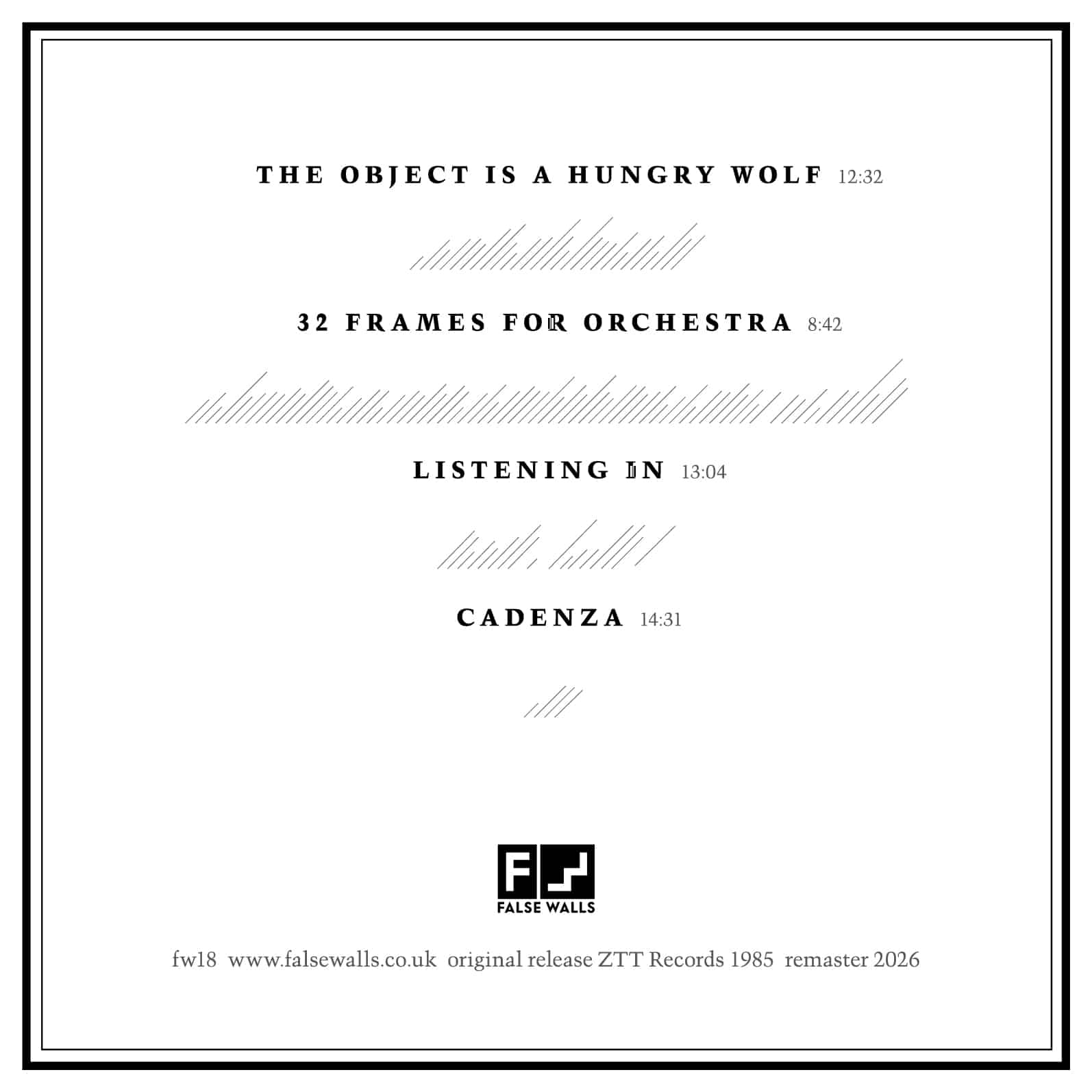
The 40th anniversary edition returns to the original four-piece sequence:
- The Object Is a Hungry Wolf – 12:32
- 32 Frames for Orchestra – 8:42
- Listening In – 13:04
- Cadenza – 14:31
Together they form a remarkably coherent 48-minute journey, but each piece possesses its own musical identity and perspective. That was always one of the album’s great strengths. Contemporary commentary on Poppy’s work has described the four pieces as demonstrating an assured command of post-minimalism, with 32 Frames for Orchestra in particular combining a large-scale orchestral conception with a powerful sense of momentum.
Yet “minimalist” can be a misleading word here. Poppy isn’t interested in minimalism as reduction. He is interested in systems that generate abundance. The repetition is there, but so are colour, interruption, density, harmonic movement, orchestral weight and the sensation that something is continually being constructed in front of us.
The opening track, “The Object Is a Hungry Wolf,” is an extraordinary statement of intent. Its pulse immediately establishes one of Poppy’s central ideas: that a composition can behave like a machine without becoming mechanical. There is something restless about the music. Patterns repeat but they are not in a cycle. They accumulate, mutate and collide. Acoustic ensemble playing is placed into a world of amplified sound and studio manipulation, creating a strange meeting point between orchestral music and the emerging sonic vocabulary of 1980s electronic production.
The piece’s title is itself wonderfully evocative. A “hungry wolf” suggests instinct, pursuit and danger, and the music seems to possess something of that predatory quality. It keeps moving. But beneath the energy is a striking sensitivity to colour. Poppy’s music does not simply stack patterns vertically. Individual sounds have character. The orchestral instruments become rhythmic objects, melodic fragments become textures, and repetition becomes a way of changing our perception of the sounds themselves. It is minimalism with a dramatic imagination.
A later retrospective described the work as using the language of American minimalism while allowing lyrical material to enter the texture, ultimately creating a sound distinctly Poppy’s own. That is an important distinction. Poppy isn’t trying to sound like Reich or Glass. He is taking some of their discoveries and asking what happens when those discoveries encounter rock, film music, recording technology and the studio. The result remains startling.
If there is a single composition that demonstrates why Poppy’s music deserves to be rediscovered by a much wider audience, it may be “32 Frames for Orchestra”. Poppy himself has explained that he wanted to create an orchestral piece with the perpetual-motion quality of rock music. His description of the work as a kind of grid that becomes a maze is particularly revealing: the listener moves along a clearly defined path, reaches a turning point, and discovers that the turn has somehow brought them both back to the beginning and somewhere completely different. That is exactly what makes the piece so compelling. It is highly organised without feeling rigid.
The music advances with extraordinary confidence, but its repetitions constantly alter our sense of where we are. Familiar patterns return in subtly transformed circumstances. Rhythmic cells become architectural structures. The orchestra stops behaving like a traditional symphonic ensemble and starts behaving like a gigantic rhythmic organism. And yet there is warmth. This is important because discussions of minimalism can sometimes emphasise process at the expense of emotion. Poppy avoids that trap. The repetition creates anticipation, while the orchestral colours provide scale and human presence. The piece can feel monumental and physical at the same time. It is also a fascinating example of how far ahead Poppy was. Decades later, orchestral composers working with electronic music, pulse-based structures and cinematic repetition would become increasingly common. Poppy was already demonstrating how naturally these worlds could coexist.
The piece’s later life confirms its durability: 32 Frames for Orchestra was performed by the BBC Concert Orchestra in 2013, where it opened a programme exploring the musical culture of the 1980s. Hearing the work in that context makes perfect sense. It isn’t merely an artefact of the 1980s, it helped anticipate them.
“Listening In” takes the album into a more elusive territory. Where 32 Frames has an immediately architectural quality, Listening In feels more like entering a space whose dimensions are constantly changing. This is where Poppy’s interest in recording becomes particularly important. His music doesn’t merely document performances; the studio becomes part of the compositional process. That approach gives the piece a peculiar intimacy. Sounds seem to occupy different distances. Patterns emerge and recede. The listener becomes aware not only of what is being played but of the act of hearing itself. There is something almost cinematic about the experience, but it isn’t conventional film music. Poppy creates suggestion without needing to provide a conventional narrative.
The music invites concentration. And the longer one listens, the more one notices how much is happening beneath the apparently simple surface. This may be one of Poppy’s most valuable qualities as a composer: he understands that clarity and complexity are not opposites. A piece can be immediately graspable while revealing more information with every subsequent listen.
Then comes “Cadenza,” the album’s longest piece at more than fourteen minutes, and perhaps its most intimate. The instrumentation, piano and electric piano, might initially suggest a conventional concerto-like relationship, but Poppy turns the idea of the cadenza inside out. Instead of treating the piano as a vehicle for virtuoso display, he explores the instrument as a source of pulse, repetition, resonance and timbral transformation. The result is fascinating because the electric piano changes our perception of the acoustic instrument. The two aren’t simply contrasted; they seem to occupy different versions of the same musical identity. The piano can sound like a traditional instrument, then like a recording, then like a rhythmic machine. This is one of the places where Poppy’s pop sensibility and his compositional background meet most naturally. The piece is sophisticated, but it doesn’t need to announce its sophistication. It simply keeps unfolding.
Perhaps the most important aspect of The Beating of Wings is the way it treats recording technology. The album brings together acoustic orchestral instruments with electric piano, electric guitar, bass guitar, sampler, Fairlight Music Computer and drum machine. This combination is crucial. The electronic elements aren’t simply added to make the music sound contemporary, they alter the way the acoustic instruments function.
Poppy was not interested in putting a little technology on top of classical composition. He was interested in changing the relationship between composition, performance and recording. This was a period when digital technology was beginning to change music profoundly. Poppy later reflected on the transition from analogue to digital, describing the digital sound of the period in terms of its clarity and “cool crisp edge.”
Yet The Beating of Wings doesn’t sound trapped between analogue nostalgia and digital futurism. It sounds like someone discovering that both worlds can be musically useful. That is why the record remains so fresh.
The temptation with a 40th anniversary edition is to listen historically. What did this sound like in 1985? What did it mean in the context of ZTT? Where does it fit into the history of British minimalism? All of those questions are worthwhile, but they can distract from the more interesting one: How does this music sound today? The answer is: remarkably alive. There are obvious connections with the contemporary resurgence of post-minimalism, modern classical music, electronic composition and artists who blur the boundaries between concert music and studio production. The label’s comparison with the worlds of Max Richter and Nils Frahm is therefore understandable, while Steven Wilson’s observation that Poppy was “ahead of his time” captures something important about the album’s continuing relevance.
But Poppy doesn’t sound like a precursor simply because today’s artists happen to resemble him. He sounds contemporary because the questions he was asking are still unresolved. How can repetition create emotion? How can orchestral music become physical? How can technology become part of composition rather than merely a recording tool? How can contemporary music retain complexity without losing immediacy? How can the recording studio become a compositional space? The Beating of Wings answers all of those questions without ever sounding as though it is answering questions. It simply makes the music. A fascinating, captivating, sublime music.
There is also something wonderfully subversive about the fact that this music appeared on ZTT. Poppy’s relationship with Trevor Horn and Paul Morley’s label placed genuinely experimental contemporary composition within a pop-cultural environment obsessed with technology, image, sampling and sonic innovation. It was a strange and fertile collision and Poppy was perfectly suited to it. His music had the discipline of contemporary composition but the instincts of a record producer. He understood the seductive power of a pulse, the dramatic possibilities of repetition and the importance of timbre. He could write for an orchestra while thinking like someone working inside a recording studio. That combination remains unusual.
It is also why The Beating of Wings doesn’t feel like “classical music made accessible to pop listeners”, nor “pop music made intellectual”. It is something more interesting: a composer discovering that the boundary between those things was largely imaginary.
This 40th anniversary edition is particularly welcome because The Beating of Wings deserves to be heard as a complete statement rather than merely encountered through individual tracks or retrospective compilations. Previous ZTT retrospectives have already documented the importance of the album, including the expanded On Zang Tuum Tumb collection, which placed the original four pieces alongside further Poppy material from the period. This new edition, however, returns the focus to the original work. The album has been remastered by Stephan Mathieu, while the expanded 24-page CD booklet includes new writing by Poppy himself. The physical presentation, a two-panel gatefold sleeve and booklet, also feels appropriate for a record so deeply concerned with the relationship between sound, technology and physical recording formats. And the timing is right. Forty years on, Poppy’s work no longer needs to be framed as an obscure curiosity from the margins of the 1980s. The musical vocabulary he helped develop has become part of contemporary listening culture.
Forty years after its original release, The Beating of Wings sounds less like a forgotten experiment from the 1980s and more like a missing link between several musical worlds that have since become much closer to one another: minimalism and post-minimalism, contemporary classical music and electronic music, orchestral composition and studio production, experimental music and pop. The record was already standing in that space in 1985. The world has simply taken forty years to catch up with it.
Put it on, listen to the patterns take shape, and allow the repetitions to work on you. What initially seems precise becomes hypnotic, what seems mechanical becomes emotional, what appears minimal gradually reveals itself as richly layered. And that is perhaps the greatest achievement of Andrew Poppy’s music. He makes complexity feel inevitable.
Frankie Pfeiffer
Editor in chief – PARIS-MOVE
PARIS-MOVE, August 15th, 2026
Follow PARIS-MOVE on X
::::::::::::::::::::::::
Andrew Poppy on False Walls’ website
Album info:
Artist: Andrew Poppy
Original label: ZTT Records
40th anniversary label: False Walls
Original release: 1985
New edition: 2 October 2026
Remastering: Stephan Mathieu
Booklet: 24 pages, including new writing by Andrew Poppy
Original running time: approximately 48 minutes
Tracklisting:
- THE OBJECT IS A HUNGRY WOLF 12:32
- 32 FRAMES FOR ORCHESTRA 8:42
- LISTENING IN 13:04
- CADENZA 14:31