| Jazz |
Summary: Andrew Kim’s Lineage is an impressive debut that showcases a gifted trombonist and composer whose original works blend jazz tradition with a fresh, contemporary voice, signaling the arrival of one of the genre’s most promising new artists.
Andrew Kim’s Lineage: A Debut That Honors Tradition While Quietly Redefining It
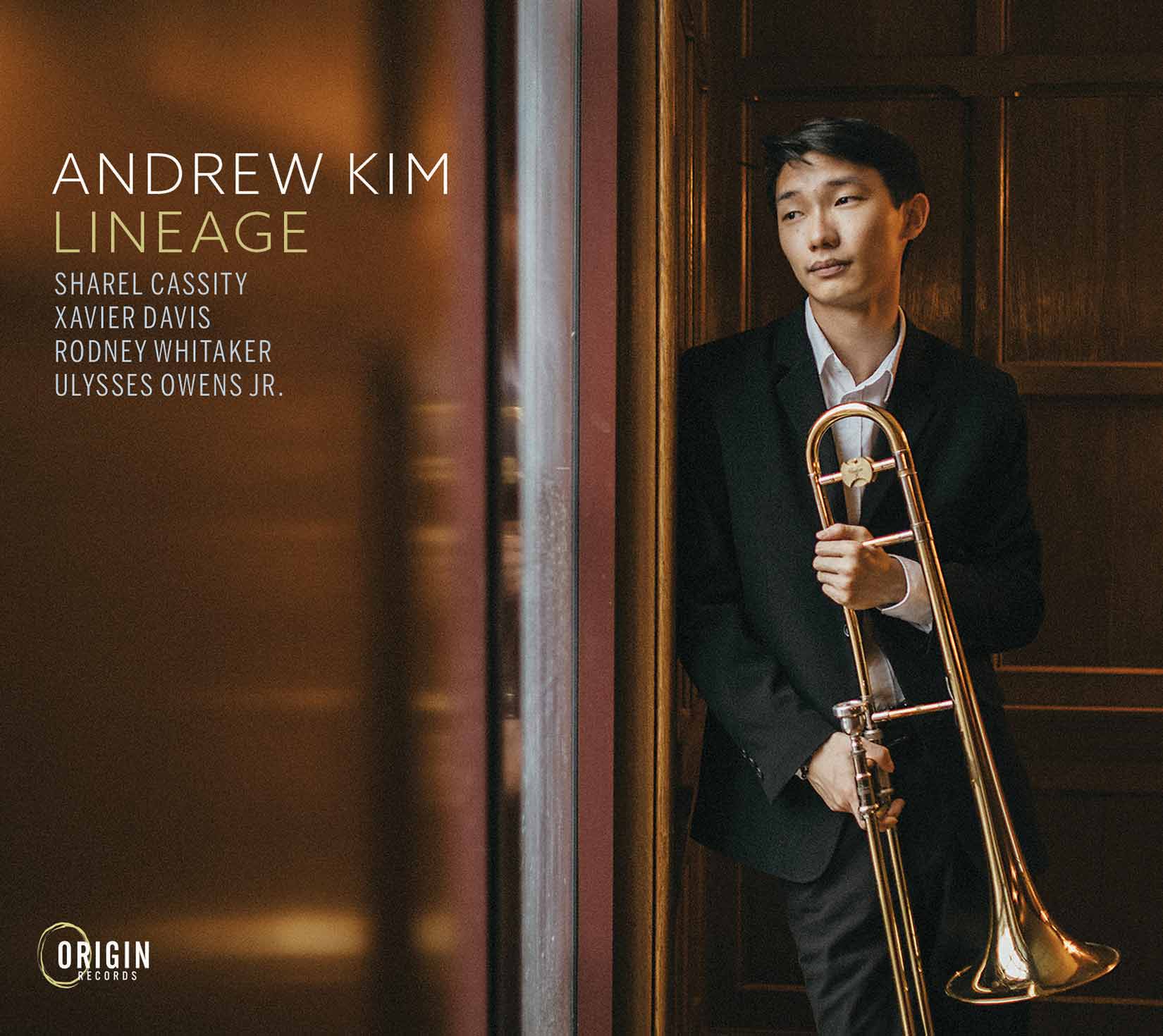
Some debut albums introduce a promising young musician. Others announce the arrival of a distinctive artistic voice. Andrew Kim’s Lineage, due for release on Origin Records at the end of the month, belongs firmly in the latter category. Long before the album reaches its closing notes, it becomes clear that Kim is not simply an accomplished trombonist but an imaginative composer whose musical vision extends well beyond the expectations usually attached to a first recording.
The story naturally begins with mentorship. Michael Dease, one of today’s most respected trombonists, taught Kim during his university years and now serves as producer of Lineage. Their connection is impossible to ignore, but it quickly becomes equally apparent that comparisons between mentor and student tell only part of the story. Kim has absorbed valuable lessons, yet he has transformed them into something unmistakably his own.
Rather than introducing himself primarily through familiar standards, Kim places his confidence in his original writing. He contributes the majority of the album’s repertoire, and those compositions emerge as its defining achievement. They reveal an artist with an unusually mature command of melody, form and orchestration, someone capable of constructing music that is intellectually engaging without ever sacrificing emotional warmth.
Surrounding himself with an exceptional ensemble, Kim is joined by saxophonist Sharel Cassity, pianist Xavier Davis, bassist Rodney Whitaker and drummer Ulysses Owens Jr. The album also includes fresh arrangements of works by trombone icons J.J. Johnson and Curtis Fuller, but it is the five original compositions that ultimately give Lineage its identity. From the opening measures, the ensemble radiates infectious energy and effortless swing. More importantly, every musician sounds genuinely invested in the material, approaching Kim’s music with the enthusiasm of collaborators discovering something both challenging and rewarding.
What immediately distinguishes Kim’s writing is its remarkable breadth. Jazz tradition forms an essential foundation, yet his music refuses to remain confined within that heritage alone. His compositions absorb multiple influences while maintaining a clear and highly personal voice. The melodies are memorable, often deceptively simple at first encounter, but beneath their accessibility lies sophisticated architecture and carefully crafted interplay.
This is where Kim’s strengths as a composer become impossible to overlook. He clearly delights in writing for the rhythm section, giving bass and drums unusually active roles that shape the music rather than merely supporting it. His pieces constantly evolve, balancing lyricism with rhythmic complexity and harmonic surprises that reward repeated listening.
“Nostos” offers perhaps the clearest example. It begins with an elegant, almost understated theme that immediately draws the listener in. As the improvisations unfold, however, the composition steadily reveals its complexity. Each soloist navigates shifting harmonic terrain while remaining deeply connected to the original melodic idea. The result is music that stimulates the intellect without ever losing its emotional immediacy.
A different kind of beauty emerges on “Welcome Home.” Here, Kim demonstrates that restraint can be just as powerful as virtuosity. His warm trombone blends gracefully with Sharel Cassity’s expressive saxophone, while Xavier Davis supplies understated elegance at the piano. Rodney Whitaker delivers one of the album’s most captivating performances, his bass lines singing with remarkable authority and warmth, all while engaging in an exhilarating dialogue with Ulysses Owens Jr., whose drumming combines precision, imagination and irresistible momentum.
Perhaps the album’s greatest accomplishment is the remarkable chemistry shared by every member of the ensemble. These are musicians with distinguished careers of their own, yet throughout Lineage they seem less interested in displaying individual brilliance than in collectively serving Kim’s musical vision. Their enthusiasm is palpable, suggesting that they, too, recognize the originality of the material before them.
One cannot help wondering whether the album might have been even more compelling had it consisted entirely of Andrew Kim’s own compositions. Personally, I would have welcomed that choice. The original works are not simply the strongest moments on the record; they are the moments that linger in the memory long after the music ends. They reveal a composer willing to take risks without becoming inaccessible, an increasingly rare balance in contemporary jazz.
That is not to diminish the value of the classic repertoire included here. Reimagining compositions by J.J. Johnson and Curtis Fuller provides listeners with familiar reference points while demonstrating Kim’s respect for the tradition from which he emerged. Yet even these pieces feel less like tributes than conversations across generations, carefully reshaped to fit the aesthetic world he is building for himself.
The role of experienced artists in encouraging emerging talent has always been central to jazz history. Swedish trombonist Nils Landgren has frequently spoken about the importance of championing younger musicians, regularly highlighting gifted performers such as Ebba Åsman as examples of jazz’s bright future. In America, Michael Dease has embraced a remarkably similar role, helping cultivate a new generation of trombonists through teaching, mentorship and collaboration. His decision to produce Lineage reflects not only confidence in Andrew Kim’s technical abilities but also a recognition that this is an artist capable of contributing something genuinely new to the evolution of the instrument.
What ultimately makes Lineage so compelling is not its technical excellence, impressive though that may be. It is the sense of discovery that runs through every original composition. Andrew Kim writes with confidence but never with complacency. He embraces jazz history without becoming constrained by it, crafting music that feels both deeply rooted and unmistakably contemporary.
If Lineage is any indication, Andrew Kim is not simply joining the conversation among today’s most exciting trombonists. He is already beginning to reshape it. For a debut album, there can be few stronger statements of intent.
Thierry De Clemensat
Member at Jazz Journalists Association
USA correspondent for Paris-Move and ABS magazine
Editor in chief – Bayou Blue Radio, Bayou Blue News
PARIS-MOVE, June 28th, 2026
::::::::::::::::::::::::
Musicians :
Andrew Kim – trombone
Sharel Cassity – alto sax, tenor sax, flute
Xavier Davis – piano
Rodney Whitaker – bass
Ulysses Owens Jr. – drumset
Guests:
Randy Napoleon – guitar (5, 10)
Michael Dease – baritone saxophone (3, 7)
Steven Bowman – bass (1, 3, 5, 9)
Track Listing :
Kimposter 5:53
The World Falls Away 5:52
Shadrach, Meshach, and Abednego 6:42
Cube Steak 4:51
Nostos 5:31
Welcome Home 5:37
Discovered Ease 5:50
Bit of Heaven 5:52
Awaken 4:58
Stella by Starlight 6:08
Compositions by:
(1,5,6,7,9) Andrew Kim
(2) Rodney Whitaker
(3) Xavier Davis
(4) J. J. Johnson
(8) Curtis Fuller
(10) Victor Young
Produced by Michael Dease
Recorded, mixed & mastered by Corey DeRushia at Troubadour Recording Studios, Lansing, MI
Recorded on May 16, 2025
Front cover photo by Yujen Tsai/ ÜJIN Studio
Cover design & layout by John Bishop