| Jazz |
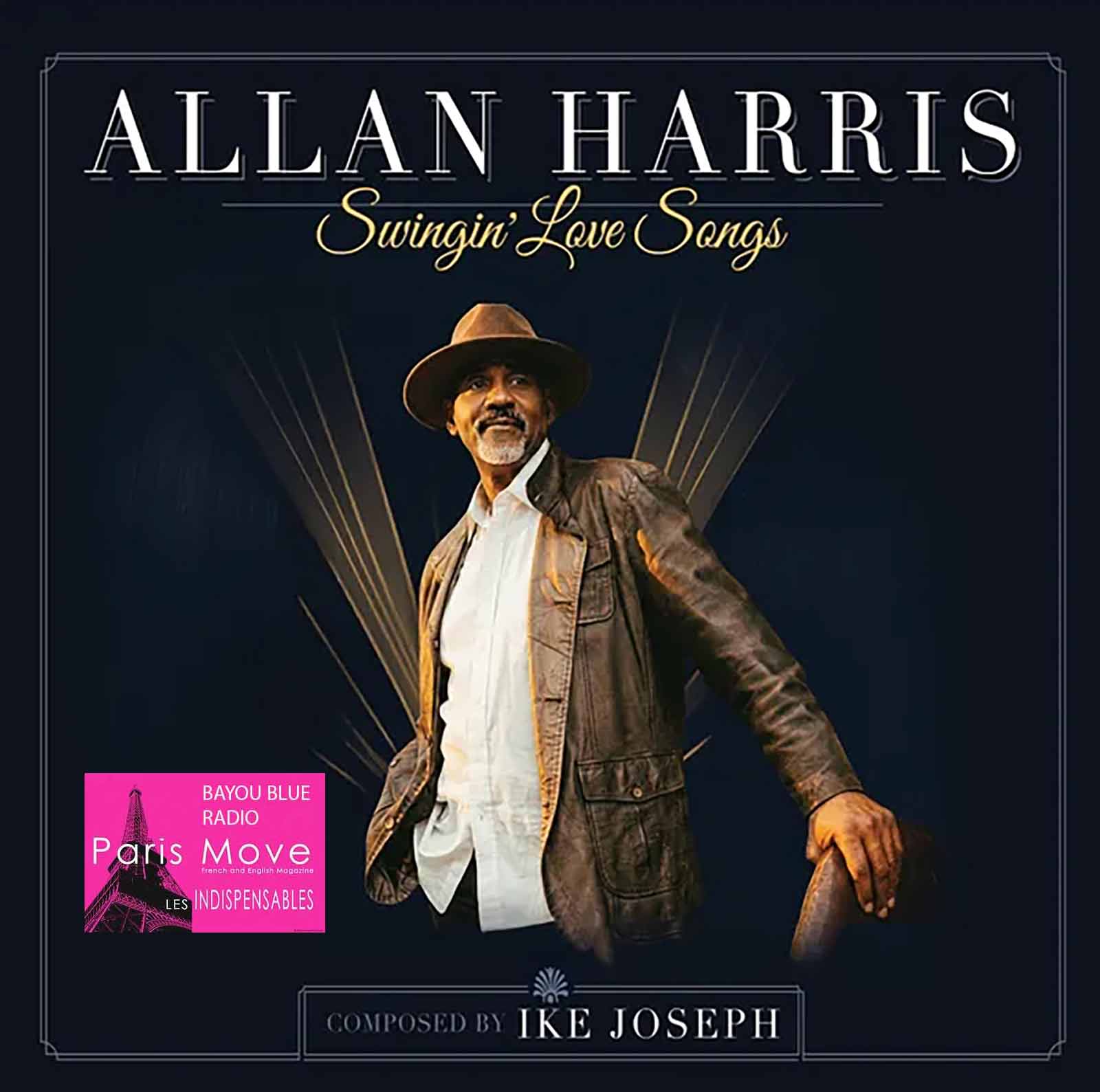
Summary: Allan Harris brings Ike Joseph’s forgotten love songs back to life on Swingin’ Love Songs, a deeply personal and elegant statement in contemporary vocal jazz.
Allan Harris: Swingin’ Love Songs, Ike Joseph and the Soul of Vocal Jazz
If Nat King Cole were still making records today, I suspect he would sound a lot like Allan Harris. That thought comes almost immediately with “I’m Hooked On You,” the opening track of Swingin’ Love Songs. Not because Harris imitates Cole, because he doesn’t, but because he possesses that increasingly rare quality Cole made seem effortless: the ability to make a love song sound honest without becoming sentimental, sophisticated without becoming complicated. Harris has a velvet voice, but velvet alone is not enough. What makes him special is the intelligence behind it. He knows when to lean into a phrase, when to let a word fall away and, perhaps most importantly, when not to sing too much. In an era in which vocal jazz can sometimes confuse emotional intensity with volume, Harris understands that restraint can be far more powerful.
Swingin’ Love Songs also has a story that makes the album impossible to hear as just another collection of romantic songs. More than 20 years ago, Harris discovered the music of Ike Joseph, a Brill Building songwriter from Charleston, West Virginia, whose songs had never received the attention they deserved. Harris immediately heard something in them: melodies with the kind of directness that has largely disappeared from contemporary popular songwriting, and lyrics that were unashamedly romantic. The sessions were recorded, the music was completed, and then everything stopped. Joseph died unexpectedly, and the project was put away. The tapes remained there for more than two decades, silent and effectively forgotten. Records are often described as waiting for their moment. These songs were waiting, too, but the man who wrote them would never know when that moment finally came.
When the masters resurfaced, Harris could have treated them simply as an interesting piece of his own past. Instead, he returned to the material and gave it a second life. That decision changes the way the album should be heard. Swingin’ Love Songs is not simply a rediscovered recording or an exercise in musical archaeology. It is an unfinished promise finally being kept, and Harris approaches that responsibility without turning the music into a museum piece. He understands that the best way to honor old music is sometimes to refuse to make it sound old.
Harris is particularly well suited to that task because he is far more than a vocalist. He is a composer, arranger and bandleader, and those different perspectives are audible throughout the album. As a singer, he hears the lyric; as a composer, he hears the melody; as an arranger, he understands the architecture; and as a bandleader, he knows how much space each musician needs. That combination gives the performances a depth that is easy to miss on a first listen because everything sounds so natural.
The musicians surrounding him understand that language. Miles Okazaki on guitar, Hayes Greenfield on tenor saxophone, Jesse Jones Jr. on alto saxophone, Jon Flaugher on bass and Russell Farhang on violin give the album a sound that is considerably more sophisticated than its title might suggest. There is warmth here, certainly, but also rhythmic intelligence, harmonic detail and a sense of movement that keeps the material firmly within the world of jazz. The violin is perhaps the greatest gamble. In romantic repertoire, it can easily send a record toward sentimentality or, worse, the restaurant circuit. Farhang avoids that trap, adding color and texture without turning the music into background decoration.
The songs themselves are almost disarmingly simple. They belong to a tradition in which love could still be expressed directly, without irony, quotation marks or the need to apologize for sincerity. Some of the lyrics may sound old-fashioned today, but Harris understands something that many contemporary singers seem to forget: a simple lyric becomes powerful when the singer actually believes it. He does not try to make these songs more important than they are. He simply gives them the musical intelligence and emotional conviction they need.
“How Wrong They Were” is a perfect example. Piano and voice do almost everything that is necessary, creating an atmosphere of remarkable intimacy. The influence of Nat King Cole is unmistakable in the economy of the performance, but Harris never disappears behind that influence. He takes that tradition and makes it his own. The phrasing is controlled, the emotion is never forced, and the result is more powerful precisely because Harris knows when to leave something unsaid.
“I’m Hooked On You” reveals another side of the album. The swing comes forward, the melody opens up and Harris allows more of his personality into the performance. This is where the record becomes particularly convincing. He can be elegant without becoming formal, romantic without becoming syrupy, and playful without sacrificing sophistication. The accessibility of the song is not a weakness; it is part of its strength.
That balance is what makes Swingin’ Love Songs so compelling. On the surface, this is a collection of love songs rescued from the past. Listen more closely and it becomes something else: a conversation between two musicians separated by death and more than 20 years of silence. Joseph wrote the songs. Harris gives them their present tense. The album is therefore both an act of remembrance and a living musical statement.
It is tempting to call Swingin’ Love Songs a historical album, and in one sense it certainly is. The material comes from another era, and the circumstances surrounding its creation give it an unusual place in Harris’s discography. But the performances themselves are not historical reconstructions. Harris does not attempt to reproduce a vanished sound. He brings these songs into his own musical world, and that is precisely why they work. Their age becomes almost irrelevant.
Great songs do not age in the same way people do. They wait for the right voice, the right musicians and the right moment. Ike Joseph waited more than 20 years, although he would never live to see that moment arrive. Allan Harris eventually returned to the music, surrounded himself with musicians capable of understanding its possibilities, and allowed the songs to breathe again. There is something profoundly moving in that story, but the album never depends on sentimentality to make its point.
For Joseph, the timing remains bittersweet. The right moment arrived without him, and his name now appears on an album that finally gives listeners the opportunity to hear what Harris heard all those years ago. There is no way to make that story anything other than sad, but there is also something deeply satisfying about the fact that the music survived. Harris has not simply brought forgotten songs back into circulation; he has restored their dignity.
For listeners who care about vocal jazz, Swingin’ Love Songs is therefore much more than a pleasant album of romantic material. Its arrangements, musicianship and vocal performances place it on a level rarely encountered in contemporary vocal jazz, where technical ability is abundant but genuine personality is considerably harder to find. Harris possesses both. His voice is immediately recognizable, his musical instincts are remarkably sure, and his interpretation of Joseph’s songs never feels like an obligation.
What makes the album ultimately memorable is its sincerity. Harris does not try to impress us with vocal acrobatics, nor does he hide behind nostalgia. He simply understands the songs and trusts them. In a musical landscape increasingly fascinated by novelty, that choice feels almost radical. Swingin’ Love Songs reminds us that there is still enormous power in a beautiful melody, a well-written lyric, a great band and a singer who knows exactly what to do with them.
More than two decades after the original sessions, Ike Joseph’s songs have finally found their moment. Allan Harris has given them something even more valuable than a second chance: he has made them sound alive. That is the real achievement of Swingin’ Love Songs, and it is why this album deserves to be heard not as an archival curiosity, but as a serious and deeply personal contribution to the tradition of vocal jazz.
Thierry De Clemensat
Member at Jazz Journalists Association
USA correspondent for Paris-Move and ABS magazine
Editor in chief – Bayou Blue Radio, Bayou Blue News

PARIS-MOVE, September 11th, 2026
Follow PARIS-MOVE on X
::::::::::::::::::::::::
Singer: Allan Harris
Track Listing:
I’m Hooked On You
They Said It Before
You Had a Change of Heart
How Wrong They Were
Any Moment Now
When You’re Young and In Love
Not Our Love
Soft Spoken
Other Side of The Fence