| Contemporary music |
Agnese Toniutti and the Ghost in the Machine: Inside Her Recording of Cage’s Sonatas and Interludes
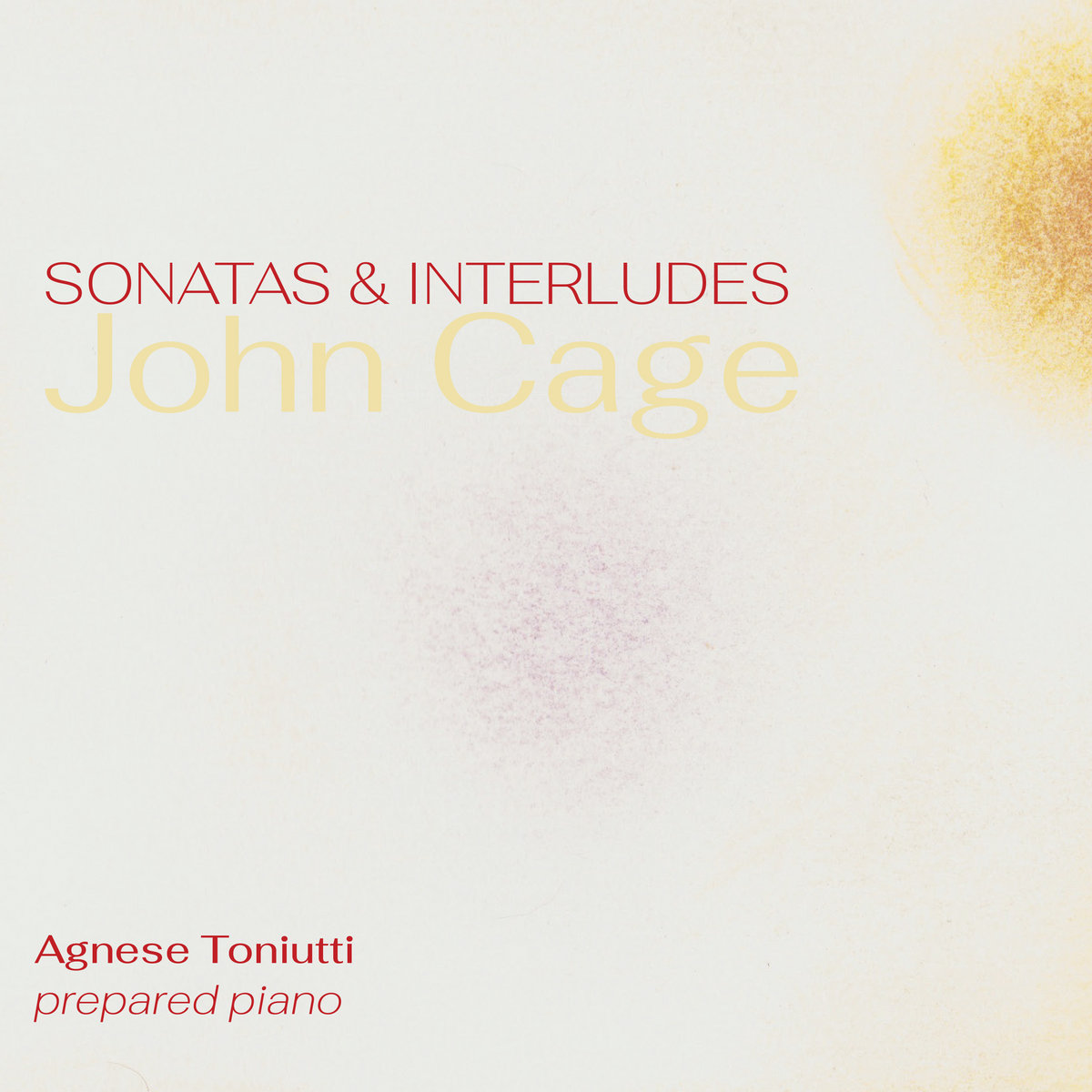
Some performances feel like an act of channelling rather than interpretation, as though the performer has stopped standing between the composer and the listener and has instead become a kind of conduit. Agnese Toniutti’s recording of John Cage’s Sonatas and Interludes for Prepared Piano is one of those recordings. Across nineteen tracks and just under an hour, Toniutti doesn’t so much play Cage’s most famous work as let it inhabit her. Every hesitation, every muted thunk and bell-tone, every silence between gestures, feels less like execution and more like listening in on a private conversation between a pianist and a composer’s ghost. It’s a fascinating album!
To understand why the Sonatas and Interludes still feels radical eighty years after its completion, it helps to remember what Cage actually did to his instrument. In the early 1940s, following a suggestion from Henry Cowell and encouragement from his own mother, Cage began inserting screws, bolts, weatherstripping, erasers, and other everyday objects between the strings of a grand piano, transforming a single keyboard into something closer to a one-person percussion ensemble. Composer Lou Harrison, upon seeing the results, reportedly said he wished he’d thought of it first. The invention solved several practical problems of the era at once, cramped orchestra pits for dance accompaniment, the scarcity of percussionists during wartime, and the simple absence of anything like a sampler, but it also opened up an entirely new sound world, one where depressing a key might produce a clean pitch, a dry knock, a metallic buzz, or a bell-like shimmer, all from the same seemingly ordinary keyboard.
Cage spent the mid-1940s exploring that world in a series of shorter, semi-improvised pieces before committing himself to what would become his most celebrated work for the instrument: the Sonatas and Interludes, composed between 1946 and 1948. The structure leans on Cage’s evolving interest in nested, proportional rhythms and symmetries, ideas he traced partly to Erik Satie, but the period also marked his growing fascination with Indian classical music, absorbed through his studies with Gita Sarabhai and Ananda K. Coomaraswamy. Concepts like tala (rhythmic cycles) and rasa (the nine “permanent emotions,” from humour and wonder to sorrow and, finally, tranquillity) shaped the sixteen sonatas and four interludes, even if no single movement maps neatly onto a single mood. What comes through instead, across the whole sequence, is something closer to a sustained, unforced calm, a strange equilibrium between chattering rhythmic activity and deep stillness.
Every prepared piano is, in effect, a new instrument. Cage’s own Table of Preparations is precise, but no two pianos respond to it identically, and the recording that results depends enormously on how a performer chooses to relate to that unpredictability. Toniutti’s choice throughout this recording is restraint in service of wonder. Rather than fighting the instrument’s reduced bass frequencies and softened dynamics, the muting that can make a prepared piano sound more like a kaleidoscopic harpsichord than a concert grand, she leans fully into it, letting the delicacy of each altered tone register on its own terms. It’s an approach that seems to answer Cage’s own instruction almost directly: he once said that if a performer enjoys playing the Sonatas and Interludes, they should play them so that it feels right to them. Toniutti’s version of “right” is unhurried, luminous, and deeply attentive to the grain of every individual sound.
That attentiveness isn’t incidental to who she is as a musician. Toniutti’s career has been built almost entirely around exactly this question, what sound itself can mean inside a composition, and how far a performer’s own research can shape an interpretation. A graduate of the Conservatory of Venice, where her thesis focused on Giacinto Scelsi, she has spent years building monographic recitals around specific composers, Cage among them, alongside Scelsi, Giancarlo Cardini, and the Fluxus movement, weaving live performance together with archival writings and audio documents rather than simply performing a program. Her recording of Lucia Dlugoszewski’s “timbre piano” works and Philip Corner’s verbal scores on Subtle Matters (Neuma, 2021) comes from the same instinct: an interpreter who treats every unconventional score as an invitation to research as much as to perform. That instinct is exactly what the Sonatas and Interludes demands, and exactly what this recording delivers.
Even Toniutti’s own words about her artistic outlook, printed in the album’s materials, read like a gloss on what happens across these nineteen tracks, a fascination with sound as something invisible yet connective, capable of holding contradiction rather than resolving it into simple opposites. That’s a fair description of what the prepared piano itself does: it turns a familiar instrument into something unfamiliar and somehow makes the two feel like the same object. Across this recording, you can hear Toniutti sitting comfortably inside that contradiction, never trying to smooth it away.
The nineteen tracks, sixteen sonatas interspersed with four interludes, plus the paired “Sonatas XIV & XV” subtitled “Gemini”, reward close listening precisely because each one asks something slightly different of the prepared piano’s timbral range. The opening Sonata I sets a tone that’s simultaneously guarded and specific, its muted attacks establishing the album’s vocabulary before the music has even had time to develop a melody. By the time the First Interlude arrives, Toniutti has settled into a genuinely unhurried lilt, treating the piece less as a transitional interlude and more as a destination in its own right.
The longer movements toward the album’s second half are where her patience pays the biggest dividends. The extended Second Interlude and the paired Sonatas XIV & XV both stretch past four minutes, giving Toniutti room to let phrases bloom and recede rather than simply state and move on, there’s a spaciousness to these performances that never tips into slackness. And the closing Sonata XVI brings the cycle to rest with a careful, unforced negotiation of space and silence, ending the record less with a flourish than with a held breath.
The Sonatas and Interludes has been recorded many times, and it doesn’t need Toniutti’s version to secure its place in the twentieth-century canon, but what her recording offers instead is a genuinely distinct relationship to the material: an interpreter whose entire artistic practice has been built around investigating what sound does inside a composition, applied to the one solo-piano work most explicitly designed to force that question. The result doesn’t feel like a young pianist checking a canonical box on the way to a conventional recital career. It feels like an artist who has found, in Cage’s transformed instrument, a subject worthy of everything she already does best.
This is a recording to sit with rather than skim, one where the space between the notes carries as much information as the notes themselves, and where Cage’s spirit of patient, curious attentiveness feels, for nearly an hour, genuinely alive in someone else’s hands. Do I have to say it again? It’s a fascinating album!
Frankie Pfeiffer
Editor in chief – PARIS-MOVE
PARIS-MOVE, August 18th, 2026
Follow PARIS-MOVE on X
::::::::::::::::::::::::
Tracklisting:
1.Sonata I – 02:51
2.Sonata II – 02:02
3.Sonata III – 02:10
4.Sonata IV – 02:03
5.First Interlude – 03:36
6.Sonata V – 01:49
7.Sonata VI – 02:12
8.Sonata VII – 02:21
9.Sonata VIII – 02:32
10.Second Interlude – 04:01
11.Third Interlude – 02:32
12.Sonata IX – 04:04
13.Sonata X – 03:09
14.Sonata XI – 03:33
15.Sonata XII – 03:00
16.Fourth Interlude – 02:27
17.Sonata XIII – 03:47
18.Sonatas XIV & XV – 06:20
19.Sonata XVI – 03:58
Total: 59:07
John Cage (1912-’92): Sonatas & Interludes for Prepared Piano (1946-’48)
Musician:
Agnese Toniutti, prepared piano
Album on NEUMA Records’ website