Sean Noonan’s interview
by Frankie Pfeiffer
Editor in chief – PARIS-MOVE
June 30th, 2026
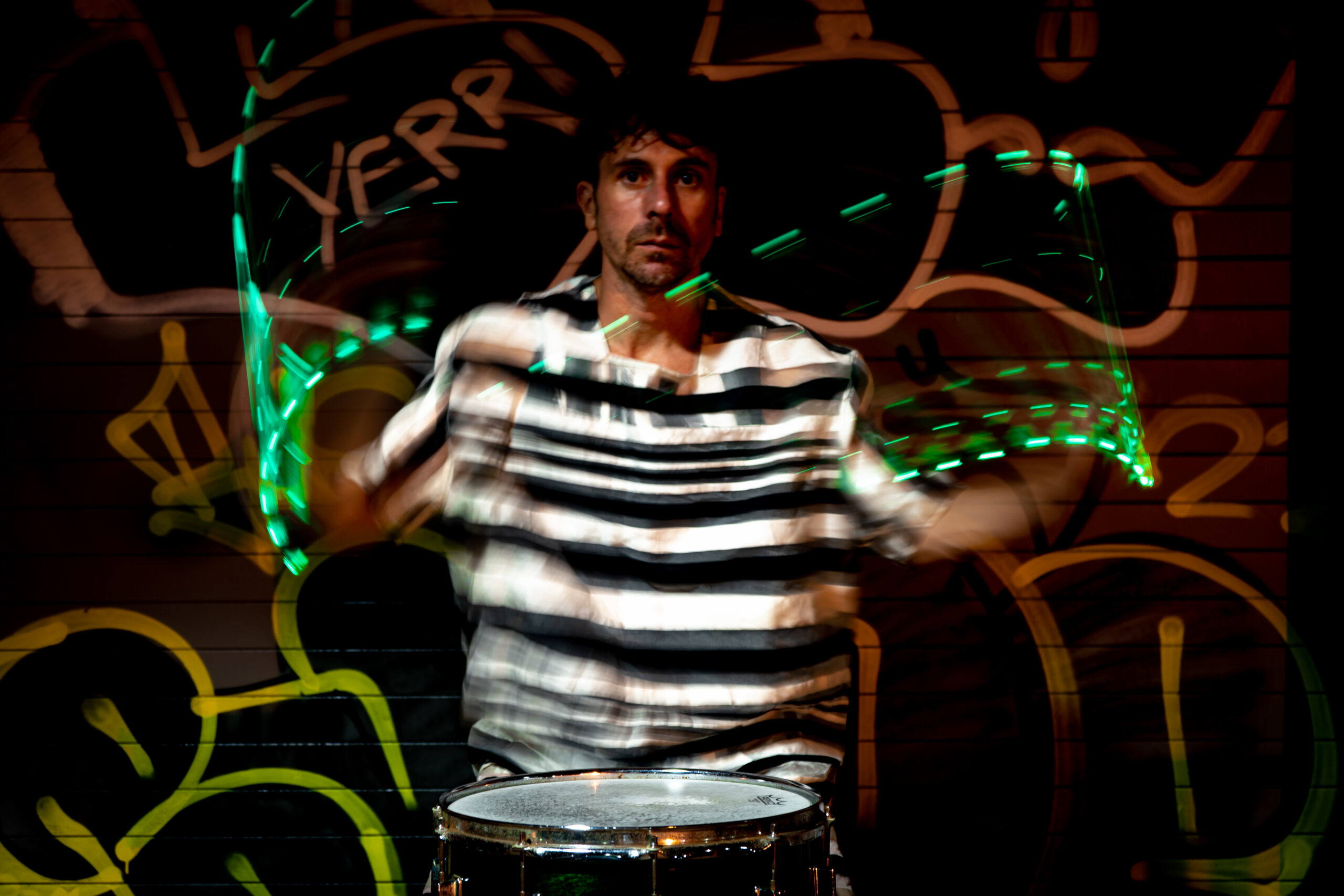
Photo by Linda Pedroso
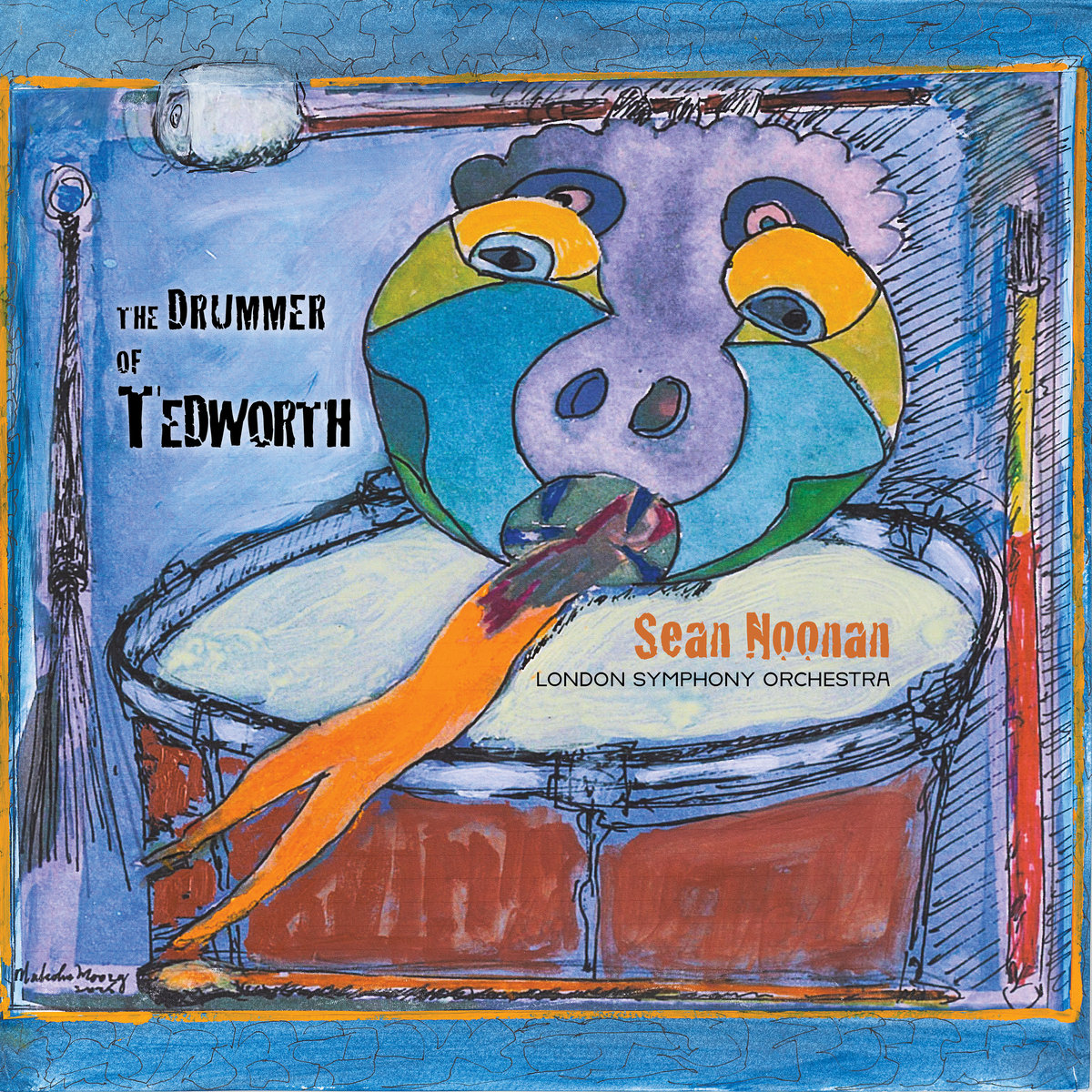
Summary: With The Drummer of Tedworth, Sean Noonan has created one of the most ambitious and original musical works of recent years. Recorded with the London Symphony Orchestra and released as a double-CD set, this extraordinary project transcends conventional categories, inhabiting a unique space somewhere between jazz, contemporary classical music, rock opera, spoken-word theatre, absurdist literature, and musical storytelling.
Review on Paris-Move
To buy the album
Sean Noonan’s interview
Frankie Pfeiffer: Sean, you are a drummer, percussionist, composer, and a “rhythmic storyteller”. Can you introduce yourself to the readers of Paris-Move who discovered you through our review of your The Drummer of Tedworth’s album?
Sean Noonan: I describe myself fundamentally as a “Speaking Drummer.” In my work, the voice isn’t just an accompaniment—it acts as a literal “fifth limb,” completely synchronized with what my hands and feet are executing behind the kit. “Rhythmic Storytelling” is the territory where avant-garde composition, folklore, theater, and raw improvisation collide.
To be completely honest, my music doesn’t sit comfortably anywhere—not in jazz, classical, rock, or musical theater. It defies standard categorization, which can make it a nightmare to market! Over my 25-year career, plenty of industry people discouraged me from taking this path. But I’m incredibly grateful for that challenge. It has turned me into an outsider, which allows me to project a totally unique artistic language. My ultimate hope is to inspire other drummers to break out from the back of the stage and find their own vocal freedom.
Frankie Pfeiffer: What is your musical background?
Sean Noonan: My background was forged in the trenches of the New York punk jazz scene, progressive improvisation, and global folklore. I have operated as a musical nomad, collaborating with everyone from Malian griots like Abdoulaye Diabaté and legendary Ornette Coleman loft-jazz pioneers like Jamaaladeen Tacuma, to avant-garde icons like Marc Ribot and classical ensembles like the Ligeti Quartet.
I didn’t take a traditional classical conservatory track. Like Frank Zappa, I am a self-taught composer. I learned the rules of orchestration simply by tearing scores apart, studying the masters, and treating the orchestra as a massive, acoustic extension of my drum kit.
Frankie Pfeiffer: Who are the musicians who influenced you?
Sean Noonan: The spirits sitting in the room with me while I compose form a wild, eclectic dinner party. You can hear the distinct DNA of Johannes Brahms, David Bowie, Lou Reed, Frank Zappa, Béla Bartók, Milford Graves, Samuel Beckett, and David Lynch, to name just a few.
That said, I think creators can do themselves a disservice by over-focusing on their idols. I am just as influenced by the raw rhythm of walking down a chaotic London street, the structural pacing of an absurdist play, or a strange visual image. Those everyday sensory inputs mutate in your subconscious until they turn into something completely unexpected.
Frankie Pfeiffer: For this album recorded with the London Symphony Orchestra, how did it happen? Why and how did you choose this orchestra and not another?
Sean Noonan: It began almost as a beautiful, cosmic accident. Years ago, I used to have these vivid dreams where Frank Zappa would visit me. Because of Zappa’s legendary, chaotic history recording his own orchestral music with the LSO in the 1980s, that specific orchestra became a mythic milestone in my mind.
Fast forward to moving to London and then the pandemic: I had a rare opportunity to participate in a brief LSO workshop for a short piece, which lit a fire under me. Around that same time, I officially became a British citizen. I thought, “What better way to celebrate my first major artistic milestone as a Londoner than by crashing the gates of the world-renowned London Symphony Orchestra with a drum kit?” It resulted in a hyper-intense two-year period of nonstop composing and orchestrating.
Frankie Pfeiffer: Tell us what inspired you to write this story? Introduce us to the characters found in this story!
Sean Noonan: The seed of the album comes from an actual historical haunting from 1661 in Wiltshire, England, where a local landowner confiscated the drum of an unlicensed, wandering vagrant performer. Shortly after, the house was plagued by phantom drumming noises. As a rhythmic storyteller, I am fascinated by how rhythm can be used as a weapon or a haunting.
But I needed to break away from history to make the myth my own. I created an existential odyssey centered around my alter-ego, Olis—a disembodied entity who refuses to be born because he views linear time and aging as a trap (“Time is never kind to those with knees”!). Olis seeks ‘pnoom’—a surreal state of cosmic nirvana—and delays his birth by diving into a pool of ketchup. This hurls him into the Féth Fiada, a reality-bending supernatural mist where he encounters a cast of absurd companions. There is Skarbnik, a blind seer who traps Olis in endless philosophical loops; the mischievous Krasnoludki (dwarfs); and Emmr, a pregnant Martian Refugee symbolizing exile and displacement. The story spirals into a cosmic battle involving Benjamin Franklin (whose mind gets stolen in a prank call) and Accabadora, the traditional Sardinian woman of death, where the ultimate weapon of choice is tickling. It’s a wild, Beckett-ian allegory about the absurdity of human existence.
Frankie Pfeiffer: You are a drummer and a percussionist. Which instruments do you play during that record?
Sean Noonan: On the record, I am strictly playing my core drum kit and providing the spoken-word/ vocal performance. Every other orchestral percussion instrument you hear—the marimbas, timpani, gongs, and tubular bells—is executed brilliantly by the LSO’s own world-class percussion section, strictly according to the score I provided.
Frankie Pfeiffer: How did you compose the different tracks for The Drummer of Tedworth’s album? Do you write the music for the Symphony Orchestra? Until which stage of composition do you go to?
Sean Noonan: Yes, every single note, dynamic, and articulation for all 40+ musicians in that orchestra was meticulously written out by me. The LSO thrives on absolute precision, so the less vagueness in the score, the better.
My composition process is deeply physical and unconventional. I don’t sit at a piano because it traps me in standard harmonic boxes. Instead, I compose sitting directly behind the drum kit, where “rhythmic cells” dictate the melodic shapes of the violins or brass. I also do a massive amount of conceptual writing underwater while I’m swimming—the weightlessness and rhythm of the water bring ideas to me from a completely subconscious level. Once the LSO locked in the instrumentation, I spent two years taking raw themes from my past work and expanding them into an orchestral fantasy, sculpting the orchestra to function essentially as a giant acoustic extension of my drum kit.
Frankie Pfeiffer: What was the role and importance of Jack Sheen, the conductor of the London Symphony Orchestra, before the recording of the album, and during its recording? Did you give instructions to other musicians?
Sean Noonan: Because I don’t come from a standard classical pedigree, I spent hundreds of exhausting hours proofreading parts to make sure there weren’t any notation errors. In a high-stakes session with an orchestra of that scale, a single typo can ruin the schedule.
Once we were in the studio, everything relied on the conductor’s expertise to translate my score instantly. Jack Sheen was magnificent at navigating the complex tempos and keeping the massive sonic architecture aligned. It was actually quite stressful for me because, for the first time in my life, I had to sit in the production booth and surrender control while they tracked. Watching your music come alive without sticks in your hands is a unique kind of creative torture!
Frankie Pfeiffer: How much freedom to play and improvise did you give them?
Sean Noonan: None at all for the orchestra. The LSO are elite masters at interpreting exactly what is written on the page, not jazz or avant-garde improvisers. The only element of improvisation on the entire double album comes from my own performance behind the kit. I actually performed off a loose lead sheet rather than a rigid classical score. I wanted to respect their flawless ability to interpret notation by contrasting it with my raw, unpredictable instincts as an improviser.
Frankie Pfeiffer: The closing “Give the Drummer a Chance” provides a triumphant and emotionally satisfying conclusion. Does it also mean, or shall we translate this title in “Give Sean Noonan a Chance”? 😉
Sean Noonan: (Laughs) You could absolutely translate it that way! That final track functions as a theatrical encore. I wanted to give the orchestra a moment to break character, let loose, and actually sing along as if we were all down at the pub celebrating the end of a long, grueling battle.
I am deeply honored that an institution as legendary as the London Symphony Orchestra took a chance on my mad vision. Putting a drum kit out front and treating it like a concerto soloist is a massive ask, and they met that challenge with total focus and commitment.
Frankie Pfeiffer: For us, there is an inevitable comparison with Jon Lord’s groundbreaking collaborations between rock musicians and symphony orchestras, like Concerto for Group and Orchestra (Deep Purple) and Gemini Suite. Do you agree with us? Have you ever listened to these two albums?
Sean Noonan: To be completely honest, I have never listened to those albums. When I am deep in the zone developing my own projects, I actively avoid listening to external music. I find that consuming too much other music traps my brain, triggers self-consciousness, and breeds a sort of writer’s block. I prefer to isolate myself in my own creative sandbox.
However, I find it absolutely spooky and magical how distinct eras, tones, and artistic currents can subconsciously mirror one another across time and space into a listener’s ear. I am incredibly flattered by the comparison.
Frankie Pfeiffer: In our review on PARIS-MOVE, we say that “the album may also remind adventurous listeners of Frank Zappa’s orchestral projects, Carla Bley’s large-scale jazz compositions, Charles Mingus’s extended suites, Robert Wyatt’s theatrical sensibilities”. Do you agree with us? And who would you be most attracted to artistically?
Sean Noonan: I will happily leave those brilliant connections to the music journalists! But if you’re going to strand me on an island alongside Zappa, Bley, Mingus, and Wyatt, I am absolutely all in. I love and respect every single one of those creators because they all fiercely refused to let walls define their sound.
Frankie Pfeiffer: Which famous musician(s) would you like to play with?
Sean Noonan: I don’t really care about fame for the sake of it; there always has to be a deeper artistic motivation or a gut feeling that something unpredictable will happen. Because my work is shifting so heavily into theatrical storytelling, my dream collaborations are actually with boundary-pushing actors and filmmakers. I would love to build a massive, multimedia Rock Opera version of The Drummer of Tedworth and feature voices like Joaquin Phoenix, Gillian Anderson, or Eddie Murphy narrating alongside a symphony orchestra. I handled all the characters myself on this record, but moving forward, I want to bring other dramatic forces into the fold! Btw next time maybe a French Symphony Orchestra and does anyone know one that would like to collaborate with me?
Frankie Pfeiffer: After such an album, how do you see your music evolving? What will be your next album?
Sean Noonan: The Drummer of Tedworth has made me realize that I am building a lifelong existential trilogy. Tedworth is officially Part 2.
This summer in London, I am producing a solo film project where the studio is built to look like I am trapped inside a giant silo. This links directly to the concept for Part 1 of the trilogy: Olis: The Silo, which explores Olis’s disembodied, unborn thoughts before he ever enters the physical world. Accompanying this, I am releasing a series of remixed retrospective singles celebrating my 25-year catalog, breathing new life into my past tracks with Marc Ribot, Jamaaladeen Tacuma, CAN vocalist Malcolm Mooney, and the Sardinian vocal quartet Drumavox.
Ultimately, the goal is to take this trilogy and mount it in two parallel formats: a grand, Wagnerian orchestral cycle, and an intimate, electro-acoustic solo show where the entire orchestra is mapped directly inside my electro-acoustic drum kit. Olis is moving out from behind the curtain and taking over the stage completely.
If The Drummer of Tedworth sparks your curiosity, it is just the tip of a very deep iceberg! Over the last 25 years, I’ve released over 30 albums tracking this journey—ranging from afro-celtic punk jazz with my group Brewed by Noon, to avant-garde rock with Pavees Dance.
I highly encourage adventurous listeners to bypass the generic streaming algorithms and head straight to my website at SeanNoonanMusic.com. There, you can explore my full discography, read the deeper narratives behind the projects, and purchase physical CDs, limited vinyl, and digital releases directly. Supporting independent music directly is what allows madness like recording with the London Symphony Orchestra to happen in the first place! Thank you for listening.
Frankie Pfeiffer: Thanks for your time, Sean, and all the Best for this solo film project!