
| Jazz |
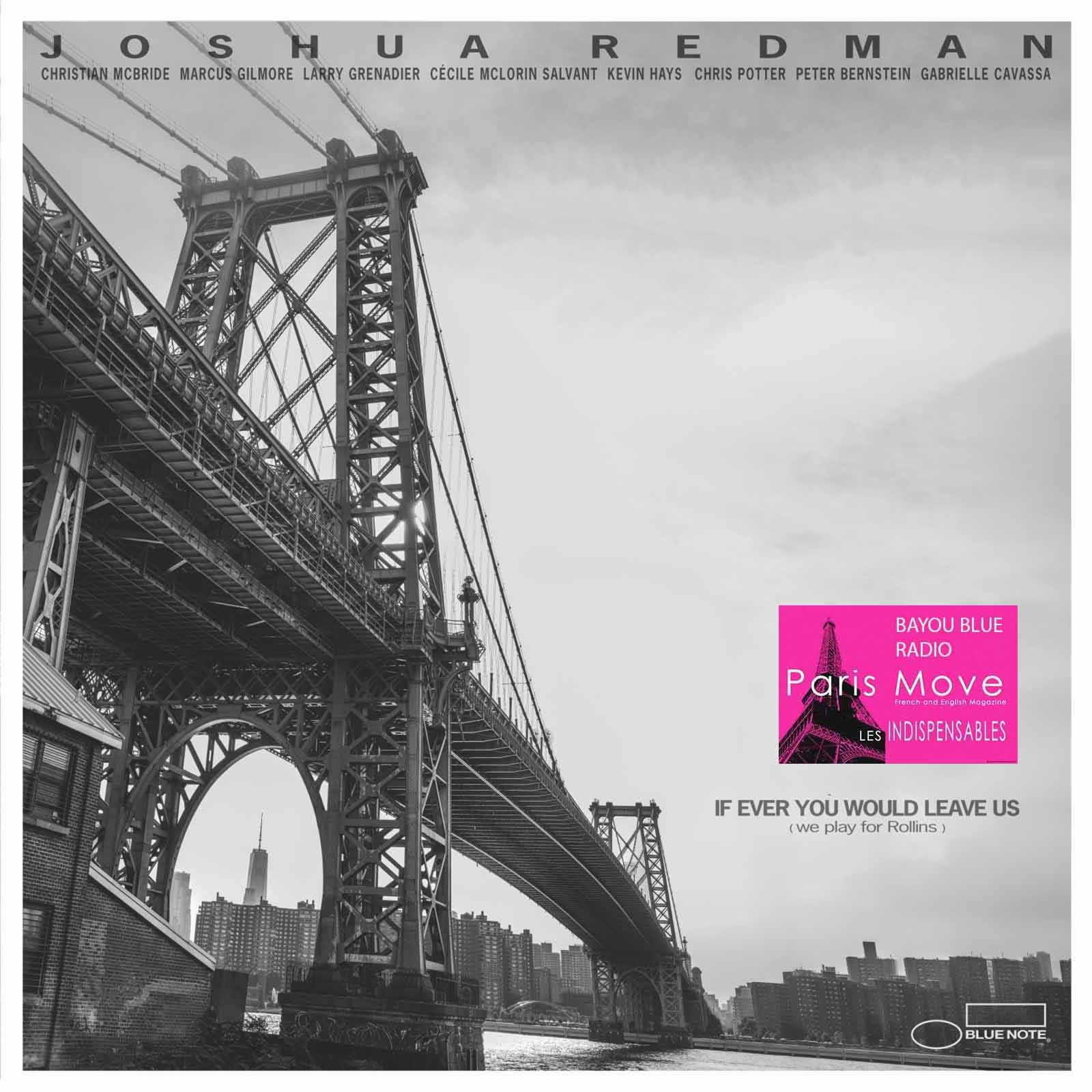
JOSHUA REDMAN: SONNY ROLLINS AND THE LEGACY OF FREEDOM
How do you pay tribute to a giant without being overwhelmed by his shadow? That is the question at the heart of Joshua Redman’s If Ever You Would Leave Us (we play for Rollins), a deeply personal album dedicated to Sonny Rollins, one of the most influential figures in the history of the tenor saxophone. Rollins’s death left more than a void in the jazz world; it marked the passing of an artistic force whose influence reached across generations. Redman could have approached this project as a celebration of a legendary repertoire, a gathering of distinguished musicians revisiting familiar classics. Instead, he has taken a more compelling-and more demanding-route. He does not seek to reproduce Rollins’s sound or retrace his steps. He takes the music into his own hands, filters it through his own experience and gives it room to breathe again. The result is not an exercise in nostalgia, but a living conversation between generations: a tribute that understands the deepest form of musical respect is not imitation, but freedom.
Sonny Rollins’s death on May 25, 2026, at the age of 95, sent a wave of sadness through the jazz world. For musicians and the countless listeners who had followed his career, it meant much more than the loss of a towering instrumentalist. It marked the end of an era and the passing of an artistic presence whose influence had long since extended beyond the tenor saxophone itself. Like Miles Davis, Rollins belonged to that rare breed of artist who never allowed an extraordinary reputation to become an excuse for standing still. Each new phase of his career seemed to challenge what had come before; each recording brought fresh surprises and reflected an enduring desire to push his musical language in new directions. Their greatness lay not only in their command of the music, but also in their refusal to settle into a style simply because they had mastered it. They understood that creativity cannot thrive on the endless repetition of past triumphs, and that remaining true to a tradition sometimes means having the courage to move beyond it.
Redman has spoken candidly about how deeply Rollins’s death affected him. He described the loss as something akin to losing a parent, calling Sonny a father figure, a grandfather and, in every sense, a musical godfather. His words help explain what lies at the heart of this project. This is not simply a tribute to a musician he admired. It is an acknowledgment of an artistic bond, built over many years through listening, studying and gradually absorbing another musician’s language. In jazz, that kind of inheritance is about much more than technique or familiarity with a repertoire. It involves learning how to think about music, how to breathe with it and how to make it part of your own life. Redman felt an almost cathartic need to do something for Rollins, although at first he wasn’t sure what form that tribute should take. He began reaching out to friends and fellow musicians, and several leading artists quickly made themselves available for recording sessions in New York that came together within a matter of weeks. Something of that urgency and spontaneity can be felt in the finished album. For all its careful musical construction, it never loses its deeply human character.
What explains Sonny Rollins’s extraordinary influence on generations of musicians? Much of the answer lies in his remarkable ability to take a relatively simple melodic idea and turn it into an almost limitless field of exploration. By the 1950s, with landmark recordings such as Saxophone Colossus, Tenor Madness and Way Out West, he had established a voice that was unmistakably his own. His tone was muscular and full-bodied, sometimes rough around the edges, yet always alive with an extraordinary sense of movement. He could stretch a phrase far beyond its expected length, shift an accent, leave an idea hanging and return to it from an entirely unexpected direction. In his hands, a melody could travel places the listener had never imagined. For Rollins, improvisation was never simply a display of technical prowess. It was an act of composition unfolding in real time, an architecture built note by note, with every pause, every silence and every rhythmic shift helping to shape the musical narrative. His celebrated retreat from the jazz scene in the late 1950s, when he practiced beneath New York’s Williamsburg Bridge, says a great deal about the artist he was. Already recognized as one of the finest saxophonists of his generation, he nevertheless felt compelled to step away from the spotlight and devote himself to his music. Public acclaim, he understood, could never replace the personal need to keep searching.
That is the musical world Joshua Redman enters with this album, but it would be a mistake to hear it as a straightforward continuation of Rollins’s work. Comparisons between the two saxophonists are inevitable, and there are certainly points of connection. But I find those comparisons less useful when they become an exercise in measuring one musician against the other. There are affinities in their phrasing, the sheer force of their expression and the freedom they bring to improvisation. Still, Redman has his own voice, his own sensibility and his own way of shaping a musical conversation. Rollins could sometimes seem to venture beyond the edges of the music, taking improvisation into territory that felt almost limitless. Redman, by contrast, often seems more directly connected to the emotional content of what he is playing. He appears to take in what the music makes him feel before deciding where to take it. That emotional immediacy, however, should not be mistaken for a lack of rigor. His technical command is formidable, and it is precisely that command that allows him to take chances while making the music sound so natural. Redman is not trying to become Sonny Rollins. He is showing us what Rollins made possible in him as a musician.
The album features 11 selections drawn from Rollins’s repertoire, including his own compositions and standards that he made unmistakably his own. The program includes “There Will Never Be Another You,” “Doxy,” “The Last Time I Saw Paris,” “Pent-Up House,” “Softly, As in a Morning Sunrise,” “If Ever I Would Leave You,” “Blue Seven,” “Valse Hot,” “Grand Street,” “God Bless the Child” and “Don’t Stop the Carnival.” The musicians assembled for the project are equally impressive: drummer Marcus Gilmore; bassists Christian McBride and Larry Grenadier; pianist Kevin Hays; guitarist Peter Bernstein; saxophonist Chris Potter; and two outstanding voices in contemporary jazz, Cécile McLorin Salvant and Gabrielle Cavassa. Several of these musicians also have a direct connection to Rollins’s musical history, including Kevin Hays and Peter Bernstein, who have been part of his musical circle. But this is not simply a gathering of celebrated names. Each musician brings something distinctive to the project, whether an intimate understanding of the repertoire, a deep feel for the tradition or an appetite for exploring where the music might go next. The changing lineups-from solo saxophone to duos, trios and larger ensembles-give Redman plenty of room to explore different textures without ever losing sight of the album’s central idea.
One of the album’s most compelling features is its economy of means, especially in the passages where Redman’s saxophone is paired with little more than a double bass, sometimes joined by drums. On the surface, the setup may seem almost bare-bones. Listen more closely, though, and a remarkably intricate musical conversation begins to emerge. The bass is never merely there to provide harmonic support. It becomes a full-fledged partner in the exchange, suggesting new directions, shifting the musical perspective and responding to the saxophone in real time. The drums, too, do far more than keep the beat. They help shape the conversation, introduce tension, shift the accents and keep the music moving in unexpected ways. These stripped-down passages bring out the beauty of the saxophone in its most direct form. But the apparent simplicity is deceptive. Beneath it lies an extraordinary degree of attention to timing, silence, breathing and the subtle interplay among the musicians. Nothing feels superfluous, and nothing is quite as simple as it first appears.
The decision to work with piano-less groups also points to a central part of Rollins’s legacy. Without a piano to lay down the harmony, every musician has to take greater responsibility for shaping the music. The harmonic structure is no longer spelled out at every turn; it is implied, suggested and reshaped through the players’ interaction. The soloist, in turn, must create much of the musical landscape around himself. This kind of playing calls for exceptional listening skills and an almost instinctive trust among the musicians. Redman knows the tradition inside out, but he has no interest in simply retracing Rollins’s steps. He uses that tradition as a launching pad for his own exploration, particularly when it comes to rhythm. “The Last Time I Saw Paris,” for example, is played in five rather than the four beats of Rollins’s familiar version. “Pent-Up House” makes extensive use of a seven-beat meter, while “Valse Hot” moves through a rhythmic pattern approaching eleven beats. What makes these choices so effective is that they never come across as intellectual exercises designed to impress fellow musicians or jazz aficionados. The music remains fluid, propulsive and deeply connected to the melody. Redman has explained how important it is for him to feel rhythm physically, to experience it as something you can dance to rather than as a sequence of measures on a page. That strikes me as a crucial point. Complexity matters only when it serves the music, when it adds to its emotional force rather than getting in the way.
The range of material on the album also brings several sides of Rollins’s musical world into focus. The opening track, “There Will Never Be Another You,” is performed on solo saxophone and immediately sets the tone. With no harmonic or rhythmic accompaniment, Redman has only his instrument and his breath with which to build the musical narrative. It is a wonderfully spare opening, a reminder that jazz can begin with nothing more than a musician engaging with a melody. “Doxy,” with Christian McBride, takes us in a different direction, offering a direct and lively exchange between saxophone and bass. The two musicians seem to be talking to each other, with an easy freedom that never needs to call attention to itself. “Blue Seven,” featuring Chris Potter, offers another highlight. A meeting between two tenor saxophonists could easily have turned into a contest of chops, but instead it becomes a genuine musical conversation between two strong individual voices. Both players know their instrument’s possibilities inside out, and both understand that developing an idea can be more rewarding than trying to overpower a partner. “Grand Street,” with Peter Bernstein on guitar, brings yet another color to the repertoire, while the title track, featuring Kevin Hays on piano, introduces a different harmonic dimension to the album.
The contributions of vocalists Cécile McLorin Salvant and Gabrielle Cavassa add another important dimension to the project. Their presence broadens the scope of the tribute and allows familiar compositions to be heard from a fresh perspective. Salvant’s performance of “Softly, As in a Morning Sunrise” is built around a deliberately spare arrangement of bass and drums, with no piano or guitar-a choice that recalls the spirit of Rollins’s classic piano-less trio. “God Bless the Child,” featuring Cavassa, brings a particularly moving moment to the album. The selection also carries a strong historical resonance. It recalls Rollins’s 1962 recording of the song on The Bridge, in which he paid tribute to Billie Holiday. There is something especially meaningful about that connection. One musician is honoring another who, in turn, had paid tribute to a great singer. The chain of musical remembrance reaches well beyond the relationship between two saxophonists. Jazz, at its best, is an ongoing conversation across generations, with each new voice finding something different in the music it inherits.
Beyond the arrangements and the impressive roster of musicians, however, it is Redman’s own personality that gives the album its real purpose. What I find most striking is his ability to express profound admiration for Rollins without becoming overly reverential. He does not try to imitate his mentor’s sound, attack or phrasing. Instead, he acknowledges the distance between them and turns that difference into a source of creative energy. He takes these compositions, reshapes them, sometimes changes their underlying balance and gives them a character of their own. That approach requires considerable confidence in his own musical voice, but it also reflects a generous spirit. Redman makes room for his fellow musicians, allowing them to contribute fully rather than treating them as supporting players in a personal statement. The music never feels like a demonstration of everything the musicians can do. It offers something more valuable: emotional depth. Redman is free without losing his sense of direction, spontaneous without becoming unfocused. That balance between instinct and structure is one of the reasons the album works so well.
It would be unfair to think of this album as an attempt to replace Sonny Rollins’s original recordings. Nothing can take the place of Saxophone Colossus, Way Out West or A Night at the Village Vanguard, all of which remain essential listening and landmarks in the history of jazz. But a genuine tribute is not supposed to replace its inspiration. At its best, it sends us back to the original music with fresh ears. It may reveal something we had overlooked, make us hear a familiar passage differently or deepen our appreciation of what one generation has passed on to the next. That is exactly what Redman achieves here. He does not turn Rollins into a museum piece. He reminds us that this repertoire is still alive, still capable of inspiring new musical ideas and new emotional responses. That feels especially important at a time when so much of the music business is driven by familiar formulas and the pursuit of immediate results. Jazz continues to offer something essential: the possibility of treating creativity as an act of freedom, with tradition not as a boundary to be respected from a distance, but as living material that every generation has the responsibility to reshape.
By the time the album ends, I find myself returning to the feeling I had at the outset: this is a wonderful achievement, not because it sets out to match Sonny Rollins’s masterpieces, but because it stands on its own. It is personal, generous, intelligent and full of life. Few musicians can revisit a repertoire so deeply rooted in jazz history without becoming overwhelmed by the weight of its legend. Redman succeeds because he never tries to be someone else. He plays for Rollins, with Rollins and, above all, from everything Rollins gave him. That distinction matters. True artistic fidelity is not about reproducing a master’s gestures; it is about carrying forward the freedom that made those gestures possible in the first place. Thank you, Blue Note, for bringing this project to life, and, above all, thank you, Joshua Redman, for understanding that the measure of a genuine tribute is not how faithfully it copies the original, but how honestly it transforms it. Sonny Rollins is no longer with us, but his spirit lives on in that restless impulse to search, start over, take chances and never assume that the musical journey is finished. When Redman’s saxophone rises above a double bass and drums, creating music that sounds so effortless while concealing such remarkable rhythmic complexity, he is not trying to bring the past back to life. He is reminding us that jazz has never stopped moving forward. And perhaps that is the finest tribute one can pay to one of the music’s greatest creators.
Thierry De Clemensat
Member at Jazz Journalists Association
USA correspondent for Paris-Move and ABS magazine
Editor in chief – Bayou Blue Radio, Bayou Blue News
PARIS-MOVE, November 23rd, 2026
Follow PARIS-MOVE on X
::::::::::::::::::::::::
Musicians:
Joshua Redman – saxophone (tenor)
Christian McBride – bass
Larry Grenadier – bass
Marcus Gilmore – drums
Kevin Hays – piano
Peter Bernstein – guitar
Chris Potter – tenor saxophone
Cécile McLorin Salvant – vocals
Gabrielle Cavassa – vocals
Tracklist:
1. There Will Never Be Another You
2. Doxy
3. The Last Time I Saw Paris
4. Pent-Up House
5. Softly, As In A Morning Sunrise
6. If Ever I Would Leave You
7. Blue Seven
8. Valse Hot
9. Grand Street
10. God Bless The Child
11. Don’t Stop The Carnival