
| Jazz |
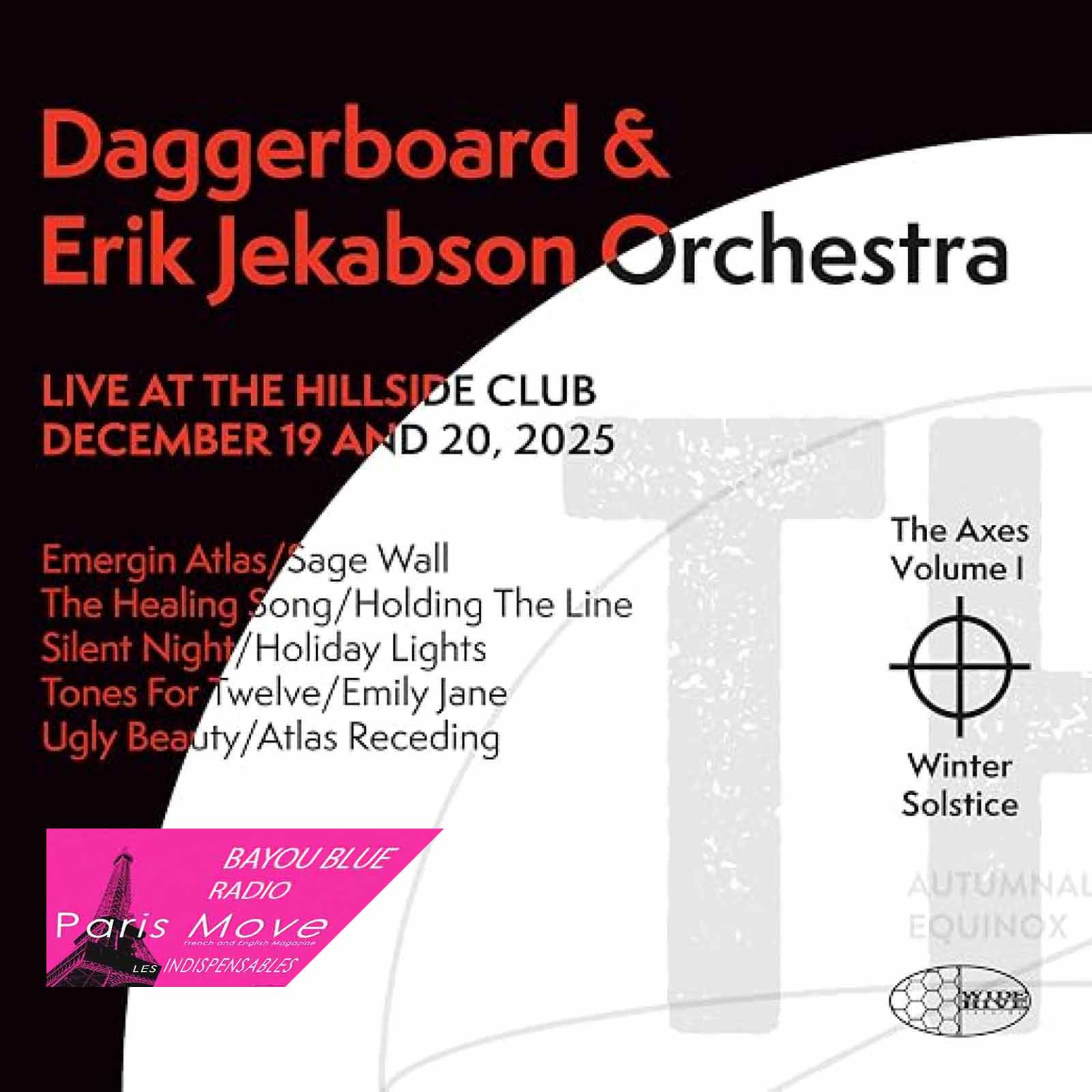
I had withdrawn my original review of this album after the label alerted me to a manufacturing flaw in the promotional CD and promised a corrected copy. It was the right call. Music deserves to be judged on its own terms, not through the failings of a defective disc. Now, with the replacement in hand, I can return to The Axes, Volume IV: Winter Solstice and give this remarkable project the attention it deserves. Recorded live at Berkeley’s Hillside Club on Dec. 19 and 20, 2025, the album brings together Daggerboard and Erik Jekabson in a work of striking orchestral ambition. The compositions are beautiful, the arrangements richly conceived, and the musicianship exceptional. Above all, this is an ensemble performance of uncommon scale and purpose-grand in sound, yet grounded in the intelligence of its collective vision.
This morning, sunlight slips through the ecru curtain in my office. A cup of cold coffee sits nearby, the residue of an already busy morning that included an online conversation with pianist Armel Dupas. I press play. Erik Jekabson’s musical world is familiar to me, but his work continues to reward closer attention. As a trumpeter, composer and arranger, he approaches the orchestra as something more than a gathering of players: he thinks in terms of musical voices, melodic architecture and the expressive possibilities of each instrument. What emerges here is not simply a showcase for virtuoso musicians. It is a fully realized artistic statement, with its own identity, direction and sense of purpose.
The opening offers an intriguing surprise. The musicians enter while playing, making their way through the room as they gradually take their places. The moment gives the recording an almost documentary quality. The concert does not begin in the usual way, with the ensemble already assembled onstage and ready to perform. Instead, we witness the event taking shape before us. The first piece therefore has a somewhat unusual acoustic character, shaped by the musicians’ movements and their gradual arrival at their positions. Then, with the second track, everyone is in place, the balances begin to settle, and the performance truly takes off. Grandiose! This choice lends the album a welcome spontaneity. It reminds us that live music is not simply the flawless execution of a score; it is also made up of encounters, gestures, movement and the particular relationship that develops between performers and audience.
“Emerging Atlas” opens the journey with an almost cinematic purpose. The title suggests an appearance, something gradually taking shape, and that idea seems especially fitting given the musicians’ entrance. We discover, little by little, the scale of the ensemble, its many colors and the possibilities of its musical language. The first piece serves as an introduction to a world that does not immediately reveal all its riches. It establishes a perspective and prepares the listener for a broader experience. I appreciate this refusal to disclose everything in the opening measures. There is real intelligence in the approach, a willingness to let the music take possession of the space before revealing the full scope of its orchestral character.
With “Sage Wall,” the project takes on a different scale. The label singles out this composition as one of the album’s highlights, particularly for the richness of its harmonic development. That quality is central to the piece: the chords do not merely provide a foundation for the melody; they help shape its evolution and give it added depth. The writing opens up different perspectives, plays with instrumental colors and gives each instrument a role that extends beyond its individual sound. The music has a density that rewards close listening. Its harmonies unfold with considerable breadth, while the orchestral architecture allows the listener to appreciate their many nuances. “Sage Wall” offers a revealing glimpse of Jekabson’s approach: building a work around melodic and harmonic material rich enough for the orchestra to explore its possibilities without losing its sense of unity.
“The Healing Song” continues that exploration in a particularly compelling direction. Here, too, the composition draws on the harmonic richness that is one of the program’s defining characteristics. But its title invites another kind of listening. It suggests music concerned with solace, restoration and a form of inner reconciliation. Without insisting on a literal interpretation, I find it interesting to hear this piece as a moment of breathing room within the album’s larger journey. The orchestral writing gives the melody a particular depth, allowing the different musical voices to contribute to a shared expression. There is something in this composition that goes beyond the exercise of writing itself. It reminds us that music can be a place of gathering, a way of recovering a certain emotional openness. That is also what makes Jekabson’s work so engaging: sophistication never comes at the expense of feeling.
With “Holding the Line,” the album introduces another dimension: the human voice. Gregory Howe takes the vocal part, naturally changing the listener’s relationship with the instrumental ensemble. The voice brings a particular sense of intimacy, a different way of carrying the musical narrative and allowing the words to emerge within this orchestral architecture. We are no longer following only the exchanges among the instruments; we are also invited to receive a human expression that moves to the foreground. The title itself suggests resistance, remaining faithful to a position and finding the strength to hold on in difficult circumstances. That idea gives the piece a resonance beyond its musical interest alone. I particularly appreciate the decision not to confine the project to an exclusively instrumental conception. The orchestra has enough resources to accommodate the voice without losing its identity.
“Silent Night” represents another important moment in the program. Here, Erik Jekabson takes a universally familiar melody and gives it a new orchestral dimension. The task is more delicate than it might seem. A well-known work carries with it established listening habits, memories and cultural associations that can easily limit the possibilities of interpretation. The challenge is to strike a balance between respecting the melody and giving it a fresh perspective. The strength of this arrangement lies precisely in the richness of its harmonic setting. The chord progressions renew our experience of a familiar theme and give it a different kind of depth. This is not simply an attempt to reproduce the atmosphere of the holiday season. The arrangement belongs to the album’s broader orchestral vision and demonstrates how much a familiar melody can still reveal when approached with imagination.
With “Holiday Lights,” Katrina Vila brings her voice to the project. The presence of a second singer further broadens the album’s expressive landscape. This is not simply a matter of adding more vocal passages; it gives the music another way to communicate with its audience. The voice becomes an additional color in an already rich palette. The title naturally evokes the lights of the holiday season, but it would be reductive to regard the composition as a straightforward musical illustration of the festivities. What interests me is the way the piece contributes to the program’s overall coherence while offering a different kind of breathing space after the instrumental developments and earlier musical statements. Katrina Vila’s contribution adds to that diversity and reminds us that an orchestra can accommodate different forms of expression without sacrificing its unity.
“Tones for Twelve” marks a particularly important stage in the album’s progression. Its length gives the composition room to develop a more expansive musical statement and allows the different components of the ensemble to occupy a broader space. It is precisely in a piece like this that we can appreciate Jekabson’s arranging skills and his understanding of the orchestra’s possibilities. A wealth of instrumental colors should never be confused with a mere accumulation of sounds. The different voices must be organized, relationships established between registers and a coherent progression maintained so that the listener can follow the musical argument. That challenge becomes especially important in a composition of this length. Its success lies in the orchestra’s ability to develop the musical material, sustain its momentum and prevent density from becoming repetitive. The piece contributes to the ambitious scale that distinguishes this project from a simple sequence of individual tracks.
“Emily Jane,” one of the program’s longest compositions, offers another opportunity for development. Its length gives the music time to breathe, allows its ideas to unfold and brings out the narrative dimension of the writing. I particularly appreciate this willingness to take time in a contemporary album. Not everything has to be built around immediate impact or a theme that stays with us after just a few seconds. A composition may need several minutes to reveal its intentions, establish its atmosphere and give the listener the sense of having traveled somewhere. This piece contributes to that impression. It reminds us that time is itself an element of composition, and that duration can become a strength when it serves the development of the music. It is also in works of this kind that we recognize a composer’s confidence in the ensemble and in the audience’s capacity for attentive listening.
Finally, “Atlas Receding” brings the journey to a close with a title that naturally answers “Emerging Atlas.” The relationship between appearance and withdrawal, emergence and distance, gives the album an almost narrative coherence. The program does not simply line up a series of independent compositions. It has an opening and a conclusion that can be heard as the two ends of a single movement. The final title suggests retreat, gradual disappearance or perhaps simply the moment when we become aware of the journey we have just completed. I find that idea especially compelling in a live recording. Having discovered the musicians, followed their musical ideas, welcomed the vocal contributions and explored the orchestra’s different dimensions, the listener arrives at a conclusion that invites a mental return to the path just traveled. The circle closes, but the musical impression remains.
Beyond the compositions themselves, what stands out across the program is the way Erik Jekabson organizes the relationships among the different instrumental families. The strings are not merely a background intended to add weight to the arrangements. The brass are not there simply to deliver the most spectacular moments. The woodwinds contribute their own colors and nuances, while the rhythm section provides the essential mobility of jazz. Each family has a role in the larger construction. Achieving this kind of balance requires a deep understanding of the instruments, but also genuine musical sensitivity, so that the writing never becomes a mechanical exercise.
The caliber of the musicians gathered around Jekabson is, of course, crucial. An ambitious score alone cannot make a convincing work. It takes performers who understand its intentions, respect its balances and bring their own sensibilities to the music. Here, technical command goes hand in hand with genuine collective listening. The musicians do not simply take turns playing. They seem attuned to what the others have just offered, and they know how to place their own contributions within the continuing flow of the music. The instrumental solos are dazzling, but they never try to take over the entire proceedings. They belong to a broader conversation, serving a musical structure that remains clearly in view throughout.
This intelligence of the writing deserves to be considered within the larger conversation about the relationship between jazz and classical music. These two worlds have different traditions, demands and histories, but they also share a particular concern for form, harmony and the relationships among instruments. Their meeting can produce remarkable results when it grows out of a genuine musical necessity. That is what happens here. The orchestra is not a backdrop intended to lend jazz a little extra prestige. It becomes a creative space, an opportunity to expand the vocabulary and bring out colors that would not exist in a smaller ensemble. The minimalist influences associated with the project also offer an interesting perspective. They invite us to consider repetition, the evolution of motifs and the gradual transformation of musical material, without confining the compositions to a single aesthetic.
Daggerboard’s contribution deserves to be appreciated in this same light. This is not simply a matter of extending a contemporary musical aesthetic by adding a few orchestral elements. The project reveals a deeper investigation into form, texture and the possibilities for renewing musical language. Gregory Howe’s presence is part of what gives the undertaking its distinctive identity. As a composer, guitarist, producer and performer, he contributes to a creative environment in which different sensibilities can circulate freely. Jazz, orchestral music and a range of contemporary concerns meet here without any one tradition needing to dominate the others. The result has a personality of its own, one that cannot be reduced to a convenient label.
The live recording adds another dimension to the project. There is a fundamental difference between a studio production, in which every element can be adjusted separately, and a performance given before an audience in a real space. A concert requires musicians to make decisions in the moment. It introduces an element of unpredictability, spontaneity and collective responsibility that is an integral part of live music. The two December performances at the Hillside Club thus preserve a particular moment in this ensemble’s life. The decision to retain the musicians’ entrance through the room reflects a desire to document the event rather than transform it into an artificially perfect performance.
The production work required for a project of this scale also deserves recognition. With an ensemble this large and varied, achieving the right sonic balance is a considerable challenge. The strings must retain their depth, the brass their brilliance, the woodwinds their precision and the rhythm section its presence. It is not enough to reproduce the orchestra’s power; the recording must preserve the clarity of its individual components. Grandeur should never become an indistinct mass of sound. Every instrument must be able to exist on its own without compromising the cohesion of the whole. It is this interplay of depth, transparency and energy that allows the listener to appreciate the details of the arrangements while still feeling the ensemble’s spectacular scale.
I believe Erik Jekabson should also be recognized for a particular quality: his understanding that a composition’s success depends not only on what the composer puts into it, but also on what he allows others to bring out. Writing for an ensemble of this size requires a knowledge of the instruments, but it also requires trust in the performers. They must be given enough room to contribute their individuality and take the music beyond what is written on the page. That trust can be heard in the space afforded to the soloists and in the way the different sections participate in the overall construction. The composer does not try to occupy every available space. He creates the conditions for collective expression.
The depth of the arrangements and the progression of the musical argument are therefore not secondary operations carried out on the margins of the creative process. They are essential links in a complex artistic chain. Composition provides the material, arrangement gives it structure, performers bring it to life, and the concert allows it to meet its audience. Each stage matters in its own right. None can be treated as secondary without risking the strength of the whole. It is precisely this continuity between the original idea and its collective realization that gives Winter Solstice its particular stature.
I finish this listening session with the feeling that I have found what I had hoped for in the replacement edition. The technical problem with the first pressing had interrupted my work and forced me to put on hold a review that could not responsibly be published under those circumstances. The new copy allows me to return to the album with the peace of mind that a proper assessment requires. This was not simply a matter of checking that the tracks could now be heard without difficulty. It was about being able to appreciate the work in its entirety: its unfolding, its contrasts and the way the individual compositions find their place within a unified project. This second listening confirms my initial impression and gives it greater depth.
The Axes, Volume IV: Winter Solstice is an album that deserves to be heard in its entirety, and without rushing. Its richness lies not only in the quality of its soloists, impressive as they are, but above all in the orchestral vision that shapes the project, the beauty of the compositions and the way the different instruments create a coherent musical space. The meeting of jazz and classical music finds genuine justification here because it rests on thoughtful writing rather than the pursuit of a superficial effect. The arrangements lend depth to the melodies, the improvisations preserve the freedom of jazz, and the collective dimension gives the music remarkable breadth.
Ultimately, Erik Jekabson and Daggerboard remind us that the greatness of an orchestra cannot be measured by sheer sonic power alone. It is measured by what it makes possible among the musicians themselves. With this recording, they offer a compelling musical vision, brought to life by performers capable of combining individual expression with a shared artistic purpose. The compositions are beautiful, the arrangements remarkably deep, and the performance has the vitality that distinguishes live recordings from mere reproductions of a score. This is expansive, intelligent and generous music-music that gives listeners the pleasure of discovering, listening again and returning to it. That is precisely what I expect from a major musical undertaking: a distinct identity, artistic rigor, freedom and the ability to stir an emotion that continues to resonate long after the final note.
Thierry De Clemensat
Member at Jazz Journalists Association
USA correspondent for Paris-Move and ABS magazine
Editor in chief – Bayou Blue Radio, Bayou Blue News
PARIS-MOVE, November 17th, 2026
Follow PARIS-MOVE on X
::::::::::::::::::::::::
Musicians :
Conductors: Charith Premawardhana who also plays Viola, and Erik Jekabson who also plays Trumpet and Flugelhorn.
Violin: Anthony Blea
Violin: Alisa Rose
Viola: Darcy Rindt
Cello: Ben Davis
Flute: Mary Fettig
Oboe: Dana Bauer
Clarinet/saxophone: Harvey Wainapel
Bassoon: Paul Hanson
French Horn: Wayne Van Lieu
Trombone: Jeff Cressman
Percussion: Kjall Nordeson
Guitar: Jordan Samuels
Piano: Matt Clark
Trumpet : Max Miller-Loran
Bass: Dan Feiszli
Drums: James Beauton
There are also two original vocal songs Holding the Line which features Gregory Howe and Katrina Vila sings Holliday Lights.
Gregory Howe : Vocals
Katrina Vila : Vocals
Track Listing :
- Emerging Atlas
- Sage Wall
- The Healing Song
- Holding The Line
- Silent Night
- Holiday Lights
- Tones For Twelve
- Emily Jane
- Ugly Beauty
- Atlas Receding