
| Pop |
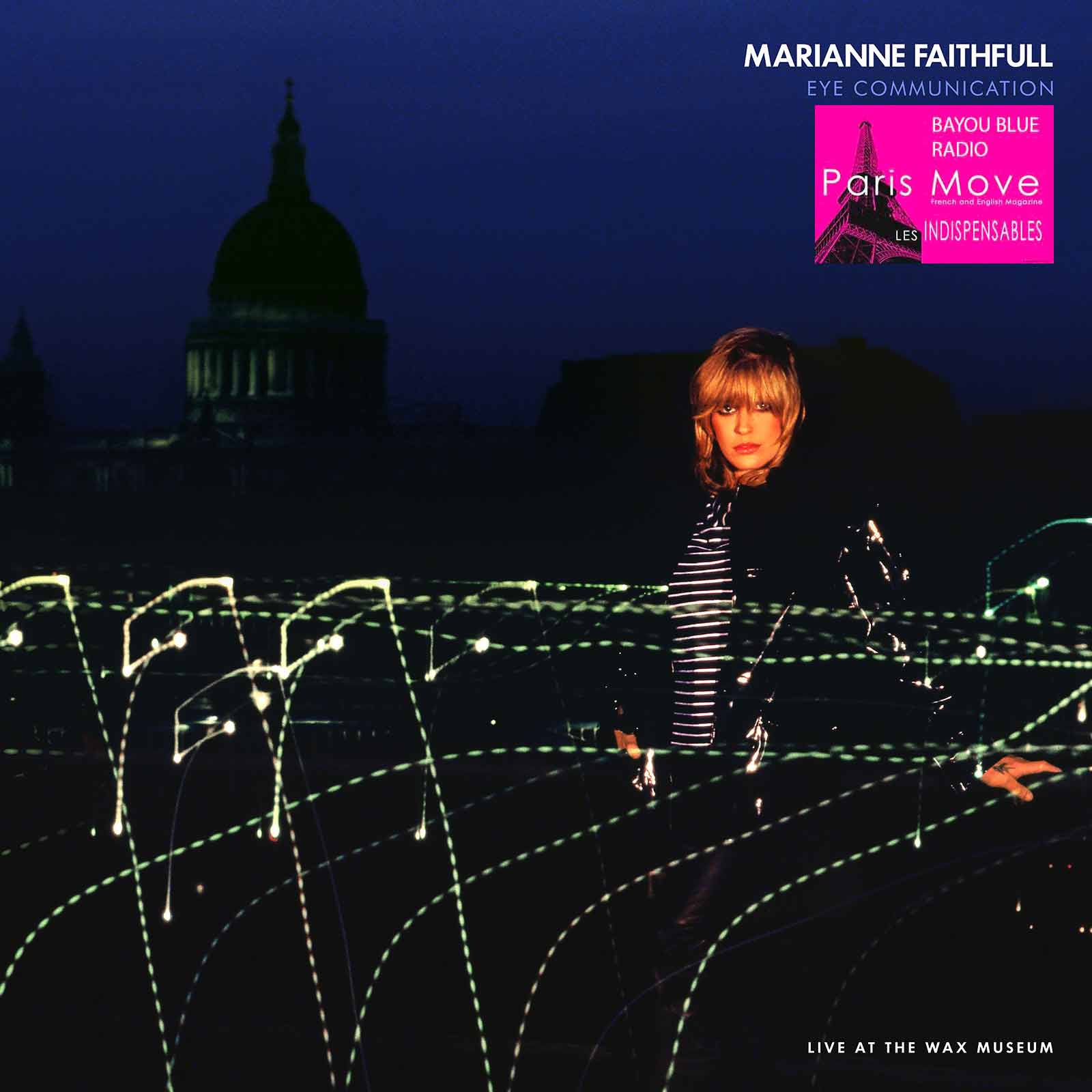
Marianne Faithfull, Eye Communication: Live at the Wax Museum, or the Poetry of Scars
Some artists become inseparable from an era. Others outlive the era that first made them famous, moving through successive generations without ever quite belonging to any of them. Marianne Faithfull was both. She emerged in the bright, carefully manufactured world of mid-1960s British pop, became one of the most recognizable faces of Swinging London, and then spent the rest of her life dismantling the image that had made her famous. Her career was not a straight line from innocence to experience, nor a conventional story of celebrity redemption. It was a long, difficult argument with the expectations imposed on a woman, an artist and, above all, a public figure. Her voice became the instrument of that argument: unmistakable, increasingly weathered, and finally capable of conveying truths that a more polished singer might never have reached. I first encountered Marianne Faithfull when I was sixteen. At the time, her name seemed inseparable from the Rolling Stones and the mythology surrounding them. She belonged to that extraordinary London moment when pop music, fashion, cinema and a new kind of youth culture appeared to be converging. There was something almost unreal about her presence: the face, the voice, the photographs, the stories. Yet the image never told the whole story. Even in those early recordings, there was a peculiar clarity and restraint in her singing, a quality that could make a seemingly simple pop song sound intimate and slightly mysterious. What I did not understand then was how far she would travel from that beginning, or how completely she would eventually reclaim her own narrative.
Her first major success, “As Tears Go By,” written by Mick Jagger and Keith Richards with Andrew Loog Oldham, established her as a distinctive new voice. The song was an unusual vehicle for a young singer: reflective, almost melancholic, and built around the passage of time rather than the exuberance expected of a pop hit. It became a defining recording of the period, but it also helped create a public persona from which Faithfull would later have to escape. Other early songs, including “Come and Stay With Me” and “This Little Bird,” confirmed her ability to inhabit delicate melodies without turning them into mere exercises in sweetness. Her early albums moved between pop and folk, and her voice carried a fragile composure that audiences and the press were quick to interpret as a personality. That interpretation was always incomplete. Faithfull was not simply a singer placed at the center of a cultural scene. She was also an actress, a reader, a woman with literary interests and a sharp sense of the absurdities surrounding fame. Her work in cinema began during the same decade, with appearances in films including Jean-Luc Godard’s Made in U.S.A. and I’ll Never Forget What’s ‘Isname. She became particularly associated with The Girl on a Motorcycle, released in the United States as Naked Under Leather, a film whose imagery seemed to crystallize the period’s fascination with sexual freedom, rebellion and the spectacle of female independence. She also appeared on stage, including in productions of Chekhov and Shakespeare. These experiences mattered: they gave her a relationship with language and performance that would remain central to her later work.
The 1960s, however, were not simply a glamorous prelude to a more serious career. They were also a period in which the machinery of celebrity could be both seductive and destructive. Faithfull’s association with the Rolling Stones, and particularly with Jagger, placed her inside a mythology that often treated women as supporting characters in the lives of famous men. The press was fascinated by her private life, while the music industry was more comfortable selling an image than encouraging an independent artistic identity. The personal upheavals that followed, including addiction and periods of homelessness, were too often reduced to scandal. In retrospect, the familiar narrative of the fallen star obscures something more consequential: an artist whose life had been exposed to public scrutiny long before she had the means or freedom to define it herself.
Her return to music in the mid-1970s was tentative. Dreamin’ My Dreams, released in 1976, drew on country and folk traditions and found a particularly receptive audience in Ireland. But the decisive transformation came with Broken English in 1979. Few comeback albums have sounded so much like a rupture with the past. The record did not attempt to restore the singer audiences remembered from the previous decade. It presented a different woman, with a different voice and a different understanding of what a song could contain. The once-delicate instrument had become low, rough and cracked. Rather than conceal the damage, Faithfull made it part of the music’s expressive force.
“Broken English,” “The Ballad of Lucy Jordan,” “Guilt” and “Why D’Ya Do It?” announced an artist who had ceased asking permission. The album’s musical language was equally uncompromising, drawing on new wave, rock and electronic textures without surrendering its emotional directness. Its title track, with its urgent rhythm and politically charged atmosphere, seemed to register a world coming apart. “The Ballad of Lucy Jordan,” by contrast, was devastating precisely because it did not need to shout. It told the story of a woman whose dreams had narrowed into domestic routine, and whose apparent escape came at an unbearable cost. Faithfull sang it with a mixture of distance and compassion that made the character’s despair feel both particular and universal. Broken English changed the terms on which she could be heard. It also made clear that her voice was no longer an obstacle to overcome. It was the subject, the evidence and the means of expression. The album received major critical recognition and a Grammy nomination, but its importance cannot be measured by awards or sales. It gave Faithfull a new artistic identity, one that did not erase the past so much as confront it. She had become a singer capable of making vulnerability sound like defiance.
The two albums that followed, Dangerous Acquaintances in 1981 and A Child’s Adventure in 1983, continued that exploration. They are sometimes treated as secondary works in the shadow of Broken English, but that judgment misses the way they develop its ideas. Dangerous Acquaintances is restless and often abrasive, while A Child’s Adventure moves through a more unsettled musical landscape. Both records belong to a period when Faithfull was testing the limits of her new voice and the possibilities of a sound that could be simultaneously theatrical, modern and emotionally exposed. They also provide the essential context for Eye Communication: Live at the Wax Museum, the newly issued document of a concert recorded in Washington, D.C., on October 2, 1983.
The recording captures Faithfull during her North American tour, a period she associated with the phrase “crisis cabaret.” The expression is revealing. It suggests a performance built not around the reassuring conventions of a concert but around the unstable territory between confession, theatre and confrontation. By 1983, Faithfull was no longer the young pop figure of the previous decade. She was an artist whose songs carried the accumulated weight of experience, and whose stage presence could turn that weight into something immediate. The Wax Museum concert preserves her at a particularly compelling point in that evolution: after the shock of Broken English, amid the continuing experiments of Dangerous Acquaintances and A Child’s Adventure, and before the further reinvention that would come with Strange Weather.
The venue itself is part of the recording’s appeal. The Wax Museum was a Washington club, not an arena designed to turn a performer into a distant spectacle. The intimacy of the setting suits Faithfull’s approach. Her songs require proximity, not because they are quiet, but because their emotional force often depends on the impression that the singer is addressing someone directly. A concert recording can sometimes flatten that relationship, leaving only the evidence of applause and amplification. Here, the performance retains a sense of occasion and immediacy. One hears a working band responding to a singer who is not merely reproducing studio arrangements but testing the material in front of an audience. The ten-song set is carefully drawn from the three albums that define this period. It opens with “Times Square,” a song from A Child’s Adventure whose urban loneliness and suppressed anger make it an ideal introduction. Faithfull does not approach it as a conventional opening number. The performance establishes an atmosphere: tense, watchful, and already charged with the feeling that something is about to break. The song’s emotional geography is unmistakably urban, but its subject is larger than a particular street or city. It is about isolation, addiction and the private fury that can accumulate beneath the appearance of ordinary life.
“Tenderness” follows, bringing a different kind of vulnerability into the set. The title might suggest a softening of mood, but Faithfull’s interpretation is not sentimental. Tenderness, in her world, is never an uncomplicated refuge. It is something fragile, difficult to sustain and often inseparable from the possibility of hurt. Her voice gives the song its tension. The grain and rasp that might once have been considered limitations now allow her to communicate a complicated emotional history without overstatement. “Brain Drain” shifts the energy again. Its title alone evokes the pressure and disorientation of a period in which personal and social breakdown seem to echo one another. The performance draws on the band’s rhythmic force, giving the song a harder edge than a more restrained studio reading might suggest. “The Blue Millionaire” continues the sequence, with its mixture of theatricality and unease. These are not songs designed to flatter the singer or the audience. They are portraits of compromised lives, distorted ambitions and the uneasy relationship between appearance and reality. Faithfull’s achievement is to make them feel less like observations from a distance than fragments of an experience she knows intimately.
“Guilt,” from Broken English, is one of the set’s central moments. The song belongs to the emotional and psychological world that made the 1979 album so startling. Its subject is not guilt as an abstract moral category, but guilt as a condition that can become inseparable from identity. Faithfull sings with a force that is neither theatrical self-pity nor detached irony. The performance carries the sense of someone who has looked directly at the consequences of a life and refuses to simplify what she sees. It is one of the reasons the song has remained so powerful: it does not offer absolution, and it does not ask for it.
“Falling From Grace,” another track from A Child’s Adventure, returns to the territory of public judgment and private shame. Faithfull has spoken of the song in connection with the events surrounding the Redlands drug bust and the court case that followed. That history gives the performance an additional resonance, but the song is not reducible to autobiography. Its strength lies in the way it transforms a specific experience into a broader meditation on exposure, humiliation and the possibility of surviving one’s own past. The title sounds almost biblical; the performance is resolutely human.
The title track, “Eye Communication,” occupies a special place in the concert. Its spoken and musical elements create a space in which Faithfull can move beyond the conventional boundaries of song. The presence of William Blake’s “The Tyger” connects the performance to a literary tradition that has always been important to her artistic identity. Blake’s poem is not an ornamental reference. Its questions about creation, violence and the nature of power belong to the same moral landscape that runs through Faithfull’s work. The image of the tiger, at once beautiful and terrifying, seems particularly appropriate for an artist whose career repeatedly challenged the idea that beauty must be passive or reassuring.
Then comes “Working Class Hero,” John Lennon’s song from John Lennon/Plastic Ono Band. Faithfull had already recorded it for Broken English, where its bleak account of social conditioning and class discipline became one of the album’s defining interpretations. At the Wax Museum, the song takes on the character of a direct address. Lennon’s original is stripped down and accusatory; Faithfull’s version is shaped by a different history, but it preserves the song’s refusal to soften its judgment. Her voice gives the words an extraordinary authority. She does not sound as though she is borrowing Lennon’s anger. She sounds as though she has arrived at the same indictment by another route.
“Rising,” co-written with bassist Fernando Saunders, is the concert’s previously unreleased song and one of its most interesting discoveries. It introduces another shade of expression, looking toward darkness without surrendering the possibility of light. The title is simple, but the song’s place in the set is significant. It suggests movement after a sequence of songs concerned with shame, isolation and the burden of experience. Faithfull does not turn that movement into a triumphant resolution. The possibility of rising is not the same as being rescued. It is a decision, or perhaps a struggle, to continue. The concert closes with “Broken English.” It is difficult to imagine a more appropriate ending. The song had already become the defining statement of Faithfull’s return, but in a live setting it acquires a further dimension. Its questions about political violence, propaganda and the instability of public language have not lost their relevance. If anything, the passage of time has made the song seem more adaptable to the crises of successive generations. The performance is driven by the band’s momentum and by Faithfull’s increasingly urgent delivery. Her voice does not smooth over the song’s anger; it sharpens it. The closing effect is not one of nostalgia, but of recognition. The world that produced the song has changed, yet the questions remain.
The musicians are essential to the success of the recording. Fernando Saunders on bass provides a strong rhythmic and melodic foundation, while Joe Mavety’s lead guitar gives the arrangements their edge. Godfrey Wang’s keyboards and synthesizers establish much of the period’s distinctive atmosphere. Carol Steele’s percussion and J.T. Lewis’s drumming give the music its physical drive. This is not a band assembled merely to reproduce the sound of the studio albums. The musicians create a flexible framework in which Faithfull can move between sharply defined songs, spoken passages and moments of emotional release. Saunders, in particular, would remain an important musical presence in her career, contributing to a number of recordings over the following decades.
Listening to the concert now, I am struck by how effectively it captures the sound world of 1983 without reducing itself to a period piece. The electronic textures, the keyboard timbres and the production vocabulary belong unmistakably to their time. The Yamaha DX7 and the Roland Juno family had become important elements of the musical landscape, and their presence helped define the decade’s particular relationship between technology and emotion. In less sympathetic hands, such sounds can date a recording very quickly. Here, they provide a setting for performances that remain alive because the human element is never subordinated to the machinery. That distinction matters to me. I have always been interested in the relationship between a recording’s technical character and its emotional truth. The sound of an album is not simply a neutral container for the music. It is part of the experience: the balance between voice and instruments, the space around a performance, the texture of the low frequencies, the way a synthesizer sits against a guitar or a drum kit. A recording can be technically immaculate and still feel lifeless. Conversely, a performance with rough edges can communicate something that a more polished production would erase. Eye Communication belongs to the latter category. Its value lies not in an artificial impression of perfection, but in the way the recording preserves the tension and immediacy of the event.
The newly prepared edition is particularly significant because the concert has been transferred from the original analogue tapes, with restoration and mastering by Andrew Batt. The release is produced by Andrew Batt, James Batsford and Zev Feldman, in association with Faithfull’s estate. The physical package has been conceived with unusual care. The limited 180-gram double LP spreads the ten performances across three sides, leaving the fourth side for an etching in Faithfull’s handwriting: an excerpt from Blake’s “The Tyger,” the poem she recites in the title track. The accompanying material includes liner notes, interviews, photographs and archival ephemera. The CD and digital editions are scheduled to follow in December.
I usually prefer to consider an album in both its LP and CD forms. They offer different ways of approaching the same recorded event, and I am interested in what each format makes perceptible: the sense of physical presence and continuity associated with vinyl, or the precision and access to detail that a well-prepared digital edition can provide. In this case, however, the release schedule requires a distinction between what can be heard now and what remains to be assessed when the physical editions become available. I would not want to pretend that a direct comparison has already been made. What can be said is that the restoration aims to preserve the original performance while making its details more accessible. The eventual LP and CD editions will offer the opportunity to judge how successfully that balance has been achieved in each format.
There is another reason this concert matters. It allows us to hear Faithfull not as a retrospective figure, already surrounded by the mythology of her later career, but as an artist in motion. In 1983, the transformation initiated by Broken English was still unfolding. The singer who had once been marketed as an emblem of youthful innocence had become a performer capable of confronting addiction, shame, class, politics and the instability of identity. Yet she had not reached a final form. Her later work would continue to change, sometimes radically, and would reveal dimensions that could not have been predicted from the early records.
Strange Weather, released in 1987, marked another important stage. It brought a new degree of control and interpretive depth to her singing, drawing on songs from different traditions and demonstrating how fully she had made the altered voice her own. The live album Blazing Away, recorded at St. Ann’s Church in Brooklyn and released in 1990, offered a powerful overview of the repertoire she had built since her return. It also confirmed that her stage presence had become one of the central elements of her art. She could inhabit a song without disguising its origins, and make a familiar composition sound as though it had been written for her.
Her later projects continued to resist easy categorization. A Secret Life, made with composer Angelo Badalamenti and released in 1995, explored an atmospheric, cinematic sound world. Her engagement with the music of Kurt Weill and Bertolt Brecht, including 20th Century Blues and The Seven Deadly Sins, brought her into contact with a theatrical and political tradition that suited her instinct for songs in which character and social criticism are inseparable. These were not side projects in any dismissive sense. They revealed the range of an artist who had never been content to remain within the boundaries of rock music.
With Vagabond Ways in 1999, Faithfull returned to songwriting with renewed confidence. The album’s title track, and its reflections on women, memory and the limits imposed by convention, showed how much her writing had developed. Kissin’ Time in 2002 brought her into collaboration with a younger generation of musicians, including Billy Corgan, Beck, Jarvis Cocker and members of Blur. Before the Poison, released in 2004, was an especially strong meeting of sensibilities, with contributions from PJ Harvey, Nick Cave, Damon Albarn and Jon Brion. These collaborations did not make her seem younger or more fashionable. They gave other artists the opportunity to work within the distinctive world she had created.
Her acting career also continued to develop. After the early films and stage work, she appeared in projects including When Pigs Fly, Shopping and Patrice Chéreau’s Intimacy. Her role in Sofia Coppola’s Marie Antoinette brought her into a new generation’s visual imagination, while her performance in Irina Palm offered one of the most striking examples of her late-career work as an actress. The film’s subject could easily have been treated as provocation or comedy alone, but Faithfull gave its central character a mixture of dignity, loneliness and practical determination. It was a performance that demonstrated how much she could communicate without relying on the mythology of her own life.
The albums that followed continued to move between intimacy and experiment. Easy Come, Easy Go in 2008 revisited songs by artists from different musical worlds. Horses and High Heels in 2011, produced by Hal Willner, included a substantial body of new material and confirmed her continuing strength as a songwriter. Give My Love to London in 2014 brought together an impressive group of writers and collaborators, among them Roger Waters, Nick Cave, Anna Calvi, Steve Earle and Tom McRae. The record was not a farewell or a summation. It was another declaration of artistic independence, shaped by a singer who continued to seek out new musical relationships. No Exit, the live recording drawn from her final touring period, preserved the intensity of her concert performances. Negative Capability in 2018 was among the most emotionally direct albums of her later years. Its songs confronted grief, friendship, loneliness and the approach of mortality with a candor that never became self-pity. The presence of Warren Ellis, Nick Cave, Mark Lanegan and other musicians gave the record a spare but deeply expressive musical language. It belongs to the same broad tradition as the late work of artists such as Leonard Cohen and Johnny Cash: not because Faithfull imitated them, but because she understood that age could bring a different kind of authority to a voice.
In 2021, She Walks in Beauty, made with Warren Ellis and a group of close collaborators that included Brian Eno and Vincent Ségal, fulfilled a long-held ambition to record poetry with music. The album placed her voice in a more spacious setting, allowing the words to take precedence over conventional song structure. It was a fitting project for an artist whose relationship with literature had been present from the beginning, but had become increasingly central to her work. Her final recordings, including the 2025 release Burning Moonlight, brought her career back toward the folk and pop roots from which it had begun. The circle was not closed so much as reimagined: the young singer’s repertoire and the older artist’s experience had become part of the same history.
Marianne Faithfull died on January 30, 2025, at the age of seventy-eight. Her death inevitably changed the way we hear the recordings that remain. It would be easy to turn every late performance into a farewell, every lyric into a prediction, every vocal imperfection into a symbol. That would be too simple, and it would diminish the intelligence of her work. Faithfull was not an artist whose significance depended on tragedy. She was an artist who repeatedly transformed difficult experience into a language that other people could recognize as their own. Her achievement was not merely to survive the past, but to make art from the complicated relationship between memory and the present. That is why Eye Communication: Live at the Wax Museum deserves to be heard as more than an archival curiosity. It documents a particular evening in Washington, D.C., but it also captures a decisive moment in a career that refused to settle into a single identity. The concert brings together the anger of Broken English, the unsettled imagination of Dangerous Acquaintances and the exploratory spirit of A Child’s Adventure. It shows a singer whose voice had become an instrument of extraordinary expressive range, and a performer who could make a club stage feel like a place where private experience and public history met.
I return to the music with the same curiosity that first drew me to Marianne Faithfull when I was sixteen, though I hear it differently now. The fascination is no longer simply with the image or the mythology. It is with the artist who emerged from beneath them, and with the courage required to keep changing when the world has already decided who you are. There are singers whose voices seem to preserve a moment in time. Faithfull’s voice did something rarer: it carried time inside it. Every fracture, every hesitation, every darkened note became part of the meaning.
The Wax Museum performance reminds us that her work was never simply about looking back. It was about confronting the present, however uncomfortable that might be, and finding a way to speak from within it. The songs remain restless because the questions they ask have not disappeared. The recording gives us the chance to hear that restlessness in the room, among musicians who understand its force and an audience drawn into its orbit. It is an intimate document, but its emotional reach is much larger than the venue in which it was made.
Some artists become icons because they represent a moment. Marianne Faithfull became one because she refused to remain trapped in it. Her life and work cannot be reduced to the people she knew, the photographs that made her famous or the crises that filled newspaper columns. They belong to a much more demanding history: that of an artist who continually reinvented her voice, and in doing so changed the meaning of her own past. Eye Communication: Live at the Wax Museum brings one chapter of that history vividly back to life. Icons never really die. They change the way we listen.
Thierry De Clemensat
Member at Jazz Journalists Association
USA correspondent for Paris-Move and ABS magazine
Editor in chief – Bayou Blue Radio, Bayou Blue News
PARIS-MOVE, November 15th, 2026
Follow PARIS-MOVE on X
::::::::::::::::::::::::
Musicians:
Guitare : Joe Mavety
Basse : Fernando Saunders
Claviers : Godfrey Wang
Batterie : J.T. Lewis
Percussions : Carol Steele
Track Listing:
Times Square
Tenderness
Brain Drain
The Blue Millionaire
Guilt
Falling From Grace
Eye Communication
Working Class Hero
Rising
Broken English
Recorded: The Wax Museum 02/10/1983
Producer: Andrew Batt, James Batsford, Zev Feldman
Mastering: Andrew Batt
Label: Time Traveler Recordings