
| Funk, R&B |
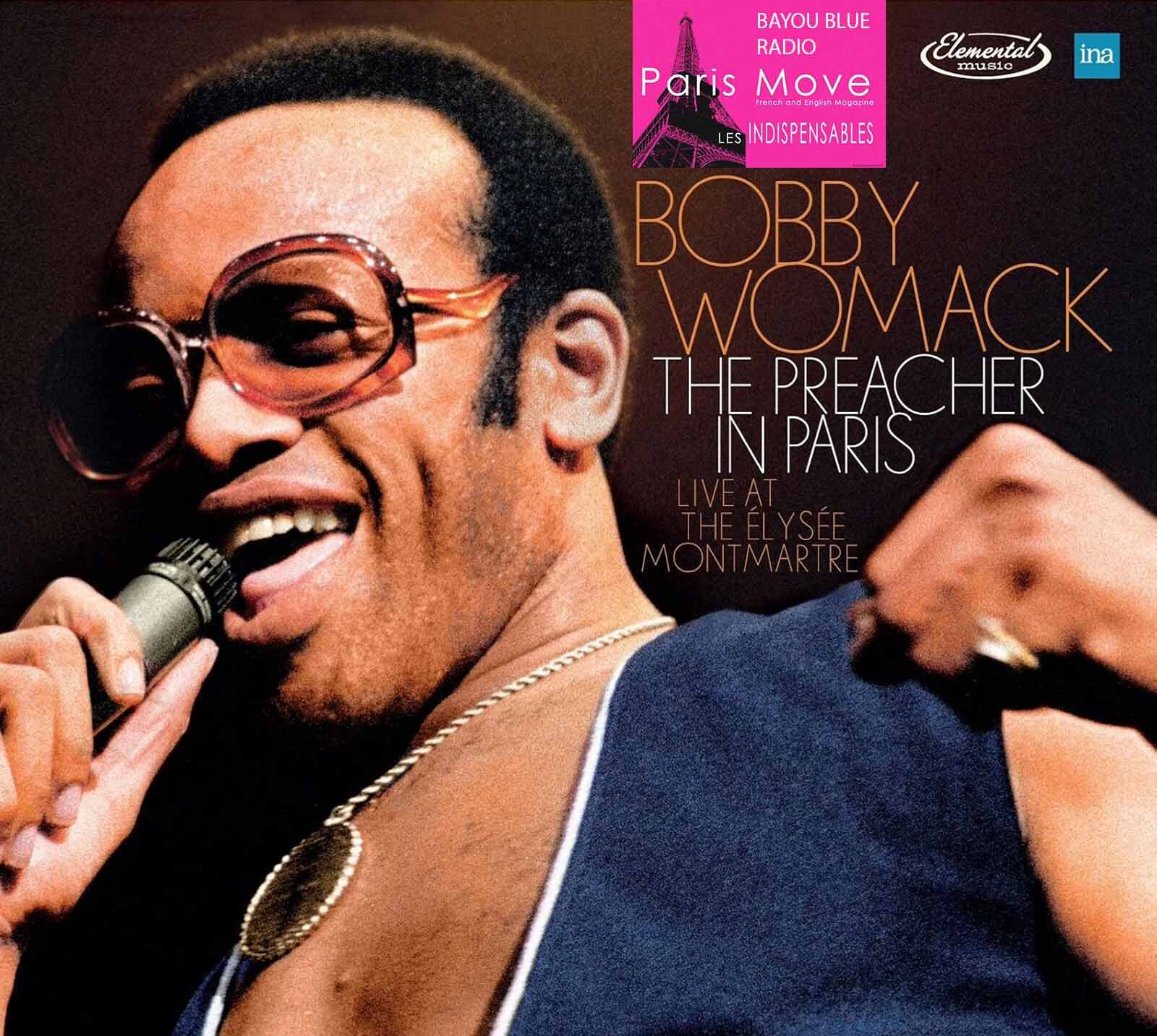
Bobby Womack, The Preacher in Paris: Fifty Years Later, the Soul Still Speaks
If I mention “It’s All Over Now,” “California Dreamin’,” “Lookin’ for a Love,” “Harry Hippie” or “If You Think You’re Lonely Now,” I can already picture a few faces lighting up. For anyone who grew up listening to soul, rhythm and blues, and the great voices of American music, these are more than familiar song titles. They belong to a shared musical memory, the kind of songs that move effortlessly across generations without losing their power to evoke a particular time and place. They bring back records, rooms, encounters, chapters of our lives and, above all, a certain way of listening to music. So imagine my reaction when I came across the announcement of a previously unreleased Bobby Womack album. Not another compilation designed to fill the shelves of nostalgic collectors, nor yet another reissue of a record already available in several editions, but an actual historical document: a Paris concert recorded in 1976, preserved on original French radio and television tapes and left in the archives for decades. Its title is The Preacher in Paris – Live at the Élysée Montmartre. That was more than enough to get my attention.
Some releases interest you. Others make you curious. And then there are those that reach straight back into your personal history, bringing an entire period of your life rushing forward. Bobby Womack belongs in that last category. His music was the soundtrack to my adolescence. His 45s and LPs occupied a place of honor on my shelves, alongside records by Sonny Rollins, Miles Davis and countless other musicians who helped shape my musical world. Back then, musical genres were not rigidly separated into compartments. You could move from jazz to soul, from blues to funk, from rhythm and blues to something else entirely without feeling the need to explain your choices. What mattered was the personality of the musician, the character of a voice, the quality of a composition and that unmistakable ability to recognize an artist within the first few bars. Womack had all of it.
When I saw the announcement, a flood of memories came rushing back. But what makes me particularly happy is that the emotional connection is not the album’s only selling point. It stands comfortably alongside the finest live recordings of soul and rhythm and blues from that era. It has its own identity, musical coherence and energy, along with the kind of performance quality that quickly takes it beyond the pleasure of hearing familiar songs again. I have always appreciated Bobby Womack’s voice, of course, but also the man himself and his approach to music. He had a rare ability to combine an almost raw edge with remarkably sophisticated songwriting and arrangements. Rediscovering that atmosphere today, in a Paris recording from 1976, is a genuine pleasure.
To understand what makes this release worthwhile, it helps to revisit the artist’s story. Bobby Womack, born in Cleveland, Ohio, in 1944, belonged to a generation of African American musicians whose musical foundations were deeply rooted in gospel. He grew up in a family where religious music and singing were part of everyday life. Along with his brothers, he began performing in churches before Sam Cooke recognized the group’s potential and played a decisive role in its transition toward secular music. The Womack Brothers became the Valentinos. That move from gospel to rhythm and blues was not nearly as dramatic a break as it might appear. It was, in many ways, the movement of a musical language, a vocal intensity and a particular way of expressing emotion from one setting to another. Womack would carry that heritage with him throughout his career.
There is a remarkable continuity between that religious tradition and his approach to soul music. The voice, the rhythm, the inflections, the rising intensity and the ability to address an audience directly all belong to the same musical inheritance. American soul did not emerge in some commercial laboratory, despite what narrowly business-oriented accounts of popular music might suggest. It grew out of a complex cultural and social history in which Black churches, African American communities, popular traditions and the recording industry continually interacted. Womack is an especially compelling example of that history. He was never simply a singer of romantic ballads or a performer of radio hits. He was also a guitarist, songwriter, producer and arranger, with a deep understanding of what gives a song its character and staying power.
The story of “It’s All Over Now” offers a particularly revealing example of his place in the music business. Written by Bobby Womack and Shirley Womack, the song was first recorded by the Valentinos before being covered by the Rolling Stones. The British band’s version became a major hit and helped establish the group in the charts. The song went on to become part of rock history, sometimes at the expense of the people who originally created it. This is not an argument against the merits of the Rolling Stones’ recording. It is simply a reminder of a familiar imbalance: much of the material that fueled British rock in the 1960s came from blues, rhythm and blues and other forms of African American music. The musicians who created those songs did not always receive the same recognition as the artists who introduced them to wider European audiences. Womack was part of that history, but his career extended far beyond it.
His solo work, beginning in the late 1960s, revealed a musician who refused to be confined to a formula. Albums such as Communication, Understanding and Facts of Life, along with his work on the soundtrack for Across 110th Street, demonstrated considerable musical freedom. Womack knew how to write accessible songs without making them simplistic, how to combine sophisticated arrangements with direct performances, and how to find the right balance between melody, groove and emotion. “Woman’s Gotta Have It,” “Harry Hippie,” “That’s the Way I Feel About Cha,” “Nobody Wants You When You’re Down and Out” and “I Can Understand It” illustrate the breadth of his work.
It is also worth remembering that Womack’s music was never limited to love songs or dance-floor material. “Harry Hippie,” in particular, reveals his ability to observe ordinary people, their contradictions and their struggles. Soul music at the time had a remarkable capacity to tell stories about everyday life while remaining deeply popular. It could be celebratory, sensual, melancholy, political or social. It did not need a theoretical framework to express the tensions of a society. Sometimes a voice, a bass line and a well-placed lyric could say more than an extended commentary.
In 1976, when Bobby Womack took the stage at the Élysée Montmartre, he already had considerable experience and a substantial body of work from which to build a live performance. The concert, recorded on March 15, places us at a particularly interesting moment in his career. This is not an artist still searching for his identity, nor an older performer revisiting his past to satisfy an audience hungry for nostalgia. Womack was a musician whose musical language was fully formed, someone who understood how to use the stage and how to reshape his compositions in a live setting. That is precisely what this recording allows us to rediscover: music that does not merely reproduce studio versions but takes on a different dimension through the musicians and the audience.
The venue itself deserves attention. The Élysée Montmartre is one of Paris’s historic entertainment institutions, with roots stretching back to 1807. Originally a dance hall, it has witnessed two centuries of cultural, artistic and social change. Its history includes popular dances, cancan performances, live entertainment and successive generations of Parisian music. Closely tied to the history of Montmartre, it also reflects a capital that has long welcomed artists from very different backgrounds. David Bowie and Bobby Womack are among the international artists associated with this storied stage, each in his own way. There is something fascinating about rediscovering, through these tapes, a concert that took place in such a historically charged space. A venue is never merely a backdrop. Its acoustics, atmosphere and relationship with the performers all contribute to the character of a live recording.
The program on The Preacher in Paris gives us a sense of the full range of Womack’s repertoire. “I Feel a Groove Coming On” immediately establishes the energy and sets the tone. “Love Ain’t Something You Can Get for Free” and “You’re Welcome, Stop on By” demonstrate his ability to develop a composition, give it room to breathe and build musical tension without losing its melodic thread. “Harry Hippie” brings us back to one of his signature songs, while “I’ve Got a Feel” and “Lookin’ for a Love” remind us of his instinct for rhythm and melody. “That’s the Way I Feel About Cha” introduces another shade of his sound, before “Communication,” “Nobody Wants You When You’re Down and Out” and “Give It Back” extend the journey through his musical world.
The second part of the program includes “Daylight,” “I Can Understand It” and, as a closing number, “It’s All Over Now.” The selection is particularly revealing. This is not simply a lineup of familiar hits assembled to create a concert album for collectors. The songs speak to one another, the moods shift, and we hear an artist capable of bringing together different aspects of his work. The more immediately accessible numbers sit alongside longer compositions that give the musicians greater freedom. That is also what makes this recording valuable as a historical document: it lets us hear how Womack approached his repertoire onstage, how he structured a performance and how he brought his songs to life outside the studio.
The musicians accompanying him are one of the album’s greatest pleasures. Womack is joined by Charles Fullilove and Scott Strong on guitar, Vince Melamed and Ian McLagan on keyboards, Veyler Hildebrand on bass, Bill Braun on drums, Lester Smith on trumpet, Dashiell Humdy on saxophone and Zaimos Rowan on trombone. The lineup gives the concert considerable breadth. The keyboards provide harmonic color, the guitars establish the necessary textures, the rhythm section supplies a solid foundation and the horns enrich the sound without weighing it down. Ian McLagan, known in particular for his work with the Faces, is an especially interesting presence in this musical encounter.
What I particularly enjoy about this band is the balance between the rawness of the performance and the precision of the arrangements. Nothing feels mechanical. The musicians do not sound as though they are simply executing a score. The music breathes. It has its variations, tensions, moments of release and surges of energy. The rhythm section does more than keep time; it gives the performance direction. The keyboards are not there merely to fill space, but to add color and support the compositions. The horns are prominent enough to give the music depth without overpowering the singer. Achieving that kind of balance requires genuine collective musicianship.
And then there is Bobby Womack’s voice. That is probably what stays with me most. It has a slightly weathered grain, a remarkable density and an unmistakable way of moving from a sung phrase to something almost spoken. You do not need elaborate vocal gymnastics to recognize a singular artist. Womack is not constantly trying to demonstrate what his voice can do. He concentrates on phrasing, intention, nuance and the relationship between words and music. His style owes much to gospel and blues, but it also reflects a conception of soul in which emotional force is inseparable from musical discipline.
The nickname “The Preacher” makes particular sense here. It is not simply a reference to his gospel roots. It also describes the way he inhabits the stage, tells a story, persuades an audience and draws listeners into a collective experience. In African American musical traditions, the boundary between religious singing and secular music has often been far less rigid than outsiders imagine. The fervor, repetition, vocal intensity and gradual building of emotion move naturally between the two worlds. Womack had a gift for bringing those qualities into songs about love, loneliness, everyday hardship and human relationships. It is one reason his performances still feel so immediate.
This recording also deserves to be placed within the broader history of musical exchange between the United States and Europe. During the 1960s and 1970s, Paris was an important stop for many American artists. The French capital had long maintained a particular relationship with jazz, blues and soul. African American musicians found attentive audiences there, along with performance venues and, at times, a kind of recognition that was not always available to them at home. It would be naive to imagine that Europe was somehow free of racial prejudice or unequal power relations. But these musical exchanges helped circulate important works, build audiences and preserve a cultural heritage whose influence extended well beyond the United States. Womack’s appearance at the Élysée Montmartre belongs to that history. It captures a period when European stages regularly welcomed artists who had helped shape modern popular music.
Yet the importance of this release goes beyond the music itself. It also lies in the preservation and restoration work that made the concert available to listeners. The original recordings were made by France’s Office de radiodiffusion-télévision française, or ORTF, and subsequently preserved in French audiovisual archives. Half a century later, these magnetic tapes have found a new life as a commercial release. Making that possible required a series of technical interventions worth recognizing. Recovering an old reel, putting it on a tape machine and transferring its contents to a computer is not enough. The condition of the medium must be assessed, the recording digitized under the best possible conditions, any deterioration addressed and a final presentation prepared that respects the character of the original performance.
That is where the work of the INA and the other specialists involved becomes especially important. High-resolution digitization was handled by Stéphane Rives for the INA. Sound restoration and mastering were entrusted to Marc Doutrepont of EQuuS Mastering and Restoration in Brussels. The release was produced by Zev Feldman, whose work with jazz and popular music archives has become well known among collectors and enthusiasts of historical recordings. His collaboration with French institutions is part of a broader effort to bring recordings back into circulation that might otherwise remain inaccessible to the public.
It is worth remembering that 1976 was a period when recording technology had already advanced considerably beyond the techniques available in the 1960s. Equipment allowed for greater definition, more precise control of individual sound sources and new possibilities for restoration today. That does not mean older recordings are technically inferior or less interesting. They often possess a texture and cohesion of their own. But in this case, the original tapes provide a particularly promising foundation for high-quality transfer and contemporary mastering.
The restoration process matters because it requires a careful balance between correcting defects and respecting the original sound. An overly aggressive approach can remove some of an old recording’s character. On the other hand, leaving problems untouched when they can be corrected may compromise the listening experience. The goal is to achieve the best possible reproduction without artificially turning a 1976 recording into a modern studio production. That distinction is essential. We do not need these tapes to sound as though the concert had been recorded yesterday. We simply want to hear as faithfully as possible what happened on that Paris stage.
On that front, the results are worth hearing. Womack’s voice remains present and well defined, the instruments occupy their own space, and the rhythm section has an appealing clarity. The horns do not dissolve into an indistinct wall of sound, while the keyboards and guitars have enough room to reveal their individual nuances. The recording retains the organic quality one hopes for in a live performance. You can hear musicians playing together, rather than a collection of artificially separated tracks. That is exactly what I look for in this kind of release: the sensation of an actual concert, with its dynamics and musical relationships, rather than a sanitized product designed to meet contemporary production standards.
The physical edition has also received particular attention. The double LP, pressed on 180-gram vinyl, comes in a gatefold package with a booklet and rare photographs from the concert by Jean-Pierre Leloir. The inclusion of this French photographer’s work is a genuine asset. His documentary photography of musicians and musical scenes has left an important record of performance history. These images help place the recording in its original context, showing the musicians, their stage presence and the atmosphere of the period. They give the release an additional dimension beyond the sound itself.
I remain especially attached to that physical aspect of records. Vinyl is not simply a playback format. It is also an object you hold, examine and keep. The cover, photographs, liner notes and technical credits are all part of the experience. For a historical concert recording, that approach makes particular sense. It allows listeners to understand how the project came together and gives a physical presence to a document that spent decades existing only as an archive.
But I certainly would not want anyone without a turntable to feel excluded from this rediscovery. The CD is an entirely worthwhile alternative. It makes little sense to assume that a digital format cannot faithfully reproduce an old analog recording. Everything depends on the quality of the transfer, the restoration and the mastering. A good digital transfer can preserve the essential characteristics of magnetic tape and deliver a thoroughly satisfying listening experience. It is time to move beyond the easy opposition between vinyl as supposedly authentic and digital sound as inherently cold. What matters most is the quality of the original source and the care taken in preparing it for release.
That is one of the things I appreciate about this edition: whether you choose the double 180-gram LP or the CD, the aim is to present the concert as faithfully as possible using the original tapes. Those who still own a turntable can enjoy the large-format artwork and the physical record. Those who have moved to CD can experience the same musical heritage in a more convenient format. There is no need to turn a personal preference for one medium into an ideological debate. The music, and the quality of its presentation, should come first.
There is, however, a larger question behind this release. At a time when millions of songs are instantly accessible, when streaming platforms create the impression that the entire history of recorded music is permanently available, we are reminded that important documents can still be buried in archives. Magnetic tapes, radio recordings, concert broadcasts and photographs constitute a substantial part of our cultural memory. Yet preserving them is not enough. They must also be identified, restored, documented and made available to the public. The work behind this concert is a reminder that musical heritage is ultimately a matter of transmission and editorial commitment.
How many other performances of comparable quality are still sitting in institutional archives? How many important musicians left no commercially available record of their live appearances, even though recordings of those performances may still exist somewhere? The question extends far beyond Bobby Womack. It concerns jazz, blues, soul, rock and all the popular musical traditions whose histories were partly preserved by public radio and television broadcasters. These archives are an invaluable cultural resource. Bringing them back into circulation not only fills gaps in official discographies; it also allows us to rediscover moments of musical creation that have largely escaped the written history of popular music.
For longtime listeners, The Preacher in Paris is a wonderful opportunity to reconnect with an artist who accompanied part of their musical journey. For newcomers, it offers an especially compelling introduction to a musician whose influence extends well beyond his best-known hits. Womack’s career spanned several decades, and his work influenced generations of singers, producers and instrumentalists. His music traveled across soul, funk, rock and hip-hop. It was covered, sampled and rediscovered in very different cultural settings. It belongs to that rare category of work that continues to live independently of the era in which it was created.
What I hear in this album is everything that has always drawn me to Bobby Womack: the unmistakable voice, the ability to combine roughness with refinement, the instinct for groove and the intelligence of the arrangements. There is an apparent ease to his music, but it has nothing to do with taking the easy way out. Behind the compositions is genuine songwriting craft; behind the arrangements is a careful understanding of instrumental balance; and behind the performance is a depth of musical experience that cannot be improvised. That combination is what makes this recording so compelling and explains why it stands comfortably alongside other major live documents of the period.
I would not claim that this release is a revelation for listeners who already know Bobby Womack’s work inside out. But it adds something genuinely new to his discography: a previously unreleased concert, an outstanding group of musicians, a Paris performance from 1976 and an archival restoration that finally allows us to hear the event under the right conditions. That is no small achievement. It is also considerably more interesting than yet another compilation, however well assembled.
Ultimately, what makes me happiest is that this album does not have to rely on the memories of people like me, who knew this music when it first appeared. It stands on its own. Someone who has never owned a Bobby Womack record can discover this performance, appreciate the power of his voice, the quality of the musicians and the coherence of the concert. Music is not a museum exhibit. It does not need a nostalgic instruction manual to retain its force. It continues to do what great music has always done: stir emotion, make you want to hear a song again and remind you why certain artists occupy such an important place in musical history.
So yes, when I first came across this release, a part of my adolescence came rushing back. But beyond that personal connection, I am simply delighted to hear Bobby Womack again in such convincing, vibrant and generous form. Fifty years after it was recorded, this Paris concert reminds us that great voices do not age in the same way as musical fashions. They endure because they have something to say, because they are grounded in a genuine artistic identity and because they can reach listeners without asking what decade they were born in.
Whether you choose the double 180-gram vinyl edition or the CD, you will have a remarkable historical document to listen to, backed by serious work in restoration, mastering and presentation. For longtime fans, it is a chance to hear a familiar voice in a new setting. For everyone else, it is an opportunity to discover a major figure in American soul: a singer, songwriter, guitarist and producer who deserves far more than the reputation of a man who simply supplied a handful of classics.
As for me, I will be heading back to my turntable. There are voices you never forget, records you never really leave behind and concerts that still manage to surprise you, even half a century later. Bobby Womack at the Élysée Montmartre is unquestionably one of them.
Thierry De Clemensat
Member at Jazz Journalists Association
USA correspondent for Paris-Move and ABS magazine
Editor in chief – Bayou Blue Radio, Bayou Blue News
PARIS-MOVE, November 15th, 2026
Follow PARIS-MOVE on X
::::::::::::::::::::::::
The performance features Ian McLagan of Faces on keyboards, alongside Charles Fullilove and Scott Strong on guitars, Veyler Hildebrand on bass, Bill Braun on drums, Lester Smith on trumpet, Dashiell Humdy on saxophone and Zaimos Rowan on trombone.
Tracklist:
Side A
- I FEEL A GROOVE COMING ON 5:04
- LOVE AIN’T SOMETHING YOU CAN GET FOR FREE 3:13
- YOU’RE WELCOME, STOP ON BY 11:54
Side B
- HARRY HIPPIE 4:42
- I’VE GOT A FEEL 2:16
- LOOKIN’ FOR A LOVE 3:09
- THAT’S THE WAY I FEEL ABOUT ‘CHA 9:07
Side C
- COMMUNICATION 3:02
- NOBODY WANTS YOU WHEN YOU’RE DOWN AND OUT 3:57
- (IF YOU DON’T WANT MY LOVE) GIVE IT BACK 9:13
Side D
- DAYLIGHT 3:26
- I CAN UNDERSTAND IT 9:32
- IT’S ALL OVER NOW 5:36
Personnel: BOBBY WOMACK vocals and guitar; CHARLES FULLILOVE and SCOTT STRONG guitars; VINCE MELAMED and IAN McLAGAN keyboards; VEYLER HILDEBRAND bass; BILL BRAUN drums; LESTER SMITH trumpet; DASHIELL HUMDY saxophone; ZAIMOS ROWAN trombone.
Produced for Release by ZEV FELDMAN.
Executive Producers: JORDI SOLEY and CARLOS AGUSTÍN CALEMBERT.
Associate Producers: ZAK SHELBY-SZYSZKO and MARTÍN ARIAS GOLDESTEIN.
INA Digitization in High Resolution, Restoration and Mastering: STÉPHANE RIVES.
Mastering and Sound Restoration by MARC DOUTREPONT, EQuuS Mastering and Restoration Studio, Brussels, Belgium.
Cover, Back Cover and Inside Photos by JEAN-PIERRE LELOIR / ARCHIVES LELOIR.
Original recordings made by Office de Radiodiffusion-Télévision Française (ORTF).
Manufactured and distributed under license from, and all recordings courtesy of, l’Institut national de l’audiovisuel (INA).