| Jazz |
There are places whose importance in the history of jazz cannot be measured by their seating capacity, their age, or even the fame of the musicians who perform there. Their real value lies in their ability to keep a particular vision of music alive, to bring artists together around a shared language, and to offer audiences the singular experience that only jazz played before a live audience can provide. In New York, Smoke unquestionably belongs to this category. It is at once a meeting place, a space for creative exchange, a home for several generations of musicians and, since the creation of its own record label, a remarkable vehicle for preserving and circulating a music whose vitality continues to renew itself. The recordings that have emerged from this institution have earned a special place in my collection. They combine exceptional musicianship with technical excellence, while preserving the sense of intimacy that the finest recordings can convey. There is an attention to detail in these productions that recalls the standards associated with ECM, even if the two labels inhabit distinctly different musical worlds. Where ECM has often favored space, breathing room, transparency and a carefully shaped sense of silence, Smoke Sessions recordings seek to capture collective energy, the warmth of individual instruments, the give-and-take among musicians and the intensity of a performance unfolding in real time. In both cases, recording is more than the reproduction of sound. It becomes an interpretation of the musical event itself.
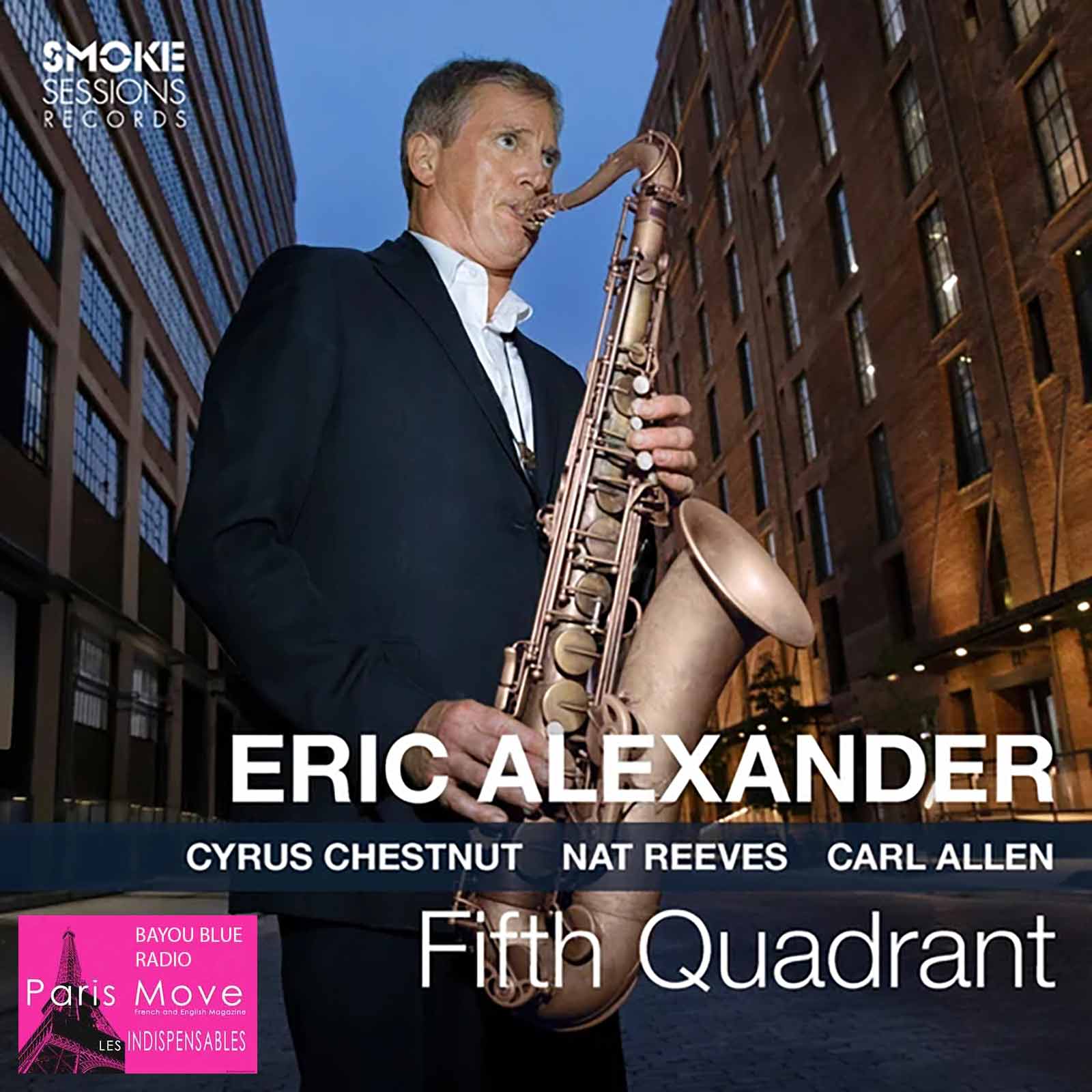
That is the context in which Fifth Quadrant, the forthcoming album by tenor saxophonist Eric Alexander, deserves to be heard. Scheduled for release on December 4, 2026, the recording brings together an especially compelling quartet: Alexander on tenor saxophone, Cyrus Chestnut on piano, Nat Reeves on bass and Carl Allen on drums. These are musicians with little left to prove individually, yet the significance of their meeting extends well beyond the sum of their reputations. This is not simply a matter of assembling four established names to produce another album for listeners devoted to traditional jazz. The ambition is more substantial: to recover, in a contemporary setting, the conditions for a demanding musical conversation, grounded in a deep understanding of jazz language, attentive listening and a freedom that should never be confused with the absence of structure.
The album’s title, Fifth Quadrant, suggests a paradox. How can an ensemble of four musicians create a fifth space? Perhaps the answer lies at the heart of the project. The jazz quartet traditionally rests on a recognizable arrangement: a soloist, piano, bass and drums. Each musician has a role, a responsibility and a territory of expression. But when the players know one another’s musical language well enough, when their experiences and sensibilities converge, the arrangement can produce something that does not exist in any one part alone. A fifth dimension emerges, not as an additional instrument, but as the result of collective intelligence. Music ceases to be a sequence of four individual contributions and becomes a living organism, capable of changing direction through phrasing, breathing, rhythmic tension and decisions made in the moment. This conception of jazz is hardly new. It is, in fact, one of the foundations of the modern tradition, from postwar small groups to the great hard-bop ensembles. But it requires a command of the language that cannot be acquired through instrumental technique alone, or simply by accumulating concert appearances. It comes from culture, study, familiarity with the repertoire and, above all, experience onstage, where every musician must learn when an intervention is necessary and when silence can give another player’s statement greater meaning. That kind of maturity is evident in the quartet assembled by Eric Alexander.
It is worth placing the saxophonist within the broader history of American jazz, because that history helps explain his musical approach. Born in 1968, Alexander belongs to a generation of musicians who chose to extend the language of bebop and hard bop without turning it into a historical reenactment. His musical education began with classical studies before leading him toward jazz and improvisation, first at Indiana University and later at William Paterson College. His arrival on the New York scene in the early 1990s followed a significant early achievement. In 1991, he placed second in the Thelonious Monk International Jazz Saxophone Competition, finishing behind Joshua Redman and ahead of Chris Potter. The result established him as one of the most promising instrumentalists of his generation, though it hardly tells the full story of the musician he has become.
Alexander has since built an extensive discography, recording more than 50 albums as a leader and appearing on more than 200 recordings as a sideman. Such productivity might suggest a career defined primarily by volume and the constant pursuit of new projects. That would be an incomplete reading. What stands out instead is the consistency of an artistic approach that has never felt compelled to reject the traditions from which it emerged. Alexander knows the great tenor saxophone lineage, from Coleman Hawkins and Sonny Rollins to Dexter Gordon and John Coltrane, but his playing is not an exercise in imitation. His sound has a distinctive weight, rhythmic authority and warmth. He favors carefully constructed phrases, melodic developments that are allowed to unfold, rising tensions and those moments when an apparently simple idea gradually becomes a fully developed improvisational architecture.
That last quality deserves particular attention. At a time when much of the music industry seems to reward immediate impact, technical display and novelty for its own sake, Alexander represents a more demanding understanding of instrumental expression. Virtuosity is never in short supply, but it is not the destination. It serves the larger musical argument. The saxophonist is not merely trying to play more notes or demonstrate the limits of his technical abilities. He is concerned with melodic substance, with the way a phrase can develop, repeat itself, change shape and eventually arrive at an unexpected resolution. This approach reflects a close relationship with hard bop, preserving its energy, expressive force and blues sensibility while embracing the harmonic and rhythmic possibilities of modern jazz.
Alexander’s relationship with Smoke is also worth examining. The club, located on Broadway on Manhattan’s Upper West Side, has a history that reflects the resilience of New York’s musical life. Before becoming Smoke, the establishment operated under the name Augie’s, a venue frequented by musicians and listeners devoted to acoustic jazz. Its transformation in the late 1990s did not mean abandoning that mission. On the contrary, Smoke gradually established itself as one of the places where traditional jazz, hard bop and their contemporary extensions could continue to develop under unusually favorable conditions. It is more than a club that books concerts. It is a place that understands that live music cannot survive over the long term without a relationship of trust among artists, organizers and audiences. That commitment to a particular vision of jazz helps explain the club’s longevity. In a city where music venues face the economic, real estate and commercial pressures of an exceptionally competitive environment, maintaining a space devoted to acoustic jazz is itself a cultural commitment. The club’s successive transformations, its development and the creation of an associated record label all reflect an ambition that extends beyond presenting concerts. The goal is to give musicians room to work, meet, develop projects and leave a lasting record of their encounters. The importance of Smoke’s recordings becomes clearer in that context.
The creation of Smoke Sessions Records in 2014 marked a decisive step. By moving from the club business into record production, Smoke extended to the recorded medium some of the qualities that had made the venue distinctive. Its early releases naturally placed considerable emphasis on live performances recorded in the club, but the catalog subsequently expanded to include studio projects and recordings in a variety of settings. That development is significant because it rejects an artificial opposition between live performance and studio work. Instead, it recognizes that the two approaches can complement one another. A concert captures music in its immediacy, with its risks, surprises and shifting balances. The studio offers the opportunity to refine certain choices, shape a program and pursue another kind of precision. In either setting, the essential question remains the same: the quality of the performance and the recording’s ability to preserve its truth.
Eric Alexander’s connection to this environment goes back many years. His relationship with the club dates to his early New York period and is part of a history of collaborations that has accompanied much of his career. He has participated in several projects recorded there, worked with the collective One For All and shared numerous musical experiences with pianist Harold Mabern. This relationship is more than professional. It reflects artistic familiarity, trust built over time and an understanding of what the venue’s acoustics, organization and atmosphere can contribute to a performance.
The 2025 album Split Decision, recorded with saxophonist Vincent Herring, illustrates that continuity. The meeting of the two instrumentalists, one on tenor and the other on alto, depended on a musical complementarity that could fully emerge only in an environment conducive to improvisation. Both have known Smoke for years and regard it as one of their natural musical homes. Alexander has spoken particularly highly of the sound in the room, an essential consideration when recording live jazz. Good musicians and quality microphones are not enough to capture a concert successfully. The venue itself must have the acoustics, organization and atmosphere that allow the music to breathe. That is precisely what Smoke’s productions have understood.
Fifth Quadrant, however, represents a different milestone. For the first time, Alexander leads an album under his own name for the label, having previously appeared on several of its releases. But that change in status should not obscure the continuity of his approach. The quartet assembled for the occasion is not an improvised lineup brought together for a convenient studio date. Its members share a long musical history, common reference points and a deep understanding of the tradition informing the project. Their first studio meeting, recorded in New York on May 4 and 5, 2026, offers an opportunity to hear what that collective experience can produce when applied to a carefully constructed program. The choice of Cyrus Chestnut on piano is especially inspired. A pianist with a highly recognizable personality, Chestnut moves naturally among gospel, blues, traditional swing and more elaborate forms of modern jazz without ever losing the thread of his musical argument. His playing combines infectious energy with an exceptional sensitivity to melody. He does not merely accompany the soloist. He helps shape the music, offering responses, altering harmonic perspectives and sometimes introducing an unexpected turn that prompts the other musicians to reconsider their own direction. In a quartet of this kind, the piano is a full participant in the conversation. The relationship between Alexander and Chestnut is therefore central to the balance of the recording.
Nat Reeves, on bass, provides the harmonic depth and rhythmic foundation that give the ensemble its stability. His presence is a reminder that jazz does not rest solely on the contributions of its soloists. The bass is often the instrument that keeps the music oriented, even when improvisations move away from the paths initially suggested by the composition. Reeves maintains that stability without rigidity, leaving enough room for the others to develop their ideas. His experience and familiarity with musicians of this generation allow him to anticipate the music’s direction without confining it to a predetermined pattern.
Carl Allen completes the lineup on drums, bringing a rhythmic intelligence that extends well beyond the conventional role of accompanist. His playing has the drive, precision and mobility required by hard bop, but it is never limited to maintaining a steady pulse. Accents, rhythmic shifts, changes in dynamics and responses to phrases from the saxophone or piano all contribute to the evolution of the music. The drums become a genuine participant in the dialogue. They can support a rising intensity, create a break, propel a phrase forward or open a space for reflection. The ability to intervene without dominating the music is one of the defining qualities of a great jazz drummer. The success of the project ultimately depends on this complementarity. Fifth Quadrant should not be approached as a straightforward demonstration of instrumental expertise. Rather, the quartet offers an opportunity to hear what hard bop can become when played by musicians who understand its foundations but feel no obligation to turn them into dogma. Hard bop has often been described as a response to certain directions taken by jazz in the 1950s, with a renewed emphasis on blues, gospel roots, rhythmic vigor and an expression more directly connected to African American culture. That definition remains valid, but it does not fully explain the richness of the music. Hard bop is also a way of thinking about interaction, organizing musical time, circulating ideas and giving improvisation a coherence that goes beyond the succession of individual solos.
The program for Fifth Quadrant appears designed to explore precisely that diversity. It brings together Alexander’s original compositions, enduring standards and material drawn from a more contemporary repertoire. This openness matters. American jazz is not a closed inheritance to be preserved under glass through endless repetitions of the same works. It is a living repertoire, enriched from one generation to the next and shaped by encounters with other musical forms. The American Songbook, understood in its broadest sense, cannot be confined to Broadway compositions or standards from the 1930s and 1940s. It also includes more recent works whenever they possess the melodic, harmonic or expressive qualities capable of nourishing improvisation.
The title composition, Fifth Quadrant, is an especially interesting starting point. Built around a minor blues framework and emerging from Alexander’s exploration of overtone structures, which he also uses in his teaching, the piece demonstrates how a technical investigation can become the foundation for a composition fully integrated into the group’s musical language. It does not impose an artificially complex architecture. Instead, it draws on a recognizable structure that remains sufficiently open to allow all four musicians to develop their ideas. The blues is not simply a formula to be reproduced. It is a starting point, a space for exploration in which familiarity with traditional forms makes freedom possible. But perhaps the album’s most appealing dimension emerges in Ribbon in the Sky. Stevie Wonder’s composition, originally written and performed in a musical world far removed from hard bop, possesses a melodic richness that lends itself remarkably well to a jazz reinterpretation. Cyrus Chestnut’s arrangement gives the song new depth without attempting to erase its original identity. This is a delicate undertaking. Transforming a popular song into a jazz performance involves more than changing the chords or increasing the tempo. Musicians must understand what makes the composition powerful, preserve its melodic character and allow it to become something new without losing its essence. Chestnut’s work appears to pursue precisely that balance between respect for the original and freedom of interpretation.
This approach deserves attention because it reveals an especially open understanding of tradition. Jazz has rarely been more alive than when it has absorbed music from different backgrounds. The great improvisers have never hesitated to draw on popular songs, Broadway melodies, soul compositions and rhythm and blues. They understood that a work’s value does not necessarily depend on its belonging to an officially recognized genre, but on its ability to provide material rich enough for reinterpretation. By choosing Ribbon in the Sky, Alexander and Chestnut continue that history. They are not trying to set popular culture against artistic sophistication. They are exploring what can bring them together in a shared musical experience.
The other selections extend that willingness to move across eras and sensibilities. One Hundred Ways, associated with the musical world of Quincy Jones, offers another perspective on the exploration of contemporary melodies. Don’t Misunderstand introduces a more emotionally charged dimension, while Newk pays tribute to Sonny Rollins, one of the defining figures in tenor saxophone history. That choice is hardly incidental. Rollins profoundly influenced the way generations of saxophonists approached improvisation, particularly through his construction of melodic ideas, his use of recurring motifs and his ability to turn formal structures into spaces for freedom. For Alexander, the tribute becomes a conversation with a foundational figure rather than a mere historical reference.
The program also includes It Might as Well Be Spring, the Rodgers and Hammerstein standard, along with Be and Bit by Bit, two compositions that give the album a more personal dimension. This diversity is not an arbitrary collection of pieces selected simply to provide variety. It allows listeners to hear how a single quartet can approach different musical territories while retaining a coherent collective identity. That is often what distinguishes the most convincing ensembles: not their ability to reproduce one style, but their capacity to preserve a shared musical character as they move among different repertoires, tempos and moods. It would also be difficult to discuss Fifth Quadrant without recalling Harold Mabern’s place in Eric Alexander’s musical development. The pianist, who died in 2019, was one of Alexander’s most important mentors and a central collaborator for nearly 25 years. Their relationship went far beyond professional association. Mabern belonged to a generation of musicians for whom passing knowledge from one player to another was an essential part of jazz life. His teaching was not limited to theoretical instruction or instrumental technique. It rested on a broader understanding of the language, its history and its demands. He sought to show younger musicians how to enter a tradition without surrendering their individual voices.
Mabern’s absence therefore forms an important part of the context surrounding this new album, even though Fifth Quadrant makes no attempt to recreate artificially the relationship between the two men. That distinction matters. A musical partnership of such depth cannot simply be reconstructed at will. It belongs to a particular history, shaped by rehearsals, concerts, conversations and shared experiences. Alexander appears to have found in Chestnut, Reeves and Allen a new configuration that allows him to recover a sense of collective trust and freedom without pretending to replace what came before. The two live bonus tracks, Afro Blue and Sugar, included on the CD and digital editions, add a particularly moving dimension to the project. They were recorded during a celebration of Harold Mabern’s 90th birthday and offer a reminder that the musical memory shared by these artists remains an active part of Alexander’s work.
This is also what gives the project a significance beyond that of another new jazz release. In jazz, transmission is never merely a matter of speeches, tributes or symbolic recognition. It happens through practice, through exchanges between musicians, through the choice of a composition, through the way a player takes up a phrase or reshapes an arrangement. It continues whenever an artist takes a musical language inherited from predecessors, makes it his own and passes it on enriched by personal experience. The relationship between Alexander and Mabern is a compelling illustration of that process. The quartet on Fifth Quadrant demonstrates how the same transmission can continue through new partnerships without losing its substance.
Finally, it is worth returning to the recording itself, which has long been one of the reasons for my interest in Smoke’s productions. Sound quality is often discussed as a technical matter, measured through definition, dynamics, instrumental separation and recording precision. Those criteria are important, but they do not fully explain why certain albums make listeners feel as though they are sitting in the room, only a few feet from the musicians. A good recording does more than reproduce each instrument clearly. It must also convey the relationships among the players, the depth of the stage, the nuances of the performance and the constant movement of energy that defines live jazz. Smoke’s productions frequently achieve that effect. They allow the saxophone to retain its full presence without overwhelming the piano, make the bass audible without pushing it into the background and preserve the drums’ dynamic role without turning every intervention into a sonic demonstration. That clarity is essential. It allows listeners to follow several musical conversations at once, return to an instrumental detail and understand how an idea introduced by one player gradually finds its answer in another. It is a way of presenting jazz in its genuinely collective dimension.
The comparison with ECM remains useful here, provided it is not mistaken for an assertion of aesthetic equivalence. Both approaches are founded on the conviction that recording quality is an integral part of the musical experience. But they take different paths. ECM has developed a distinctive sound in which space, natural reverberation and precise instrumental colors help create an atmosphere that can sometimes feel almost contemplative. Smoke’s recordings place greater emphasis on the physical presence of the musicians and the energy of the performance. They do not seek to distance listeners from the stage. They bring listeners closer to it. That sense of proximity is all the more impressive because it never comes at the expense of sonic balance.
There is a larger issue behind this commitment, one that extends beyond the concerns of audiophiles. At a time when musical listening is increasingly fragmented, compressed and shaped by habits of rapid consumption, the work of independent organizations that take the time to document live music has particular cultural importance. The album serves a purpose that is not simply commercial. It preserves an encounter, transmits an interpretation and allows an ephemeral musical event to continue existing long after the concert has ended. A successful live recording cannot replace the physical experience of being in the room. But it can preserve something of that experience, especially when the musicians are inspired enough to turn a performance into a genuine musical event.
That is precisely what I look for in the recordings coming from this New York institution. I do not listen to them solely to revisit musicians whose work I have followed for years. I listen because they offer access to a particular understanding of jazz, grounded in continuity, high standards and respect for the intelligence of the audience. There is no need to multiply production effects, spectacular arrangements or sonic gimmicks to make an album compelling. When musicians share a musical culture, possess genuine instrumental mastery and are committed to advancing the music collectively, the essential ingredients are already there.
For those of us who do not have the good fortune to live in New York and visit Smoke regularly, these recordings offer an especially valuable opportunity. They allow us to cross, symbolically, the thousands of miles separating us from Broadway and rediscover through speakers or headphones something of the musical life that continues to unfold there. For those who have attended these concerts, the recordings also provide a way to extend the memory, recover the atmosphere and discover details that may have escaped notice during the first listening. Perhaps that is one of the finest functions of a recording: not to claim that it can replace the experience itself, but to give that experience a new and lasting life.
With Fifth Quadrant, Eric Alexander appears to be opening a new chapter in his career without abandoning the principles that have guided it. Cyrus Chestnut, Nat Reeves and Carl Allen provide the project with an exceptionally strong artistic foundation. The range of material explores several territories of American jazz, while the musicians’ long-standing relationships give the recording a depth that cannot be manufactured. The quartet’s first studio collaboration offers a compelling opportunity to hear the richness of an interaction built on experience, trust and the unmistakable pleasure of playing together. Ultimately, the album makes a case for a particular vision of jazz: a music that does not have to reject its past to exist in the present, that does not confuse tradition with immobility and that understands improvisation as an exercise in freedom requiring a deep knowledge of its own foundations. In a musical culture where novelty is sometimes treated as an absolute value, that commitment to a living language deserves to be heard and defended. Jazz is not a relic of the past that a handful of enthusiasts are trying to keep artificially alive. It remains a contemporary practice, a way of thinking collectively, engaging in dialogue and transforming an inheritance into a new experience.
That is why I continue to take such pleasure in the recordings coming from Smoke. They do not need to persuade us that jazz is still alive. They simply demonstrate it, concert after concert, album after album. And if Fifth Quadrant fulfills the promise suggested by the meeting of these four musicians, it should provide another compelling illustration of that remarkable continuity. For those of us who have followed Eric Alexander’s work and the activity of the New York jazz scene with particular interest, this is a date worth marking. After that, all that remains is to do what jazz has always asked of us: take the time to listen, return to the music, follow the exchanges and allow ourselves to be surprised by something that will never happen in quite the same way again.
Thierry De Clemensat
Member at Jazz Journalists Association
USA correspondent for Paris-Move and ABS magazine
Editor in chief – Bayou Blue Radio, Bayou Blue News
PARIS-MOVE, November 12th, 2026
Follow PARIS-MOVE on X
::::::::::::::::::::::::
Musicians:
Eric Alexander – tenor saxophone
Cyrus Chestnut – piano
Nat Reeves – bass
Carl Allen – drums
Track Listing:
Fifth Quadrant
One Hundred Ways
Don’t Misunderstand
Newk
Be
Ribbon in the Sky
Bit by Bit
It Might as Well Be Spring
Afro Blue [Live]
Sugar [Live]
Recorded May 4 & 5, 2026 at Power Station, Studio C, New York City
Produced by Paul Stache & Damon Smith
Recorded by Chris Allen
Recording Assisted by Ben Miller
Mixed & Mastered by Chris Allen
Photographed by Kevin Scanlon
Liner Notes by Shaun Brady
Executive Producers: Paul Stache & Molly Johnson